How psychological testing billing is structured
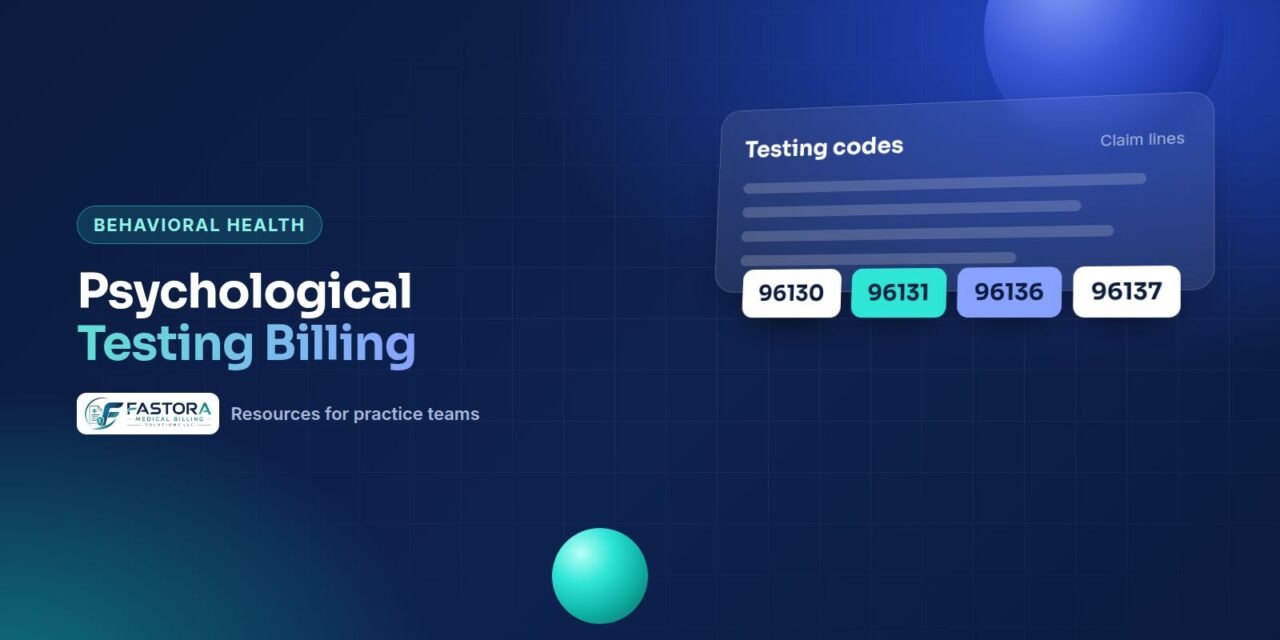
Psychological testing billing splits one assessment into two kinds of work. Test administration and scoring is reported with one set of codes, and the evaluation work (integrating data, interpreting results, writing the report and giving feedback) is reported with another. Both are time-based, and both can appear on the same claim.
This structure took effect in 2019, when CPT replaced the older per-hour testing codes. Many denials still come from practices billing as if one code covered the whole assessment, or from counting the same minutes twice.
This guide covers the psychological testing CPT codes, how units are counted, and the documentation payers expect. For psychotherapy and diagnostic evaluation codes, see the behavioral health billing guide.
Psychological testing CPT codes at a glance
| Code | Service | Time unit |
|---|---|---|
| 96130 | Psychological testing evaluation services by a physician or other qualified health care professional | First hour |
| 96131 | Psychological testing evaluation services, each additional hour (add-on to 96130) | Each additional hour |
| 96132 | Neuropsychological testing evaluation services by a physician or other qualified health care professional | First hour |
| 96133 | Neuropsychological testing evaluation services, each additional hour (add-on to 96132) | Each additional hour |
| 96136 | Psychological or neuropsychological test administration and scoring by a physician or other qualified health care professional, two or more tests, any method | First 30 minutes |
| 96137 | Test administration and scoring by a physician or other qualified health care professional, each additional 30 minutes (add-on to 96136) | Each additional 30 minutes |
| 96138 | Psychological or neuropsychological test administration and scoring by a technician, two or more tests, any method | First 30 minutes |
| 96139 | Test administration and scoring by a technician, each additional 30 minutes (add-on to 96138) | Each additional 30 minutes |
| 96146 | Psychological or neuropsychological test administration, single automated instrument via electronic platform, with automated result only | Per instrument |
Related codes include 96116 and 96121 for the neurobehavioral status exam and 96127 for brief emotional or behavioral assessment with a scored standardized instrument. These are separate services with their own rules.
The 96130 CPT code: evaluation services
The 96130 CPT code covers the clinician's evaluation work for psychological testing. CPT describes it as including integration of patient data, interpretation of standardized test results and clinical data, clinical decision making, treatment planning and the report, plus interactive feedback to the patient, family or caregivers when performed.
Count only the qualified professional's time on these activities. Under the CPT time convention most payers follow, a unit of time is reached once the midpoint is passed, so the first hour of 96130 needs at least 31 minutes, and each 96131 unit needs more than half of an additional hour. Check payer policy, as some apply stricter rules.
Document the total evaluation time and the activities it included. A note that says only "report written" does not show the time or the integration work the code describes.
The 96136 CPT code: test administration and scoring
The 96136 CPT code is used when the physician or qualified health care professional personally administers and scores two or more tests. The first 30-minute unit needs at least 16 minutes under the midpoint rule, and 96137 is added for each further 30-minute block that passes its midpoint.
When a trained technician administers the tests under the professional's supervision, use 96138 and 96139 instead. If both the professional and a technician administer tests on the same day, each reports their own time with their own codes, and no minute is counted twice.
Record which tests were given, who administered each, and the start and stop times or total minutes. Payers auditing testing claims compare billed units to the tests listed; a short screening instrument billed as several hours of administration draws attention.
96130 and 96136 billing together on one claim
Billing evaluation and administration codes for the same patient is expected, not a conflict. A typical testing claim includes 96136 (with 96137 units as needed) for administration and 96130 (with 96131 units as needed) for evaluation. The time for each must be distinct.
| Example activity | Time | Code |
|---|---|---|
| Psychologist administers and scores a test battery | 1 hour 45 minutes | 96136 x1, 96137 x2 |
| Psychologist interprets results, writes report, gives feedback | 2 hours 10 minutes | 96130 x1, 96131 x1 |
In the example, the 105 minutes of administration are reported as one 96136 unit for the first 30 minutes and two 96137 units for the next 60 minutes. The last 15 minutes do not pass the midpoint of a third block, so no further unit is billed. The 130 minutes of evaluation become one 96130 unit and one 96131 unit, with the final 10 minutes unbilled. Work through each claim this way rather than estimating, and check rounding against payer policy.
Date of service is another frequent question. Professional guidance commonly reports administration codes on the dates tests are given and evaluation codes on the date the evaluation is completed, often the feedback date. Some payers want every service on its actual date, so confirm and stay consistent.
Neuropsychological testing billing
Neuropsychological testing billing uses the same administration codes (96136-96139, 96146) as psychological testing. Only the evaluation codes differ: 96132 and 96133 replace 96130 and 96131 when the evaluation addresses brain-behavior relationships, such as cognitive changes after a brain injury or in suspected dementia.
Do not bill 96130 and 96132 for the same evaluation work. The diagnosis and the clinical question in the referral should support the choice of neuropsychological rather than psychological evaluation codes.
Authorization, medical necessity and common denials
Many commercial and Medicaid plans require prior authorization for testing and approve a set number of hours. Medicare coverage policies describe when testing is reasonable and necessary, for example when results will affect treatment, and exclude testing done only for educational or vocational purposes.
- Units billed exceed the hours authorized: track authorized hours per code family.
- Add-on billed without its primary code: 96131, 96133, 96137 and 96139 need their base codes.
- Same minutes counted for administration and evaluation: keep separate time logs.
- Technician time billed under 96136: technician administration belongs under 96138 and 96139.
- Testing for school placement or employment billed to insurance: check the plan's exclusions first.
Our prior authorization services page explains how testing hours are requested and tracked.
Billing support for testing practices
Fastora's certified coders check testing time logs, unit counts and authorization limits before claims are submitted. See our psychology billing services or request a free claims audit of your recent testing claims.
Looking for a psychological testing billing company?
Psychological testing claims (96130-96139) are authorization-heavy and time-documented — the two things payers audit first. A psychological testing billing company that handles these codes daily checks the authorization before testing starts, matches billed units to documented testing and interpretation time, and appeals medical-necessity denials with the testing report attached. The intake evaluation that precedes testing matters too: when it is coded and documented cleanly, the testing authorization that follows is far less likely to stall. Related reading: psychology billing, CPT 90791, free medical billing audit.
Frequently asked questions
Can 96130 and 96136 be billed on the same day?
Yes. They describe different work, evaluation and test administration, so they can be billed together for the same patient as long as the time for each is documented separately and not double-counted.
Who can bill 96136?
A physician or other qualified health care professional, such as a psychologist, who personally administers and scores two or more tests. When a technician administers the tests, use 96138 and 96139 instead.
How many minutes are needed to bill 96130?
Under the CPT time convention most payers follow, the first hour is reached once more than half of it has passed, which is at least 31 minutes. Some payers apply their own rules, so check policy.
When should 96132 be used instead of 96130?
Use 96132 when the evaluation is neuropsychological, addressing brain-behavior relationships such as cognitive changes after injury or in suspected dementia. Use 96130 for psychological testing evaluation.