
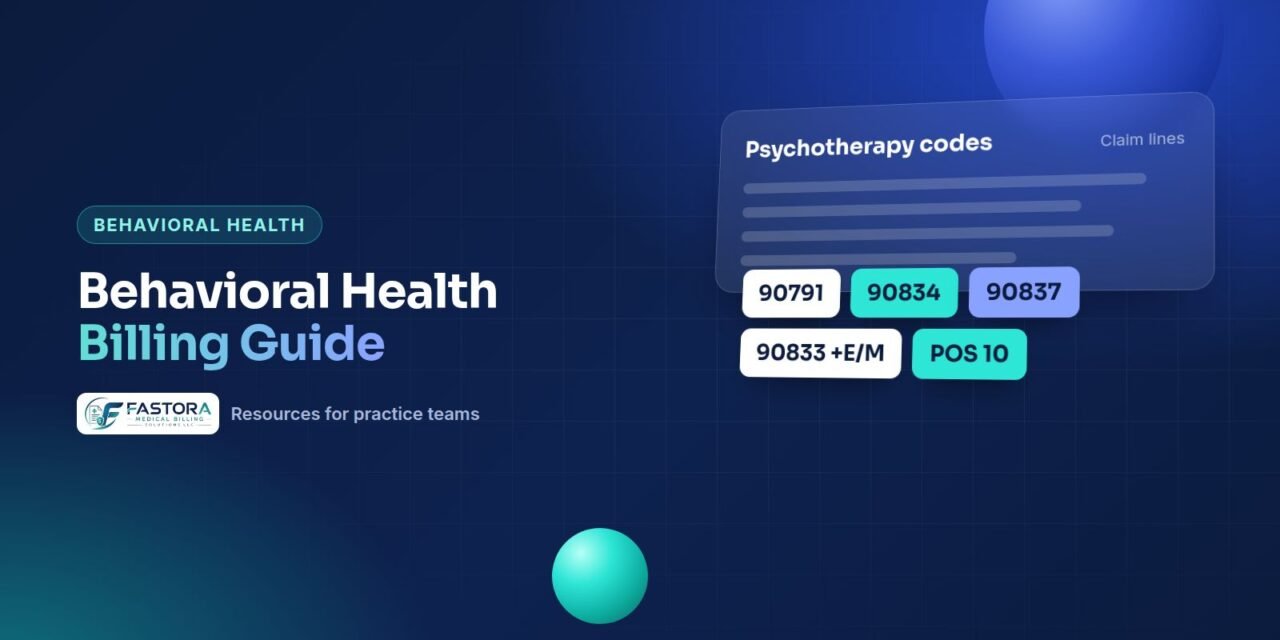
Mental health CPT codes: what this guide covers
Mental health CPT codes describe what psychiatrists, psychologists, therapists and counselors do in a session, and most of them are time-based. This mental health billing guide explains which code fits which service, how time is counted, which diagnosis and modifier rules payers apply, and how to bill insurance for mental health services without the denials that come from carve-outs, session limits and license rules.
It also works as a behavioral health billing guide for office managers. Four questions shape almost every claim: which clinician provided the service and what their license allows them to bill, which code matches the service and the time spent, which payer actually manages the behavioral health benefit, and whether the service needs authorization.
- Diagnoses are reported with ICD-10-CM codes, most often from the mental, behavioral and neurodevelopmental disorders chapter (F01 to F99).
- Services are reported with CPT codes from the psychiatry section (the 908xx range) and, for prescribers, evaluation and management (E/M) codes.
- Many health plans carve out mental health benefits to a separate behavioral health organization, which means a different payer ID, portal and authorization process.
- Payers decide which license types they credential and pay. A code that one clinician can bill may not be billable by another.
Behavioral health CPT codes at a glance
The table groups the behavioral health billing codes practices use most. CPT descriptors are summarized here in plain language; the AMA’s CPT code set is the controlling source, and the codes are reviewed every year, so check the current edition when your 2026 code files are loaded.
| Code | Service (summary) | Who typically bills it |
|---|---|---|
| 90791 | Psychiatric diagnostic evaluation | Therapists, psychologists and prescribers |
| 90792 | Psychiatric diagnostic evaluation with medical services | Physicians, NPs and other clinicians whose scope includes medical services |
| 90832 / 90834 / 90837 | Individual psychotherapy, 30 / 45 / 60 minutes | Therapists, psychologists and prescribers |
| 90833 / 90836 / 90838 | Psychotherapy add-ons with an E/M visit | Prescribers only, with an E/M code |
| 90839 / 90840 | Psychotherapy for crisis, first 60 minutes / each additional 30 | Any clinician licensed for psychotherapy |
| 90846 / 90847 | Family psychotherapy without / with the patient | Therapists, psychologists and prescribers |
| 90853 | Group psychotherapy | Therapists, psychologists and prescribers |
| 90785 | Interactive complexity add-on | Added to eligible primary codes only |
| 99202 to 99215 | Office E/M visits for medication management | Prescribers |
For deeper dives on the two most-billed codes, see our guides to the 90837 CPT code and the 90791 intake evaluation.
How to bill insurance for mental health services: verify benefits first
Many behavioral health denials start with a benefit check that looked only at the medical plan. Mental health benefits often have their own rules, vendor and cost sharing, so verify them separately.
- Confirm whether the plan manages behavioral health itself or through a carve-out vendor, and get the correct payer ID and claims address.
- Check outpatient mental health copay or coinsurance, deductible status and any annual visit limits.
- Ask whether the plan requires authorization for the intake, for ongoing therapy after a set number of visits, or for specific services such as psychological testing.
- Confirm that telehealth sessions are covered on the same terms as in-person visits.
- Check that the clinician’s license type is covered and in network with that plan.
Record the reference number, the representative’s name and the date of every benefits call. That record is often the deciding evidence when a claim is later denied for eligibility or authorization.
Psychotherapy CPT codes and time ranges
Individual psychotherapy codes are chosen by the time spent face-to-face with the patient and/or family member. These psychotherapy time rules, CPT conventions repeated in CMS billing guidance, tell practices to choose the code closest to the actual time and not to report psychotherapy of less than 16 minutes.
| Code | Descriptor time | Time range to report | Used when |
|---|---|---|---|
| 90832 | 30 minutes | 16–37 minutes | Psychotherapy alone |
| 90834 | 45 minutes | 38–52 minutes | Psychotherapy alone |
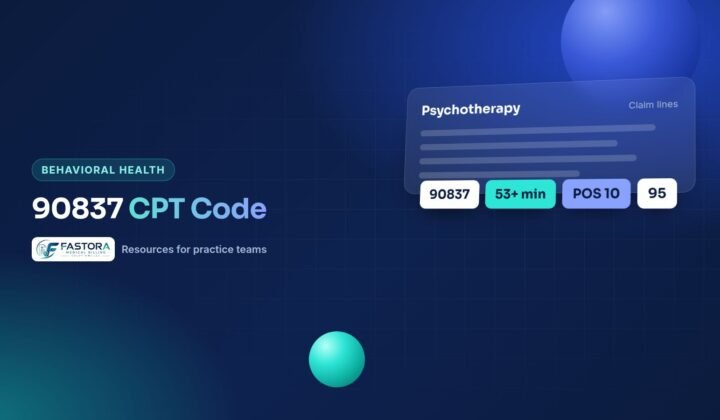
| 90837 | 60 minutes | 53 minutes or more | Psychotherapy alone |
| 90833 | 30 minutes (add-on) | 16–37 minutes | With an E/M service on the same day |
| 90836 | 45 minutes (add-on) | 38–52 minutes | With an E/M service on the same day |
| 90838 | 60 minutes (add-on) | 53 minutes or more | With an E/M service on the same day |
Time is psychotherapy time only. It does not include time spent on the E/M portion of a visit, on documentation after the patient leaves or on scheduling. Some commercial payers apply extra review to 90837, so the note should explain why a longer session was needed.
For code-by-code detail, see the guides to CPT 90837, 90834 vs 90837, the 90791 and 90792 diagnostic evaluation codes and psychological testing codes.
Psychiatry billing guide: E/M and add-on codes
This part of the guide works as a short psychiatry billing guide for psychiatrists, psychiatric nurse practitioners and other prescribers. Their visits often combine medical management with psychotherapy, and the coding has to show both parts clearly.
- Initial evaluations. 90791 is a psychiatric diagnostic evaluation. 90792 is a psychiatric diagnostic evaluation with medical services, and is reserved for clinicians whose scope includes medical services, such as physicians and nurse practitioners. CMS guidance notes that a prescriber may use 90792 or an E/M code for a diagnostic evaluation with medical assessment.
- Medication management. Follow-up visits focused on medication are reported with E/M codes, selected by medical decision making or total time under current E/M rules.
- E/M plus psychotherapy. When a prescriber also provides psychotherapy, the E/M code is reported with an add-on code (90833, 90836 or 90838). The psychotherapy must be a distinct service, and its minutes cannot also be counted toward E/M time.
- Prolonged services. CMS guidance states that prolonged services may not be reported with the psychotherapy add-on codes.
The 90838 CPT code is the longest add-on, for 53 minutes or more of psychotherapy alongside an E/M visit. Because the E/M work and the psychotherapy minutes must be separate, a long combined visit only supports 90838 when the note shows at least 53 minutes of psychotherapy on its own.
A common audit finding is a note that supports the E/M level but does not separately describe the psychotherapy or its time. Documenting the two parts under separate headings makes the claim easier to defend.
Our guide to billing E/M with add-on code 90833 walks through pairing rules and documentation, and the collaborative care billing guide covers CoCM and BHI codes.
Therapy billing guide: basics for therapists
For psychologists, clinical social workers, licensed counselors and marriage and family therapists, this section serves as a compact therapy billing guide. Non-prescribing clinicians bill psychotherapy and evaluation codes, not E/M codes or 90792.
- Use 90791 for the intake or diagnostic evaluation, then 90832, 90834 or 90837 for individual sessions based on time.
- Bill under your own NPI only when you are credentialed with the payer. Pre-licensed clinicians usually cannot bill under their own name, and rules for billing their services under a supervisor vary widely by payer and state.
- Medicare pays clinical psychologists and clinical social workers, and since January 1, 2024 it also pays marriage and family therapists and mental health counselors who enroll.
- Check each plan’s visit limits, authorization rules and whether it pays the same rate for every license type.
- Use the rendering provider’s NPI and the correct taxonomy on the claim so the payer matches it to the credentialed clinician.
Crisis, family and group psychotherapy CPT codes
| Code | Service | Billing notes |
|---|---|---|
| 90839 | Psychotherapy for crisis, first 60 minutes | Time-based. Under CPT guidance it is reported once at least 30 minutes of crisis psychotherapy are provided. |
| 90840 | Psychotherapy for crisis, each additional 30 minutes | Add-on to 90839 for longer crisis sessions. |
| 90846 | Family psychotherapy without the patient present, 50 minutes | Coverage varies; the note should show how the session addresses the patient’s treatment. |
| 90847 | Family psychotherapy (conjoint) with the patient present, 50 minutes | Used when the patient takes part in the family session. |
| 90853 | Group psychotherapy (other than of a multiple-family group) | Billed per patient in the group; each patient needs their own note. |
| 90785 | Interactive complexity (add-on) | Added when specific communication factors complicate the service. CMS guidance notes it should not be billed when a patient cannot communicate by any means. |
Crisis codes describe urgent assessment and psychotherapy for a patient in high distress, not simply a longer routine session. Document the nature of the crisis, the interventions used and the total time.
90839 crisis psychotherapy
90839 crisis psychotherapy covers urgent assessment, history of the crisis, mental status exam and interventions to reduce distress, with the full attention of the clinician. Time does not need to be continuous, but it must be documented. 90840 is added for each additional 30 minutes beyond the first 60. Under CPT guidance, interactive complexity (90785) is not reported with the crisis codes.
90846 vs 90847: family therapy with or without the patient
The difference between 90846 vs 90847 is whether the patient is present. Use 90846 when the clinician meets with family members alone, for example to coach parents on managing a child’s behavior. The 90847 CPT code applies when the patient takes part in the conjoint session. Both describe 50-minute services, and coverage of 90846 varies more between plans, so check the policy before scheduling.
The 90853 group therapy CPT code
The 90853 group therapy CPT code is billed once per patient for each group session. Each member needs an individual note that records attendance, participation and progress toward their own goals, and some payers limit group size.
Mental health ICD-10 codes and Z codes
Every claim pairs a CPT code with a diagnosis that supports it. ICD-10 codes behavioral health practices bill most come mainly from chapter 5 of ICD-10-CM (F01 to F99). Code to the highest specificity the note supports, and update the diagnosis when the clinical picture changes rather than carrying the intake diagnosis forward for months.
Example: F41.1 ICD-10 billing for generalized anxiety disorder
F41.1 is the ICD-10-CM code for generalized anxiety disorder. The note should show the symptoms and duration that support the diagnosis, and the treatment plan should tie the psychotherapy goals to it. A nonspecific anxiety code may be accepted at intake, but many payers expect a specific diagnosis once the evaluation is complete.
Z codes in mental health billing
Z codes describe factors that influence health status, including social determinants of health in categories Z55 to Z65, such as housing, employment or family circumstances. CMS encourages their use to capture these factors. Report them as additional diagnoses that add context; many payers will not accept a Z code as the primary diagnosis for psychotherapy, so confirm each plan’s policy.
Mental health billing modifiers
Mental health billing modifiers tell the payer how or by whom a service was delivered. Requirements differ widely between Medicare, Medicaid and commercial plans, so keep a payer-by-payer list.
| Modifier | Meaning | Typical use |
|---|---|---|
| 95 | Synchronous telemedicine via real-time audio and video | Required by many commercial and Medicaid plans on video sessions |
| 93 | Synchronous telemedicine via audio-only | Where the payer allows audio-only behavioral health services |
| AJ | Clinical social worker | Used by Medicare and some other payers on services by a clinical social worker |
| AH | Clinical psychologist | Used by some payers on services by a clinical psychologist |
| HO / HE | Master’s degree level / mental health program | Examples of modifiers some state Medicaid programs and managed care plans require |
A missing or wrong modifier usually produces a CO-4 or CO-16 denial rather than a coverage dispute, so it is quick to fix but easy to repeat. Build required modifiers into each payer’s charge setup.
Behavioral health billing for Medicaid
Behavioral health billing for Medicaid adds a layer of state rules on top of CPT. Most states, including Texas, deliver much of their Medicaid behavioral health benefit through managed care organizations, and each one has its own provider manual, authorization rules and claim edits.
- Enroll each rendering clinician with the state Medicaid program and with every managed care plan you bill.
- Check which license types the state pays for each service, and whether supervised or pre-licensed clinicians can bill.
- Look up required modifiers and taxonomy codes in the state and plan manuals.
- Track authorization limits per member, since Medicaid plans often authorize a set number of sessions.
- Watch each plan’s timely filing limit, which is set by the state and the plan contract.
Our Texas Medicaid billing guide covers the state-specific steps for Texas practices.
Telehealth billing rules for behavioral health
Behavioral health is one of the most common telehealth services, but payer rules differ on place of service codes and modifiers. Check each payer’s current policy before billing.
| Element | What it means | Notes |
|---|---|---|
| POS 02 | Telehealth provided other than in the patient’s home | For example, the patient is at a clinic or other site. |
| POS 10 | Telehealth provided in the patient’s home | Added by CMS for patients located at home, which includes most therapy sessions by video. |
| Modifier 95 | Synchronous telemedicine via real-time audio and video | Many commercial payers require it; Medicare instructions have changed over time. |
| Modifier 93 | Synchronous telemedicine via audio-only | Used where the payer allows audio-only behavioral health services. |
Medicare’s telehealth rules for mental health services have changed several times since 2020. CMS’s current telehealth FAQ says the statutory in-person visit requirement for mental health telehealth applies after December 31, 2027, and that home telehealth billed with POS 10 has been paid at the non-facility rate since January 1, 2024. Confirm current CMS guidance and each commercial plan’s policy, and document the patient’s location, the clinician’s location and whether video or audio-only was used.
Documentation that supports psychotherapy claims
- Record start and stop times, or total psychotherapy minutes, for every time-based service.
- Name the therapeutic approach and interventions used, and the patient’s response.
- Link the session to the treatment plan and the diagnosis, and update the plan as goals change.
- For E/M with psychotherapy, document each part separately so both can be supported.
- Sign notes promptly, and for telehealth record the modality and patient location.
Behavioral health billing challenges to plan for
The common behavioral health billing challenges come from structure, not coding difficulty. Benefits are often carved out, authorizations are counted in sessions, payers credential by license type, and time-based codes leave little room for rounding. Each needs a simple tracking habit: a carve-out field in registration, an authorization counter, a credentialing date for each clinician and a minute count in every note.
Common mistakes with mental health billing codes
- Rounding session time up to reach 90837 when the note shows fewer than 53 minutes.
- Billing a psychotherapy add-on without an E/M service, or billing 90834 and an E/M together instead of the add-on.
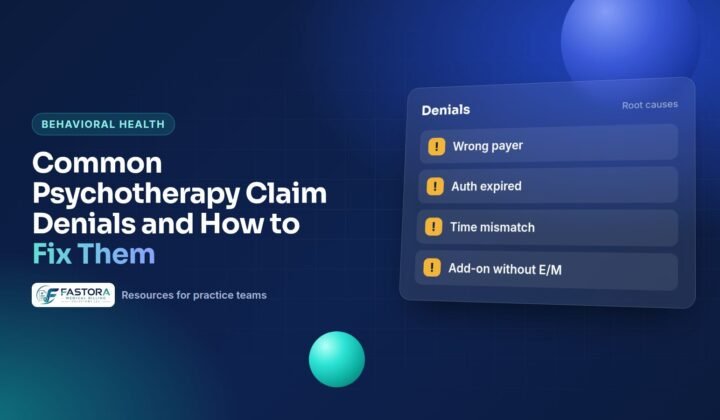
- Sending claims to the medical plan when behavioral health is carved out to another payer.
- Seeing patients before authorization or before the clinician’s enrollment is effective.
- Using the wrong place of service or modifier for telehealth.
Each of these mistakes shows up as a predictable denial. Tracking them by payer and clinician is the fastest way to stop repeat errors.
Billing support for behavioral health practices
Fastora’s certified coders review psychotherapy time, add-on pairings and telehealth coding before claims go out. Read about our behavioral health billing support and coding review services, or request a free billing assessment to check your recent psychotherapy claims.
Two treatments with their own billing rules are covered separately: Spravato billing and TMS billing.
Intensive outpatient and partial hospitalization programs bill by level of care; see IOP and PHP billing codes.
Checklist
Frequently asked questions
What is the time range for 90837?
53 minutes or more of psychotherapy, based on CMS guidance and CPT time conventions. 38 to 52 minutes is reported as 90834.
Can a therapist bill 90792?
No. 90792 includes medical services and is reserved for clinicians whose scope includes them, such as physicians and nurse practitioners. Therapists use 90791 for diagnostic evaluations.
Can psychotherapy be billed with an E/M visit on the same day?
Yes, by prescribers, using the E/M code plus a psychotherapy add-on code (90833, 90836 or 90838). The psychotherapy must be separately documented and its time excluded from E/M time.
Can 90785 be added to a crisis or family session?
Not under CPT guidance. Interactive complexity can be reported with diagnostic evaluations, individual psychotherapy, psychotherapy add-ons and group psychotherapy, but not with the crisis codes 90839 and 90840 or with family psychotherapy.
Which place of service code should I use for video therapy at home?
POS 10 describes telehealth provided in the patient's home. Some payers have their own rules, so confirm each plan's policy.
7 comments