
What the Collaborative Care Model pays for
The Collaborative Care Model (CoCM) brings behavioral health treatment into a primary care or other medical practice. A treating practitioner leads the care, a behavioral health care manager works with the patient between visits, and a psychiatric consultant reviews the caseload and advises on treatment. Collaborative care billing pays the treating practitioner for that team's monthly work.
Unlike a psychotherapy visit, CoCM is billed per calendar month based on care manager time. The claim goes out under the treating practitioner, even though most of the minutes are spent by the care manager and the psychiatric consultant.
Medicare has paid for CoCM since 2017, and many commercial and Medicaid plans now cover the same codes. Coverage and cost-sharing outside Medicare vary, so check each plan before enrolling patients.
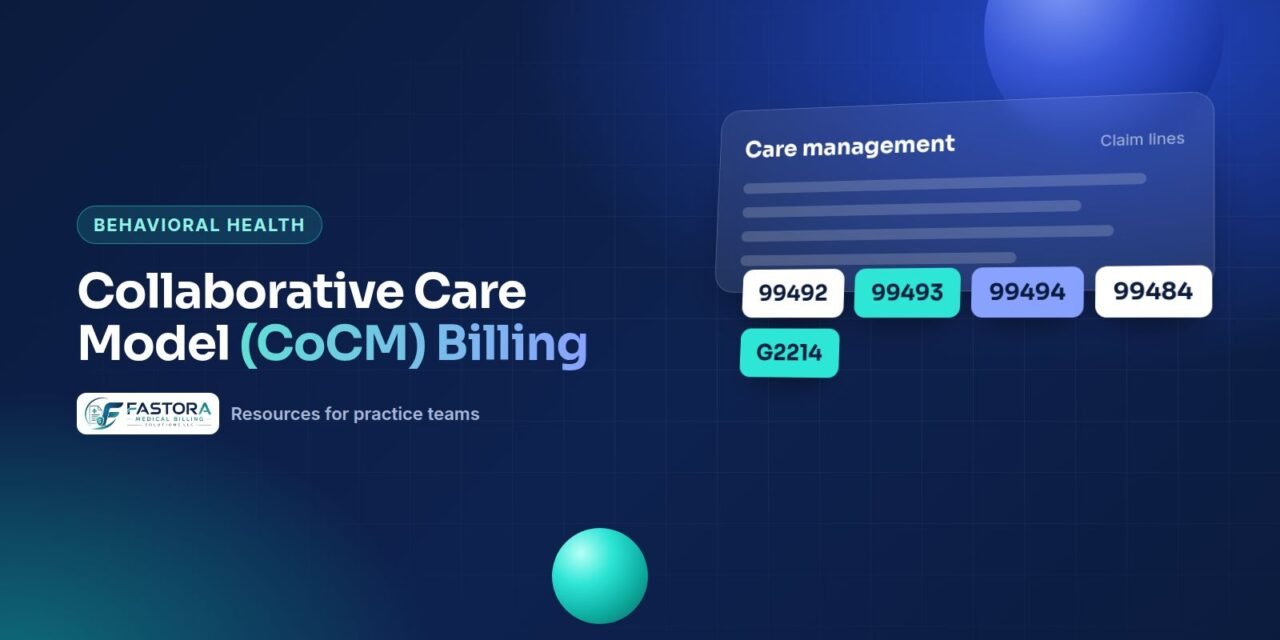
CoCM billing codes 99492, 99493, 99494 and G2214
| Code | Period | Care manager time described |
|---|---|---|
| 99492 | First calendar month of behavioral health care manager activities | First 70 minutes of initial psychiatric collaborative care management |
| 99493 | Each subsequent month | First 60 minutes of subsequent psychiatric collaborative care management |
| 99494 | Initial or subsequent month (add-on) | Each additional 30 minutes, reported with 99492 or 99493 |
| G2214 | Initial or subsequent month | First 30 minutes of psychiatric collaborative care management (Medicare HCPCS code) |
CMS created G2214 for months when the care manager spends less time than 99492 or 99493 requires, which often happens when a patient is starting out or stepping down. Many commercial payers do not recognize G2214, so check before using it outside Medicare.
Time counts only for care manager activities: outreach and engagement, the initial assessment, entering the patient in a registry and tracking follow-up, participation in the weekly caseload review with the psychiatric consultant, and brief interventions such as behavioral activation or motivational interviewing. CMS's behavioral health integration FAQs explain how much time beyond each code's threshold must be reached before the next code or add-on unit can be reported.
Behavioral health integration billing with 99484
Some practices provide integrated behavioral health care without a full CoCM team. CPT 99484 covers general behavioral health integration (BHI): at least 20 minutes per calendar month of clinical staff time, directed by a physician or other qualified health care professional, for a patient with a behavioral health condition.
Required elements of behavioral health integration billing under 99484 include an initial assessment or follow-up monitoring using validated rating scales, behavioral health care planning with revision for patients who are not improving, facilitation and coordination of treatment such as psychotherapy or psychiatric consultation, and continuity of care with a designated member of the care team.
Medicare also recognizes G0323 for general BHI performed by a clinical psychologist or clinical social worker, for at least 20 minutes per calendar month. Confirm which practitioner types each payer allows for 99484 and G0323.
Choosing between CoCM and general BHI
| Feature | CoCM (99492-99494, G2214) | General BHI (99484) |
|---|---|---|
| Team | Treating practitioner, behavioral health care manager, psychiatric consultant | Treating practitioner and clinical staff |
| Registry | Required for tracking patient follow-up and progress | Not required |
| Psychiatric consultant | Required, with regular caseload review | Not required |
| Time unit | 70 or 60 minutes plus 30-minute add-ons, or 30 minutes with G2214 | At least 20 minutes per month |
| Typical use | Structured program with measurement-based care | Lighter integration or practices building toward CoCM |
CMS guidance does not allow CoCM and general BHI to be billed for the same patient in the same month. Practices can bill chronic care management for the same patient in the same month as long as the time and activities counted are not double-counted.
Initiating visit, consent and cost-sharing
For Medicare, an initiating visit is required for new patients and for patients not seen by the billing practitioner within the past year. Qualifying visits include a comprehensive E/M visit, an annual wellness visit, the initial preventive physical exam or a transitional care management visit. The initiating visit is billed separately and is not part of the CoCM or BHI time.
Before services start, the practice must get the patient's consent, which may be verbal, and document it in the record. The consent discussion should explain that the patient may owe cost-sharing for each month billed, that the patient can stop at any time, and that the care team, including the psychiatric consultant who may never meet the patient, will share information.
Patients who are surprised by a monthly charge are a common source of complaints. A short written explanation at enrollment helps; our patient billing and collections page describes how statements and payment questions are handled.
Time tracking and documentation
- Log every care manager contact with date, duration, activity and who performed it.
- Record the psychiatric consultant's caseload review and resulting recommendations.
- Keep rating scale scores, such as PHQ-9 or GAD-7, in the registry and the chart.
- Total time at month end, then select the code and add-on units from that total.
- Keep time for separately billed services, such as psychotherapy or an E/M visit, out of the CoCM total.
- Bill once per month, after the month closes, using a date of service the payer accepts.
Monthly billing means a missed month cannot be fixed by adding minutes to the next one. A month-end reconciliation of the registry against claims prevents lost months.
Watch the transition from the first month to later months. The first month of care manager activity in an episode of care is reported with 99492, and every later month in that episode with 99493. Under CMS guidance, an episode ends when the patient meets the treatment goals, is referred for direct psychiatric care, or has no CoCM services for 6 consecutive months; a new episode after that starts again with 99492. Commercial payers may set their own rules, so check their guidance.
Common collaborative care billing denials
| Denial | Cause | Prevention |
|---|---|---|
| Missing initiating visit | No qualifying visit within the past year | Schedule the initiating visit before enrollment |
| Add-on without primary code | 99494 billed without 99492 or 99493 | Report 99494 only with its primary code on the same claim |
| Code not recognized | G2214 billed to a payer that does not accept it | Check payer code lists before billing |
| Same-month conflict | CoCM and 99484 billed for the same patient in one month | Assign each patient to one model per month |
| Insufficient time | Minutes below the code threshold | Reconcile time logs before code selection |
For a wider view of denial patterns in mental health claims, see common psychotherapy claim denials.
Billing support for integrated care programs
Fastora's certified coders review monthly CoCM and BHI time logs, check code thresholds and payer code lists, and follow up on denials. See our behavioral health billing services or our primary care billing support, or request a free claims audit of your integrated care claims.
Frequently asked questions
Who bills the collaborative care codes?
The treating physician or other qualified health care professional who directs the care bills the codes. The care manager's and psychiatric consultant's work is included in the payment and is not billed separately under their own names for the same service.
Can 99494 be billed alone?
No. 99494 is an add-on code for each additional 30 minutes and must be reported with 99492 or 99493 for the same month.
Does the psychiatric consultant need to see the patient?
No. The psychiatric consultant typically reviews the caseload and advises the treating practitioner without seeing the patient. Patients should be told about this role when they give consent.
Is written consent required for CoCM?
Medicare accepts verbal consent as long as it is documented in the medical record. Some payers or state rules may ask for more, so check local requirements.
1 comment