What the CO-97 denial code means
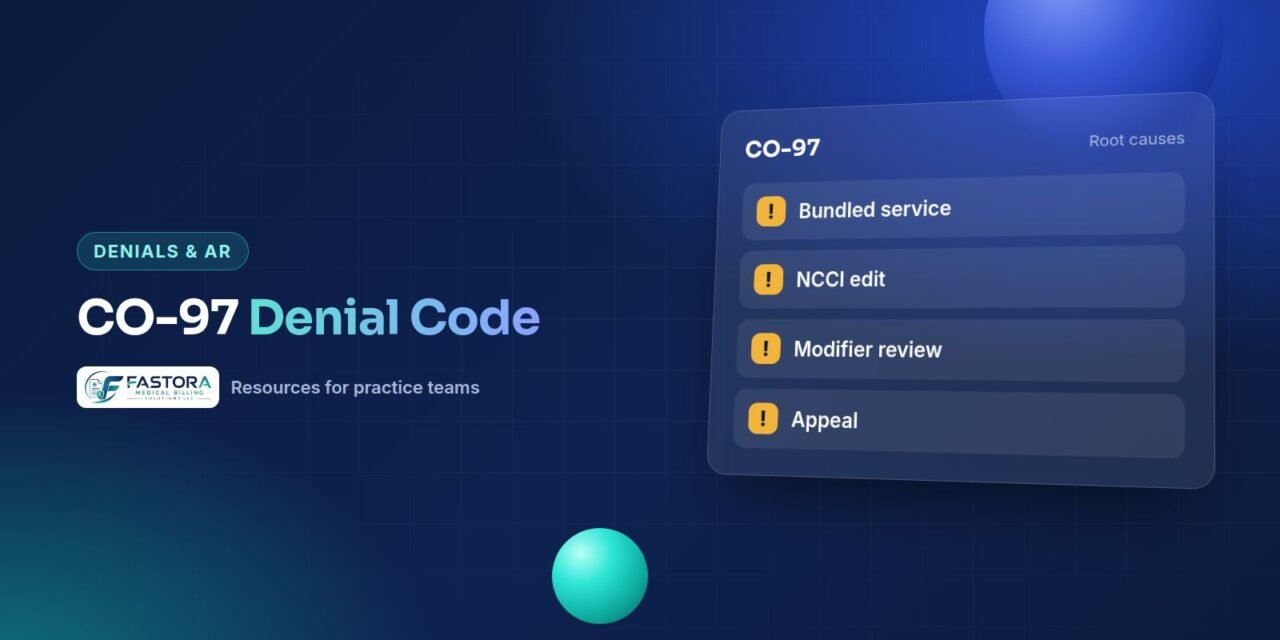
The CO-97 denial code tells you the payer considers one service part of another service it has already processed, so it will not pay the first one separately. The X12 descriptor for claim adjustment reason code (CARC) 97 is: "The benefit for this service is included in the payment/allowance for another service/procedure that has already been adjudicated."
With group code CO, the amount is a contractual adjustment. It cannot be billed to the patient. The practice either accepts the bundling as correct or shows the payer why the two services were truly separate.
CO-97 is a coding and documentation denial rather than a data-entry one. Before changing anything, work out whether the payer's edit is right. Adding a modifier to force payment for a service that really was bundled is a compliance problem, not a fix.
Remark codes that come with CARC 97
The remark code tells you which kind of bundling the payer applied. These pairings are common; the descriptors are from the X12 remark code list.
| RARC | X12 descriptor | What it usually points to |
|---|---|---|
| M15 | Separately billed services/tests have been bundled as they are considered components of the same procedure. | A component service billed alongside the comprehensive one, such as a procedure-to-procedure edit. |
| N20 | Service not payable with other service rendered on the same date. | Two services on the same date that the payer will not pay together without support for a distinct service. |
| M144 | Pre-/post-operative care payment is included in the allowance for the surgery/procedure. | A visit inside a surgical global period that the payer treats as routine pre- or post-operative care. |
X12's usage note for code 97 also points to the 835 healthcare policy identification segment (loop 2110 REF). When a payer sends one, it names the policy behind the edit, which is the document you need if you plan to dispute it. A related CARC, 236, is used when a procedure or procedure and modifier combination is not compatible with another on the same day under the National Correct Coding Initiative (NCCI).
What triggers a bundling denial
NCCI procedure-to-procedure edits
CMS publishes NCCI procedure-to-procedure (PTP) edits listing code pairs that should not normally be paid together for the same patient on the same date. Medicare and Medicaid apply them, and many commercial payers use NCCI or similar edit logic in their claim systems.
Each PTP edit has a modifier indicator. An indicator of 0 means no modifier will allow the pair to be paid separately. An indicator of 1 means an appropriate modifier may bypass the edit when the documentation supports a separate service. An indicator of 9 means the edit does not apply.
Global surgical periods
Surgical procedures carry a global period that includes routine pre-operative and post-operative care. A follow-up visit billed inside that window, without a modifier that shows it was unrelated or a separate decision, is often denied with CO-97 and M144.
Payer-specific bundling
Commercial payers may bundle supplies, certain add-on services or same-day evaluation and management (E/M) visits under their own policies. These rules sit in the provider manual or reimbursement policy library, not in NCCI, so check the payer's own document.
How to fix a CO-97 denial
- Read the remark code and any policy reference to see whether the edit is a PTP pair, a global period or a payer policy.
- Identify the code the denied line was bundled into. It is usually another line on the same claim or a claim already paid for the same date.
- Check the edit. For Medicare and Medicaid, look up the code pair and its modifier indicator in the current NCCI tables. For commercial payers, read the reimbursement policy.
- Read the clinical note. Decide whether the denied service was a separate procedure, at a separate site or session, or by a different practitioner, or whether it was really part of the main service.
- If the edit allows a modifier and the note supports a distinct service, send a corrected claim with the right modifier on the correct line.
- If the bundling was correct, post the adjustment and close the line. Do not resubmit the same claim unchanged.
- If you believe the payer applied an edit that does not exist or misapplied its policy, appeal with the note and the policy citation.
Modifiers that can apply, and when they cannot
Modifier 59 (distinct procedural service) and the more specific X modifiers exist for PTP edits with an indicator of 1. CMS describes XE for a separate encounter, XS for a separate structure or organ, XP for a separate practitioner and XU for an unusual non-overlapping service. Many payers prefer the X modifier when one fits. Our article on modifier 59 and the X modifiers explains the differences.
For a significant, separately identifiable E/M service on the same day as a minor procedure, the modifier is 25, not 59. The note must show work beyond the usual pre-procedure assessment. See our guide to modifier 25 for documentation examples.
A modifier does not help when:
- The PTP edit has a modifier indicator of 0.
- The services were performed at the same session, on the same site, as part of one procedure.
- The note does not describe a separate incision, lesion, organ, encounter or practitioner.
- The payer's own policy excludes separate payment regardless of modifiers.
When to appeal vs send a corrected claim
Send a corrected claim when the original claim was missing a modifier the documentation supports, used the wrong code, or put the modifier on the wrong line. The fix is a change to claim data.
File an appeal when the claim was coded correctly and the payer still bundled it, for example by applying a commercial edit that conflicts with its published policy, or denying a modifier-supported line. Include the operative or visit note, a short explanation of why the services were distinct, and the policy or NCCI reference.
Write off the line when the bundling is correct. Repeated resubmission of a correct edit wastes follow-up time and can look like a pattern of unbundling to a payer.
Preventing CO-97 denials
- Run claims through NCCI and payer edits before submission, and route edit hits to a coder rather than letting staff add modifiers by default.
- Train providers to document the separate site, session or reason when two services on one date are both billed.
- Track global periods in the practice management system so post-operative visits are flagged before billing.
- Load current NCCI quarterly updates and commercial payer policy changes into scrubber rules.
- Audit modifier 59, X modifier and modifier 25 use periodically against the notes.
Logging CO-97 lines by code pair and provider usually reveals two or three recurring combinations. Fixing those templates or habits removes most of the volume.
Getting help with bundling denials
Fastora's certified coders review bundling edits against the documentation and send corrected claims or appeals only where the record supports them. Learn more about our denial management and appeals work, see the full CARC and RARC denial codes list, or ask for a free billing assessment to see which code pairs are being bundled on your claims.
Checklist
Frequently asked questions
Can I bill the patient for a CO-97 denial?
No. CO-97 is reported with group code CO, which means the amount is a contractual adjustment the provider absorbs. If the bundling is correct, write it off; if it is not, correct or appeal the claim.
Should I just add modifier 59 to fix CO-97?
Only if the code pair allows a modifier and the note documents a distinct service, such as a separate site, session or practitioner. Adding modifier 59 without that support is unbundling and creates compliance risk.
Is CO-97 the same as CO-236?
They are related but different. CARC 97 says the benefit is included in another service already adjudicated. CARC 236 says a procedure or procedure and modifier combination is not compatible with another on the same day under NCCI or workers' compensation rules.
Do commercial payers use NCCI edits?
Many do, either directly or through similar edit logic, and some add their own bundling rules. Check the payer's reimbursement policy to see which edits apply to your contract.