
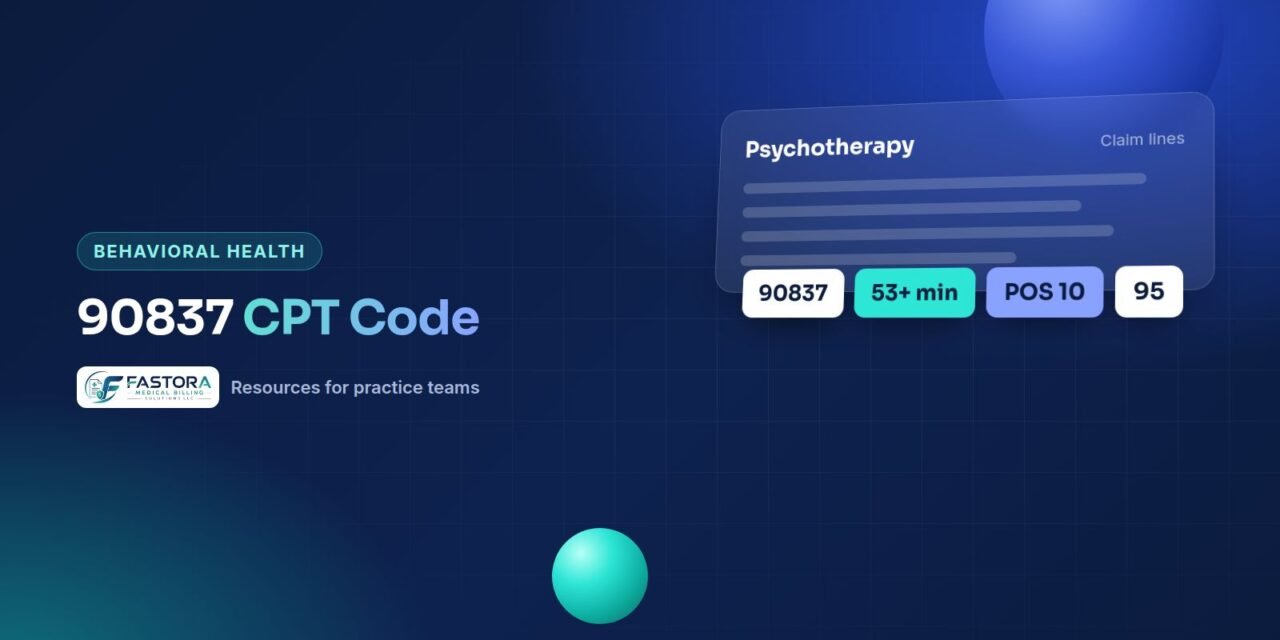
What the 90837 CPT code covers
The 90837 CPT code reports individual psychotherapy of 60 minutes with the patient. It is the longest of the three standalone psychotherapy codes, alongside 90832 (30 minutes) and 90834 (45 minutes) in the mental health CPT code set, and it is billed by psychiatrists, psychologists, clinical social workers, counselors and marriage and family therapists whose license and payer contracts allow psychotherapy.
Because it is the highest-paying routine therapy code, 90837 also draws the most payer attention. Billing it correctly comes down to three things: real session time of at least 53 minutes, a note that shows why the session needed that length, and a payer that covers it for the clinician's license type.
- Code type: time-based psychotherapy, psychotherapy alone (no E/M on the same claim).
- Companion add-on for prescribers: 90838 is the 60-minute psychotherapy add-on used with an E/M visit.
- Common add-on: 90785 interactive complexity, when a qualifying communication factor applies.
- Diagnosis: an ICD-10-CM code that supports medical necessity, usually from the F-code chapter.
90837 time requirements
The 90837 time requirements follow CPT's time conventions for psychotherapy codes. Although the descriptor says 60 minutes, the code is reported once the session reaches 53 minutes. Shorter sessions move to a lower code.
| Psychotherapy time | Code to report |
|---|---|
| Less than 16 minutes | Not reported as psychotherapy |
| 16–37 minutes | 90832 |
| 38–52 minutes | 90834 |
| 53 minutes or more | 90837 |
Count only time spent in psychotherapy with the patient (a family member may take part when the patient is present for all or some of the session). Do not count time spent writing the note after the patient leaves, scheduling, or reviewing records outside the session.
There is no separate CPT code for individual psychotherapy beyond 60 minutes. Some payers allow a prolonged service code for unusually long sessions, while others do not; check the payer policy before billing anything beyond 90837. One Medicare contractor's billing guideline, for example, states that sessions longer than 90 minutes are paid only when the record documents the face-to-face time and the medical necessity for the extended time.
Documentation that supports 90837
A 90837 note has to stand on its own if the payer requests records. Payers that audit this code typically look for exact time, a clear clinical reason for a full-hour session, and progress tied to the treatment plan.
- Start and stop times, or total psychotherapy minutes, written in the note.
- The therapeutic approach used (for example, CBT or trauma-focused therapy) and the interventions delivered.
- Current symptoms, risk assessment where relevant, and the patient's response.
- Why the session required 53 minutes or more, such as symptom severity, a crisis that did not meet crisis-code criteria, or a treatment phase that needs longer sessions.
- Link to treatment plan goals and the plan for the next session.
- For telehealth, the patient's location and the technology used.
Cloned notes are a frequent audit finding. If every session for every patient is documented as exactly 60 minutes with identical wording, expect questions.
Same-day and code-pair rules
The Medicare NCCI policy manual states that 90791 and 90792 are not separately reportable with individual, group, family, crisis or other psychotherapy codes on the same date of service. In practice, that means an intake evaluation and a 90837 session are not billed for the same patient on the same day.
- 90837 and E/M: a prescriber who provides an E/M service and 60 minutes of psychotherapy reports the E/M code with add-on 90838, not 90837.
- 90837 and crisis codes: psychotherapy for crisis (90839, 90840) is a different service. Report one or the other based on what was provided and documented.
- 90837 and 90785: interactive complexity may be added to 90837 when a qualifying factor is documented, such as use of an interpreter or caregiver behavior that interferes with treatment.
- 90837 and family therapy: family psychotherapy codes (90846, 90847) describe a different service; check payer edits before billing both on one day.
For a side-by-side look at the two most common therapy codes, see 90834 vs 90837.
90837 reimbursement rate: how to find it
There is no single 90837 reimbursement rate. What a practice is paid depends on the payer, the contract, the clinician's license type, the location and, for Medicare, whether the service was billed at the facility or non-facility rate. Rates also change every year, so a number copied from an old article is rarely accurate.
Medicare
- Open the CMS Physician Fee Schedule Look-Up Tool and select the current year.
- Enter 90837 and choose your Medicare Administrative Contractor and locality.
- Note the non-facility amount (office or POS 10 telehealth) and the facility amount.
- Apply any reduction for the clinician's license type. Medicare pays some non-physician practitioners a set percentage of the fee schedule amount, so check the rules for your provider type.
Medicaid and commercial plans
- State Medicaid programs publish fee schedules, and Medicaid managed care plans set rates in their own contracts.
- Commercial rates come from your payer contract or fee schedule, sometimes with different rates by license type or for telehealth.
- Compare the allowed amount on each ERA with the contracted rate. Short payments on 90837 are worth tracking because the code is billed so often.
If remittances do not match your contracts, an underpayment review can show where the gap is and whether it is worth appealing.
Why payers review 90837 more closely
Some commercial payers and behavioral health organizations run focused reviews on clinicians who bill 90837 for a large share of sessions. These programs may send letters, request records or move a clinician to prepayment review.
- Bill the code that matches the time actually spent. Do not round up a 50-minute session.
- Watch your own mix of 90834 and 90837 by clinician. A sudden shift can trigger a review.
- Keep records ready to send. A complete, timed note is the best response to a review letter.
- Read payer bulletins. Some plans publish policies that require authorization or extra documentation for 90837.
Denials tied to this code are covered in more depth in our article on common psychotherapy claim denials.
Billing 90837 by telehealth
90837 can be delivered by telehealth under Medicare and most commercial plans. The time and documentation rules are the same as in person. The differences are the place of service code (POS 10 for the patient's home, POS 02 elsewhere), any modifier the payer requires, and the patient's location and state recorded in the note.
Medicare's in-person visit requirement for mental health telehealth is currently scheduled to apply from January 1, 2028. Our telehealth billing guide explains POS and modifier choices in detail.
Getting 90837 claims right
Most 90837 problems are fixable at the front end: time captured in the note, the right code for that time, no same-day intake, and a payer that covers the clinician. Our therapist billing team at Fastora checks these points before claims go out, and a free billing assessment can review a sample of your psychotherapy claims for coding and documentation gaps.
Frequently asked questions
How many minutes do you need to bill 90837?
Under CPT time conventions, 90837 is reported when psychotherapy time reaches 53 minutes or more. Sessions of 38 to 52 minutes are reported with 90834, and 16 to 37 minutes with 90832. Only psychotherapy time with the patient counts, not documentation time afterwards.
Can a psychiatrist bill 90837?
A psychiatrist can bill 90837 when the visit is psychotherapy only. If the psychiatrist also provides an E/M service such as medication management in the same visit, the correct coding is the E/M code plus add-on 90838 for 53 minutes or more of psychotherapy.
Can you bill 90837 and 90791 on the same day?
Generally no. The Medicare NCCI policy manual states that 90791 and 90792 are not separately reportable with psychotherapy codes on the same date of service, and many commercial payers follow the same edits. Schedule the first psychotherapy session on a later date.
Where can I find the current Medicare rate for 90837?
Use the CMS Physician Fee Schedule Look-Up Tool. Select the current year, enter 90837, choose your MAC and locality, and read the facility and non-facility amounts. Then apply any payment adjustment that applies to the clinician's license type.
2 comments