Telehealth billing guidelines: how a virtual visit becomes a clean claim
Telehealth billing guidelines answer three questions on every virtual claim: where the patient was, what technology connected the patient and clinician, and whether this payer covers the code when it is delivered remotely. The CPT or HCPCS code for the service usually stays the same as in person. What changes is the place of service (POS) code, the modifier and the payer rules behind them.
Medicare, Medicaid programs and commercial plans each publish their own telehealth policy, and those policies have changed often since 2020. This guide explains the parts that are stable, flags the parts that depend on legislation, and gives you a checklist you can apply payer by payer.
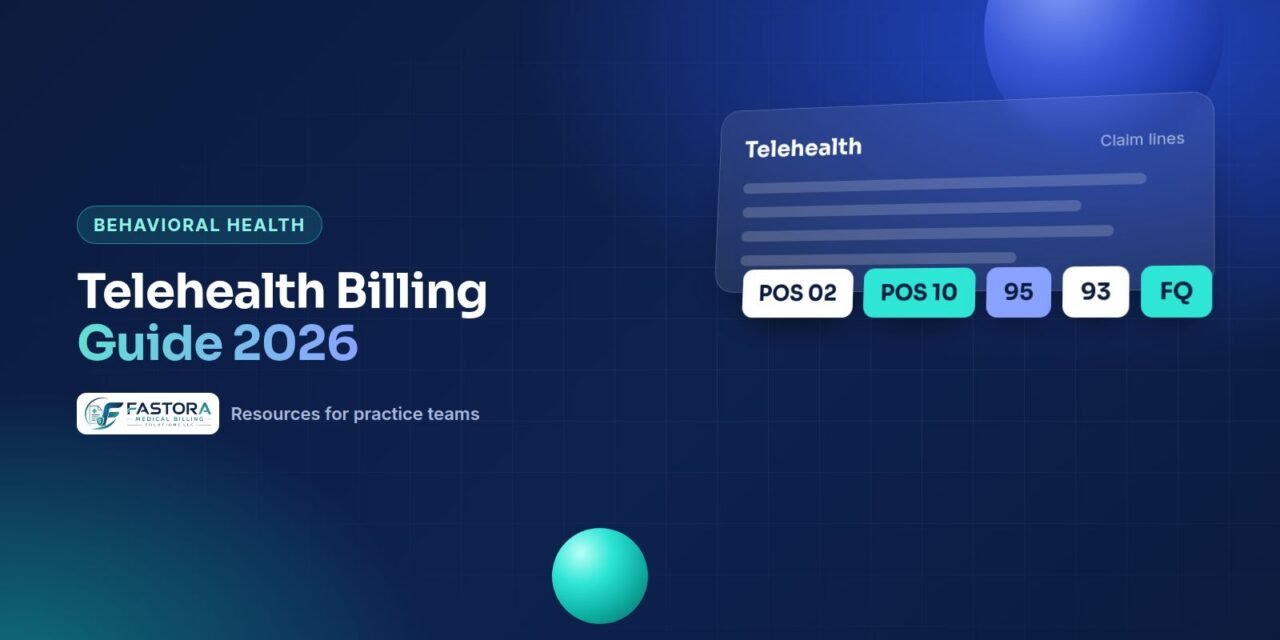
- Patient location drives the POS code (02 or 10 for most payers).
- Technology drives the modifier (95 for real-time audio and video, 93 for audio-only, plus payer-specific modifiers such as GT or FQ).
- Payer policy decides whether the code is covered by telehealth at all, at what rate, and with what documentation.
Telehealth place of service codes
The CMS Place of Service code set includes two telehealth place of service codes. Professional claims (837P / CMS-1500) report them in the place of service field for each service line.
| POS | CMS descriptor | Use when | Medicare payment note |
|---|---|---|---|
| 02 | Telehealth provided other than in patient's home | The patient is somewhere other than their home, such as a clinic, hospital or other originating site, when the service is delivered by telecommunication technology. | Paid at the facility rate under the Physician Fee Schedule. |
| 10 | Telehealth provided in patient's home | The patient is in their home (or another private location the payer treats as home) when the service is delivered. | Since January 1, 2024, Medicare pays POS 10 claims at the non-facility rate. |
The distant site is where the clinician is. The originating site is where the patient is. POS describes the patient's side of the visit, not the clinician's office, so a therapist working from the practice who sees a patient at home still reports POS 10.
POS 02 vs POS 10: choosing the right code
The POS 02 vs POS 10 decision comes down to one documented fact: where the patient was during the session. Record the patient's location at the start of every visit, along with the state they are in, because licensure rules depend on the patient's state as well.
- Confirm the patient's physical location and write it in the note (for example, "patient at home in Austin, TX").
- If the patient is at home, use POS 10. If the patient is at another site, use POS 02.
- Check the payer's policy. Some commercial and Medicaid plans still ask for the POS that would apply in person (often 11) plus a telehealth modifier, instead of 02 or 10.
- Compare the payer's allowed amount for POS 02 and POS 10 claims during payment posting. A facility rate on a home visit can point to a POS error or a contract term worth reviewing.
A frequent error is a scheduling template that defaults every video slot to POS 02. Build separate visit types for home and non-home telehealth, or have the clinician confirm location before the claim is released.
Modifier 95 telehealth rules and other telehealth modifiers
Modifier 95 is the CPT modifier for a synchronous telemedicine service delivered through a real-time interactive audio and video connection. Modifier 95 telehealth use is widespread with commercial payers and Medicaid plans, but each payer decides whether it wants 95 alone, POS alone, or both.
| Modifier | Meaning | Where it commonly applies |
|---|---|---|
| 95 | Synchronous telemedicine via real-time audio and video | Many commercial and Medicaid plans. In Medicare guidance, outpatient therapy furnished via telehealth by hospital-employed PTs, OTs and SLPs on institutional claims. |
| 93 | Synchronous telemedicine via real-time interactive audio-only | Audio-only services, including Medicare audio-only telehealth where permitted. |
| FQ | Service furnished using audio-only communication technology | Medicare audio-only services from FQHCs and RHCs. |
| GT | Via interactive audio and video telecommunication systems | Medicare critical access hospital optional payment Method II institutional claims; some other payers still request it. |
For Medicare professional claims, the POS code now carries most of the telehealth signal, and the rules on when modifier 95 is still expected have shifted from year to year. Confirm the current instruction in your Medicare Administrative Contractor's telehealth page before changing a claim template.
Modifier GT vs 95: which one a payer wants
The modifier GT vs 95 question usually comes from older payer manuals. GT is the older HCPCS modifier for interactive audio and video. Modifier 95 was added to CPT later and became the more common choice for professional claims during the pandemic.
- Medicare: GT is limited to institutional claims under critical access hospital Method II. Do not add it to a physician or therapist's professional claim.
- Commercial payers: most current policies ask for 95, but some plans and some employer contracts still reference GT. Follow the payer's written policy, not habit.
- Medicaid: each state program sets its own modifiers. Check the state provider manual and any managed care plan bulletins.
- Never report GT and 95 together unless the payer's policy says so.
Medicare telehealth billing in 2026
Medicare telehealth billing depends on statute as much as on CMS rules. Most pandemic-era flexibilities, such as the patient's home as an originating site for non-behavioral services and the waiver of geographic limits, have been extended by Congress in short increments, and some extensions briefly lapsed.
According to the CMS telehealth FAQ updated February 26, 2026, these flexibilities run through December 31, 2027. That means, for now, beneficiaries can receive covered telehealth services anywhere in the United States, including at home, and audio-only services in the home can continue. Because this has changed several times, check CMS and your MAC for any newer legislation before you bill.
- Only services on the Medicare Telehealth Services List can be billed as telehealth. Check the current list for each code.
- The distant site practitioner must be a type Medicare allows to bill telehealth. Under the current extension that includes PTs, OTs, SLPs and audiologists through December 31, 2027.
- Bill the service code with POS 02 or POS 10 and any modifier your MAC requires.
- Document patient location, the technology used and, for time-based codes, the time spent.
Under the same FAQ, starting January 1, 2028 many of these flexibilities end unless Congress acts again, while the behavioral health rules described below continue.
Telehealth billing for mental health
Telehealth billing for mental health has the most stable Medicare rules. By statute, a patient's home can be the originating site for telehealth services to diagnose, evaluate or treat a mental health disorder, without the geographic limits that apply to other services.
- In-person visit requirement. Medicare's rule calls for an in-person, non-telehealth visit within 6 months before an initial mental health telehealth service and generally within 12 months for later services, with exceptions. CMS's February 2026 FAQ says this requirement applies starting January 1, 2028, and that beneficiaries receiving mental health telehealth on or before December 31, 2027 are not required to have the 6-month in-person visit. Track this date, because it has been delayed before.
- Codes. Psychotherapy and diagnostic evaluation codes such as 90837, 90834 and 90791 are billed with the same time rules as in person. The session time in the note must match the code.
- License and location. The clinician must be licensed in the state where the patient is located, and credentialed with the payer for telehealth if the plan requires it.
- FQHCs and RHCs. CMS pays behavioral and mental health telehealth visits under the RHC all-inclusive rate and FQHC prospective payment system; check your MAC for current billing instructions.
For a full code reference, including add-on codes and documentation tips, see our behavioral health billing guide.
Telepsychiatry billing: E/M and psychotherapy add-ons
Telepsychiatry billing adds E/M codes to the mix. A psychiatrist or psychiatric nurse practitioner who manages medication by video reports an office E/M code with POS 02 or 10. If psychotherapy is also provided, the matching add-on (90833, 90836 or 90838) goes on the same claim.
When psychotherapy is added to an E/M, the American Psychiatric Association's guidance is that the E/M level must be selected by medical decision making, not by time. Document the E/M and the psychotherapy under separate headings, with psychotherapy minutes recorded separately. Our page on psychiatric practice billing covers prescriber workflows in more detail.
Audio only telehealth billing
Audio only telehealth billing is allowed in narrower cases than video. Medicare permits two-way, real-time audio-only technology for telehealth services when the patient is at home, the practitioner is able to use video, and the patient is not able to use video or does not consent to it. For mental health services the patient must be at home.
- Confirm the payer covers audio-only for that code. Many plans limit audio-only to behavioral health or a short list of services.
- Document why video was not used, for example the patient lacked a device or declined video.
- Append modifier 93 (or FQ for FQHC and RHC Medicare claims) when the payer requires it.
- Do not bill telephone-only check-ins under telehealth service codes unless the payer's policy allows it.
Telehealth billing for physical therapy
Telehealth billing for physical therapy is the area most exposed to changing law. Medicare's ability to pay private practice PTs, OTs and SLPs for telehealth comes from the temporary extension, which CMS lists through December 31, 2027. The CMS FAQ states that starting January 1, 2028 these therapists can no longer furnish Medicare telehealth services unless the law changes.
- Check that each therapy code is on the Medicare Telehealth Services List before scheduling it virtually. Hands-on procedures rarely translate to video.
- Apply the same timed-code rules as in person, including the 8-minute rule for Medicare.
- Commercial plans and state Medicaid programs set their own therapy telehealth policies. Some cover only evaluations or therapeutic exercise.
- Keep the KX modifier and plan of care rules in place. Telehealth does not change therapy threshold or certification requirements.
Practices with mixed in-person and virtual caseloads can review the physical therapy billing page for authorization and documentation steps.
Commercial and Medicaid telehealth policies
Outside Medicare, there is no single rulebook. Each commercial plan and each state Medicaid program publishes its own telehealth policy, and Medicaid managed care plans may add rules on top of the state's.
| Check | Why it matters |
|---|---|
| POS required (02, 10 or in-person POS) | The wrong POS is one of the most common telehealth denials. |
| Modifier required (95, GT, 93 or none) | Some plans deny without a modifier; others deny if one is added. |
| Covered codes and audio-only rules | Coverage lists differ by plan and line of business. |
| Payment parity | Some plans pay the same as in person; others pay less. Check your contract. |
| Credentialing for telehealth | Some plans require a separate telehealth enrollment or attestation. |
Save the dated policy document for each payer. When a telehealth claim is denied, that record makes the appeal faster.
Telehealth billing guidelines checklist and next steps
Run this checklist before you release telehealth claims, and repeat it when a payer updates its policy. Errors in POS and modifiers tend to repeat across every claim until the template is fixed, so a short monthly sample review is worth the time. Our claims management process includes this kind of pre-submission check.
If you are weighing outside telehealth billing services, Fastora's certified billing and coding professionals can review a sample of your telehealth claims for POS, modifier and documentation issues during a free billing assessment, before you commit to anything.
Therapists billing remote sessions should pair this guide with telehealth billing for therapy practices and confirm coverage through eligibility verification before the visit.
How does Medicare telehealth billing work in 2026?
Medicare telehealth billing in 2026 still hinges on the flexibilities Congress extends year to year: which services are on the telehealth list, where the patient may be located, and whether audio-only visits count. Mental health telehealth kept broader flexibilities than most specialties, but place-of-service codes, modifier 95, and originating-site rules all affect payment. Verify the current-year CMS telehealth list before assuming last year\u2019s rules still apply.
Checklist
Frequently asked questions
What is the difference between POS 02 and POS 10?
POS 02 is telehealth provided other than in the patient's home, and POS 10 is telehealth provided in the patient's home. The code describes where the patient is, not where the clinician is. Medicare pays POS 10 at the non-facility rate, while commercial plans set their own rules, so check each payer's policy.
Is modifier 95 still required for telehealth?
It depends on the payer. Many commercial and Medicaid plans still require modifier 95 for real-time audio and video visits. For Medicare professional claims, the POS code carries most of the telehealth information, and specific modifier instructions have changed over time, so confirm the current rule with your Medicare Administrative Contractor.
Can therapists bill Medicare for audio-only sessions?
Medicare allows audio-only telehealth for mental health services when the patient is at home, the clinician can offer video, and the patient cannot use or does not consent to video. Document why video was not used and add modifier 93, or FQ for FQHC and RHC claims, when required.
What are the telehealth billing guidelines 2026 changes to watch?
The main dates are December 31, 2027, when Medicare's temporary telehealth flexibilities are currently set to end, and January 1, 2028, when the in-person requirement for mental health telehealth is currently set to apply. Both have been moved before, so check CMS updates and payer bulletins regularly.
Do commercial payers pay telehealth at the same rate as in-person visits?
Not always. Some plans and some state laws provide payment parity, while other contracts pay telehealth differently. Compare remittances for telehealth and in-person claims for the same code and review your payer contract or fee schedule if amounts differ.