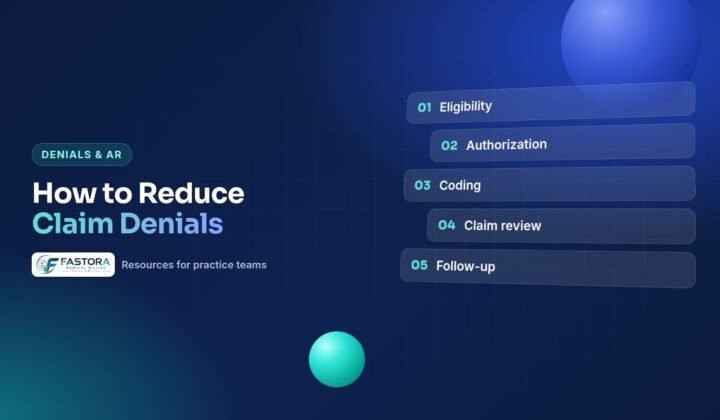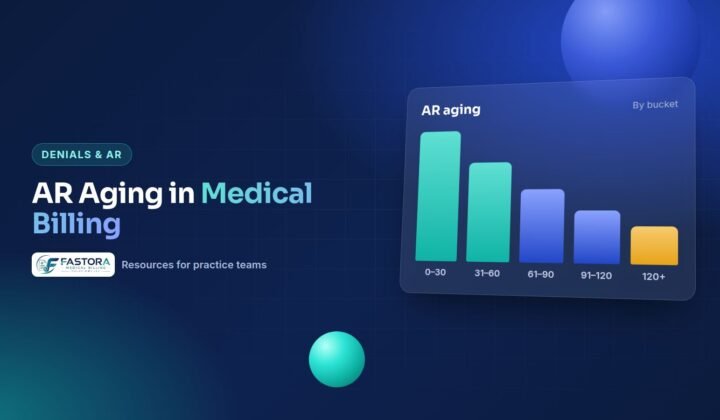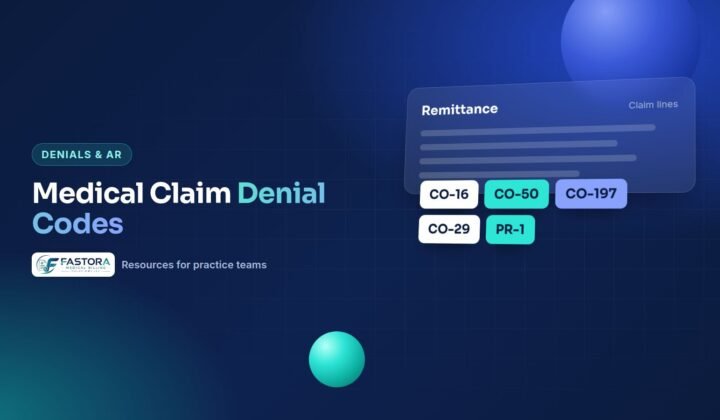
Most practices experience denials and old accounts receivable as two separate problems. Denials feel immediate — a remittance arrives, a claim needs correcting or appealing, someone works it. Old A/R feels distant — a balance on an aging report that gets attention when cash flow tightens. In reality, they are the same claim at different points in its life. A claim that leaves with a small, catchable error becomes a denial. A denial that sits unworked becomes an aging balance. An aging balance nobody owns becomes the oldest bucket.
That is why denial management and A/R recovery work better as one workflow than as two separate efforts. When prevention, denial work, and follow-up run on a shared weekly rhythm — with clear handoffs and a report the practice can actually read — each stage makes the next one smaller.
Why the two ends of the problem belong together
Separate the work and three gaps open up. The people reviewing claims before submission never hear which errors turned into denials, so the same mistakes go out again. The people working denials have no view of which denied claims are quietly aging. And the people chasing old balances inherit claims whose appeal windows have been running down for weeks.
A connected workflow closes those gaps by design. Every denial carries information back to the pre-submission check. Every unworked denial has a visible place in a queue, sorted before it becomes urgent. And every aging balance already has a history — what was submitted, what the payer said, what was appealed — so follow-up starts from evidence rather than a fresh investigation.
Stage 1: Prevention at pre-submission review
The cheapest denial is the one that never happens, and the last chance to prevent it is the review a claim receives before it leaves the practice. Fastora calls this step Advanced Pre-Submission Claim Review — its claim-scrubbing step within claims management — and a disciplined version checks more than formatting.
What gets checked before a claim goes out
A useful pre-submission review confirms that the basics behind the claim still hold: the patient’s coverage and eligibility as recorded, any required authorization and whether it matches the service, date, and units billed, and the link between diagnosis and procedure. It checks modifiers, required fields, and payer-specific requirements, and it holds a claim missing documentation the payer will predictably ask for, rather than letting the payer discover the gap weeks later.
A claim that fails the check should not simply be fixed silently and sent. It should be returned, with the reason recorded, to the point where the error started — scheduling, authorization, documentation, or coding — so the person who can prevent the next one sees it. That feedback step turns scrubbing from a filter into a prevention habit.
What the practice sees at this stage
Expect a brief, regular summary: how many claims were held, the main hold reasons, and which holds were resolved by the practice and which by the billing team. You are looking for repetition — the same hold reason appearing week after week is a process asking to be changed, and a good billing partner will name it rather than keep quietly correcting it.
Stage 2: A disciplined denial workqueue
Prevention reduces denials; it does not eliminate them. Payer rules change, coverage ends mid-treatment, and some denials are simply payer errors. What separates a manageable volume from a revenue problem is rarely the number of denials — it is whether every denial enters a queue with a triage decision, an owner, and a deadline. That discipline is the core of a denial management service.
Triage by reason and by value
Not all denials need the same response, and treating them alike wastes timely attention. Sort incoming denials first by what they need. Some need a corrected claim, because the error was in the submission. Some need information — a record, an authorization number, a referring provider detail. Some need a formal appeal, because the payer’s decision itself is being disputed. Sending an appeal where a correction was needed can waste the window the correct route needed.
Within each group, order by deadline pressure, then by value. Timely filing limits and appeal windows are set by each payer, plan, and contract and differ widely, so the queue should show which items have a clock running down soonest. A modest claim whose window closes this week outranks a larger claim with months remaining.
Appeals with documentation, not volume
A strong appeal is specific. It names the determination being disputed, attaches the remittance and the records supporting the service as billed — the clinical note, the authorization, the relevant contract or policy language — and stops there. A short packet answering the denial reason directly is easier to approve than a large, unfocused one. Log every appeal as it goes out — date, payer, reason, attachments — so its outcome can be tracked.
The broader practical habits that reduce claim denials sit upstream of this stage. The workqueue’s job is different: to make sure denials are each answered once, correctly, and in time.
What the practice sees at this stage
A weekly denial view should show the queue by reason and by payer, items with deadlines falling due soon, appeals submitted and awaiting a decision, and appeals decided. If a denial needs something from your practice, such as a signed record or a clinician’s note, that request should appear here with a date, not surface weeks later when the window has narrowed.
Stage 3: Aging-bucket A/R recovery
Whatever survives the first two stages collects in outstanding accounts receivable, and it should be worked by aging bucket rather than as one undifferentiated total. Younger balances usually need a status check and a prompt answer to whatever the payer is waiting on. Older balances need a collectibility judgment first: is there still a route open — a correction, an appeal, an escalation under the contract — and how much time remains on it?
Two habits keep this stage honest. Separate payer balances from patient balances; they follow different rules and timelines, and mixing them makes both harder to work. And give every balance a next action and a date. A balance without one is not being recovered — it is being stored, and storage is how a manageable bucket becomes an old A/R recovery project later.
What the practice sees at this stage
The aging report you receive should show movement, not just totals: balances by bucket and by payer, what moved into an older bucket this week and why, what was collected, what advanced a step, and what is proposed for documented closure because no remedy remains. Some old balances are genuinely finished, and a billing partner should bring you the evidence for that decision rather than leaving dead balances on the report.
The weekly cadence that connects the stages
Stages alone do not make a workflow — the handoffs do, and handoffs need a fixed rhythm. Run as a weekly operating cadence, the workflow looks like this:
- The prevention log is reviewed. The week’s pre-submission holds are read alongside the week’s new denials. When a denial matches a hold reason that was waived or missed, the check itself is adjusted that same week.
- The denial queue is re-sorted. New denials are triaged, deadline pressure is recalculated, and anything waiting on the practice is flagged while there is still time to act.
- The aging buckets are re-read in light of the queue. An appealed claim becomes a tracked item with an expected decision; a claim whose remedy has closed is prepared for a documented decision instead of drifting into the next bucket.
- One short report goes to the practice. Holds, denial movement, and aging movement on a single summary, with the items that need a practice decision clearly marked.
The point is that no claim falls between stages unnoticed for long, because each stage’s output is the next stage’s input, reviewed on the same cycle. A workflow that only runs when someone has spare time will always lose to the urgent claim of the day — and the claims it loses are the quiet ones aging in the background.
How Fastora runs this work
Fastora Medical Billing Solutions runs denial management and A/R recovery as connected services rather than separate engagements, so the pre-submission review, the denial workqueue, and aging follow-up share one team view of a claim’s history. The practice keeps visibility through the stage reporting described above, and the work is carried out under HIPAA-aligned workflows by an experienced billing team.
If your denials are rising while your oldest balances grow, treat that as one symptom, not two. A free medical billing audit can show where claims are leaving the workflow — at submission, in the denial queue, or in the aging buckets — so you can see which stage needs attention first.
Frequently asked questions
What is denial management and A/R recovery as a single workflow?
It is running three stages as one system: reviewing claims before submission to prevent avoidable denials, working denials that still occur through a triaged queue with deadlines, and following up aging balances by bucket — each stage feeding the next, with a shared weekly report covering all three.
How does pre-submission review reduce claim denials?
It catches errors while they are still cheap to fix: coverage or authorization mismatches, diagnosis and procedure linkage problems, modifier and required-field errors, and missing documentation. Recording why claims were held, and returning that reason to where the error started, prevents the same error being submitted again.
How should a denial workqueue be prioritized?
First by the response the denial needs — a corrected claim, missing information, or a formal appeal — then by deadline pressure from timely filing and appeal windows, then by value. A claim with a window closing soon should be worked before a larger claim with time remaining, because an expired window usually ends its options.
When does an unpaid claim become an A/R recovery problem?
Age alone is not the test; lost options are. A claim becomes a recovery problem when follow-up has stalled, no one owns its next action, or its correction and appeal windows have been running down unworked. Working balances by bucket, each with a named next step and date, prevents that.
What reporting should a practice expect from this workflow?
A short weekly summary covering all three stages: claims held at pre-submission review and why, denial queue movement including appeals submitted and decided and deadlines approaching, and aging balances by bucket and payer — what moved, what was collected, and what is proposed for documented closure.
Can old A/R still be recovered if denials were not worked promptly?
Sometimes. It depends on whether a remedy remains open under the payer’s filing and appeal rules and your contract, and whether the documentation still supports the claim. Assessing the oldest balances, starting with their deadlines, is the honest way to find out — recovery should never be promised before that check.
Conclusion
Denials and old A/R are not two problems competing for your billing team’s attention; they are one problem seen at two moments. Prevent what can be prevented at pre-submission review, work every denial that remains through a queue sorted by reason and deadline, follow aging balances by bucket with a next action on each, and bind the three together with a weekly cadence and a report your practice can read at a glance. Run that way, the workflow works both ends of the problem at once.