
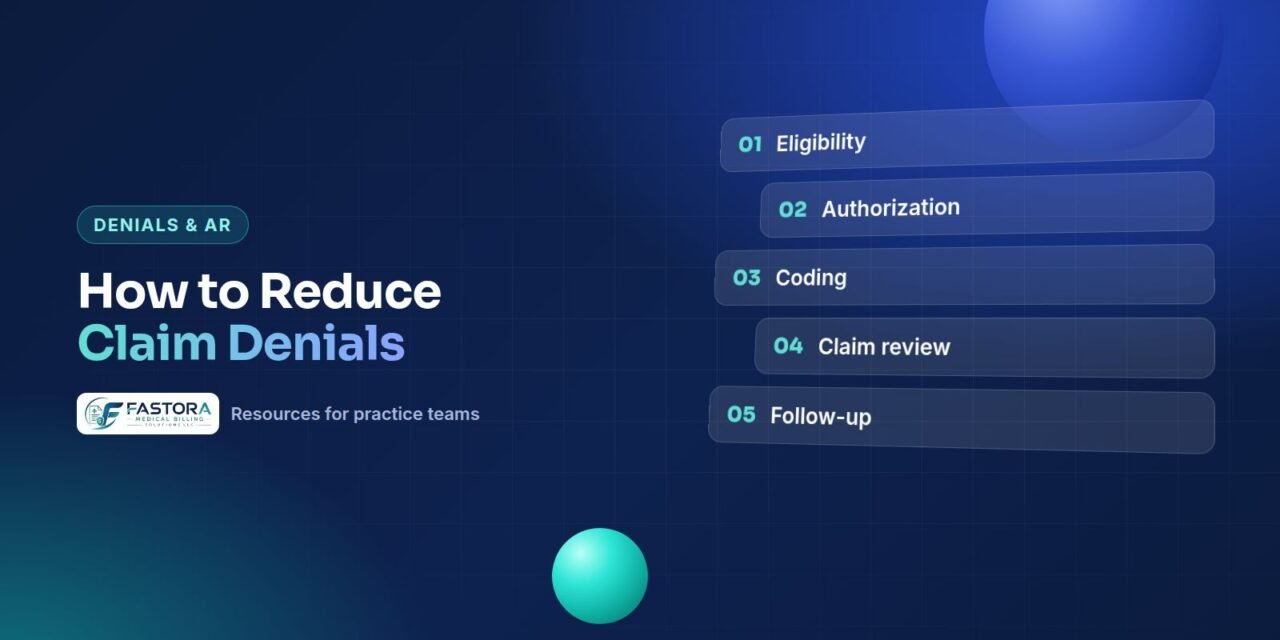
Why denials are a process problem
Learning how to reduce claim denials starts with one idea: most denials are created before the claim is ever submitted. A wrong member ID at check-in, a missing authorization or a note that does not support the code will produce the same denial every time until the step that caused it changes.
Denials cost more than the missing payment. Each one adds staff time to research, correct and resubmit, and some are never reworked at all. In a July 2026 MGMA Stat poll write-up, MGMA reported that its benchmarking data has shown first-submission denial rates holding at roughly 7% to 8% over the past four years, which means a steady share of claims needs rework in a typical group.
Common claim denial reasons by category
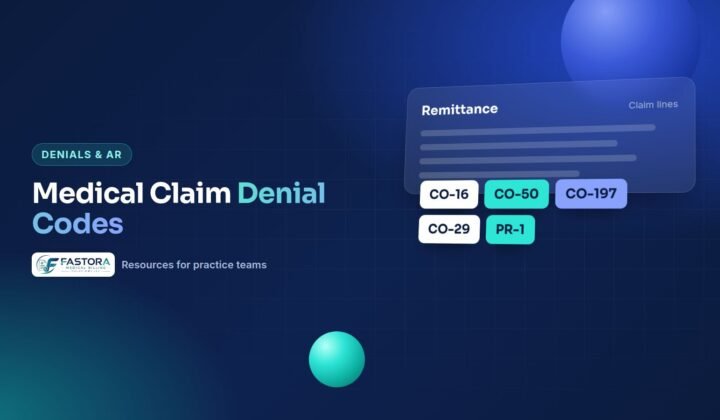
Grouping common medical billing denials by the stage that caused them makes prevention easier to assign. The reason codes shown are typical examples; payers can report the same problem with different codes, and our guide to reading CARC and RARC denial codes explains each one in more detail.
| Category | Typical causes | Codes often seen |
|---|---|---|
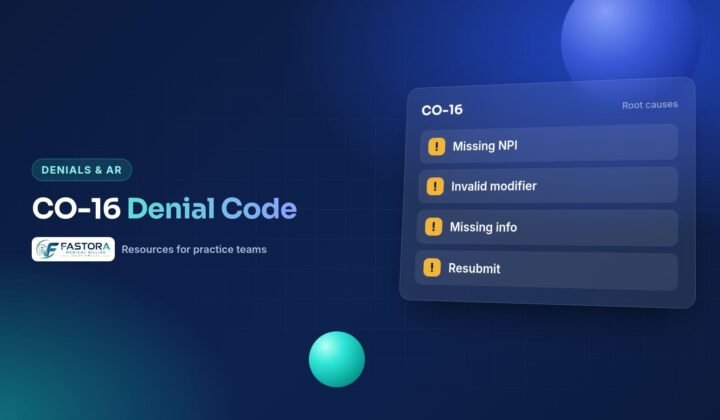
| Registration and eligibility | Wrong member ID or date of birth, terminated coverage, wrong payer on file | CO-16, CO-27, CO-109 |
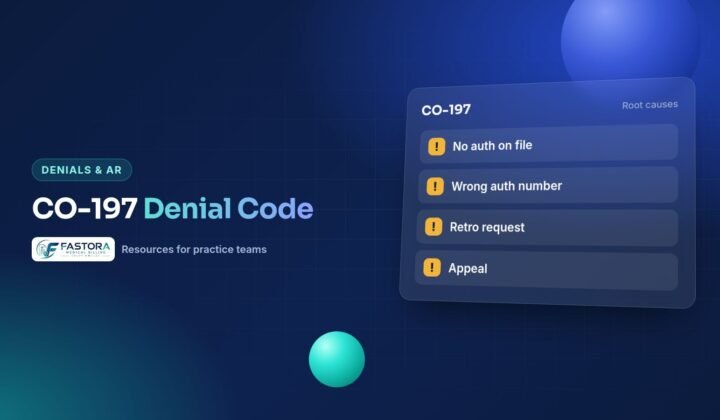
| Authorization | No authorization, expired authorization, visits or units beyond what was approved | CO-197 |
| Coding and medical necessity | Diagnosis does not support the procedure, missing or wrong modifier, bundled services | CO-11, CO-50, CO-4, CO-97 |
| Duplicate claims | Resubmitting instead of checking status, sending a corrected claim as a new claim | OA-18 |
| Timely filing | Claims held too long, rejections never worked, wrong payer billed first | CO-29 |
| Coordination of benefits | Primary and secondary reversed, other coverage not updated with the plan | CO-22 |
How to reduce claim denials at the front end
Registration and eligibility errors are the easiest denials to prevent because the fix happens before the visit. The goal is a clean, verified patient record on every date of service.
- Scan the insurance card front and back at every visit and compare the name, member ID and date of birth with the payer's eligibility response.
- Run an eligibility check before each visit, not just the first one. Coverage can end or change mid-year.
- Ask about other coverage at check-in and record the order of benefits. Many plans send an annual coordination of benefits questionnaire to members; encourage patients to complete it.
- Confirm whether the plan carves out a benefit, such as mental health or therapy, to a separate vendor, and bill that vendor.
- Collect copays upfront so patient responsibility is not left for the statement cycle.
Preventing authorization denials
Authorization denials are costly because many payers will not approve care after the fact. Treat authorizations as a tracked record, not a note in the chart.
- Check the payer's authorization list for each procedure or service type at scheduling.
- Record the authorization number, approved codes, number of visits or units, and start and end dates.
- Schedule follow-up visits against the remaining count, and request an extension before the last approved visit.
- Put the authorization number on the claim when the payer requires it.
- When a service is added on the day of the visit, check whether it needs its own authorization before it is performed where possible.
Some payers allow retroactive authorization in limited situations, such as emergencies or when eligibility was not known at the time of service. Policies vary, so check the provider manual before relying on it.
Preventing coding and medical necessity denials
Coding denials usually come from a mismatch between the documentation, the diagnosis and the procedure. Medical necessity denials come from payer coverage policies that list which diagnoses support a service.
- Code diagnoses to the highest specificity the note supports, and list the diagnosis that explains why the service was needed first on the line.
- Check Medicare coverage policies and commercial medical policies for services with frequent necessity denials.
- Review bundling edits before adding modifiers. A distinct-service modifier should reflect a separate, documented service, not a way around an edit.
- For time-based codes, make sure the note records the minutes or start and stop times the code requires.
- Run claims through a pre-submission review that checks code pairs, modifiers, units and diagnosis links before they reach the payer.
How to improve clean claim rate before submission
The clean claim rate is the share of claims that pass every edit without manual correction. Raising it is the cheapest way to cut denials, because each claim fixed before submission never enters the payer's queue. Our guide to medical billing KPIs gives the formula and how to track it.
- Pull a month of clearinghouse rejections and scrubber edits and group them by cause, such as missing subscriber data, invalid diagnosis code or missing referring provider.
- Fix the top three causes at the source: a registration field made mandatory, a charge template corrected or a provider reminded about a documentation element.
- Add payer-specific edits to your scrubber for rules that keep recurring, such as a payer that requires the authorization number in a particular field.
- Hold claims for missing information instead of sending them incomplete, and work the hold queue every day.
- Re-measure monthly. If a cause stays in the top three, the fix did not reach the step that created it.
Preventing duplicate, timely filing and COB denials
These three denial types share a cause: weak claim follow-up. When a claim does not appear on a remittance, staff often resubmit it instead of checking status, which leads to duplicate denials. When rejections sit unworked, claims age past the filing limit.
- Check claim status in the payer portal or through a status inquiry before resubmitting anything.
- Send changes to a paid or denied claim as a corrected or replacement claim using the payer's claim frequency code, not as a new claim.
- Work clearinghouse rejections daily. A rejected claim was never received, so the filing clock keeps running.
- Keep a list of timely filing limits by payer. Medicare's limit is one calendar year from the date of service; commercial and Medicaid limits vary and can be much shorter.
- Save clearinghouse acceptance reports. They are the usual proof of timely filing on appeal.
- When a secondary payer denies for coordination of benefits, attach the primary remittance and confirm the order of benefits with the patient.
Giving each stage an owner
Denial prevention stalls when everyone assumes someone else is watching. Naming one owner for each stage makes the feedback loop work, even in a small office where one person covers several roles.
| Stage | Typical owner | What they check |
|---|---|---|
| Scheduling and registration | Front desk | Demographics, insurance card, other coverage, copay |
| Eligibility and authorization | Front desk or authorization coordinator | Active coverage, benefits, carve-outs, approved visits and dates |
| Documentation | Providers | Notes that support the codes, time, and medical necessity |
| Coding and charge entry | Coder or biller | Code accuracy, modifiers, units, diagnosis links |
| Submission and follow-up | Biller | Rejections, claim status, filing limits, denials and appeals |
When a denial is traced back to a stage, the fix goes to that owner with a specific example. Short, regular feedback changes habits faster than an annual training session.
Tracking your denial rate
You cannot manage a denial rate you do not measure. A simple, consistent definition is more useful than a precise one that changes every month.
| Measure | How to calculate | What it shows |
|---|---|---|
| Initial denial rate | Claims denied on first submission ÷ claims submitted in the period | How clean claims are when they leave the practice |
| Denials by category | Denied claims grouped by stage (eligibility, authorization, coding and so on) | Which part of the workflow needs attention |
| Denials by payer | Denied claims grouped by payer | Payer-specific rules or policy changes |
| Overturn rate | Appealed denials paid ÷ denials appealed | Whether appeals are well targeted |
| Denial dollars written off | Denied dollars closed without payment | The real cost of denials that were never recovered |
Review these measures monthly with the people who own each stage. When one category rises, trace a sample of claims back to the step that caused them.
The denial management process for denials that get through
Prevention lowers volume, but some denials will always need work. A consistent denial management workflow keeps them from aging and feeds the lessons back into prevention.
- Post every denial from the remittance the day it arrives, with its group code, reason code and remark codes.
- Sort denials by deadline and dollar value so the most time-sensitive work comes first.
- Decide whether each one needs a corrected claim, an appeal, a patient bill or a write-off, and record the reason.
- Appeal with a clear letter and only the documents that support the argument.
- Log the root cause and send it back to the team that owns that step.
Medical necessity denial
A medical necessity denial means the payer does not consider the service supported for the diagnosis billed, often reported with CARC 50. First check whether the right diagnosis was coded and linked to the line; if so, a corrected claim may be enough. If the coding was right, appeal with the note, the payer's own coverage policy and any test results that show why the service was needed.
Prior authorization denial appeal
Start by confirming whether an authorization actually existed: many of these denials are an authorization number missing from the claim or attached to the wrong date range, which a corrected claim fixes. If no authorization was obtained, check the provider manual for retroactive authorization rules. A prior authorization denial appeal is strongest when it shows the payer's own criteria were met, includes the clinical notes, and is filed within the payer's appeal deadline. Some plans offer a peer-to-peer review with their medical director before or alongside a formal appeal.
Denials that repeat across payers usually point to an internal workflow issue. Denials concentrated in one payer often reflect a policy change worth confirming with the payer's provider relations team. Specialties with time-based or visit-limited services, such as physical therapy practices, benefit from tracking authorization and frequency denials separately.
How Fastora supports denial prevention
Fastora's certified billing and coding professionals combine front-end eligibility and authorization checks with Advanced Pre-Submission Claim Review and root-cause tracking, and report results through transparent dashboards and a monthly review call. See how our denial management services work, or request a free billing audit to find where your denials start.
Most preventable denials start with the errors listed in common medical billing mistakes, so fixing intake and charge entry usually moves the denial rate first.
How can I reduce medical claim denials?
To reduce medical claim denials, start before the visit: verify eligibility and benefits, confirm prior authorization, and check medical necessity. Then tighten the back end — clean coding, correct modifiers, timely filing, and a weekly denial review that fixes root causes instead of just reworking claims. Practices that track denial reasons by category typically cut their denial rate within two to three billing cycles.
Checklist
Frequently asked questions
What is the most common cause of claim denials?
Registration and eligibility errors are among the most frequent causes in many practices, followed by authorization and coding issues. Your own denial log, grouped by category, is the best guide for your practice.
What are the most common claim denial reasons?
In many practices the largest groups are registration and eligibility errors, missing or expired authorizations, coding and medical necessity issues, duplicate claims and missed timely filing limits. Group your own denials by these categories for a month to see which stage needs attention first.
Should every denial be appealed?
No. Front-end errors are usually fixed with a corrected claim. Appeals are best reserved for coverage, medical necessity, bundling or authorization disputes where documentation supports payment.
How often should a practice review its denial rate?
Monthly is a practical rhythm for most practices, with a closer look whenever a payer changes a policy or a new service line starts.
Can a prior authorization denial be appealed?
Often, yes. First check whether an authorization existed and was simply missing from the claim. If not, review the payer's retroactive authorization and appeal rules, gather the clinical notes that show the payer's criteria were met, and file within the deadline in the provider manual or contract.
Платформы для взрослых способны являться средством интимного образования, а также поддержкой в осознании личных желаний.
Подобные сервисы позволяют людям исследовать собственные желания в защищённой среде, снижая риски фактических осложнений.
ero-storitop.com
В отношениях взаимное изучение таких материалов способно укреплять взаимопонимание и служить причиной для честного диалога о желаниях и рамках.
Также эти платформы обеспечивают возможность для безрисковой реализации потребностей и снятия психологического напряжения, не причиняя вреда другим.