How to switch medical billing companies: plan before you give notice
Knowing how to switch medical billing companies is mostly about sequencing. Revenue is lost during a switch when claims sit unsubmitted, old AR goes unworked or the practice loses access to its own reports. A written plan, started before you give notice, prevents most of that.
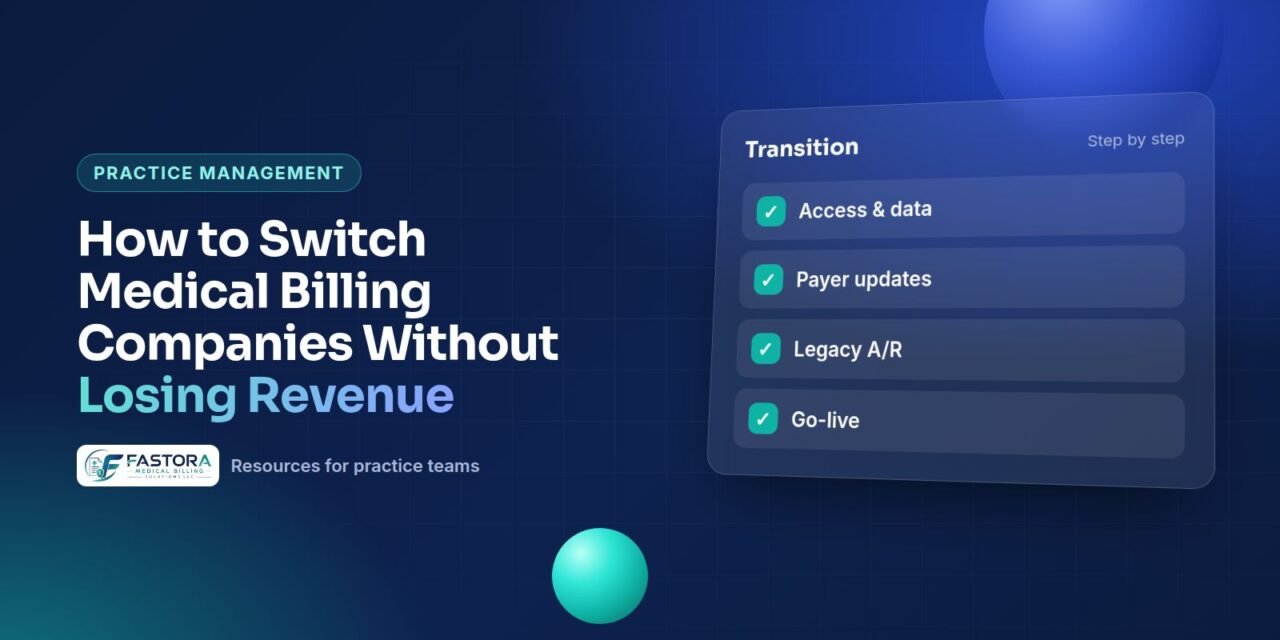
Switching medical billing companies usually involves three groups of work running in parallel: closing out the old relationship, setting up the new one, and protecting the claims already in flight. The sections below cover each, with a timeline you can adapt.
Step 1: read your current contract
Start with the agreement you signed. Look for:
- Notice period: how many days of written notice are required and how notice must be delivered.
- Post-termination work: whether the current company keeps working claims for dates of service before the end date, and for how long.
- Fees after termination: whether the vendor is paid a percentage on collections that arrive after you leave, and for which claims.
- Data return: what reports and files you receive at exit, in what format and by when.
- System ownership: whether the PM system and clearinghouse account are in the practice's name or the vendor's.
If the vendor owns the software or the clearinghouse account, your plan needs extra time to export data and re-enroll. If the practice owns the system, the switch is mostly a change of user access.
Step 2: secure your data and access
Your billing company is a HIPAA business associate, and the BAA usually requires it to return or destroy PHI when the contract ends. HHS has also stated that a business associate may not block or terminate a covered entity's access to PHI it maintains on the entity's behalf, for example during a payment dispute. Even so, request your data early rather than relying on that at the last minute.
Before notice takes effect, request and save:
- A full AR aging report by payer and by patient, with claim-level detail.
- Open denials and appeals with their status and deadlines.
- Unposted payments, unapplied cash and credit balances.
- Charge, payment and adjustment history for at least the last 12 months.
- Patient statements in progress and any payment plans.
- Payer enrollment details, portal logins the practice owns, and ERA/EFT enrollment records.
- Fee schedules and any contracted rates on file.
Change passwords and remove the outgoing vendor's user accounts on the date access is meant to end, and document that you did it.
Step 3: decide who works legacy AR
Legacy AR, meaning claims with dates of service before the switch, is where the most revenue is at risk. There are three common approaches.
| Approach | How it works | Watch for |
|---|---|---|
| Old vendor finishes it | Outgoing company works claims for older dates of service for a set run-out period | Their incentive to work hard claims after you leave; agree on reporting |
| New vendor takes it all | Incoming team works old and new AR from day one | Fees on old AR and whether they have full history |
| Split by age | Old vendor keeps recent claims; new vendor or internal staff take older balances | Clear cut-off rules so no claim is worked twice or not at all |
Whatever you choose, sort the legacy AR by timely filing risk first. Medicare generally requires claims within 12 months of the date of service under 42 CFR 424.44, and many commercial payers set shorter limits in their contracts. Claims close to their filing or appeal deadline should be worked before anything else. Our guide to AR aging explains how to read the buckets.
Step 4: set up the new company
How to transition to a new medical billing company depends on whether the systems change. Work through this list with the incoming team:
- Sign the BAA and service agreement, with a written scope listing every task.
- Grant user access to the EHR/PM system, or plan the data migration if systems are changing.
- Confirm the clearinghouse: keep the current one or enroll with a new one, including EDI and ERA enrollment with each payer.
- Confirm where EFT payments land; deposits should go to the practice's bank account.
- Load fee schedules and payer contract terms so underpayments can be spotted.
- Agree on the cut-over date for new charges and the reporting the practice will receive.
ERA and clearinghouse enrollments can take time to process with some payers. Start them early so remittances do not arrive on paper or stop during the switch.
A sample 90-day transition timeline
Every switch is different, but this sequence shows how the pieces fit.
| Timing | Practice | Outgoing vendor | Incoming vendor |
|---|---|---|---|
| Weeks 1-2 | Review contract, pull baseline reports, choose new vendor | Normal operations | Assessment, proposal, BAA |
| Weeks 3-4 | Give written notice; request data exports | Provides reports and files | Access setup, clearinghouse and ERA enrollment |
| Weeks 5-8 | Monitor both teams weekly | Works agreed run-out claims | Takes new charges from cut-over date; starts assigned AR |
| Weeks 9-12 | Remove old access; compare results to baseline | Final report and data return | Full operations; first monthly review |
Telling staff, providers and patients
A switch affects more people than the billing team. Front-desk staff need to know who to contact about eligibility questions, claim status and patient balance calls from the cut-over date. Providers need to know whether documentation or charge entry steps are changing.
Patients notice when statements arrive with a new layout, a new billing phone number or a new payment portal. A short notice at check-in and on the first new statement reduces confused calls and late payments. Make sure open payment plans carry over with the same terms.
Common mistakes when switching
- Giving notice before securing data exports.
- No written cut-off date, so some claims are billed twice and others not at all.
- Forgetting ERA and EFT enrollment, so remittances stop or go to the wrong place.
- Ignoring credit balances, which still need to be resolved and refunded where owed.
- Not telling patients when statements will come from a different name or phone number.
- Judging the new vendor in the first few weeks, before legacy AR and new claims have settled.
How to measure whether the switch worked
Pull the same baseline reports you collected in step 2 at three and six months. Compare days in AR, AR over 90 days, first-pass acceptance, denial rate and net collections. Look at trends, not single months, because collection timing shifts during a transition.
For a list of what to measure and how, see medical billing KPIs and the broader medical billing process guide.
Getting help with the transition
If you are planning a move, Fastora offers a free claims audit that reviews your current AR before you commit, and its certified billing professionals provide legacy AR cleanup and follow-up inside your existing EHR/PM system under the access you grant.
How do you fire your medical billing company without disrupting cash flow?
Deciding how to fire your medical billing company starts with the contract: check the termination notice period, any tail on collected accounts, and who owns the A/R data. Give written notice on the contract timeline, secure your clearinghouse and EHR credentials, and have the new company run parallel on new claims while the old one closes out aging. The cleanest handoffs move the open A/R inventory with documented claim statuses — that is where revenue is usually lost in a switch. Read our guide to choosing a medical billing company first.
Switching medical billing companies checklist
Use this switching medical billing companies checklist before you sign anything: confirm the termination date and data handoff in writing; export all open A/R with claim statuses; transfer clearinghouse, payer portal and EHR access; verify credentialing and ERA enrollment carry over; agree on who works the aging and for how long; and set the go-live date for new claims with the incoming company. A free billing review before the switch tells you whether the problem is the company or the process — sometimes it is fixable without moving. Start with our free medical billing audit. See what full medical billing services cover.
How do I switch medical billing companies?
To switch medical billing companies without disrupting cash flow, line up the new biller 30–60 days before the changeover: transfer payer enrollments and EDI connections, hand over open A/R with aging detail, and run parallel for two weeks so nothing falls through. Get your data export in writing before you give notice — patient demographics, charge history, and claim status belong to your practice.
What does a medical billing transition involve?
A medical billing transition covers data migration, payer re-enrollment, clearinghouse setup, staff retraining on new workflows, and a full accounting of legacy A/R. The riskiest part is the handoff of in-flight claims — every open claim needs an owner and a follow-up date, or timely filing deadlines will quietly expire during the move.
Checklist
Frequently asked questions
How long does it take to switch medical billing companies?
Many practices plan for roughly 60 to 90 days from decision to full operation, depending on the contract's notice period, whether systems change, and how long payers take to process clearinghouse and ERA enrollment. The run-out of legacy AR can continue longer. A written timeline with a clear cut-over date keeps both vendors aligned.
Will I lose money when switching medical billing companies?
A switch can slow cash flow briefly if claims stall or remittances are interrupted. Securing data first, setting a firm cut-over date, starting ERA enrollment early and prioritizing claims near their timely filing deadlines all reduce that risk. Track collections weekly during the first months.
Who owns the billing data when I leave a billing company?
The practice is the covered entity and the PHI is maintained on its behalf. Your BAA and service agreement should say how data is returned at termination. HHS has stated a business associate may not block a covered entity's access to PHI it maintains for the entity, for example over a fee dispute.
Should the old company finish working my AR?
It can, if the contract provides for a run-out period and reporting. Some practices prefer the new team to take all AR so one team owns results. Others split by claim age. The key is a written cut-off rule so every claim has exactly one owner.