
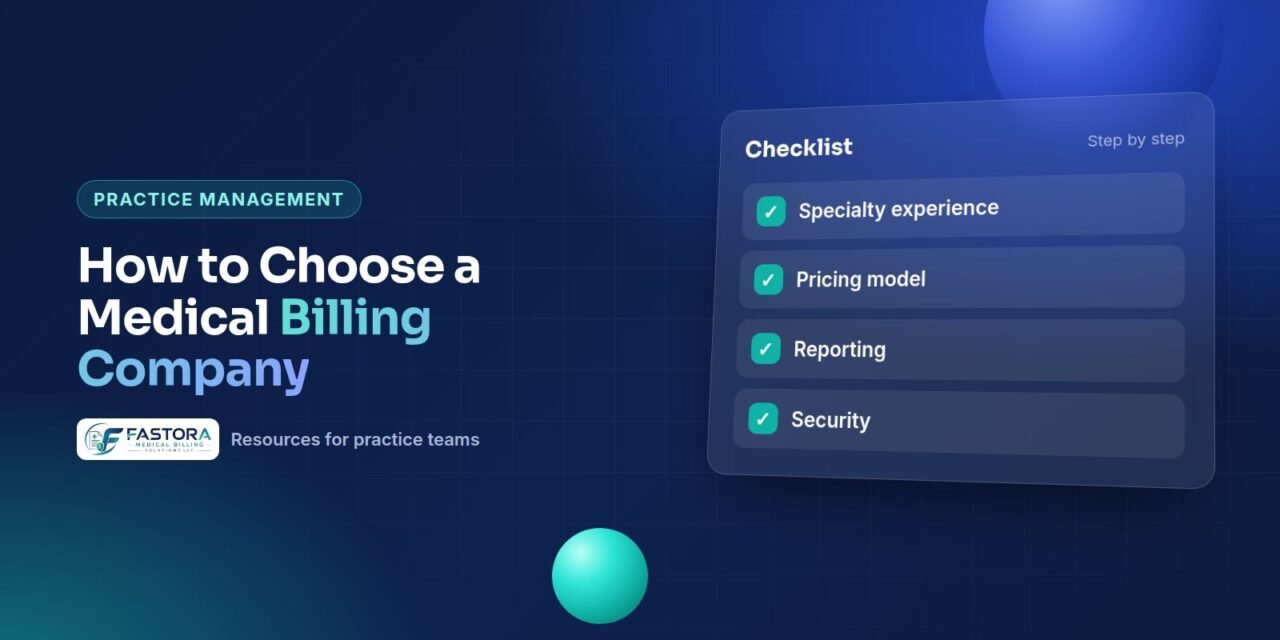
How to choose a medical billing company: start with your own numbers
Knowing how to choose a medical billing company starts before the first sales call. If you do not know where your revenue cycle stands today, you cannot judge a vendor's proposal, compare quotes fairly or tell later whether the change worked.
Pull the last 12 months from your practice management system: charges, payments, adjustments, denials by reason and payer, and an accounts receivable aging report. Note which EHR/PM system you use, your payer mix, your monthly claim volume and who currently does each billing task. This baseline becomes the yardstick for every vendor you talk to.
Then write down what you want to change. "Fewer denials for missing authorizations" or "someone to work our old AR" is far more useful than "better billing". Specific goals make it easier to ask pointed questions and to spot a vendor that is answering a different question.
When to outsource medical billing: signs it's time
The clearest signs to outsource medical billing are operational, and they show up in reports before they show up in the bank account. One sign on its own may be a training issue. Several together usually point to a capacity or expertise gap.
- The share of AR older than 90 days keeps growing from month to month.
- The same denial reasons repeat because nobody has time to fix the root cause.
- Charges are entered days or weeks after the visit.
- Claims are written off for missed timely filing deadlines.
- Billing depends on one person, and vacations or turnover stall collections.
- The owner or office manager is working claims after hours.
- You cannot get a clear monthly report of collections, denials and AR.
- You are adding providers, a location or a new service line and billing cannot keep up.
If several of these sound familiar, compare the cost of fixing them in-house with the cost of outsourcing your billing. The comparison should include staff time, software, training and the revenue currently being lost, not just salaries.
Specialty experience: what a specialty billing company should know
Payer rules differ sharply by specialty, so general billing experience is not enough. A specialty billing company should be able to explain, without looking it up, the issues that drive denials in your field.
For example, behavioral health practices deal with time-based psychotherapy codes, add-on codes paired with E/M services and plans that carve out mental health benefits to a separate payer. Therapy practices deal with timed units, plans of care and visit limits. Orthopedic and surgical practices deal with global surgical periods and laterality modifiers, while radiology and cardiology bill professional and technical components separately.
Ask each vendor to walk you through two or three denials typical of your specialty and how they would prevent them. Ask how many practices in your specialty their team supports today and whether the same people will work your account. Vague answers are informative.
What to look for in a medical billing company
Before you compare prices, decide what good looks like. Most of what matters falls into six areas, and each can be checked with evidence rather than a sales promise. Score every vendor on the same scale, for example 1 to 5, and write down the evidence behind each score.
| Area | What to check | Evidence to ask for |
|---|---|---|
| Specialty knowledge | Familiarity with your codes, modifiers and payer rules | Walk-through of typical denials in your specialty |
| Scope | Which tasks they own from eligibility to patient billing | A written task list showing who does what |
| People | Certified billers and coders, a named contact | Credentials and an introduction to the account lead |
| Process | Pre-submission review, denial and AR follow-up routines | A description of daily and weekly work queues |
| Reporting | KPIs, dashboards and review meetings | A sample monthly report |
| Security and contract | BAA, access controls, exit and data return | Draft BAA and contract for review |
This is the core of how to evaluate a medical billing company: the vendor that scores well across all six areas is usually a safer choice than the one with the lowest quote and gaps in two of them.
Pricing models to compare
Billing companies price their work in a few common ways. Each model shifts risk and incentives differently, so the headline rate matters less than what it covers.
- Percentage of collections: the fee is a share of what the vendor collects. Ask exactly which payments count, including patient payments and money collected on claims billed before the vendor started.
- Per-claim fee: a fixed charge per claim submitted. Clarify whether resubmissions, corrected claims and appeals are charged again.
- Flat monthly fee: predictable, but check what volume it assumes and what happens when volume changes.
- Hybrid: a base fee plus a percentage, or different rates for different services.
- One-time fees: onboarding, old AR cleanup or credentialing projects may be priced separately.
Our guide to what billing services cost explains each model in more detail and shows how to compare quotes against your in-house cost.
Questions to ask a medical billing company
Use the same questions to ask a medical billing company with every vendor so the answers are comparable. Ask for answers in writing where the answer will end up in the contract.
- Which parts of the revenue cycle will you handle, and which stay with our staff?
- Will you work inside our existing EHR/PM system, or do we need new software?
- Who will be our day-to-day contact, and how quickly do you respond to questions?
- Are your billers and coders certified, and who reviews coding on our claims?
- How do you check claims before submission, and how do you use rejection data?
- How do you work denials: who appeals, within what timeframe, and how are root causes fixed?
- How do you prioritize AR follow-up across payers and aging buckets?
- How will the transition work for claims, denials and credit balances that are open on the start date?
- Will you work AR that existed before you started, and how is that priced?
- Which reports will we receive, how often, and can we see our data at any time?
- How do you calculate your fee, and what counts toward it?
- Will you sign a business associate agreement, and how do you protect patient data?
- Do you handle credentialing, eligibility checks and prior authorizations, or only claims?
- What does onboarding look like, and what do you need from our team?
- What are the contract term, notice period and exit process, and how do we get our data back?
A business associate agreement is required when a vendor handles protected health information for you under HIPAA. HHS publishes sample provisions that are a useful reference when you review the vendor's version.
Medical billing company contract terms to review
The contract decides what happens when things go wrong, so read it as carefully as the proposal. Have your attorney review it, and compare every vendor's medical billing company contract terms against the same list.
- Scope of services: each task listed, including which claims the vendor works (new only, or prior AR as well).
- Fee definition: exactly which payments or claims count, minimums, and charges for appeals, statements or reports.
- Term and termination: initial term, renewal, notice period and whether you can exit for cause if service levels are missed.
- Runout: who works claims still open when the contract ends, and how that work is paid for.
- Data and access: your right to your data at any time, in what format, and with no fee to get it back.
- Business associate agreement: required under HIPAA when the vendor handles protected health information, including breach notification duties.
- Reporting and service levels: the reports you receive, how often, and the response times for questions.
If you are already with a vendor and planning to leave, the guide on how to switch billing companies covers notice timing, runout and handover in more detail.
Medical billing company red flags
Some warning signs are obvious in hindsight. Watch for these during the sales process, when a vendor is on its best behavior.
- Promises of specific results. No honest vendor can promise a collection increase or a denial rate before reviewing your data, payer mix and documentation.
- No access to your own data. You should be able to see claims, payments and reports in your own system or a shared dashboard at any time.
- Long lock-in with no exit terms. Multi-year terms without a clear notice period, data return process or runout plan leave you stuck if service slips.
- Vague fee definitions. If the vendor cannot say in one sentence what counts toward its fee, expect surprises on the invoice.
- No interest in your current process. A vendor that quotes without asking about your baseline is selling a package, not a fix.
- Reluctance to sign a business associate agreement or to explain how staff access your data.
Industry guidance on revenue cycle outsourcing, including HFMA's, stresses clear service levels, agreed KPIs and regular reporting. A vendor that resists measurable commitments on process, reporting and communication is telling you how the relationship will go.
Medical billing outsourcing checklist
The medical billing company checklist below pulls the steps in this guide into one list you can print and use in vendor meetings. Score each vendor against the same items and keep the notes with the contract.
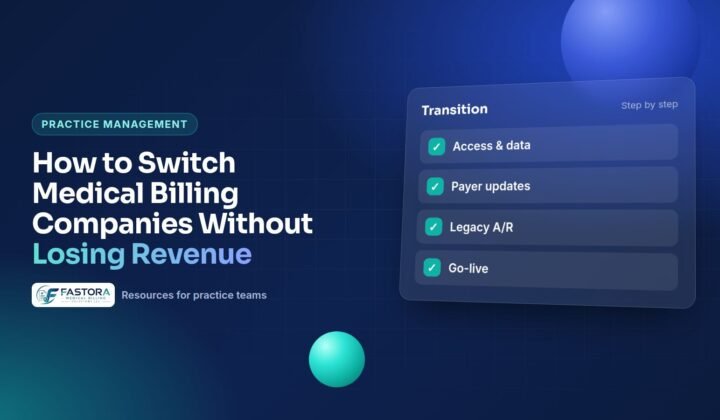
Pay special attention to the transition. Agree who works claims billed before the start date, how open denials and credit balances are handed over, and when the vendor takes over each task. A clean handover prevents a gap in follow-up during the first few months.
Finally, agree how you will judge the first 90 days. Pick a handful of measures from your baseline, such as clean claim rate, denial rate, days in AR and the share of AR over 90 days, and review them together each month. Early numbers can move in either direction while old claims are cleaned up, so look at the trend and the reasons behind it rather than a single month.
Keep your own copy of every report. If you ever need to change vendors again, a consistent history of your numbers makes the next comparison much easier.
How Fastora approaches a first conversation
Fastora starts with a free claims audit before a practice commits to anything, so the discussion is based on your own claims rather than a generic pitch. There are no hidden setup fees and no software to install, because the team works inside your existing EHR/PM system.
Each practice has a dedicated account contact, transparent dashboards, monthly performance reporting and a monthly review call. You can see how our revenue cycle management services are organized, or request a free billing assessment to get a baseline for your own vendor comparison.
Before signing, compare the way a vendor works with your own billing tools in medical billing software vs a billing service, and read the frequently asked questions practices ask us most often.
Related reading
Ask any billing partner how their tools are supervised. Our article on AI in medical billing sets out the questions that separate useful automation from unsupported claims, so you can compare answers on evidence.
Billing company comparison checklist
Use this vendor-comparison checklist to score each billing company the same way. Ask for specifics, not promises:
- Specialty experience: which practices like yours they bill today, and whether they can describe your top denial reasons
- Scope in writing: exactly which tasks they own — eligibility, coding, claims, denials, A/R, patient balances — and which stay with you
- Staffing: who handles your account day to day, and whether the coders are certified
- Denial and A/R process: how often denials are worked, and what the monthly report shows
- Pricing definition: the model, what the fee base includes, minimums and contract terms
- Transition plan: how claims move over without a cash-flow gap, and how your data comes back if you leave
Medical billing company red flags
Watch for these red flags before you sign: a guaranteed collection rate with no definition behind it, a refusal to put the exact scope in writing, no named person handling your account, fees outside the quote that appear after onboarding, and reporting you cannot check against your own EHR. A billing company that will not show you its denial and A/R process in plain terms during the sales conversation will not show you afterward either.
Medical billing company alternatives and reviews
A full-service billing company is not the only option. Realistic medical billing company alternatives include billing software with your own in-house staff, a part-time biller plus a dedicated denial service, or revenue cycle consulting for a defined cleanup project instead of ongoing billing. Medical billing company reviews help at this stage — read them for patterns across many reviewers (responsiveness, reporting, transition quality) rather than any single five-star or one-star story. Compare the models in our in-house vs outsourced billing comparison and read how to switch billing companies if you are leaving a current vendor.
What to look for in a medical billing company?
Look for specialty experience you can verify, scope in writing, certified coders, a defined denial and A/R routine with monthly reporting, and a transition plan that protects cash flow. The questions to ask a medical billing company — covered in the guide above — give you the interview script; the comparison checklist gives you the scoring sheet; this section tells you how to read the answers. One practical test: ask for a look at your own claims before the quote. A company that quotes without seeing your denial data is guessing. Our free medical billing audit is that look — no obligation and see how our pricing is built.
Checklist
Frequently asked questions
How long does it take to switch billing companies?
It depends on your volume, the condition of your AR and how quickly system access and payer enrollment details can be set up. Ask each vendor for a written onboarding plan with dates, and agree who works claims billed before the handover.
Should a small practice use a specialty billing company?
Specialty experience matters more than practice size. A small practice in a specialty with complex rules, such as behavioral health or therapy, benefits from a team that already knows those payer rules.
Can we keep some billing tasks in-house?
Yes. Many practices keep front-desk tasks such as scheduling and copay collection in-house and outsource claims, denials and AR follow-up. Make sure the contract clearly states who owns each task.
What should we ask for in writing?
The scope of services, how the fee is calculated, the reports you will receive, the business associate agreement, the contract term and notice period, and how your data is returned if the relationship ends.


3 comments