Why a checklist matters
A payer contract quietly governs almost every dollar your practice collects: what you get paid for each service, how long you have to file a claim, what happens when the payer recoups money, and how either side can walk away. Most practices sign or renew under a deadline and discover the costly clauses later — during an underpayment dispute, a credentialing hold, or an unexpected termination notice.
This medical billing contract checklist covers the sections worth reviewing line by line before you sign or renew. Use it to spot what to verify and which clauses deserve pushback or a legal review.
1. Parties, plans, and products
- Who is covered. Confirm the legal names of your practice entities, all locations, and any newly acquired sites or providers. A location or tax ID that is not named may not be paid correctly.
- Which plans and products. Spell out exactly which of the payer’s plans, networks, and products are covered — commercial, Medicare Advantage, Medicaid, exchange. Do not assume every product is included.
- Which providers. Check how new physicians, extenders, and locums get added, and how quickly the payer’s credentialing moves.
2. Definitions
Contracts define their own vocabulary, and definitions control how the payment clauses behave.
- Clean claim. The contract’s definition of a clean claim determines when your payment clock starts. If the definition is unrealistically narrow compared with your actual claim data, expect delays.
- Covered services and medical necessity. Check how covered services are defined and who decides medical necessity. Vague definitions give the payer wide latitude at review.
- Effective date. Confirm the date coverage and rates begin. Gaps between signing and the effective date can strand claims filed in between.
3. Payment provisions
This is the heart of the agreement. Read every payment clause before anything else.
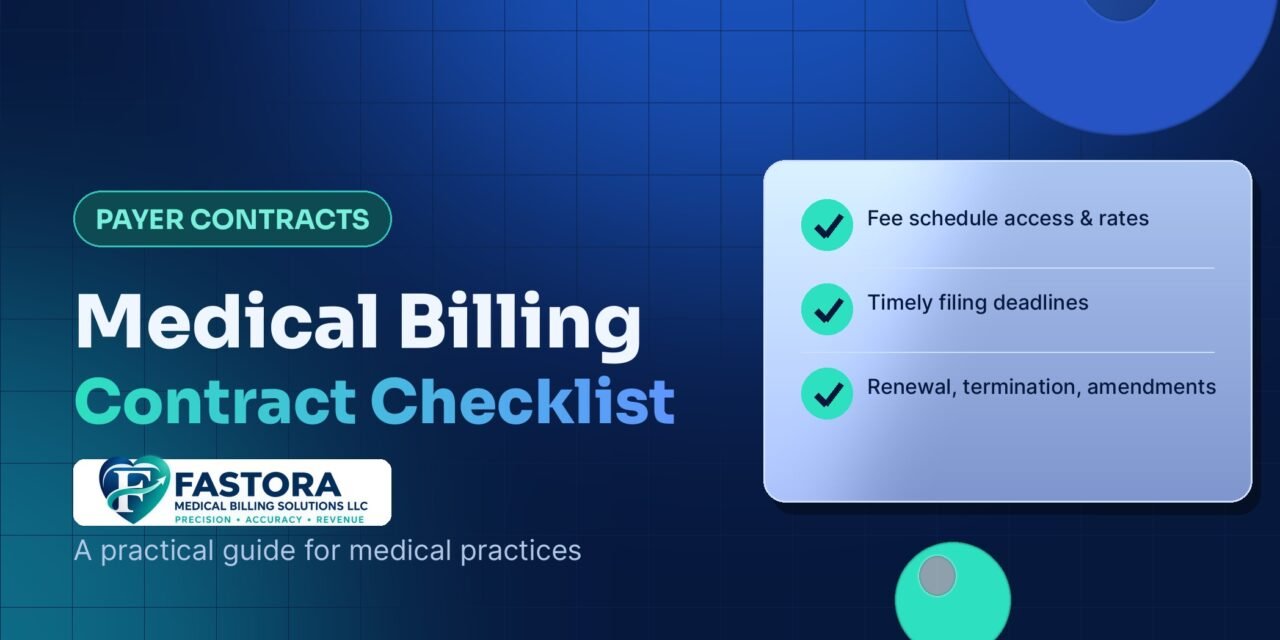
- Fee schedule access. The contract should state how you obtain the current fee schedule, how often it updates, and whether the payer must notify you of changes. If you cannot see your rates in writing, you cannot verify you are being paid correctly.
- Timely filing. Note the exact filing deadline and what starts the clock (date of service, date of discharge). Deadlines differ by payer and product; missing them usually means the claim cannot be paid at all. Confirm the deadline in your own contract rather than relying on a general memory of the payer’s rules.
- Late payment. Check whether the contract imposes interest or penalties on the payer for late payment, and what remedies you have when clean claims go unpaid.
- Overpayments and recoupment. Note how the payer identifies overpayments, how far back it can look, how it recoups (often by offsetting future payments), and what appeal rights you have before funds are taken. Offset mechanics can quietly move money before you can dispute the underlying claim.
- Enrollee payments and appeals. Review what you may collect from the patient and confirm the levels of appeal available and their deadlines.
- Coordination of benefits. Check the rules for when another payer is primary so claims do not stall between carriers.
4. Credentialing requirements
- Process and timeline. The contract or its manual should describe the credentialing and revalidation process, what documents are required, and how long each stage takes. If that process is a weak spot for your practice, our credentialing and enrollment service page describes how practices keep these filings current.
- Retroactivity. If credentialing takes months, check whether payments can be backdated to the application date. Unpaid services delivered while credentialing is pending are a common source of lost revenue.
- Ongoing obligations. Note revalidation intervals and notification duties when a provider leaves or changes status — lapses can trigger payment holds.
5. Audits, policies, and utilization review
- Audit rights. Note the scope, notice requirements, and any limits on how far back an audit can reach.
- Policies and guidelines. You will be bound to the payer’s manuals and policies, which can change. Check how the payer must notify you of policy changes — this is often where unilateral-change language hides.
- Utilization and quality review. Understand the payer’s review rights, including pre-payment review programs and the standards applied to your claims.
6. Term, renewal, termination, and assignment
- Initial term and renewal. Contracts often run a fixed initial term and then renew automatically (evergreen). Note the renewal date and, more importantly, the notice window for opting out of renewal — it is frequently short.
- Termination. Distinguish termination for cause from termination without cause, the notice period for each, and any early-termination fees. Also check what happens to pending claims, appeals, and credentialing status after termination.
- Assignment and change of control. If your practice merges, is acquired, or adds partners, the contract may require consent or allow the payer to terminate. Flag this well before any transaction.
7. Amendment provisions
The amendment clause controls how the contract itself evolves. Watch for unilateral amendment language: provisions that let the payer change rates, policies, or terms by notice alone. Even when you cannot remove such language, knowing it is there changes how you monitor fee schedules and policy bulletins. If the contract gives you a right to object to material adverse changes within a set window, calendar that window and assign someone to watch for change notices.
8. Indemnification, dispute resolution, and data
- Indemnification. Check who indemnifies whom, and for what. One-sided indemnification can make your practice responsible for losses it cannot control.
- Dispute resolution. Note whether disputes go to arbitration, mediation, or court; who bears the cost; and where proceedings take place.
- Data and delegation. Confirm your practice retains ownership of its billing and clinical data and how data is returned at termination. Any party touching protected health information should be covered by appropriate privacy agreements.
Red flags: when to push back or call counsel
- Evergreen auto-renewal with a short opt-out window. One missed calendar reminder locks you in for another year.
- Unilateral amendment rights. Ask for advance-notice minimums and a right to object to material adverse changes.
- Short termination notice or steep early-termination fees. Both reduce your leverage and your exit options.
- Vague fee-schedule access. “Available upon request” without a defined update and notification process makes underpayments harder to detect.
- Aggressive recoupment terms. Short appeal windows and automatic offsets mean money moves before disputes are resolved.
- Credentialing gaps without retroactivity. If the contract does not backdate payments to the application date, every week of credentialing delay is revenue risk.
Illustrative example: how a missed notice can cost you (illustrative, not a real case)
Suppose a contract allows the payer to amend the fee schedule with written notice, and the notice provision permits delivery to the address on file — an office your practice vacated two years ago. Months pass before anyone notices payments drifting downward on common codes, and by the time the billing team connects the dots, the window to object has closed. The loss is not dramatic in any single month; it is the quiet compounding across every claim since the change took effect. Notice addresses, amendment mechanics, and objection windows decide whether a rate change is something you agreed to or something that happened to you.
How to work through the checklist
- Gather the documents. Pull the agreement, the current fee schedule, the provider manual, and any amendments — the contract often incorporates the manual by reference.
- Mark every item above. For each section, note the page, the finding, and any clause you do not fully understand.
- Verify the fee schedule independently. Compare a sample of high-volume codes against your actual paid claims — a structured underpayment review can quantify any gap before renewal talks.
- Bring the marked-up list to counsel. A healthcare attorney who regularly reviews provider agreements will spot risks faster and can suggest language the payer is more likely to accept.
FAQ
How often should a practice review its payer contracts?
Before every renewal cycle, and whenever the payer issues a material amendment or policy change. An annual pass over your highest-volume payers — checking paid claims against contracted rates — also catches quiet drift early. Revisit this medical billing contract checklist each time you do.
What is the most commonly overlooked item in a payer contract?
The amendment and notice provisions. Practices focus on rates and filing deadlines, but the clauses that let the payer change rates by notice — and the address that notice goes to — quietly move money over time.
Can a small practice actually negotiate payer contract terms?
Sometimes. Large payers rarely rewrite their standard agreements, but practices can often secure changes on specific points: notice periods, retroactive credentialing, amendment objection windows, and termination terms. Our payer contract negotiation guide covers how to frame the request.
What should we do if we find we have been underpaid?
Document the gap first: compare contracted rates against actual payments for your highest-volume codes and quantify the difference. Then follow the contract’s dispute or appeals process, and raise the findings in your next negotiation cycle.
Does this checklist replace an attorney’s review?
No. It helps you read the contract with sharper eyes and ask better questions, but provider agreements have jurisdiction-specific implications. Have healthcare counsel review anything you sign or renew.
Conclusion
A payer contract is not paperwork — it is the financial architecture of your relationship with each insurer. Review these agreements deliberately, section by section, and you enter every renewal with data instead of assumptions. Work through this medical billing contract checklist before your next signature or renewal, flag the red flags for your counsel, and keep every deadline on a shared calendar with a named owner.
If the review turns up questions about underpayments, denied claims, or whether your current setup is capturing what your contracts allow, start with a free billing assessment. We will look at how your claims are actually performing and where the gaps are.