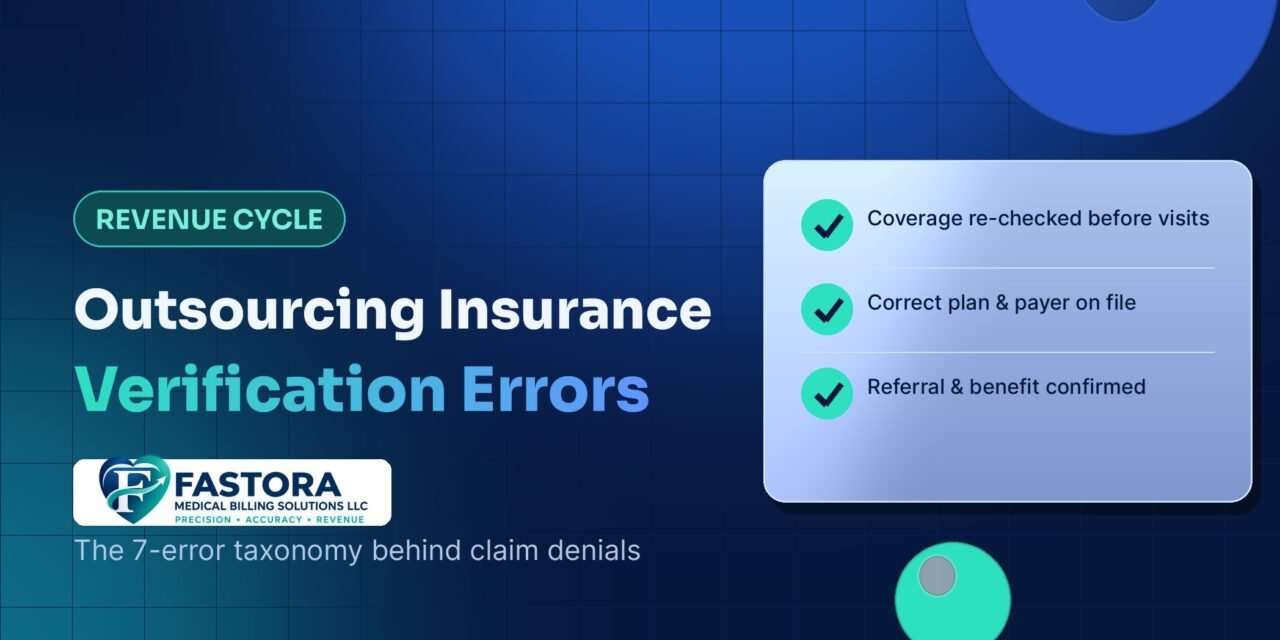
When a claim denies for an eligibility reason, the instinct is to blame the payer. But read the denial from the other end — the verification step before the visit — and a pattern usually emerges. The coverage was never re-checked. The wrong plan was on file. The carve-out was missed. The referral was assumed. These are not seven different problems; they are seven ways of getting the same step wrong, and each one leaves a different fingerprint in your denial data.
This guide maps the seven most common insurance verification errors to the denial codes they produce, shows how to tell which error your own process is making, and explains when the fix is a better checklist — and when it is a dedicated verification process, including the decision to outsource insurance verification.
Why verification errors deserve their own taxonomy
Most denial advice treats verification as one checkbox: “verify eligibility before the visit.” Practices that check the box still see verification-related denials, because the check itself can fail in specific ways. A taxonomy turns a vague problem (“we verified, but it still denied”) into a diagnosable one — each error below has a distinct signature in your remits and a distinct checkpoint that catches it.
The seven verification errors that cause denials
1. Coverage confirmed at scheduling, lapsed by the appointment
Coverage is checked when the appointment is scheduled, the chart is marked “verified,” and nobody looks again before the visit. Between the two dates, the policy lapses, the patient changes employers, or the plan year rolls over.
Denial-data signature: CO-109 denials (“service not covered”) that cluster on appointments booked more than a week before the visit.
Checkpoint: Re-verify within a short window of the visit itself — not just at scheduling — and flag policies with a known end date. Our eligibility verification checklist shows exactly when to run each check.
2. The wrong plan or payer is on file
The patient is covered, but the system points at the wrong payer: an HMO member filed as PPO, a Medicare Advantage plan filed under traditional Medicare, or a secondary payer listed as primary. The claim bounces.
Denial-data signature: CO-22 denials (care may be covered by another payer per coordination of benefits) and OA-23 — watch for them on established patients whose claims suddenly deny after a plan change.
Checkpoint: When demographics are updated, re-select the plan and payer instead of carrying the old ones forward, and confirm the primary/secondary order explicitly.
3. Carve-out benefits are missed
Some benefits are carved out of the main plan and paid by a different payer: behavioral health to a managed BH organization, lab or radiology to a reference-lab benefit, DME to a separate administrator. The main plan verifies as active — but the carved-out service is not covered under it.
Denial-data signature: Denials that hit one service family only while everything else pays cleanly — all therapy claims deny, or all lab claims deny, for a payer whose medical claims pay fine. That one-family pattern is the giveaway.
Checkpoint: For every new patient, ask which benefits are carved out and to whom. Verifying “the patient has coverage” is not the same as verifying “this payer covers this service.” The service-page section on insurance verification that fits your front desk describes how a dedicated process handles exactly this.
4. The deductible and out-of-pocket are misread
The number is pulled correctly but interpreted wrong: a remaining deductible of $2,400 read as met, coinsurance applied to the wrong base, or the out-of-pocket maximum confused with the deductible. The claim pays, but the patient responsibility comes back wrong — bills go to patients who expected a copay, or expected payments never get collected.
Denial-data signature: PR-1, PR-2, and PR-3 codes where the amounts do not match what the front desk quoted. When patient-responsibility write-offs climb on otherwise clean claims, the benefits were misread, not missed.
Checkpoint: Quote the patient responsibility in writing before the visit, and compare the quote against the remit’s PR codes after payment. The gap between quote and remit is your measurement of this error. The claim-denial-code reference documents the full PR-code definitions.
5. The referral is assumed but never confirmed
HMO plans require a referral from the primary care physician before a specialist visit is covered. Practices verify eligibility and coverage but never confirm the referral is in the payer’s system — it was requested, or the patient says their PCP sent one, but no one verifies receipt.
Denial-data signature: Authorization-family denials on plainly covered services that mention a missing or invalid referral.
Checkpoint: Confirm the referral number in the payer’s portal before the visit, the same way you would confirm a prior authorization. For HMO-heavy schedules, make referral confirmation its own line item in the workflow.
6. Authorization is obtained, but the benefit is never verified
The expensive one: the practice does the hard authorization work, the payer approves, the service is rendered — and the claim denies because the service itself is excluded from the plan. An authorization is not coverage; payers authorize medical necessity, but plan exclusions still apply.
Denial-data signature: CO-96 and N290-class denials (“non-covered charges”) on services that were authorized.
Checkpoint: Verify the benefit (is this service covered under this plan?) before requesting the authorization — not after. If you outsource the verification step, require benefit confirmation in the returned packet before any authorization work begins.
7. Dependent versus subscriber mix-ups and stale demographics
The policy is active, but the claim is filed under the wrong person: a dependent’s date of birth on the subscriber’s policy record, a spouse listed as subscriber, a name change that never reached the payer, or a policy number from an old card.
Denial-data signature: CO-16 denials (“claim/service lacks information”) clustered on new-patient claims or right after a demographics update.
Checkpoint: Match the card, the photo ID, and the payer portal in the same sitting — not the card alone. Two-source matching catches what a single-source check misses.
Recurring visits need a re-verification cadence
A note for therapy, behavioral health, and other recurring-visit practices: verifying once at intake is not a verification process. A patient who comes in weekly for months will cross plan-year boundaries, deductible thresholds, and sometimes policy changes with no event triggering a re-check. Set a re-verification cadence — monthly for weekly recurring patients is a common pattern — covering active coverage, correct plan, carve-outs, remaining deductible, and referral status.
In-house or outsourced: treating it as a diagnostic decision
Not every practice should outsource insurance verification. Use the taxonomy as a diagnostic:
- One or two errors in specific patterns: fixable in-house with a tightened checklist, a dedicated verification slot in the daily workflow, and a monthly audit of your denial codes. The eligibility verification checklist is the “do it right” companion to this article.
- Three or more errors, or errors that persist after you fix the workflow: the work does not fit the front desk’s workload — it needs someone whose job it is. Verification by a dedicated team gets checked the same way for every patient, which is exactly what eliminates errors 1, 2, and 7.
- Any single error costing more than the alternative: add up the rebills, appeals, write-offs, collection effort, and staff time against what a dedicated verification process costs. Practices that run this arithmetic usually find the decision makes itself.
For a wider look at where these errors sit in the full denial picture, see how to reduce claim denials.
Frequently asked questions
What is the difference between verifying eligibility and verifying benefits?
Eligibility confirms the patient is covered by the plan at all. Benefits verification goes further: it confirms the specific service is covered, how much deductible remains, what the patient’s share will be, and whether a referral or authorization is required. Most errors in this taxonomy are benefits errors, not eligibility errors.
How do I know if my practice should outsource insurance verification?
Use the diagnostic above. If your denial data shows three or more of the seven errors, or the same errors return after you tighten the checklist, the work likely does not fit your front desk’s bandwidth. A dedicated verification process — in-house or outsourced — exists to be consistent where a busy front desk cannot be.
Does outsourcing verification mean my front desk does nothing?
No. A good verification process hands your front desk cleaner information to act on: confirmed coverage, correct patient-responsibility quotes, referral numbers on file. The front desk collects better payments and spends less time re-working denials.
How often should coverage be re-verified for recurring patients?
At minimum, monthly for weekly recurring patients, plus any time there is a plan-year change, a reported insurance change, or a benefit-year deductible reset. One-time intake verification does not protect a patient who visits for months.
Why not just fix the checklist instead of outsourcing?
If the errors are one or two and contained, fix the checklist — that is the right call. Outsource only when the errors are systemic or recurring, meaning the front desk lacks the time or consistency the step demands.
Conclusion
Verification-related denials are not a payer problem; they are a process problem — and processes can be diagnosed. Map your eligibility-family denials against the seven errors above — the pattern will usually point at one or two failure modes. Fix the checkpoint, re-measure the denial codes, and the avoidable denials drop.
If you would like a second set of eyes on your own denial patterns, request a free medical billing audit — we will map your eligibility-family denials to their verification-step causes and show you which ones a dedicated verification process would catch.