
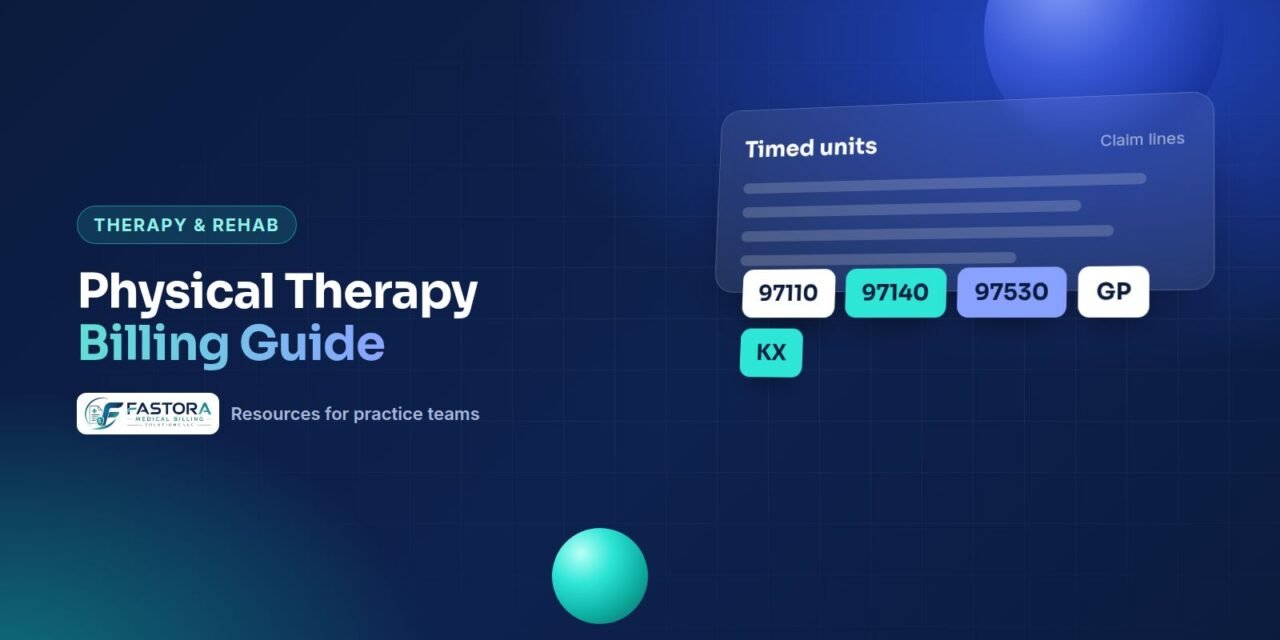
Physical therapy CPT codes start with time
Most physical therapy CPT codes are billed in 15-minute units, so small errors in counting time repeat across every visit and every patient. This physical therapy billing guide covers the rules that cause the most confusion in outpatient PT: how minutes become billable units, which modifiers Medicare expects, what the plan of care must show and how workers' compensation claims differ.
The examples below follow Medicare's published physical therapy billing guidelines. Many commercial payers follow Medicare, but some use their own unit rules, so check each payer's policy and your contracts. CPT codes are updated every year, so confirm the physical therapy CPT codes for 2026 against the current AMA code set and your payers' fee schedules.
Physical therapy billing codes: timed and untimed
PT codes fall into two groups. Service-based (untimed) codes are billed once per session no matter how long they take. Timed codes are billed in units based on the minutes of direct, one-on-one care.
| Type | Examples | How it is billed |
|---|---|---|
| Untimed | PT evaluations 97161, 97162 and 97163; re-evaluation 97164; unattended electrical stimulation (Medicare uses HCPCS G0283) | One unit per session. Minutes do not count toward timed units. |
| Timed | Therapeutic exercise 97110, neuromuscular re-education 97112, gait training 97116, manual therapy 97140, therapeutic activities 97530 | Units based on total timed minutes, in 15-minute increments. |
Only direct, face-to-face time spent performing a timed service counts. Rest breaks, time waiting for equipment, and documentation after the patient leaves are not billable minutes.
The timed codes PT practices bill most
Four timed codes make up a large share of outpatient PT claims. The summaries below are plain-language descriptions; the note must show which one was performed, for how long and why it needed a therapist's skill.
97110 CPT code: therapeutic exercise
The 97110 CPT code covers therapeutic exercise to develop strength and endurance, range of motion and flexibility, billed per 15 minutes. Documentation should show progression, such as changes in load, repetitions or difficulty, and the skilled cueing provided. Exercise a patient could do alone at home is hard to defend as skilled care.
97112 CPT code: neuromuscular re-education
The 97112 CPT code describes neuromuscular re-education of movement, balance, coordination, kinesthetic sense, posture and proprioception. Use it when the goal is retraining control, for example balance work after a stroke or proprioceptive training after an ankle sprain, and record the specific deficit and the response.
97140 CPT code: manual therapy
The 97140 CPT code covers manual therapy techniques such as mobilization, manipulation, manual lymphatic drainage and manual traction, per 15 minutes, for one or more regions. Name the technique and the body region. Some payers apply bundling edits when 97140 is billed with other services on the same day, so check the edit tables before adding a modifier.
97530 CPT code: therapeutic activities
The 97530 CPT code describes dynamic activities to improve functional performance with direct one-on-one contact, such as lifting, transfers or reaching tasks. Tie each activity to a functional goal in the plan of care, and do not report the same minutes under 97110.
The 8-minute rule and Medicare's unit method
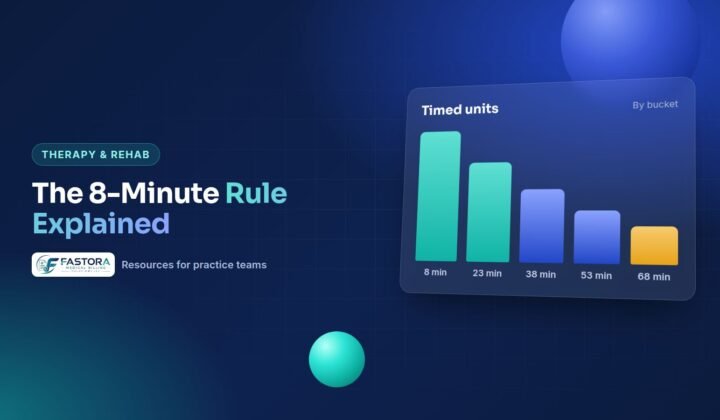
Medicare's Claims Processing Manual counts units by adding up all timed minutes in the session, then converting the total to units. A unit is billable once at least 8 minutes of timed service are provided, which is where the 8-minute rule gets its name.
| Total timed minutes | Units billable |
|---|---|
| Fewer than 8 | 0 |
| 8 to 22 | 1 |
| 23 to 37 | 2 |
| 38 to 52 | 3 |
| 53 to 67 | 4 |
| 68 to 82 | 5 |
| 83 to 97 | 6 |
Once the number of units is known, assign them to codes. Each code first gets a unit for every full 15 minutes. Any units left over go to the services with the most remaining minutes.
Worked examples
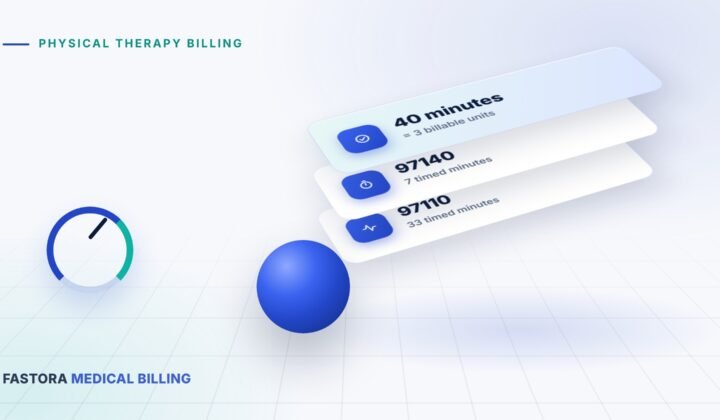
- 33 minutes of 97110 and 7 minutes of 97140. Total 40 minutes = 3 units. 97110 has two full 15-minute units with 3 minutes left over. The third unit goes to 97140, which has 7 minutes. Bill 2 units of 97110 and 1 unit of 97140.
- 24 minutes of 97112 and 23 minutes of 97110. Total 47 minutes = 3 units. Each code has one full unit, with 9 minutes left on 97112 and 8 left on 97110. The third unit goes to 97112. Bill 2 units of 97112 and 1 unit of 97110.
- 5 minutes of 97112 and 4 minutes of 97110. Total 9 minutes = 1 unit. Bill 1 unit of 97112, the service with more minutes.
- 7 minutes of 97110 only. Total timed minutes are under 8, so no timed unit is billed under Medicare's method.
Some commercial payers apply the rule to each code separately, requiring at least 8 minutes of a given code before that code can be billed. Under that approach, example 3 would produce no billable timed units. Confirm which method each payer uses.
For more examples, including mixed timed and untimed sessions, see our 8-minute rule explainer.
PT evaluation codes 97161, 97162 and 97163
PT evaluations are reported by complexity, not by time. The therapist selects the level based on the documented components of the evaluation.
| Code | Level | What drives the level |
|---|---|---|
| 97161 | Low complexity | Few or no personal factors or comorbidities, a limited examination and a stable clinical presentation |
| 97162 | Moderate complexity | Some personal factors or comorbidities, a broader examination and an evolving presentation |
| 97163 | High complexity | Multiple personal factors or comorbidities, a comprehensive examination and an unstable presentation |
| 97164 | Re-evaluation | A formal reassessment when there is a new clinical finding, a significant change or a failure to respond to treatment |
The note should support each element of the level chosen, including the history, the body systems examined, the clinical presentation and the decision making, such as standardized outcome measures. Routine progress notes are not re-evaluations.
Therapy modifiers: GP, GO, GN, KX and CQ
| Modifier | Meaning | When it applies |
|---|---|---|
| GP | Services delivered under an outpatient physical therapy plan of care | On every PT service billed to Medicare, and required by many other payers |
| GO | Services delivered under an outpatient occupational therapy plan of care | OT services |
| GN | Services delivered under an outpatient speech-language pathology plan of care | Speech-language pathology services |
| KX | Attests that services above the annual threshold are medically necessary and documented | Medicare claims once the patient's therapy spending passes the threshold for the year |
| CQ | Outpatient PT services furnished in whole or in part by a physical therapist assistant | Medicare claims where PTA minutes exceed the 10% de minimis standard |
The KX modifier and the therapy threshold
The Bipartisan Budget Act of 2018 replaced Medicare's hard therapy caps with annual thresholds that can be exceeded when services are medically necessary. Physical therapy and speech-language pathology share one combined threshold, and occupational therapy has its own. CMS publishes the amounts each year in a transmittal on per-beneficiary threshold amounts and in the Physician Fee Schedule final rule, so check the current figure rather than relying on last year's number. Our KX modifier guide explains how to track it.
Adding the KX modifier for physical therapy is an attestation, not a formality. The record must show why continued therapy is needed. Claims above a higher amount may also be selected for targeted medical review.
PTA services and the CQ modifier
Since January 1, 2022, Medicare pays for PT services furnished in whole or in part by a physical therapist assistant at 85% of the otherwise applicable amount. A service carries CQ when the PTA's separately furnished minutes exceed 10% of the total minutes for that service. CMS's own example: a PTA provides 10 minutes of 97110 and the PT provides 5 minutes, so the single unit is billed with CQ. Track PT and PTA minutes separately in the note so the modifier can be applied correctly.
Physical therapy plan of care certification
Medicare requires outpatient therapy to be furnished under a plan of care that is certified by a physician or qualified nonphysician practitioner. The plan sets the diagnosis, long-term goals, and the type, amount, frequency and duration of treatment.
- Initial certification should be obtained as soon as possible, generally within 30 days of the initial treatment.
- Recertification is required when the plan changes significantly and at least every 90 days.
- Since January 1, 2025, a signed and dated order or referral can meet the initial certification requirement if it is in the record and there is evidence the plan of care was sent to the referring practitioner within 30 days of the initial evaluation.
- Keep proof of when the plan was sent and track certification end dates so treatment does not run past them.
Workers' comp billing for physical therapy
Workers' comp billing for physical therapy follows state rules rather than the patient's health plan. The claim goes to the employer's workers' compensation insurance carrier, tied to the claim number and date of injury, and the state sets fee schedules, preauthorization rules and filing deadlines.
Texas workers' compensation billing rules for PT
Texas workers' compensation billing is governed by the Texas Labor Code and Texas Department of Insurance, Division of Workers' Compensation (DWC) rules. Three rules matter most for PT practices:
- Filing deadline. Texas Labor Code section 408.027 requires a provider to submit the bill to the insurance carrier no later than the 95th day after the date of service. Missing it generally forfeits the right to payment for that bill.
- Preauthorization. Under 28 TAC section 134.600, physical and occupational therapy services require preauthorization, except for the first six visits after the evaluation when treatment is given within two weeks of the date of injury or of a surgery the carrier preauthorized.
- Fee guideline. DWC's professional fee guideline uses Medicare coding and billing policies, so timed-unit rules, modifiers and correct coding edits generally carry over. The reimbursement amounts themselves come from DWC's own guideline, not the patient's health plan.
Carriers and certified networks may add their own requirements, so confirm the carrier, any network and the adjuster's contact details at intake, and keep the preauthorization number with the visit count.
Documentation that holds up
- Record total timed minutes and total treatment time for each visit, plus minutes by code.
- Describe the skilled service provided, not just the exercise performed.
- Link treatment to plan of care goals and measurable progress.
- Note which minutes were furnished by a PTA.
- Document the reason care continues when the patient approaches or passes the annual threshold.
Common mistakes and how to avoid them
| Denial cause | Prevention |
|---|---|
| Units billed exceed documented time | Calculate units from the note's minutes before charge entry. |
| Missing GP modifier | Build the modifier into the charge setup for PT services. |
| KX missing above the threshold | Track each Medicare patient's year-to-date therapy amount, including care at other practices where known. |
| Missing or expired plan of care certification | Track certification dates and send plans promptly. |
| Bundling edits between codes | Check edit pairs and use a distinct-service modifier only when separate, documented services support it. |
| Visit limits or missing authorization | Verify commercial visit limits and authorization rules at intake and track visits used. |
| Workers' comp bill sent late or without preauthorization | Check the carrier's preauthorization rules at intake and bill within the state deadline. |
Most of these denials come from the charge entry step. A short pre-submission check of units, modifiers and certification dates prevents them from reaching the payer.
Billing help for PT practices
Fastora's certified coders check timed units, therapy modifiers and plan of care dates before claims are submitted, and work any denials that come back. Read about our PT billing support and coding review services, or request a free billing assessment of your recent therapy claims.
Occupational therapists in the same clinic bill from a related code set; see occupational therapy CPT codes for 97165-97168 and 97530.
Checklist
Frequently asked questions
Do untimed codes count toward the minutes for timed units?
No. Evaluation codes and other service-based codes are billed once per session, and their time is not added to the timed minutes used to calculate units.
Is there still a Medicare therapy cap?
No hard cap. Since the Bipartisan Budget Act of 2018, Medicare uses annual thresholds that can be exceeded by adding KX to the claim when care is medically necessary and documented.
When does a PTA-furnished service need CQ?
On Medicare claims when a physical therapist assistant furnishes more than 10% of the minutes of a service separately from the PT. Those services are paid at 85% of the otherwise applicable amount.
Can 97110 and 97530 be billed on the same day?
Yes, when each is a distinct service with its own documented minutes and purpose. The same minutes cannot be counted under both codes, and some payers apply edits that require documentation of separate services.
How long do I have to bill a Texas workers' comp claim?
Texas Labor Code section 408.027 sets a 95-day deadline from the date of service for submitting the bill to the insurance carrier. Late bills generally forfeit payment, so bill workers' comp visits promptly.

1 comment