
What the rule says
The Medicare 8-minute rule is the method CMS uses to turn minutes of timed therapy into billable 15-minute units. It is set out in the Medicare Claims Processing Manual, Chapter 5, section 20.2, and applies to outpatient physical therapy, occupational therapy and speech-language pathology billed under the Medicare Physician Fee Schedule.
In plain terms, a single 15-minute unit can be billed once a timed service reaches 8 minutes. When several timed services are provided on the same day, Medicare adds the minutes together first and then decides how many total units the visit supports. The units are then shared among the codes.
Two points cause most errors. First, only timed codes count toward the total; untimed codes such as evaluations are billed as one unit no matter how long they take. Second, Medicare does not let you bill a lone timed service that lasted less than 8 minutes.
Timed codes vs. untimed codes
Timed codes are described per 15 minutes of direct, one-on-one patient contact. Untimed (service-based) codes are reported once per session. Keep the two groups separate before you count anything.
| Type | Examples | How units are reported |
|---|---|---|
| Timed | 97110 therapeutic exercise; 97112 neuromuscular reeducation; 97116 gait training; 97140 manual therapy techniques; 97530 therapeutic activities; 97535 self-care/home management training | By total timed minutes, using the units table |
| Untimed | 97161–97163 PT evaluations; 97165–97167 OT evaluations; 97150 group therapy; G0283 unattended electrical stimulation (Medicare) | One unit per session, regardless of time |
Minutes spent on untimed services never go into the timed total. If an evaluation and therapeutic exercise happen in the same visit, document the time for each separately so the timed minutes can be counted correctly.
Units table for timed codes
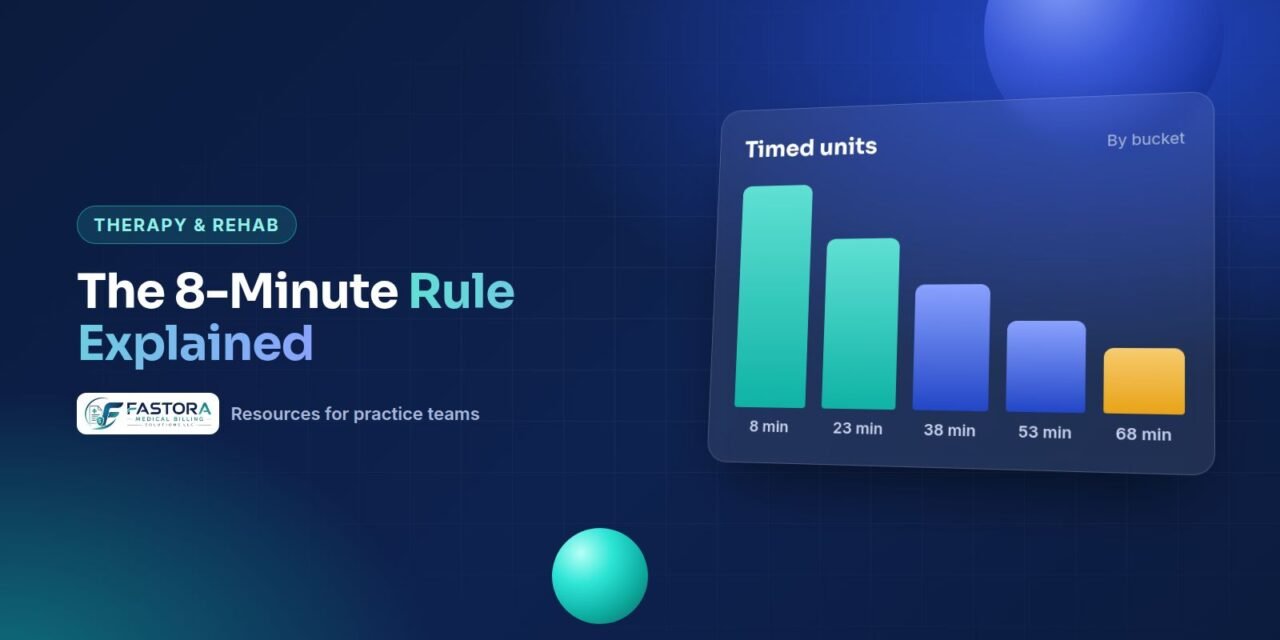
CMS publishes this conversion in Chapter 5. Use the total timed minutes for the day, not the minutes of each code, to read the table.
| Total timed minutes | Billable units |
|---|---|
| Fewer than 8 | 0 |
| 8 to 22 | 1 |
| 23 to 37 | 2 |
| 38 to 52 | 3 |
| 53 to 67 | 4 |
| 68 to 82 | 5 |
| 83 to 97 | 6 |
| 98 to 112 | 7 |
| 113 to 127 | 8 |
The pattern continues in 15-minute steps: each further unit begins at the 8th minute of the next 15-minute block.
How to calculate units: an 8-minute rule calculator in steps
You do not need software for this. The same five steps work for any combination of timed codes, and they give the same answer every time when minutes are documented accurately.
- List every timed service delivered that day with its direct one-on-one minutes. Leave untimed codes aside.
- Add the timed minutes to get the total timed minutes.
- Read the total in the units table to find how many units the visit supports.
- Give each service one unit for each full 15 minutes it received.
- If units remain, assign them to the services with the most leftover minutes, largest first, until the total from step 3 is reached.
Then add one unit for each untimed service. A quick cross-check: the number of units on the claim for timed codes must never exceed what the units table allows for the total.
8-minute rule physical therapy examples
The examples below apply the steps above. Minutes are direct treatment minutes as documented in the daily note.
| Services and minutes | Total timed minutes | Total units | How units are assigned |
|---|---|---|---|
| 97110 for 7 min (only service) | 7 | 0 | Not billable; a lone timed service under 8 minutes |
| 97110 for 24 min | 24 | 2 | 97110 x 2 |
| 97112 for 33 min + 97110 for 7 min | 40 | 3 | 97112 x 2 (two full units, 3 leftover minutes); third unit to 97110 (7 leftover minutes) |
| 97110 for 18 min + 97140 for 22 min | 40 | 3 | One unit each for the full 15 minutes; third unit to 97140 (7 leftover vs 3) |
| 97112 for 7 min + 97140 for 6 min | 13 | 1 | 97112 x 1, the service with more minutes |
| 97530 for 30 min + 97140 for 15 min + 97110 for 8 min | 53 | 4 | 97530 x 2, 97140 x 1, 97110 x 1 |
| 97162 evaluation for 40 min + 97110 for 20 min | 20 | 1 timed + 1 untimed | 97162 x 1; 97110 x 1 |
Note the third row. A service of under 8 minutes can still receive a unit when the total timed minutes support it and it has the most leftover minutes to claim it. The rule is about the total, not each code on its own.
Documentation that supports the units
Medicare reviewers compare billed units to the daily note. CMS expects the note to show the total timed code treatment minutes and the total treatment time, and minutes per code make audits far easier to defend.
- Record minutes for each timed code, not just the visit length.
- Exclude rest periods, waiting time and time spent on unbilled services.
- Separate evaluation or re-evaluation time from timed treatment time.
- Describe the skilled intervention, not only the exercise list.
- Make sure the treating clinician signs and dates the note.
When a physical therapist assistant or occupational therapy assistant furnishes part of a timed service, the CQ or CO modifier rules also apply. CMS publishes separate billing examples for that situation.
Do commercial payers follow the same rule?
Not always. Many commercial and Medicare Advantage plans follow the CMS method, but some apply a per-code approach in which each timed code must reach at least 8 minutes on its own before it earns a unit. Under that method, the 97112 and 97140 visit above (7 and 6 minutes) would not be billable at all.
Medicaid programs set their own rules too. Check each payer's reimbursement policy and your contract, and build the payer's method into your charge entry so units are counted consistently.
Common unit errors and how to catch them
- Counting each code separately under Medicare. This undercounts visits where several short services add up.
- Including untimed minutes. Evaluation time inflates the timed total and can overbill units.
- Rounding visit length. A 60-minute appointment is not 60 minutes of timed treatment.
- Wrong unit assignment. Giving the extra unit to the lower-minute service can create a mismatch with the note.
- Same-day pairs that need a modifier. Some timed codes pair with NCCI edits; see modifier 59 vs X modifiers.
A short weekly sample of notes against claims catches most of these patterns before they become an audit finding. Our physical therapy billing guide covers the wider PT code set, and the KX modifier guide explains the annual Medicare threshold that applies once therapy spending for a patient reaches it.
Getting help with therapy billing
Fastora's certified coders review timed-code units, modifiers and documentation for physical therapy practices as part of medical coding and claims work. A free billing assessment is a simple way to see whether unit counting is costing your clinic time on rework.
Speech-language pathologists use mostly untimed codes, listed in speech therapy CPT codes.
How does the 8 minute rule work in physical therapy?
The 8 minute rule physical therapy practices follow comes from CMS: a timed CPT unit is billable only when at least 8 minutes of that service were provided. For a typical 60-minute PT session this usually works out to 3–4 units depending on how time was split across codes. Document start and stop times for each timed code so the units match the note.
What is the 8 minute rule?
The 8 minute rule is the CMS method for counting timed therapy units: each 15-minute unit requires a minimum of 8 minutes of direct service. It applies to outpatient therapy billed to Medicare and many payers that follow CMS guidance.
Does the Medicare 8 minute rule apply to all payers?
The Medicare 8 minute rule is mandatory for Medicare claims, but commercial payers vary — some follow CMS, others use the AMA substantial-portion rule (more than half the unit). Check each payer contract, because billing the wrong unit count is a common reason therapy claims get downcoded or denied.
Try our 8-minute rule calculator to check your unit counts before you bill.
Checklist
Frequently asked questions
Can I bill a timed code for 7 minutes?
Under Medicare, not when it is the only timed service that day. A service of 7 minutes can receive a unit when it is combined with other timed services and the total timed minutes support another unit, and it has the most leftover minutes.
Does the rule apply to evaluations?
No. Evaluation and re-evaluation codes are untimed and billed as one unit per session. Their minutes are not added to the timed total. Document evaluation time separately from timed treatment time.
How many units is 38 minutes of therapy?
Under the Medicare units table, 38 to 52 total timed minutes supports 3 units. The units are then shared among the timed codes based on full 15-minute blocks and leftover minutes.
Does it apply to occupational and speech therapy too?
Yes. The Medicare method applies to timed codes billed by physical therapists, occupational therapists and speech-language pathologists under the physician fee schedule. Many speech-language pathology codes are untimed, so it comes up less often for SLP.



3 comments