Physical Therapy Billing
The 8-minute rule decides how many units a physical therapy clinic can bill for timed services. Bill one unit too many and the claim is overpaid and exposed in an audit. Bill one unit too few and the clinic gives away revenue on every visit. Because most outpatient therapy visits include several timed codes, the rule affects nearly every claim a PT, OT or speech therapy practice sends.
This guide explains how the 8-minute rule works, how to calculate units when a visit includes more than one timed code, how it differs from the CPT “substantial portion” method many commercial payers use, and what therapists need to document.
Key takeaways
- The 8-minute rule applies only to timed codes; evaluations and supervised modalities are untimed.
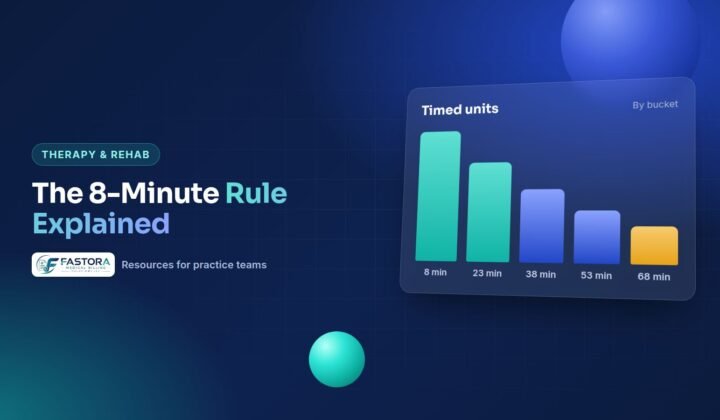
- Medicare counts total timed minutes for the visit: 8 to 22 minutes is 1 unit, 23 to 37 is 2, 38 to 52 is 3.
- Some commercial payers use the CPT method instead, so set the rule per payer.
In this guide
- 01Timed and untimed therapy codes
- 02How the 8-minute rule works
- 03Assigning units when a visit has more than one timed code
- 04The CPT “substantial portion” method used by some payers
- 05What counts as timed minutes
- 06Documentation the 8-minute rule requires
- 07Common 8-minute rule errors
- 08Frequently asked questions
Timed and untimed therapy codes
The 8-minute rule applies only to timed codes, which CPT describes as “each 15 minutes” of one-on-one, direct service. Common timed codes include:
| CPT code | Service |
|---|---|
| 97110 | Therapeutic exercise |
| 97112 | Neuromuscular re-education |
| 97116 | Gait training |
| 97140 | Manual therapy techniques |
| 97530 | Therapeutic activities |
| 97535 | Self-care and home management training |
| 97035 | Ultrasound (a timed, attended modality) |
Untimed (service-based) codes are billed once per visit regardless of length. Examples include the PT evaluations (97161, 97162, 97163), re-evaluation (97164), group therapeutic procedures (97150) and supervised modalities such as hot or cold packs (97010) and mechanical traction (97012). Minutes spent on untimed services are not added to the timed-minute total.
How the 8-minute rule works
Medicare’s method, which many Medicare Advantage plans, some Medicaid programs and some commercial payers also follow, works on the total timed minutes in the visit rather than code by code:
- Add up the direct, one-on-one minutes for every timed code performed that day.
- Use the total to find how many units can be billed for the visit.
- Assign those units to the individual codes.
A single unit requires at least 8 minutes of timed service. Each additional unit requires another 15 minutes.
| Total timed minutes | Units billable |
|---|---|
| Fewer than 8 | 0 |
| 8 to 22 | 1 |
| 23 to 37 | 2 |
| 38 to 52 | 3 |
| 53 to 67 | 4 |
| 68 to 82 | 5 |
| 83 to 97 | 6 |
| 98 to 112 | 7 |
| 113 to 127 | 8 |
Assigning units when a visit has more than one timed code
Once you know the total units, distribute them:
- Give each code one unit for every full 15 minutes performed.
- Add up the minutes left over from each code.
- If the total units allow another unit, assign it to the code with the most remaining minutes.
Example 1: two codes, one short
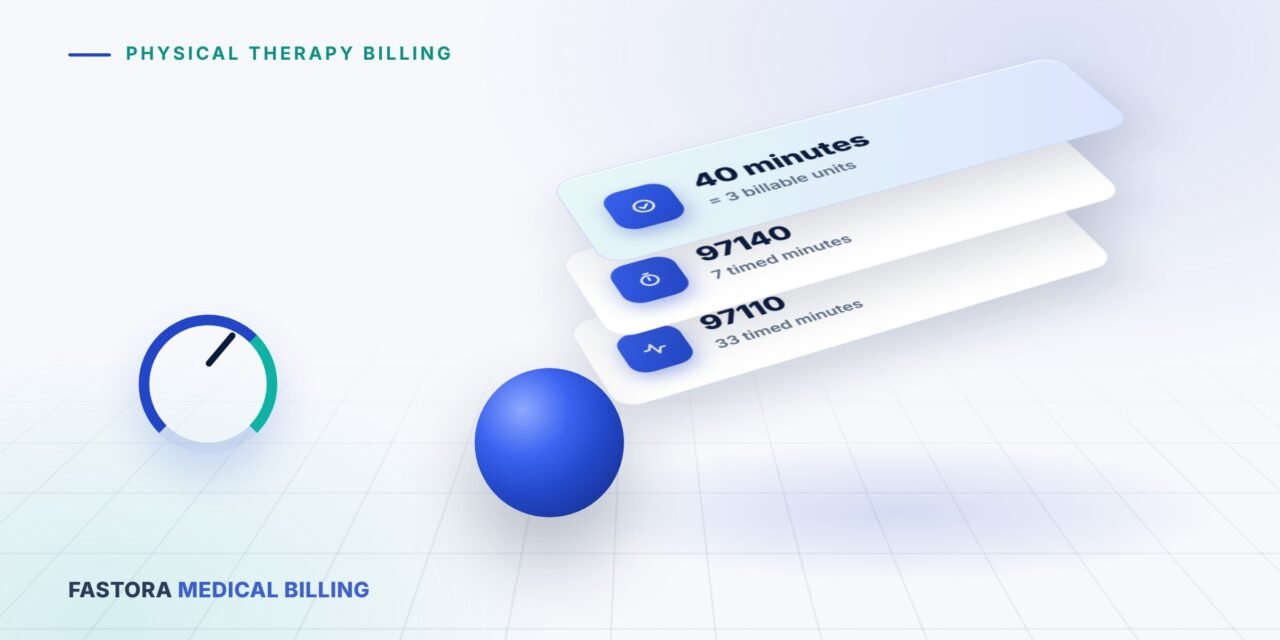
A patient receives 33 minutes of therapeutic exercise (97110) and 7 minutes of manual therapy (97140). Total timed minutes: 40, which allows 3 units.
- 97110: 33 minutes contains two full 15-minute blocks (2 units), with 3 minutes left over.
- 97140: 7 minutes, no full block, 7 minutes left over.
- One unit remains. 97140 has more leftover minutes (7) than 97110 (3), so it receives the unit.
- Bill: 97110 x 2 and 97140 x 1.
Note that 97140 is billable here even though it was performed for fewer than 8 minutes, because the visit’s total timed minutes support a third unit.
Example 2: two codes, nearly equal
A patient receives 24 minutes of neuromuscular re-education (97112) and 23 minutes of therapeutic exercise (97110). Total: 47 minutes, which allows 3 units.
- 97112: 1 full block, 9 minutes left over.
- 97110: 1 full block, 8 minutes left over.
- The third unit goes to 97112, which has more leftover minutes.
- Bill: 97112 x 2 and 97110 x 1.
Example 3: three short codes
A patient receives 8 minutes each of 97110, 97112 and 97140. Total: 24 minutes, which allows only 2 units under the Medicare method. Because the leftover minutes are equal, the therapist assigns the two units to two of the codes and documents all three services. Any two of the three may be billed; the clinic should apply a consistent, documented approach.
Example 4: timed and untimed together
A visit includes a re-evaluation (97164) plus 20 minutes of therapeutic activities (97530). The re-evaluation is billed as one untimed unit. The 20 timed minutes support 1 unit of 97530. Total treatment time includes the re-evaluation, but the timed-minute total for the 8-minute rule is 20.
The CPT “substantial portion” method used by some payers
Some commercial payers follow the CPT time rule instead, often called the substantial portion or “rule of eights” method. Under it, each timed code is evaluated on its own: a unit is reportable when more than half of the 15 minutes (8 minutes or more) of that specific service is performed.
| Visit | Medicare 8-minute rule | CPT substantial portion method |
|---|---|---|
| 8 minutes each of 97110, 97112, 97140 (24 total) | 2 units | 3 units (one per code) |
| 33 minutes 97110 and 7 minutes 97140 (40 total) | 3 units (97110 x 2, 97140 x 1) | 2 units of 97110 plus 0 units of 97140 (under 8 minutes), so 2 units |
The two methods can produce different answers in both directions. That is why the method should be set per payer in the billing system, based on each contract or provider manual, rather than applied the same way to every claim.
What counts as timed minutes
- Count: direct, one-on-one time the therapist or assistant spends performing the timed service with the patient.
- Do not count: time the patient spends on equipment unattended, rest breaks, warm-up the patient does independently, time spent on untimed services, or time spent waiting.
- Do not count: documentation time after the patient leaves.
Pre-service and post-service work is part of the service value, not additional billable minutes.
Documentation the 8-minute rule requires
Medicare expects therapy notes to show both:
- Total timed code treatment minutes for the visit.
- Total treatment time, including timed and untimed services.
Recording the minutes for each timed code is strongly recommended because it is the only way a reviewer can verify how units were assigned. The note should also describe what was done in each service so the code choice is clear: what exercises, what manual techniques, what functional activity, and the patient’s response.
Common 8-minute rule errors
| Error | Consequence |
|---|---|
| Counting units code by code for a payer that uses the Medicare method | Overbilled units and overpayment exposure |
| Applying the Medicare method to a payer that uses the CPT method | Underbilled units on some visits |
| Adding untimed minutes to the timed total | Too many timed units |
| Notes that show total time only, with no minutes per code | Units cannot be verified on review |
| Billing 1 unit for a lone timed service under 8 minutes | Unsupported unit |
| Rounding every service up to a “standard” number of units | Pattern that payers flag |
Frequently asked questions
Does the 8-minute rule apply to occupational and speech therapy?
It applies to timed codes billed under Medicare’s outpatient therapy rules, which include PT and OT timed codes. Most speech-language pathology treatment codes, such as 92507, are untimed and billed once per session, so the 8-minute rule rarely affects SLP claims.
Can I bill a timed code performed for less than 8 minutes?
Under the Medicare method, yes, if the total timed minutes for the visit support another unit and that code has the most leftover minutes. Under the CPT method, generally no.
Do all commercial insurers use the 8-minute rule?
No. Some follow Medicare’s method, some follow the CPT substantial portion method, and some have their own rules. Check each payer’s policy.
Does the 8-minute rule apply to evaluations?
No. Evaluations and re-evaluations are untimed codes billed once per visit, regardless of how long they take.
Do minutes from a physical therapist assistant count?
Yes, direct one-on-one time by a PTA or OTA counts toward timed minutes. For Medicare, services furnished in whole or in part by an assistant also need the CQ or CO payment modifier, which reduces payment for those lines.
Work with Fastora
Bill every unit you earn, and no more
The 8-minute rule is simple arithmetic once it is set up correctly in your billing system: the right method per payer, timed minutes recorded per code, and a review step that catches units the documentation does not support.
Fastora Medical Billing Solutions works with physical therapy and rehab practices on coding review, claim submission, denial management and A/R follow-up, including pre-submission review of units and modifiers. Learn more about our physical therapy billing services, read our guide to the KX modifier and 2026 therapy threshold, or contact Fastora.