What revenue leakage is
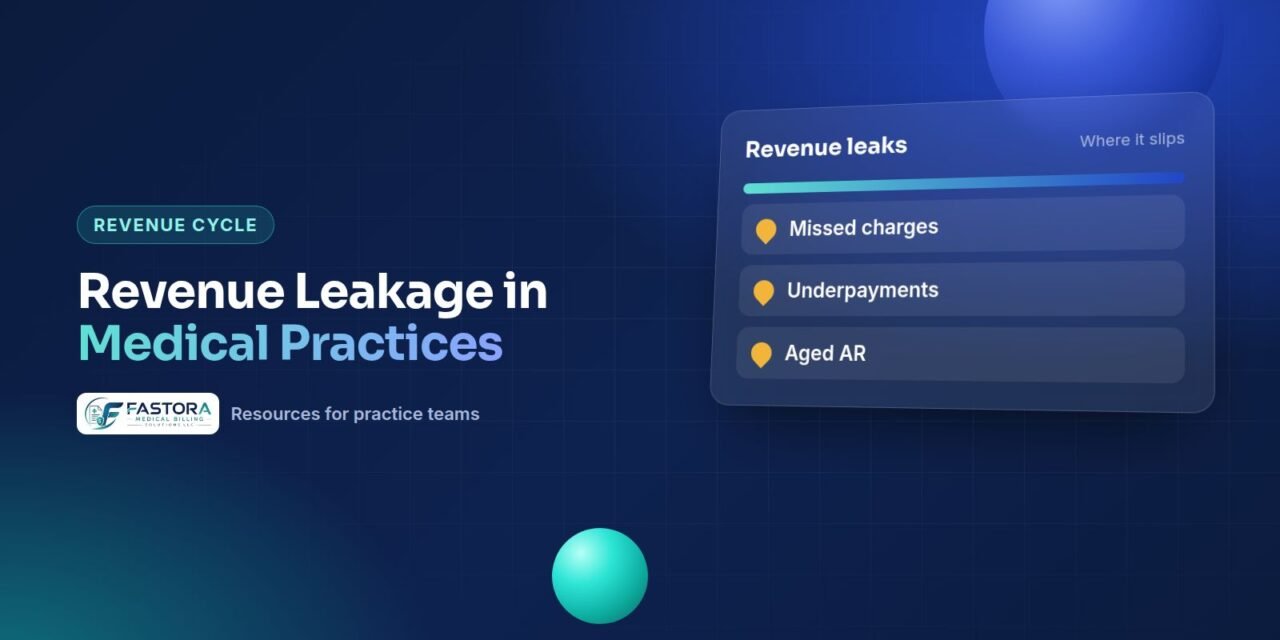
Revenue leakage is money a practice has earned but never collects. The care was delivered and documented, yet some or all of the payment is lost to a missed charge, a coding error, a denial nobody worked or a payment below the contracted rate.
Unlike a bad month, these losses rarely show up as a single event. They are small, repeated gaps spread across thousands of claims, and many are recorded as routine adjustments. That is why they can continue for years without anyone noticing.
The good news is that most leaks follow predictable patterns. Revenue leakage in healthcare is studied mostly at hospital scale, but the same causes apply to a small physician or therapy office. Once you know where to look, standard reports from your practice management system can expose them. For how each step fits into the wider billing cycle, see the medical billing process guide.
Where practices lose revenue
Missed charges
A service is performed but never billed. Common causes are unsigned notes, procedures documented in a free-text field, supplies and injectable drugs left off the charge and services performed outside the normal schedule.
Undercoding
Visits coded at a lower level than the documentation supports, or missing modifiers and add-on codes that would have been payable. Undercoding often comes from caution after an audit scare. It is as much a coding accuracy problem as overcoding, just with the opposite financial effect.
Eligibility gaps
Coverage that ended, changed plans or a secondary payer nobody recorded. Claims sent to the wrong payer are denied, and by the time the correct payer is found the filing deadline may be close.
Missed authorizations
Services that needed prior authorization, or visits that went beyond the approved number or date range. Many payers will not pay these claims at all, and some retro-authorization requests are refused.
Timely filing write-offs
Claims submitted, corrected or appealed after the payer's deadline. For Medicare fee-for-service, the limit is one calendar year after the date of service. Commercial and Medicaid plans set their own limits, and many are shorter. Once missed, the balance usually cannot be billed to the patient either if you are in network.
Unworked denials
Denials that are posted and then left alone because nobody has time to research them. Every denial type has an appeal window, and once that closes the money is gone.
Underpayments
Payments below the contracted rate because of a payer fee schedule error, an outdated rate, an incorrect bundling edit or a multiple-procedure reduction applied wrongly. If payments are posted without comparing them with the contract, underpayments look like normal contractual adjustments. For Medicare, bundling follows the National Correct Coding Initiative edits published by CMS; commercial payers may use NCCI or their own edit sets, so an edit that looks wrong should be checked against the payer's published policy.
Patient balances never collected
Copays not collected at check-in, deductibles billed months after the visit and statements that go unanswered. The longer a balance waits, the less likely it is to be paid.
Credentialing gaps
A new provider sees patients before enrollment with a payer is complete, or a revalidation lapses. Claims for those dates may be denied, and whether they can be billed later depends on the payer's effective-date rules.
How to find revenue leakage: reports to run
Run these reports for the last 6 to 12 months. Look for patterns by payer, provider, location and code, not just totals.
| Leak | Report that exposes it |
|---|---|
| Missed charges | Appointments or encounters with no charges; charge lag by provider |
| Undercoding | E/M level distribution by provider compared with peers in the same specialty; coding audit sample |
| Eligibility gaps | Denials by reason code filtered for coverage and eligibility reasons |
| Missed authorizations | Denials for missing or expired authorization; visits used against visits approved |
| Timely filing write-offs | Adjustments by adjustment code, filtered for timely filing |
| Unworked denials | Open denials by age and days left in the appeal window |
| Underpayments | Payment variance: expected contracted amount compared with amount paid, by payer and code |
| Uncollected patient balances | Patient AR aging; time-of-service collections compared with patient responsibility |
| Credentialing gaps | Denials for provider not enrolled; enrollment effective dates compared with first dates of service |
Denial and adjustment reports are most useful when grouped by Claim Adjustment Reason Code. These standard codes, maintained by X12, explain why a claim line was paid differently from what was billed, and they appear on every electronic remittance.
Pay particular attention to adjustments. Many practices post write-offs under a single generic adjustment code, which hides the reason. Separate adjustment codes for contractual, timely filing, small balance and bad debt make leaks visible in one report.
How to stop the leaks
Finding lost money is only half the job. Each leak needs a process change so it stops recurring.
- Reconcile charges daily. Compare the schedule with charges entered and follow up on any visit without a charge before the day closes.
- Audit coding regularly. Review a sample of each provider's visits against the documentation, and share the findings as education rather than blame. An orthopedic practice, for example, should check that global periods, modifiers and laterality are handled consistently.
- Verify eligibility before every visit, not just the first one, and record secondary coverage.
- Track authorizations with approved units, visits and expiry dates, and alert staff before they run out.
- Scrub claims before submission to catch missing data and edit failures while they are cheap to fix.
- Work every denial by reason code, within the appeal window, and log the root cause.
- Load contracted rates into your PM system so each payment is compared automatically with the expected amount.
- Collect at the time of service and offer payment plans for larger balances.
- Track credentialing and revalidation dates, and do not schedule a new provider with a payer until enrollment is confirmed.
Underpayments deserve special attention because they are invisible without contract data. Our underpayment recovery page explains how payment variance analysis compares what payers paid with what your contracts say they owe.
Leakage, coding accuracy and compliance
Fixing leaks must not create a compliance problem. A practice that discovers undercoding can overcorrect, and a push to capture every charge can drift into billing for services the documentation does not support. The goal is accurate billing in both directions.
The HHS Office of Inspector General (OIG) published its compliance program guidance for individual and small group physician practices in 2000. It is voluntary, but it remains a practical framework, and its seven components overlap closely with leakage control:
- Conducting internal monitoring and auditing.
- Implementing compliance and practice standards.
- Designating a compliance officer or contact.
- Conducting appropriate training and education.
- Responding appropriately to detected offenses and developing corrective action.
- Developing open lines of communication.
- Enforcing disciplinary standards through well-publicized guidelines.
In November 2023 OIG also issued General Compliance Program Guidance that applies across the health care industry. If you are building an OIG compliance program for physician practices, the same coding audit that finds missed revenue can serve as your internal monitoring step: review a sample of claims against the documentation, record errors in both directions, correct and refund overpayments where required, and use the findings for training.
Who should own each leak
Leaks persist when nobody owns them. Assign each category to a role, with a report that person reviews on a set schedule.
| Leak | Usual owner | Review frequency |
|---|---|---|
| Missed charges and charge lag | Billing lead with each provider | Daily reconciliation, monthly review |
| Undercoding | Coding lead or certified coder | Quarterly audit sample |
| Eligibility and authorization gaps | Front desk or patient access lead | Weekly denial review |
| Unworked denials and timely filing | Denial and AR follow-up staff | Weekly |
| Underpayments | Payment posting lead or billing manager | Monthly variance report |
| Patient balances | Front desk and patient billing staff | Monthly |
| Credentialing gaps | Credentialing coordinator or practice manager | Before each new provider start and each revalidation |
In a small practice one person may own several rows. That is fine, as long as each report is actually reviewed and the findings lead to a change in the process that caused the loss.
Put a number on it
Once the reports are run, total each category for the period reviewed. Even a rough figure helps you decide where to start, and it gives you a baseline for measuring whether the fixes work. A simple starting formula is: identified leakage = unworked denials still open + timely filing write-offs + payment variance below contract + unbilled encounters × average payment per encounter.
Start with the leaks that are both large and fixable. Unworked denials still inside their appeal window and recent underpayments can often be recovered. Missed charges and undercoding usually cannot be rebilled for older dates, but fixing the process protects every future visit.
How Fastora helps find and close leaks
Fastora's free claims audit reviews denial and rejection patterns, aging AR, coding accuracy and fee schedules before you commit to anything. Services include underpayment recovery, payer contract and fee schedule review, coding audits and denial management, all handled by certified medical billing and coding professionals working inside your existing EHR/PM system.
To see where your own practice may be losing money, request a free billing assessment.
Frequently asked questions
What is the most common source of lost revenue in a practice?
It varies by specialty and practice. Denials that are never worked, underpayments posted as normal adjustments and missed charges are common places to start looking.
Can we recover underpayments from past years?
Sometimes. It depends on the payer contract, the payer's appeal and reconsideration deadlines and any applicable state rules. Recent underpayments are usually the easiest to recover.
How often should we review for lost revenue?
Review denial, adjustment and payment variance reports monthly, and run a deeper review of coding and contracts at least once a year.
Does a compliance program help reduce lost revenue?
Yes. Regular internal audits, written coding standards and staff training are core elements of OIG's compliance guidance for physician practices, and the same audits that check for overbilling also reveal missed charges and undercoding. Reviewing errors in both directions keeps fixes accurate.