
Behavioral Health Billing
Mental health CPT codes look simple on paper: a handful of psychotherapy codes, an evaluation code, and a few add-ons. In practice, they cause a large share of behavioral health billing problems. A session billed one time bracket too high invites an audit, a session billed too low leaves money behind, and an add-on reported in the wrong combination is denied outright.
This guide covers the CPT codes outpatient mental health practices use most, the time rules behind them, which codes can and cannot be billed together, and the documentation each one needs. It is written for therapists, psychologists, psychiatric providers and the practice managers who bill for them in the United States.
Code descriptors and payer policies change. Always confirm current-year CPT guidance from the AMA and each payer’s own policy before relying on any single rule below.
Key takeaways
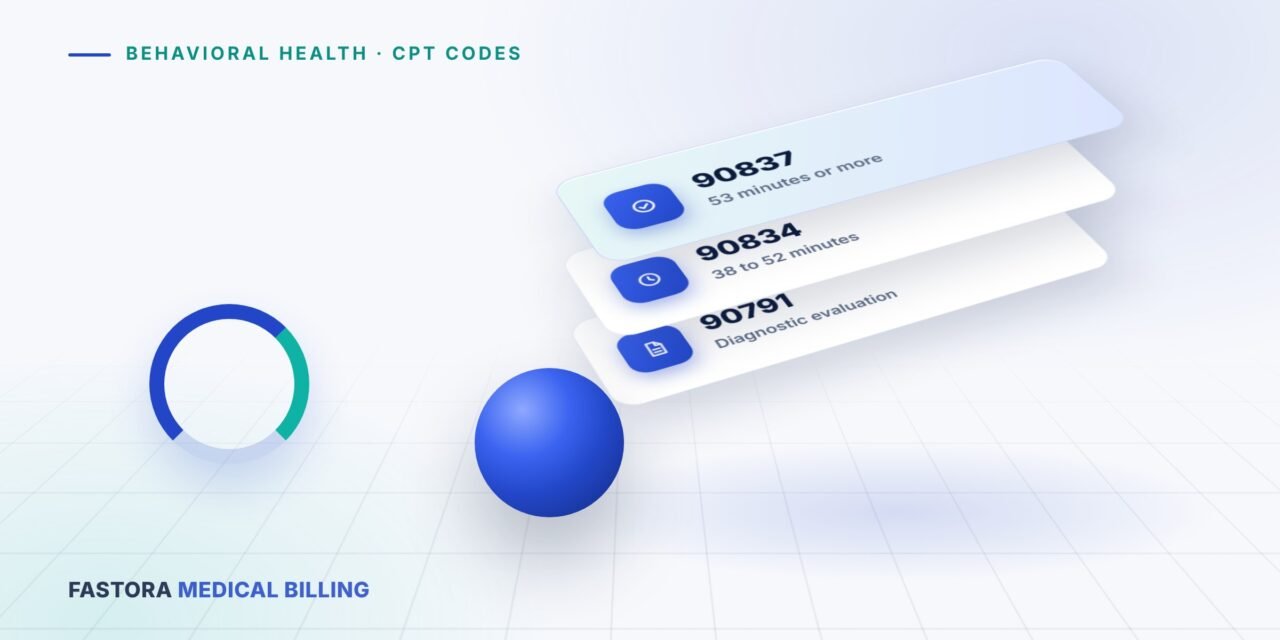
- Psychotherapy codes follow documented time: 90832 (16 to 37 minutes), 90834 (38 to 52) and 90837 (53 or more).
- Prescribers bill an E/M code plus add-on 90833, 90836 or 90838, never an E/M plus a standalone psychotherapy code.
- Many denials come from code pairs, such as 90791 and psychotherapy on the same day.
In this guide
- 01How mental health CPT codes are organized
- 02Diagnostic evaluation codes: 90791 and 90792
- 03Individual psychotherapy codes: 90832, 90834 and 90837
- 04Psychotherapy add-on codes for prescribers: 90833, 90836 and 90838
- 05Crisis psychotherapy: 90839 and 90840
- 06Family and group psychotherapy codes
- 07Interactive complexity: 90785
- 08Brief assessments and screening: 96127
- 09Codes that cannot be billed together
- 10HCPCS codes and payer-specific codes
- 11Documentation checklist for psychotherapy claims
- 12Telehealth and mental health CPT codes
- 13Frequently asked questions
How mental health CPT codes are organized
Most outpatient behavioral health services fall into the CPT psychiatry section, codes 90785 through 90899. Within that range, the codes most practices bill every week fall into five groups:
- Diagnostic evaluations (90791, 90792): the intake or initial assessment.
- Individual psychotherapy (90832, 90834, 90837): time-based therapy sessions.
- Psychotherapy add-on codes (90833, 90836, 90838): psychotherapy performed on the same day as an evaluation and management (E/M) visit, used by prescribers.
- Crisis, family and group psychotherapy (90839, 90840, 90846, 90847, 90849, 90853).
- Add-ons and assessments such as interactive complexity (90785) and brief emotional or behavioral assessments (96127).
Every claim pairs these procedure codes with ICD-10-CM diagnosis codes, usually from the F01 to F99 range (mental, behavioral and neurodevelopmental disorders). The diagnosis must support the medical necessity of the service billed.
Diagnostic evaluation codes: 90791 and 90792
90791 is a psychiatric diagnostic evaluation without medical services. Therapists, counselors, social workers and psychologists use it for intake assessments: history, mental status, a diagnosis and an initial treatment plan.
90792 is a psychiatric diagnostic evaluation with medical services. Only providers licensed to perform medical services, such as psychiatrists and psychiatric nurse practitioners, should report it. The medical component typically includes a medication review, a physical examination element, or ordering and reviewing labs.
Practical points for both codes:
- Neither code is time-based, so there is no minimum session length, but the documentation must show a complete evaluation.
- Many payers limit how often a diagnostic evaluation can be billed, commonly once per episode of care or once per year per provider. Check frequency limits before scheduling a reassessment.
- A diagnostic evaluation and a psychotherapy code are generally not billed on the same day by the same provider.
- A prescriber should not report 90792 and an E/M code on the same day for the same patient.
Individual psychotherapy codes: 90832, 90834 and 90837
The three individual psychotherapy codes are distinguished only by face-to-face time with the patient (and/or family member, when the patient is present for part of the session). CPT uses a “midpoint” approach to decide which code a session qualifies for.
| CPT code | Descriptor time | Time range that qualifies | Typical use |
|---|---|---|---|
| 90832 | 30 minutes | 16 to 37 minutes | Shorter check-in or brief session |
| 90834 | 45 minutes | 38 to 52 minutes | Standard therapy session |
| 90837 | 60 minutes | 53 minutes or more | Extended session |
Sessions under 16 minutes are not reportable with these codes. A 50-minute session is a 90834, not a 90837, even if it was booked as an hour.
Why 90837 deserves extra care
Several commercial payers and managed behavioral health organizations monitor how often a provider bills 90837 compared with 90834. A high share of 60-minute sessions is not wrong in itself, but it can trigger a records request. If a clinician regularly bills 90837, the notes should show the actual start and stop times (or total time) and a clinical reason the longer session was needed, such as trauma processing, complex family dynamics or an acute symptom change.
What counts toward psychotherapy time
- Count only time spent in psychotherapy with the patient or family member. Time spent on scheduling, billing or note writing after the session does not count.
- If part of the session is spent administering a separately billed assessment, do not count those minutes twice.
- Record the total psychotherapy time in the note. Many payers also expect start and stop times.
Psychotherapy add-on codes for prescribers: 90833, 90836 and 90838
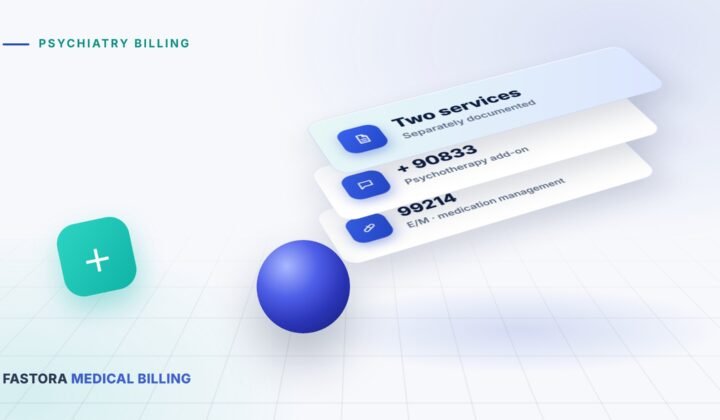
When a psychiatrist or psychiatric nurse practitioner performs a medical E/M service and psychotherapy in the same visit, they report the E/M code plus a psychotherapy add-on code rather than a standalone psychotherapy code.
| Add-on code | Descriptor time | Qualifying psychotherapy time | Must be reported with |
|---|---|---|---|
| 90833 | 30 minutes | 16 to 37 minutes | An E/M code (e.g., 99212 to 99215) |
| 90836 | 45 minutes | 38 to 52 minutes | An E/M code |
| 90838 | 60 minutes | 53 minutes or more | An E/M code |
The E/M and the psychotherapy must be separately identifiable in the note. Time spent on the medical portion of the visit cannot be counted toward psychotherapy time. We cover this combination in detail in our guide to billing psychiatry E/M visits with psychotherapy add-on codes.
Crisis psychotherapy: 90839 and 90840
90839 covers the first 60 minutes of psychotherapy for a patient in crisis and is reported for 30 to 74 minutes of crisis psychotherapy. 90840 is an add-on for each additional 30 minutes, first reportable once total crisis time reaches 75 minutes. Under 30 minutes, report the regular psychotherapy code that matches the time instead.
Crisis codes require an urgent assessment, history of the crisis, mental status exam and a disposition, along with psychotherapy aimed at mobilizing resources to defuse the crisis. They are not a substitute for a long routine session. Crisis codes are not reported with 90785 (interactive complexity), and on the same day the same provider generally does not bill crisis codes alongside 90791, 90792 or routine psychotherapy codes.
Family and group psychotherapy codes
| CPT code | Service | Key billing note |
|---|---|---|
| 90846 | Family psychotherapy without the patient present | Must be directed at the patient’s treatment, not the family members’ own care |
| 90847 | Family psychotherapy with the patient present | Conjoint session; the patient is present for all or part |
| 90849 | Multiple-family group psychotherapy | Groups of several families; coverage varies widely |
| 90853 | Group psychotherapy (other than multiple-family) | Billed per patient in the group, not per group session |
Family psychotherapy codes describe 50-minute services, and current CPT guidance allows them to be reported once at least 26 minutes have been provided. Some payers also cover family therapy only when the identified patient carries a covered diagnosis, so the claim should be billed under the patient, not a family member.
Interactive complexity: 90785
90785 is an add-on that recognizes communication factors that make a session harder to deliver. Examples include managing maladaptive communication among participants that interferes with treatment, caregiver emotions or behavior that interfere with implementing the treatment plan, discussing a sentinel event that requires a mandated report to a third party, or using play equipment or a translator because the patient cannot communicate otherwise.
It can be added to 90791, 90792, the psychotherapy codes (90832 to 90838) and group psychotherapy (90853). It is not reported with crisis codes, with family psychotherapy codes, or with an E/M code alone. The note must name the specific complicating factor; “session was difficult” is not enough.
Interpretation or translation services alone do not qualify for 90785.
Brief assessments and screening: 96127
96127 covers a brief emotional or behavioral assessment using a standardized instrument, such as a depression or anxiety screening questionnaire, scored and documented. It is reported per instrument, and payers often limit the number of units per day. Coverage for 96127 when billed by therapists alongside psychotherapy varies by payer, so confirm it before building it into routine workflows.
Psychological and neuropsychological testing uses a separate family of codes (96130 to 96139 and related codes) with their own time and documentation rules.
Codes that cannot be billed together
Many mental health denials come from code combinations rather than individual codes. The most common conflicts:
| Combination | Usual outcome | What to do instead |
|---|---|---|
| 90791 and 90834 same day, same provider | One line denied | Bill the evaluation; schedule therapy on a later date |
| 90834 (standalone) and an E/M code | Denied or bundled | Prescribers use E/M plus 90833, 90836 or 90838 |
| 90792 and an E/M code same day | Denied | Choose one service |
| 90785 with 90839 or 90840 | Add-on denied | Do not report interactive complexity with crisis codes |
| 90785 with an E/M code only | Add-on denied | Report 90785 only with an eligible psychiatric service |
National Correct Coding Initiative (NCCI) edits govern many of these pairs for Medicare and Medicaid, and most commercial payers apply similar edits. Run claims through edit checks before submission rather than finding the conflict on the remittance.
HCPCS codes and payer-specific codes
Some state Medicaid programs and managed care plans require HCPCS Level II codes, such as H-codes for behavioral health and substance use services, instead of or in addition to CPT codes. Some payers also require specific modifiers to identify the rendering clinician’s license level (for example, modifiers that distinguish a master’s-level clinician from a doctoral-level clinician). These requirements are set by each state or plan, so a practice that bills Medicaid in more than one state needs a code crosswalk for each one.
Documentation checklist for psychotherapy claims
Each session note should allow a reviewer to confirm the code without guessing. At a minimum, include:
- Date of service and the rendering clinician’s name and credentials.
- Total psychotherapy time (and start and stop times where the payer expects them).
- Who attended (patient alone, patient and family, family without patient).
- The modality and interventions used, such as CBT, DBT skills or EMDR.
- The patient’s response and progress toward treatment plan goals.
- The diagnosis being treated, consistent with the treatment plan.
- For telehealth: the patient’s location, the clinician’s location and whether the session was audio-video or audio-only.
- For 90785: the specific interactive complexity factor.
A current, signed treatment plan supports medical necessity for ongoing sessions. Many payers expect it to be reviewed and updated at regular intervals.
Telehealth and mental health CPT codes
Psychotherapy and diagnostic evaluation codes are reported with the same CPT codes whether the session is in person or virtual. What changes is the place of service code and, for some payers, a telehealth modifier. Medicare uses place of service 10 when the patient is at home and 02 when the patient is somewhere else, and modifier 93 identifies audio-only services. Commercial and Medicaid requirements vary, including whether they still want modifier 95 or GT. Our guide to telehealth billing for mental health walks through the current rules.
Frequently asked questions
What is the difference between 90834 and 90837?
Time. 90834 covers 38 to 52 minutes of psychotherapy and 90837 covers 53 minutes or more. Bill the code that matches the documented time, not the length of the scheduled appointment.
Can a therapist bill 90791 and a psychotherapy code on the same day?
Generally no, not for the same provider and patient. Most payers treat the evaluation as including the therapeutic work done that day. Bill the evaluation and start psychotherapy at the next visit.
Can a licensed counselor or social worker bill 90792?
No. 90792 includes medical services, so it is reserved for providers whose license allows them to perform medical services, such as psychiatrists and psychiatric nurse practitioners. Non-prescribing clinicians use 90791.
Is 90785 billed every time a parent attends a child’s session?
No. Interactive complexity applies only when a specific factor, such as caregiver behavior that interferes with treatment, actually complicated the service and is documented. A parent simply being present does not qualify.
How is group therapy billed?
Group psychotherapy (90853) is billed once for each patient who attended, under each patient’s own insurance. It is not billed once for the whole group.
Do mental health CPT codes change every year?
The AMA updates CPT annually, and payers update their policies throughout the year. Review the psychiatry section and your top payers’ behavioral health policies at least once a year, and whenever a new denial pattern appears.
Work with Fastora
Getting mental health coding right, every claim
Accurate mental health CPT coding comes down to three habits: match the code to documented time, check code combinations before submission, and keep notes that show medical necessity. When those habits slip, the result is denials, payer audits and revenue that never arrives.
Fastora Medical Billing Solutions works with behavioral health and mental health practices on coding review, claim submission, denial management and accounts receivable follow-up, including pre-submission claim review designed to catch coding conflicts before payers do. If your practice wants a second set of eyes on its psychotherapy coding, contact Fastora to talk through your current process, or learn more about our mental health billing services.
2 comments