What the 90833 add on code is for
The 90833 add on code reports 30 minutes of psychotherapy provided in the same visit as an evaluation and management (E/M) service. It exists for psychiatrists, psychiatric nurse practitioners and other prescribers who manage medication and also provide psychotherapy, so both parts of the visit can be paid.
As an add-on, 90833 is never billed alone. It must be reported with a primary E/M code on the same claim, for the same date, by the same clinician. The NCCI policy manual describes these add-on codes as the way to report psychotherapy in conjunction with the appropriate E/M code when the E/M is a distinct, significant service.
| Add-on code | Descriptor time | Report for | Standalone equivalent |
|---|---|---|---|
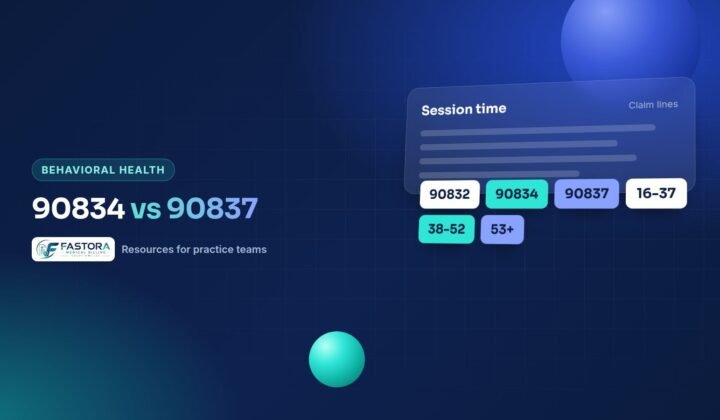
| 90833 | 30 minutes | 16–37 minutes of psychotherapy | 90832 |
| 90836 | 45 minutes | 38–52 minutes of psychotherapy | 90834 |
| 90838 | 60 minutes | 53 minutes or more of psychotherapy | 90837 |
The 90836 CPT code and 90838 for longer sessions
The 90836 CPT code is the 45-minute add-on, reported when psychotherapy time during the E/M visit is 38 to 52 minutes. 90838 is reported for 53 minutes or more. The same CPT time conventions apply as for standalone psychotherapy, and psychotherapy of less than 16 minutes is not reported.
Choosing between the three add-ons depends only on psychotherapy minutes. The E/M portion of the visit does not count toward that time, which is why the note has to separate the two.
How to choose the E/M level when psychotherapy is added
Since the 2021 office E/M changes, office visit codes can usually be selected by medical decision making (MDM) or by total time. When psychotherapy is added, the American Psychiatric Association's guidance is that the E/M level must be determined by MDM; time cannot be used to choose the E/M when a psychotherapy add-on is billed.
- Problems addressed: for example, a chronic illness with exacerbation or side effects of treatment.
- Data reviewed: labs, outside records, collateral information from family.
- Risk of management: for example, prescription drug management.
Document MDM for the E/M in its own section, then document psychotherapy separately with its own time. Without that separation, a reviewer may conclude the psychotherapy was part of the E/M and deny the add-on.
Billing 99214 with 90833: a worked example
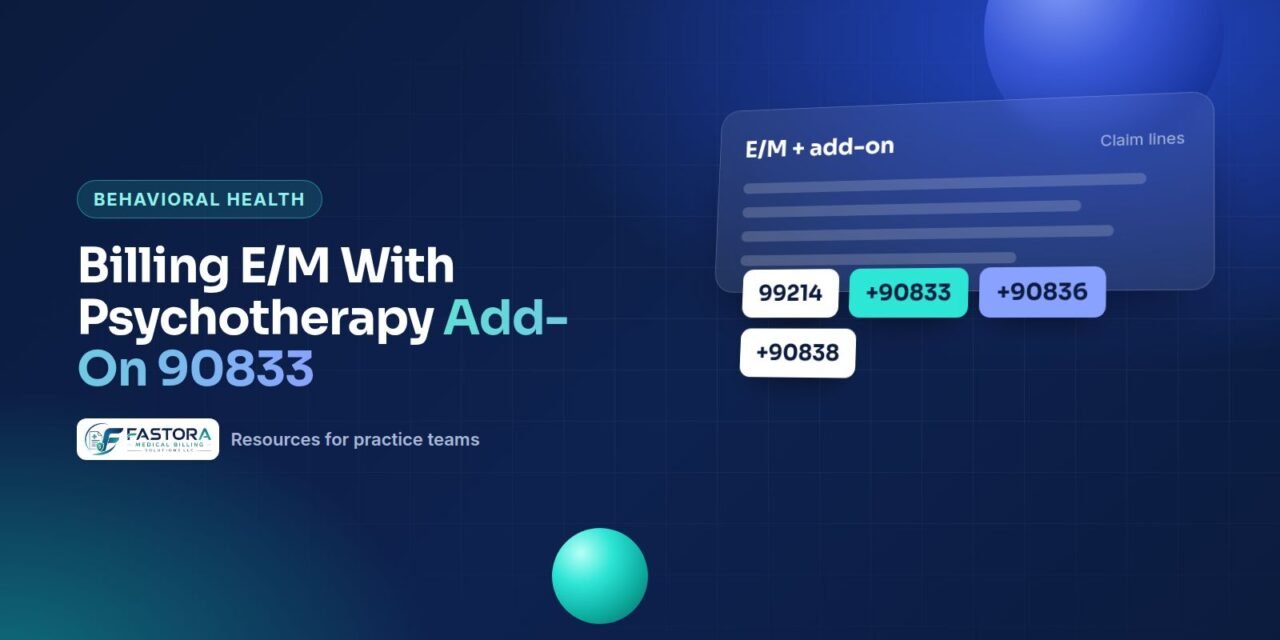
99214 with 90833 is one of the most common pairs in outpatient psychiatry. 99214 is an established patient office or outpatient visit at a moderate level of MDM. Paired with 90833, it describes a medication management visit with a short block of psychotherapy.
Example visit
An established patient with major depressive disorder reports partial response and new sleep problems. The psychiatrist reviews symptoms and side effects, adjusts the dose of an antidepressant and orders a follow-up. That medical work supports moderate MDM. The psychiatrist then spends 25 minutes on cognitive behavioral therapy focused on sleep and activity scheduling.
| Claim line | Code | Supported by |
|---|---|---|
| 1 | 99214 | Moderate MDM: chronic illness with side effects of treatment and prescription drug management |
| 2 | 90833 | 25 minutes of psychotherapy, documented separately with interventions and response |
If the psychotherapy had lasted 40 minutes, the add-on would be 90836. If the MDM had been straightforward or low, the E/M code would be 99212 or 99213 instead. Each part of the visit is coded on its own merits.
Pairing add-ons with other E/M levels and settings
The add-on codes are not tied to 99214. Any E/M level the MDM supports can carry a psychotherapy add-on, and the two choices are made independently.
| Visit pattern | E/M (by MDM) | Add-on (by psychotherapy time) |
|---|---|---|
| Stable patient, refill with no changes, 20 minutes of supportive therapy | 99212 or 99213 | 90833 |
| Dose adjustment for a chronic condition, 40 minutes of psychotherapy | 99214 | 90836 |
| Severe exacerbation with drug therapy needing intensive monitoring for toxicity (high MDM), 30 minutes of psychotherapy | 99215 | 90833 |
| New patient seen for an E/M with medication start, 20 minutes of psychotherapy | New-patient office E/M | 90833 |
The add-ons can be reported with E/M codes in other settings as CPT allows, such as hospital or nursing facility visits, subject to payer policy. Visits by video follow the same rules, with the payer's telehealth place of service code and any modifier it requires on each line. Record the patient's location in the note, and confirm the payer covers both the E/M and the add-on by telehealth before scheduling.
Documentation checklist for E/M plus psychotherapy
- Separate headings for the E/M and the psychotherapy.
- E/M section: problems addressed, data reviewed and medication decisions, enough to support the MDM level billed.
- Psychotherapy section: psychotherapy minutes (start and stop times or total), the type of therapy, interventions and the patient's response.
- A statement or structure that makes clear the psychotherapy time excludes the E/M work.
- Diagnoses that support both services.
- For telehealth, the patient's location and the technology used.
Our behavioral health billing guide shows how these add-ons fit with the rest of the mental health code set.
Other codes that can and cannot go with the add-ons
| Code | With E/M + 90833/90836/90838? | Note |
|---|---|---|
| 90785 interactive complexity | Yes, when a qualifying factor is documented | Not reported with an E/M alone; it needs the psychotherapy add-on. |
| 90832, 90834, 90837 | No | Standalone psychotherapy codes are for visits without an E/M. |
| 90791, 90792 | No | NCCI does not allow diagnostic evaluations to be separately reported with psychotherapy on the same date. |
| 90839, 90840 crisis | No | CPT does not allow the crisis codes to be reported with the psychotherapy add-ons or 90785 on the same day; report the service that was actually provided. |
Most payers do not need modifier 25 on the E/M for this pairing, because the add-on codes were designed to be billed with E/M. Follow the payer's instructions where they differ.
Common denials and how to prevent them
- Add-on billed without a primary E/M: the add-on is rejected. Check that both lines are on the same claim.
- Psychotherapy time counted twice: the same minutes supported the E/M by time and the add-on. Select the E/M by MDM.
- Note does not separate the services: reviewers deny the add-on as part of the E/M.
- Provider not credentialed for psychotherapy: some plans credential prescribers for medication management only, or route psychotherapy to a carve-out vendor.
- Wrong add-on for the time: for example, 90836 with 35 minutes of psychotherapy.
Patterns like these usually show up in denial reports within a few weeks. Our psychiatric billing team at Fastora reviews E/M and add-on pairs before submission, and a free billing assessment can check a sample of your psychiatry claims.
Frequently asked questions
Can 90833 be billed without an E/M code?
No. 90833 is an add-on code and must be billed with a primary E/M code for the same visit by the same clinician. If no E/M service was provided, bill standalone psychotherapy with 90832, 90834 or 90837 based on time instead.
Can a therapist bill 90833?
Generally no. The psychotherapy add-on codes are used with E/M services, which non-prescribing clinicians such as psychologists, social workers, counselors and marriage and family therapists do not bill. Those clinicians use standalone psychotherapy codes.
Can I use time to choose the E/M level when billing 90833?
According to American Psychiatric Association guidance, no. When a psychotherapy add-on is billed, the E/M level must be selected by medical decision making, and psychotherapy minutes are documented separately for the add-on.
What add-on code do I use for 45 minutes of psychotherapy with an E/M?
Use 90836, which covers 38 to 52 minutes of psychotherapy provided with an E/M service. For 53 minutes or more, use 90838. For 16 to 37 minutes, use 90833.