EAP referrals can look like any other new client — until the first claim is rejected. EAP sessions run on their own billing rules: different codes, different authorization numbers, a different payment flow, and sometimes a different program entirely from the client’s regular insurance. This guide explains how therapists bill EAP sessions — from the first verification call through the final payment — plus the practical question every practice owner should ask: are EAPs worth accepting at all?
What Is an EAP — and Why It Changes Your Billing
An Employee Assistance Program is an employer-funded benefit. Employees get a small, defined number of short-term counseling sessions — typically a few per issue, per year — at no cost to the employee. That last point is what separates EAP billing from ordinary insurance billing:
- The client pays nothing. EAP sessions carry no copay, deductible, or coinsurance. If your front desk collects payment from an EAP client at check-in, something has already gone wrong.
- The benefit is session-limited. EAP authorizations cover a set number of visits for a defined presenting issue. When the sessions run out, the client converts to regular insurance, self-pay, or ends treatment.
- The payer may differ from the client’s main insurance. Everyday coverage and the EAP may run through completely different companies. Verifying “regular” benefits does not verify EAP benefits — check both separately.
So before the first appointment, verify the EAP benefit specifically: session count, effective date range, and which program the authorization belongs to. Unverified EAP authorizations are one of the most common reasons EAP claims deny.
How EAP Sessions Are Billed: Two Patterns
There is no single “EAP billing code.” Different programs route sessions through different code combinations — here’s where therapists get tripped up:
Pattern 1: A dedicated EAP code — CPT 99404. Some programs bill EAP sessions under a specific code rather than the routine psychotherapy codes. Cigna’s EAP is the best-known example: providers in its EAP network bill EAP sessions with CPT 99404, and the EAP authorization number doubles as the member ID on the claim.
Pattern 2: A routine code plus the HJ modifier. Other programs take the opposite approach: bill your usual psychotherapy code (often 90837 or 90832) and append the HJ modifier — the EAP visit designation — to flag the session as an EAP encounter. The modifier tells the payer to process the claim under the EAP program’s rules, not the client’s ordinary mental-health benefits. This is how EAP billing works for programs like Anthem, Aetna, and UnitedHealthcare EAPs. Without the modifier, the claim processes under the client’s regular benefits and may deny.
Never assume the pattern. Two clients, two different EAPs, two different claims — one billed 99404, the other billed 90837+HJ. Always confirm the EAP’s own billing instructions (usually in the provider manual or authorization paperwork) before you build the claim.
| Pattern 1: dedicated code | Pattern 2: modifier on routine code | |
|---|---|---|
| Used by | Programs that route EAPs through their own coding (Cigna EAP) | Programs that flag standard codes as EAP (Anthem, Aetna, UHC EAPs) |
| Procedure code | CPT 99404 | Your usual code (e.g., 90837, 90832) |
| Modifier | None needed | HJ (EAP visit) |
| Member ID | The EAP authorization number | Client’s regular insurance member ID |
| Patient responsibility | None | None |
Illustrative example only — your EAP’s provider manual is the authority.
The EAP Authorization Number: Your Most Important Field
In EAP billing, the authorization number identifies the episode of care, the program paying for it, and — for programs like Cigna’s — the member on the claim itself. Handle it exactly:
- Get it before the first visit. Never schedule an EAP session without the authorization number in hand, and confirm it with the EAP directly — not just from the client’s memory of it.
- Match it to the client and the date range. Numbers are tied to a specific person, issue, and visit window. A number issued for one family member doesn’t cover another.
- Put it where the payer expects it. On a CMS-1500, the authorization number goes in Box 23. On electronic claims, it belongs in the authorization-number segment — never the member ID field, except where a program explicitly uses the authorization number as the member ID.
- Track session usage against the cap. EAP authorizations are session-limited. Know when you’re billing the last covered visit so you can have the coverage conversation with the client before — not after — it ends. Some EAPs allow additional sessions with a new authorization; others don’t. Ask when you verify the first one.
A missing or mismatched authorization number is the single most common reason EAP claims deny — and it’s entirely preventable with a front-desk checklist.
Filing the EAP Claim
Once the code pattern and authorization number are confirmed, building the claim is straightforward, with a few EAP-specific adjustments:
- Use the right claim path. Electronic claims through your clearinghouse are the norm, with the authorization number in the auth segment. Some smaller EAPs still require paper or portal submission — their provider manual will say.
- Bill zero patient responsibility. EAP sessions are fully covered by the program. Don’t collect from the client and don’t report a balance due — reporting patient responsibility on an EAP claim invites a denial.
- Submit the EAP’s own paperwork. Several EAPs require their specific intake forms, treatment plans, or session documentation. Build them into your intake packet for EAP clients rather than discovering the requirement after the claim is filed.
Should Your Practice Accept EAPs? A Decision Framework
Billing mechanics aside, decide deliberately whether EAP participation fits your practice:
- Referral flow. EAPs can send a steady stream of clients — valuable for newer practices. Ask how referrals arrive and whether there’s any volume commitment.
- The revenue tradeoff. EAP reimbursement is set by the program and often runs lower than your commercial contracted rates, in exchange for zero collections work and predictable payment. Run the math on what an hour nets under EAP rules versus your other payers.
- Session limits. Short EAP episodes don’t suit every clinical model. If your approach needs longer engagements, factor in how often EAP clients convert to ongoing insurance or self-pay cases.
- Administrative load. EAPs add authorization tracking, program-specific paperwork, and the “which pattern does this EAP use?” question to every case. Manageable with a checklist — but real, and it scales with EAP volume.
- Fit with your niche. EAPs serve working adults with short-term concerns — stress, adjustment, workplace issues, family strain. If that’s your wheelhouse, EAPs are a natural fit.
There’s no wrong answer — successful practices thrive with and without EAPs. The key is choosing on purpose, with the economics and admin work fully understood.
Common EAP Billing Mistakes
- Wrong code pattern — billing 90837 to an EAP that expects 99404, or skipping the HJ modifier where it’s required. Fix: verify the EAP’s coding instructions before the first session.
- No authorization number on file — scheduling before the EAP authorization exists guarantees a denied claim. Fix: make the auth number a required intake field for EAP clients.
- Auth number in the wrong field — as a member ID where it doesn’t belong (or vice versa) mismatches the payer’s records. Fix: follow the EAP’s instructions, and know which programs use the auth number as the member ID.
- Collecting from the client — any copay collected on an EAP session has to be refunded and creates a billing mess. Fix: flag EAP clients in your scheduler so the front desk knows no payment is due.
- Mixing EAP and regular benefits — billing routine mental-health benefits for a session that belongs to the EAP (or vice versa) creates denials on both sides. Fix: confirm at every visit which program the session belongs to, especially when authorizations expire.
Frequently Asked Questions
Do I need to be paneled with an EAP to bill EAP sessions?
Generally, yes. EAP programs have their own networks and credentialing, separate from the payer’s commercial mental-health network. Being paneled with an insurer’s commercial plan doesn’t automatically make you paneled with its EAP. Check your EAP network status before taking referrals — seeing an EAP client out-of-network without realizing it means denied claims and a difficult conversation with the client.
What CPT code do therapists use for EAP sessions?
It depends on the EAP. Cigna’s EAP directs providers to bill CPT 99404. Other EAPs — including Anthem, Aetna, and UnitedHealthcare EAPs — use standard psychotherapy codes such as 90837 with the HJ modifier to designate the EAP visit. Always confirm the EAP’s own billing instructions; there is no universal EAP code.
Can therapists bill EAP and regular insurance for the same client?
Yes, but not for the same session. A client might use their EAP sessions first, then continue under regular insurance once the authorization runs out. Bill each session to the correct program, verify both benefits separately, and document the transition.
What happens when an EAP authorization runs out?
The EAP stops paying. Talk with the client before the last authorized session about next steps: converting to regular insurance (verify those benefits), self-pay, or ending treatment with a referral. Some EAPs allow additional sessions with a new authorization — ask the program rather than assuming.
Do EAP sessions require a deductible or copay?
No. EAP sessions are fully covered by the program — the client pays nothing. Never collect a copay for an EAP session, and don’t report patient responsibility on the claim.
The Bottom Line
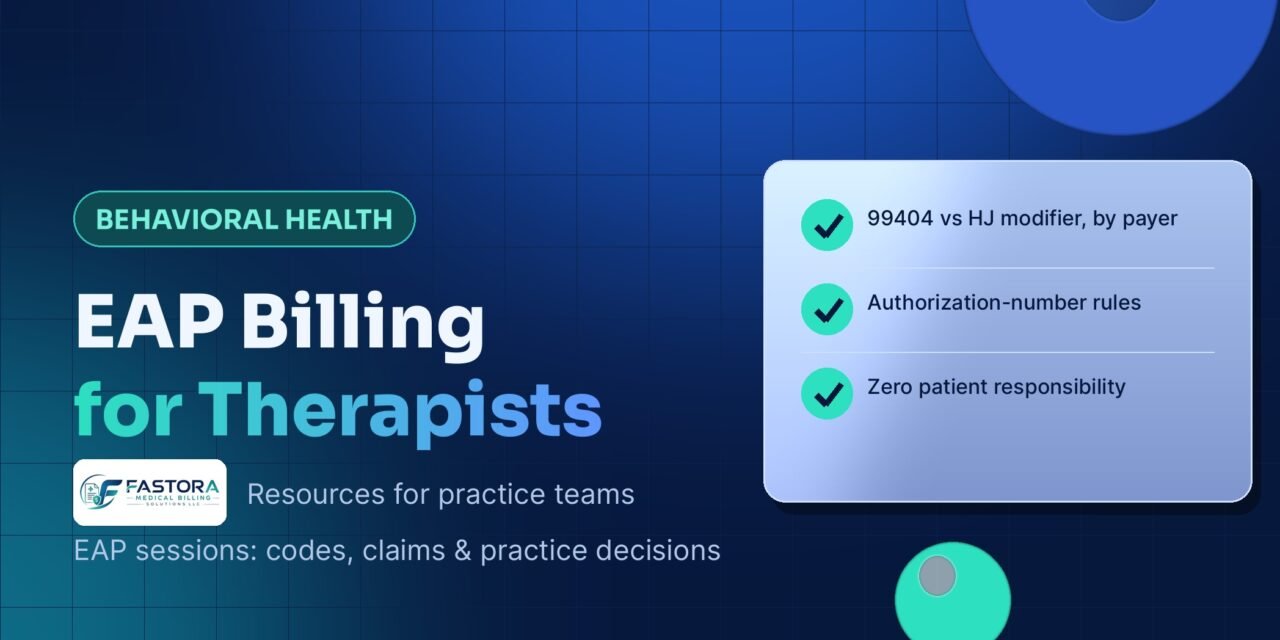
EAP billing isn’t complicated — it’s just different from regular insurance billing. The workflow reduces to three habits: verify the EAP benefit (not just the client’s regular insurance) before the first visit, use the EAP’s exact code pattern and authorization-number rules, and bill zero patient responsibility. Get those right and EAP claims pay cleanly and predictably.
If EAP claims — or any part of your therapy billing — are producing denials, delays, or write-offs you can’t explain, a free billing assessment can pinpoint exactly where the revenue is leaking. And if you’re building a behavioral health practice’s billing operation from the ground up, see how we support behavioral health billing end to end.