In behavioral health, the diagnosis code on a claim does more work than in almost any other specialty. Procedure codes say what happened — a 45-minute psychotherapy session, an intake evaluation, a group session. The ICD-10 diagnosis code says why it was medically necessary. When that diagnosis is vague, mismatched, or missing, the claim stalls: denied for lack of medical necessity or questioned at authorization.
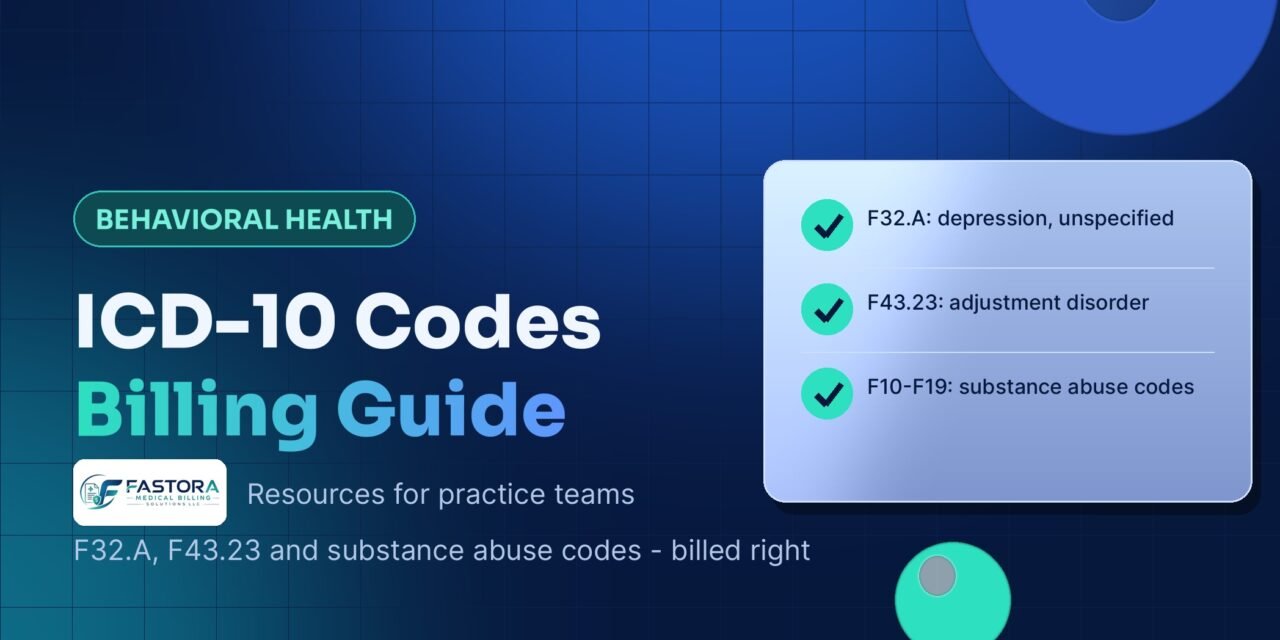
Three of the busiest — F32.A (depression, unspecified), F43.23 (adjustment disorder with mixed anxiety and depressed mood), and the F10–F19 substance abuse code block — are also the most commonly misused. This guide explains what each means, when it belongs on a claim, and the billing mistakes that turn everyday codes into denials.
Why Diagnosis Coding Carries Extra Weight in Behavioral Health
In surgical specialties, the procedure often speaks for itself. Behavioral health doesn’t work that way — a 90834 (45-minute psychotherapy session) for depression looks identical on paper to a 90834 for an adjustment disorder. The diagnosis code is what the payer uses to decide medical necessity (does the diagnosis justify the service billed?), authorization outcomes (continued-stay reviews lean on diagnosis specificity), and denial patterns (unspecified codes carried too long, diagnoses that don’t support the billed procedure, codes that contradict the note). Getting the code right is a documentation discipline first.
F32.A — Depression, Unspecified
F32.A is the ICD-10-CM code for “depression, unspecified” — added October 1, 2021 for depression documentation that doesn’t support a major depressive disorder (MDD) diagnosis. Inclusion terms: “Depression NOS” and “Depressive disorder NOS.”
When it belongs on the claim: the record documents depression, but MDD has not been established — no episode type, no severity level, no confirmed MDD criteria. The classic scenario is an intake or early evaluation where the assessment is still in progress.
The F32.A vs F32.9 trap: the most common depression coding mistake is defaulting to F32.9. The codes describe different situations — F32.9 requires actually documented MDD, single episode (only severity unspecified); F32.A is for depression documentation where MDD is not established. Reaching for F32.9 whenever a note says “depression” overstates the diagnosis — exactly the habit that invites upcoding scrutiny (see our guide on what upcoding is). F32.A exists so vague documentation gets an honest code — and our mental health CPT guide covers the procedure side of the same claims.
The billing caution: F32.A is legitimate at intake; it becomes a problem when it never leaves. Unspecified codes are acceptable while the clinical picture develops, but audit flags when they persist across months of treatment. Once assessment clarifies severity or a more specific diagnosis, the code should move with it.
F43.23 — Adjustment Disorder with Mixed Anxiety and Depressed Mood
F43.23 is the ICD-10-CM code for adjustment disorder with mixed anxiety and depressed mood: symptoms developing in response to an identifiable stressor such as a job loss, divorce, or major life change.
The rules that define it: an identifiable stressor must exist — and be documented; onset within three months of the stressor; the mixed anxiety-depression picture is the point (sadness and hopelessness alongside worry, nervousness, poor concentration); and it is expected to resolve once the stressor is managed or removed — this code is not designed for open-ended, long-term use.
F43.23 vs F32.A: look for the stressor. F43.23 names a stressor and a mixed picture with a time limit; F32.A describes depression documentation with no established MDD and no stressor in the story.
Illustrative example (not a real patient): an intake note documents a client who lost their job four weeks ago and now reports persistent worry, poor sleep, tearfulness, and trouble concentrating — mixed symptoms tied to a recent, identifiable stressor. That points to F43.23, and the note must say so, because the code alone doesn’t prove the stressor exists.
The billing caution: the two most common F43.23 problems are missing stressor documentation and indefinite use. The stressor, its timing, and its connection to the symptoms must be in the record — and carrying the code unchanged for many months contradicts its own definition.
Substance Abuse ICD-10 Codes (F10–F19)
Substance-related billing lives in the F10–F19 block of ICD-10-CM — mental and behavioral disorders due to psychoactive substance use, organized by substance: F10 alcohol, F11 opioids, F12 cannabis, F13 sedatives/hypnotics/anxiolytics, F14 cocaine, F15 other stimulants, F16 hallucinogens, F17 nicotine, F18 inhalants, F19 other/unknown.
Within each category, the code distinguishes the documented pattern — use, abuse, or dependence — with the 6th character completing it. Common billable examples: F10.20 (alcohol dependence), F11.20 (opioid dependence), F12.20 (cannabis dependence).
Why the pattern matters: the use/abuse/dependence distinction changes the medical-necessity picture for higher levels of care — detox, residential, and intensive outpatient programs are authorized against a dependence diagnosis far more readily than a use diagnosis. The code must match what the provider diagnosed. Coding “dependence” because it authorizes better, when the record documents “use,” is misrepresentation with a paper trail.
Documentation keys: name the substance and the pattern (“alcohol dependence” supports F10.20; “alcohol use” does not); document severity, withdrawal features, and functional impairment; when substance use travels with depression or anxiety, code both in the right order.
At a Glance: The Codes Side by Side
| Code | Description | When to use | Watch out |
|---|---|---|---|
| F32.A | Depression, unspecified | Depression documented; MDD not established (often intake) | Temporary — refine to a specific code as assessment clarifies |
| F43.23 | Adjustment disorder with mixed anxiety and depressed mood | Identifiable stressor within 3 months; mixed anxiety + depression | Time-limited; stressor and timing must be documented |
| F10.20 | Alcohol dependence | Provider diagnosed alcohol dependence | Must match documented pattern |
| F11.20 | Opioid dependence | Provider diagnosed opioid dependence | Documented pattern only |
| F12.20 | Cannabis dependence | Provider diagnosed cannabis dependence | Documented pattern only |
Common Billing Mistakes With These Codes
1. Living on unspecified codes. F32.A at intake is honest. F32.A at month six with a fully assessed patient is a red flag. Review unspecified codes on a standing schedule.
2. The F32.9 default. Using F32.9 (documented MDD) whenever a note says “depression” overstates the diagnosis. Without documented MDD, F32.A is the correct code.
3. Missing stressor documentation on F43.23. The code claims a stressor exists. If the note doesn’t name and date one, the claim’s foundation is missing.
4. Diagnosis–CPT mismatch. Billing 90837 or intensive services against a diagnosis that doesn’t support that intensity is a fast route to a medical-necessity denial.
5. Copy-paste coding. The same diagnosis on every patient’s claim regardless of the note. Payers notice patterns; documentation should drive the code, never the reverse.
6. Wrong diagnosis linkage. Each procedure line points to the diagnosis that justifies it. The right codes with the wrong linkage still get rejected.
For how these mistakes fit into the full revenue cycle, our behavioral health billing guide walks the process from intake to payment.
How Practices Keep BH Diagnosis Coding Clean
- Document to support the code. Symptoms, severity, stressors, onset timing, and the use/abuse/dependence pattern belong in the note — not in the biller’s memory.
- Refine unspecified codes on a timeline. Any F32.A older than the initial assessment window gets re-evaluated against current documentation.
- Match the CPT to the diagnosis. Before the claim leaves, confirm the procedure and diagnosis describe the same encounter at the same intensity.
- Verify coverage and authorization first. The cleanest claim still fails if the behavioral health benefit isn’t there.
- Scrub every claim before submission. Diagnosis–procedure linkage, code specificity, payer edits — fixes cost minutes in-house, days as a denial.
If your process leans on any of the mistakes above, a free billing assessment shows exactly where diagnosis coding is costing you — before the next round of denials does.
Frequently Asked Questions
Is F32.A a billable ICD-10 code? Yes — F32.A is valid and billable for depression, unspecified, when the record documents depression without establishing MDD. Treat it as a starting point: refine to a specific F32.x or F33.x once assessment supports one.
What is the difference between F32.A and F32.9? F32.9 requires documented MDD, single episode — only severity is unspecified. F32.A applies when MDD has not been established at all. Using F32.9 where the record only supports F32.A overstates the diagnosis.
Can F43.23 be used for long-term treatment? No. Adjustment disorder is a reaction to an identifiable stressor, expected to resolve once the stressor is managed or removed. Carrying F43.23 indefinitely contradicts the code’s own definition.
Which ICD-10 codes do substance abuse claims use? The F10–F19 block, organized by substance (F10 alcohol, F11 opioids, F12 cannabis, and so on). Within each category, the code reflects the documented pattern — use, abuse, or dependence. Common examples: F10.20 (alcohol dependence), F11.20 (opioid dependence), F12.20 (cannabis dependence).
What happens when the diagnosis doesn’t support the procedure code? The claim is typically denied for lack of medical necessity — or flagged at authorization before it is even billed. The procedure says what was done; the diagnosis must justify why it was needed.
Conclusion
F32.A, F43.23, and the F10–F19 substance abuse codes are the everyday vocabulary of behavioral health billing. Used honestly — F32.A for unspecified depression at intake, F43.23 for a documented stressor-linked mixed picture, F10–F19 matching the diagnosed substance and pattern — they keep claims clean and defensible. The denials come from the habits around them: unspecified codes never refined, stressors never documented, mismatches a scrub would catch.