Emergency departments run on speed. Billing for them runs on documentation precision — and the gap between the two is where revenue disappears. These are the pitfalls we see most often in emergency medicine billing, and what each one costs the practice.
Pitfall 1: E/M levels that don’t match the documentation
Emergency visit codes 99281 through 99285 are leveled by medical decision-making, not by how busy the department felt. A level 5 requires high-complexity MDM; a level 1 may not require a physician’s presence at all.
When the documented MDM supports a 99283 but the claim goes out as 99285, that’s an upcoding exposure — the kind of pattern that draws payer audits. When it supports 99285 but goes out as 99283, that’s revenue left behind on every visit. Both errors come from the same root: coding from habit instead of from the note.
The fix is straightforward but requires discipline: code to the MDM the documentation actually supports, every time. That means the coder (or the physician, if they code their own visits) reads the MDM elements — number of diagnoses, data reviewed, and risk — and assigns the level those elements support. Not the level the visit “felt like.” Not the level the department usually bills.
Practices that do this well build a quick MDM checklist into their ED workflow so the leveling decision happens at the point of documentation, not days later when the coder is guessing.
Pitfall 2: Critical care time that’s documented wrong
Code 99291 covers the first 30 to 74 minutes of critical care. Two documentation requirements trip up EDs regularly.
First, the time must be recorded. A note that describes critical care in vivid clinical detail but never states the minutes doesn’t support 99291. “Patient critically ill, multiple interventions” is a clinical description, not a time record. The note needs the minutes.
Second, separately billed procedures don’t count toward critical care time. If the physician spent 20 minutes on a procedure that’s billed separately and 40 minutes on critical care management, the critical care time is 40 minutes — not 60. ED notes often bundle these together, which either underbills (leaving time uncounted) or overbills (counting procedure time as critical care).
The workflow fix: a dedicated critical care time field in the ED note template, with a reminder that procedure time is excluded. It takes seconds at the bedside and prevents hours of rework later.
Pitfall 3: The retro-authorization that never happened
Some payers require authorization for ED visits after the fact, and the window for obtaining it is short. Miss it, and a legitimate emergency visit becomes a denial.
Separately, some Medicaid plans allow retroactive coverage — meaning a patient who was uninsured at the time of the visit may gain coverage retroactively. When nobody checks for retroactive Medicaid before a balance is treated as self-pay, the practice chases patients for money a payer would have covered, damages the patient relationship, and eventually writes off balances it didn’t have to.
Both problems share a solution: a post-visit coverage check built into the billing workflow. Before any ED balance goes to patient statements, verify whether retroactive coverage exists and whether a retro-authorization is still obtainable. This single step recovers revenue that most EDs write off without realizing it was collectable.
Pitfall 4: Freestanding EDs billed like hospital departments
Freestanding emergency departments aren’t hospital outpatient departments, and billing them as if they were creates a mismatch between the place of service, the codes submitted, and what the payer expects to see.
Professional-fee billing for freestanding EDs needs its own workflow: the correct place of service code, E/M leveling appropriate to the setting, and no facility-fee assumptions carried over from hospital billing. When a billing operation handles both hospital EDs and freestanding EDs with the same workflow, the freestanding claims inherit errors — wrong POS, mismatched code sets, and payer confusion that turns into denials.
If your billing was set up for a hospital ED and you’ve since added a freestanding location (or vice versa), audit the workflow for each setting separately. They are different billing environments.
Pitfall 5: No Surprises Act compliance gaps
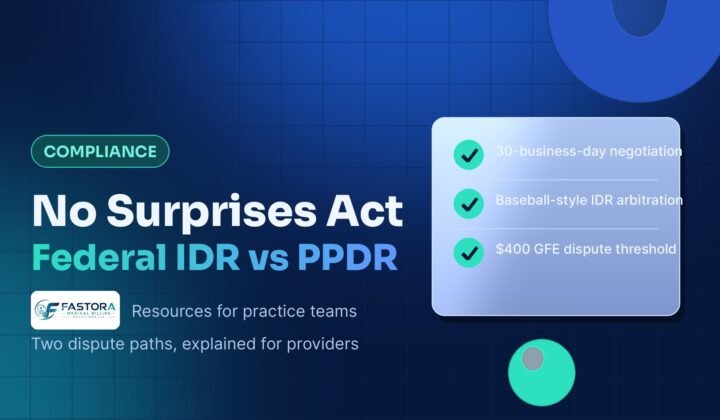
The No Surprises Act changed what emergency departments can bill patients for out-of-network emergency care. Balance billing restrictions, good faith estimate requirements, and the independent dispute resolution (IDR) process all touch emergency medicine directly.
An ED that hasn’t updated its billing workflow for these rules carries two risks: compliance exposure from balance billing violations, and revenue loss from not using the IDR process when payers underpay out-of-network emergency claims. The practices that handle this well have built No Surprises Act checks into their front-end process — eligibility verification that flags out-of-network scenarios, estimate workflows, and a defined IDR path for disputed payments.
What a clean ED billing workflow looks like
- E/M levels set from documented MDM, reviewed before the claim goes out
- Critical care minutes recorded separately from procedure time, in a dedicated note field
- Retro-authorization and retroactive coverage checked before balances go to patients
- Freestanding EDs billed under their own professional-fee workflow, audited separately from hospital EDs
- No Surprises Act rules built into the front-end process, with a defined IDR path for disputes
Emergency medicine billing rewards precision. The departments that get paid correctly are the ones whose documentation, coding, and payer rules all say the same thing. If your ED workflow has any of the gaps above, start with a free billing audit to see where the revenue is going — and pair it with a denial management process that catches what slips through. Our guide to reduce claim denials covers the prevention side in detail.
Frequently asked questions
What’s the most common emergency room billing error?
E/M leveling that doesn’t match the documented medical decision-making. It’s the most common because it’s the easiest to get wrong — coders level from habit or from the visit’s intensity rather than from the MDM elements in the note.
Can freestanding EDs bill the same way as hospital EDs?
No. Freestanding emergency departments need their own professional-fee billing workflow with the correct place of service and code sets. Using a hospital ED workflow for a freestanding location creates systematic errors.
How does the No Surprises Act affect ED billing?
It restricts balance billing for out-of-network emergency care, requires good faith estimates in certain scenarios, and provides an IDR process for payment disputes. EDs need these rules in their front-end workflow, not as an afterthought.
What should we check before sending an ED balance to the patient?
Verify whether retroactive Medicaid coverage exists and whether a retro-authorization is still obtainable. Both can convert a patient balance into a payer payment.
Do you handle facility fees for emergency departments?
No. Fastora focuses on professional-fee billing for physician practices and outpatient providers. Facility-fee billing is a separate discipline with different code sets and payer rules.