The No Surprises Act created two different federal dispute paths, and mixing them up can cost your practice its window to challenge a payment. One path handles insured surprise bills — a fight between the provider and the health plan over what the plan owes. The other handles uninsured and self-pay patients — a fight between the patient and the provider over a bill that exceeded a good faith estimate.
This guide explains both paths in plain terms: federal independent dispute resolution (IDR) and patient-provider dispute resolution (PPDR), which one applies to your situation, how each works, and what to have ready before a dispute starts.
Federal IDR: the provider-vs-plan path
Federal IDR is an arbitration-style process that settles payment disputes between providers and health plans for protected out-of-network services: out-of-network emergency services, non-emergency services furnished by nonparticipating providers at participating facilities, and out-of-network air ambulance services.
The critical point: the patient is not a party to federal IDR and is held harmless from the outcome. A federal IDR dispute is an argument over how much the plan owes you — not an appeal of a denied claim. A denial means the plan refused to pay at all; an IDR dispute happens after the plan has agreed to pay something and you disagree on the amount.
How the process works:
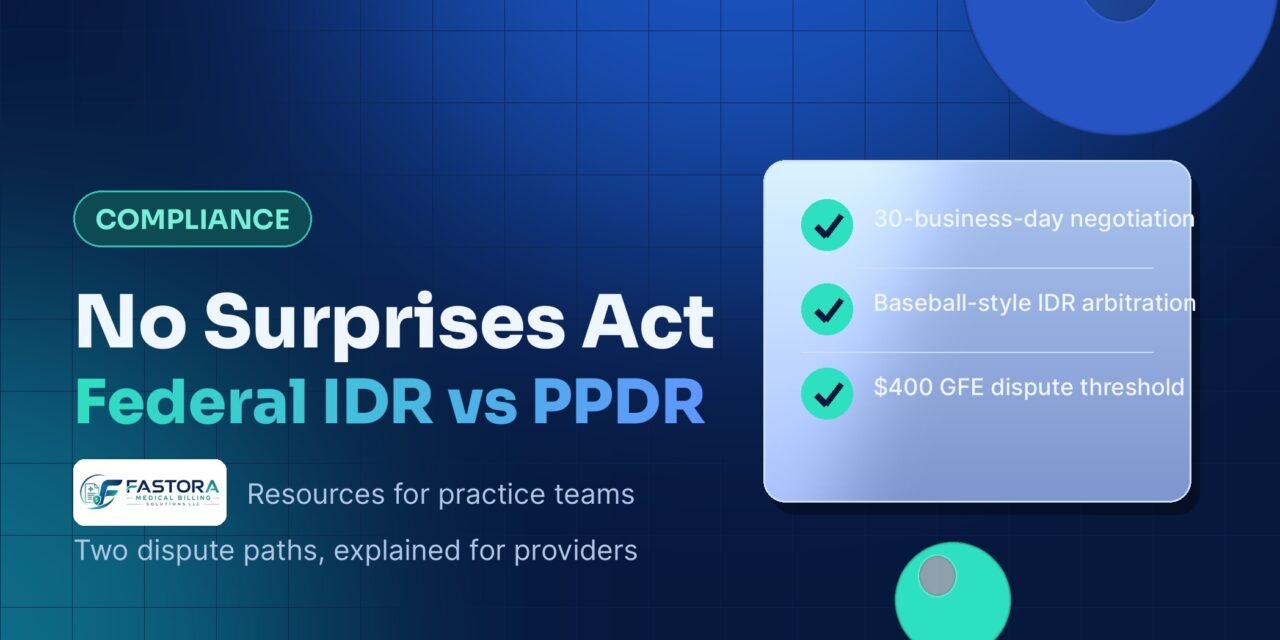
Step 1: Open negotiation — 30 business days. After the plan pays or denies a covered claim, the two sides get 30 business days to agree on an amount. Miss this window and the route to arbitration is closed entirely, so track it from day one.
Step 2: Initiate IDR — within 4 business days. If negotiation fails, either party may initiate federal IDR through the CMS portal in a 4-business-day window after the negotiation period ends.
Step 3: Baseball-style arbitration. Each side submits the payment amount it believes is correct, and the certified IDR entity picks one — it cannot split the difference. That format pushes both sides to submit reasonable numbers.
Step 4: The qualifying payment amount (QPA). The IDR entity starts from the QPA, generally the plan’s median contracted rate for a comparable service. A party can rebut it with credible information — case complexity, provider experience, market conditions — but the evidence must clearly show the service’s value is materially different.
Step 5: A binding determination. The IDR entity issues a binding decision, generally within 30 business days of selection. The party whose offer was not chosen pays the IDR entity’s fee; both parties pay a non-refundable administrative fee.
State law comes first. In states whose laws already set a payment standard or their own dispute process, the state rules generally apply instead of the federal process — check your state before assuming federal IDR.
Patient-provider dispute resolution: the patient-vs-provider path
The second federal path has nothing to do with insurance. Patient-provider dispute resolution (PPDR) is for uninsured and self-pay patients whose final bill came in at least $400 more than the good faith estimate they received before care, measured per provider or facility.
The patient (not the practice) initiates it, and it works like this:
- The patient first contacts the practice. The patient should tell you the bill is more than $400 above the estimate and ask you to match the estimate, negotiate, or discuss financial assistance. Many disputes end right here.
- If that fails, the patient has 120 calendar days (about four months) from the date of the original bill to start the dispute through the HHS/CMS process, at a $25 administrative fee.
- Collections must pause. While a PPDR dispute is pending, the disputed bill cannot be moved into collections or threatened with collections; if it is already there, it goes on hold, and no late fees can be collected until the process ends.
- An HHS-selected entity decides. It reviews the estimate, the bill, and both sides’ documentation, then sets what the patient owes: the estimate amount, the billed amount, or something in between. It weighs whether your documentation credibly shows the difference reflects a medically necessary service stemming from unforeseen circumstances that could not reasonably have been anticipated.
- Providers cannot retaliate. The dispute cannot be used against the patient or affect the quality of their care.
The contrast with federal IDR is sharp: no negotiation period, no QPA, no baseball-style offers — just a review of whether your estimate was sound and the extra charges were genuinely unforeseeable.
Federal IDR vs. patient-provider dispute resolution at a glance
| Federal IDR | Patient-provider dispute resolution (PPDR) | |
|---|---|---|
| Who disputes | Provider vs. health plan | Patient vs. provider or facility |
| Which patients | Insured, in surprise-billing situations | Uninsured or self-pay |
| Deciding | How much the plan owes the provider | How much the patient owes the provider |
| Trigger | Payment falls short; negotiation fails | Bill is $400+ above the good faith estimate |
| Time limits | 30-business-day negotiation, then 4 days to initiate | Patient contacts the practice first; 120 calendar days to file |
| Decision style | Baseball-style: IDR entity picks one offer | Reviewer sets estimate, billed, or in between |
| Key benchmark | Qualifying payment amount (QPA) | The good faith estimate |
| Collections | Not applicable — patient is held harmless | Collections must pause |
| Cost | Loser pays the IDR entity fee; both pay an admin fee | $25 administrative fee |
| State law | State standards can preempt the federal process | Federal process |
What your practice should do now
Sort every dispute into the right path on day one. Insured surprise bill (dispute with the plan) or self-pay estimate dispute (dispute with the patient) — train the team to tell the difference fast, because the deadlines do not wait.
Treat open negotiation like a hard deadline. Miss the 30-business-day window and arbitration is off the table. Keep out-of-network claims, estimates, consent records, and remittances organized so negotiation starts the day the plan’s determination lands. Underpayments that look like routine denials may be IDR-eligible — systematic denial management and underpayment recovery reviews catch these.
Make good faith estimates defensible. In PPDR, the estimate is the benchmark — its charges, expected scope, and assumptions must match what your team actually does. Practices issuing superbills for out-of-network visits already have much of that documentation discipline.
Never balance-bill a protected patient. In an insured surprise-billing situation the patient is not part of the payment fight — billing them the difference buys no leverage and invites compliance penalties.
Check state law first. Where your state has its own payment standard or dispute process, it generally governs — multi-state practices need a state-by-state answer.
For the full compliance picture — balance-billing prohibitions, notice and consent, good faith estimate requirements, and state-vs-federal rules — read our companion guide, No Surprises Act billing compliance for providers.
Common mistakes practices make
- Confusing an IDR dispute with a claim denial. Denials are appealed through the plan’s process; IDR disputes argue the amount on a claim already processed. Filing in the wrong system burns the deadline on the right one.
- Letting the open-negotiation window expire. It runs from the plan’s determination, and late discovery usually means losing the arbitration option.
- Submitting an IDR offer without evidence. Decisions start from the QPA — an offer asserting a charge is “reasonable” without market data or case justification rarely moves it.
- Treating good faith estimates as informal. In PPDR the estimate is the benchmark; vague estimates are the easiest disputes to lose.
- Pursuing collections during a PPDR dispute. All collection activity and late fees must stop while the dispute is pending. Patient billing and collections workflows need a dispute-hold step built in.
Frequently asked questions
Can the patient be billed if the provider loses a federal IDR dispute?
No. The patient is not a party to federal IDR and is held harmless — they cannot be billed the difference between the award and the plan’s payment, whoever wins. If such a bill arrives, the patient can contact the provider’s billing office and file a complaint with the federal No Surprises Help Desk.
What is the difference between federal IDR and a regular claim appeal?
A claim appeal challenges a plan’s decision not to pay a claim. Federal IDR challenges the amount of a payment on a claim the plan has already processed, for protected out-of-network services. The parties, processes, and timelines differ — sort them correctly from the start.
Does the $400 threshold apply per service or per provider?
Per provider or facility: if any one provider’s or facility’s bill is at least $400 more than its good faith estimate, the patient can start the process.
How long does the patient-provider dispute resolution process take?
The HHS-selected entity generally determines the amount owed within about 30 business days of receiving all necessary information. The patient has 120 calendar days from the original bill’s date to start the process.
Can a practice settle with the patient during PPDR?
Yes — the patient contacts the practice before starting the formal process, and many disputes resolve there through a corrected bill, a negotiated amount, or financial assistance. That first conversation is the cheapest dispute-resolution step a practice has.
Federal IDR and patient-provider dispute resolution share a name and a law, but almost nothing else: different parties, triggers, decision rules, and deadlines. Sorting each dispute into the right path on day one — insured surprise bill vs. self-pay estimate dispute — protects your revenue and keeps you on the right side of the compliance rules.
If payment disputes are eating into your collections, our free billing assessment reviews your denials, underpayments, and billing workflows to show exactly where revenue is leaking.
Sources: CMS No Surprises Act resources (cms.gov/nosurprises); Health Affairs Forefront guidance on No Surprises Act implementation; Conference Board research on health care costs and the No Surprises Act.