Start by deciding whether the denial needs an appeal
Knowing how to appeal a denied insurance claim starts one step earlier: confirming that an appeal is the right tool. Many denials are not disputes at all. They are rejections or front-end errors, such as a wrong member ID, a missing modifier or a typo in the date of service, and they are fixed faster by correcting and resubmitting the claim.
An appeal is for a decision you disagree with on the merits: the payer says the service was not medically necessary, was not covered, needed an authorization you believe was not required, or was bundled when it should have paid separately. Our guide on corrected claims versus appeals walks through that choice in detail.
- Rejected at the clearinghouse or payer front end: fix the data and resubmit. No appeal exists because no claim was adjudicated.
- Denied for a billing error you made: submit a corrected claim or, for Medicare, request a reopening.
- Denied on medical necessity, coverage, authorization or coding judgment: appeal with documentation.
- Paid less than your contract rate: many payers treat this as a payment dispute or reconsideration first, then a formal appeal.
Read the denial before you write anything
The remittance tells you what the payer decided and why. Look at the group code, the Claim Adjustment Reason Code (CARC) and any Remittance Advice Remark Code (RARC). Group code CO means the contractual obligation sits with the provider, PR means patient responsibility, and OA covers other adjustments. Our CARC and RARC reference explains the common codes.
Then pull the pieces you will need: the original claim, the remittance or denial letter, the visit note, any authorization record, the eligibility response from the date of service and the payer policy that applies. Appeals succeed or fail on documentation, so gather it before you draft.
The Medicare claim appeal process: five levels
Original Medicare (Parts A and B) has a fixed, five-level structure. Each level has its own deadline, counted from the date you receive the previous decision. CMS presumes receipt five days after the date on the notice unless you can show otherwise.
| Level | Who decides | Filing deadline |
|---|---|---|
| 1. Redetermination | The Medicare Administrative Contractor (MAC) that processed the claim | 120 days from receipt of the initial determination |
| 2. Reconsideration | A Qualified Independent Contractor (QIC) | 180 days from receipt of the redetermination |
| 3. Hearing | Office of Medicare Hearings and Appeals (Administrative Law Judge or attorney adjudicator) | 60 days from receipt of the reconsideration; an amount-in-controversy threshold applies |
| 4. Council review | Medicare Appeals Council | 60 days from receipt of the hearing decision |
| 5. Judicial review | Federal district court | 60 days from receipt of the Council decision; a higher amount-in-controversy threshold applies |
The amount-in-controversy thresholds for levels 3 and 5 are adjusted each year and published by CMS, so check the current figure before filing. Most Medicare claim appeals are decided at levels 1 and 2. Redetermination requests can be made on form CMS-20027 or through the MAC's portal, and reconsiderations on form CMS-20033.
Submit everything you want considered by level 2. New evidence presented after the reconsideration may be excluded later unless there is good cause, so a thin first appeal can weaken the whole case.
Commercial payer appeals: the common pattern
Commercial plans set their own appeal steps in provider manuals and contracts. Most follow a similar outline, but the names and deadlines vary, so treat the list below as a pattern, not a rule for any one payer.
- Informal reopening or reconsideration. Often a phone call, portal request or form that asks the payer to look again, usually for straightforward errors.
- First-level formal appeal. A written appeal with a letter and records, filed within the window in your contract or provider manual.
- Second-level appeal. Some plans offer a second internal review, sometimes by a different reviewer or a physician of the same specialty.
- External review or dispute resolution. For member appeals, federal and state law provide independent review in many cases. Provider contract disputes may go to arbitration under the agreement.
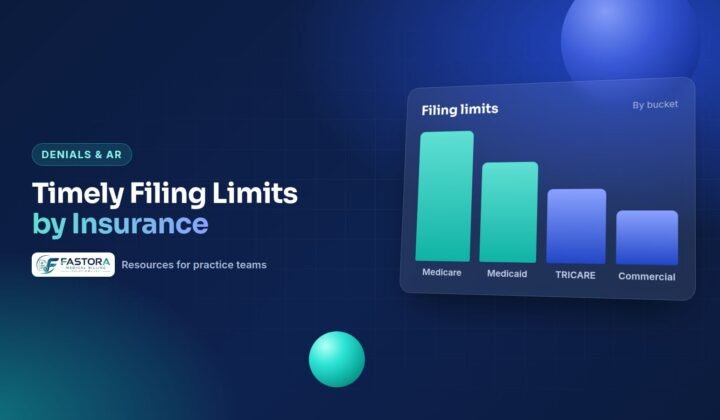
Medicare Advantage and Medicaid managed care plans have their own processes, separate from Original Medicare. A Texas Medicaid plan such as Superior HealthPlan, for example, publishes its own reconsideration and appeal deadlines. See our guide to timely filing limits for how filing and appeal windows differ by payer.
Step-by-step: how to file the appeal
- Log the denial with the date received and the appeal deadline, so it shows up in your work queue well before it expires.
- Confirm the denial reason and whether an earlier step (reopening, reconsideration or corrected claim) is required first.
- Pull the payer policy, LCD or NCD, or contract section that supports payment.
- Collect the medical records, and highlight or tab the parts that answer the denial reason.
- Write the appeal letter using the outline below, and use the payer's required form if it has one.
- Submit through the channel the payer specifies (portal, fax or mail) and keep proof of submission.
- Calendar a follow-up date. If there is no decision within the payer's stated response time, call and document the call reference.
- Record the outcome and the root cause, so the same denial is prevented at the front end next time.
Insurance appeal letter template (structured outline)
Use this insurance appeal letter template as an outline, not a script. Fill each part with the facts of your claim. Keep the letter to one or two pages, and let the attached records carry the detail.
| Section | What to include |
|---|---|
| Header | Practice name, address, NPI and tax ID; date; payer name and appeals address or fax |
| Reference block | Patient name, member ID, claim number, date(s) of service, billed CPT/HCPCS codes, billed amount, denial date and denial reason code |
| Opening statement | One sentence stating that you are requesting a first-level (or second-level) appeal of the denial, and what outcome you are asking for |
| Clinical summary | Two to four sentences on why the patient was seen and what was done, written so a reviewer understands the need without reading the full chart |
| Reason the denial is incorrect | Point-by-point response to the denial reason, citing the specific policy, coverage article or contract section |
| Supporting evidence | List of enclosures: visit notes, test results, authorization number, prior treatment history, letter of medical necessity |
| Request | A clear ask: reprocess and pay the claim per the contract, or reverse the medical necessity determination |
| Signature and contact | Name, title, phone and email of the person the payer should contact |
Avoid emotional language and long histories. A reviewer is matching your evidence against a policy, so make the match easy to see.
Common reasons appeals fail
- Filed after the deadline, or sent to the wrong address or portal queue.
- Missing the records that answer the specific denial reason.
- Appealing a claim that should have been corrected and resubmitted instead.
- Arguing coding preference without citing a policy, NCCI edit or code descriptor.
- No follow-up, so the appeal sits unresolved until the next deadline passes.
Track your overturn rate by payer and denial reason. If one reason keeps coming back, the fix usually belongs upstream in eligibility checks, authorizations or charge entry, as covered in our billing process guide.
Getting help with appeals
If appeals are piling up or deadlines are slipping, Fastora's denial management and appeals service handles denial research, appeal letters and payer follow-up, with every claim worked by certified billing and coding professionals. A free claims audit can show where your denials start.
Missing-information denials have their own route; see CO-16 denial code before you appeal.
Checklist
Frequently asked questions
How long do I have to appeal a denied Medicare claim?
For Original Medicare, a redetermination must be filed within 120 days of receiving the initial determination. If that fails, you have 180 days from receiving the redetermination to request a reconsideration by a Qualified Independent Contractor. Later levels each allow 60 days.
Is a corrected claim the same as an appeal?
No. A corrected claim replaces a claim that had an error you made, such as a wrong code or date. An appeal asks the payer to change a decision you believe was wrong. Using the wrong route can delay payment or burn an appeal level.
What should an insurance appeal letter include?
Identify the patient, claim number, date of service and denial reason, state what you are asking for, explain why the denial is incorrect with a cited policy or contract section, and list the enclosed records. Keep it short and factual.
How long do commercial payers allow for appeals?
It depends on the payer, plan and your contract. Windows are set in the provider manual or participation agreement, and they often differ from the initial filing limit. Check the document that governs your agreement and record the deadline when the denial arrives.