Why secondary claims go wrong
Knowing how to bill secondary insurance matters because a second plan can cover part or all of what the primary plan left unpaid, but only if the claim reaches it in the right order and with the right data. Most secondary denials trace back to three gaps: the wrong payer was billed first, the primary payer's adjudication was missing, or the deadline ran out while staff waited on the first payment.
The process has four parts: identify every plan at registration, decide which plan is primary, bill the primary, then bill the secondary with the primary's payment and adjustment detail attached. The sections below cover each step and the Medicare-specific rules that change it.
Coordination of benefits: deciding which plan pays first
Coordination of benefits (COB) is the set of rules payers use to decide the order of payment when a person has more than one plan. It also keeps the combined payments from exceeding the total amount of the claim. The primary plan pays first under its own terms, and the secondary plan then considers what is left.
Commercial plans generally follow order-of-benefit rules modeled on industry standards, though the plan document has the final word. Common rules include:
- Own coverage before dependent coverage: a plan that covers the patient as the employee or subscriber usually pays before a plan that covers them as a spouse or dependent.
- Birthday rule for children: when a child is covered by both parents' plans, many plans make the parent whose birthday falls earlier in the calendar year primary. Divorce decrees or custody orders can change this.
- Active before retiree or COBRA: coverage through current employment usually pays before retiree coverage or continuation coverage.
- Longer coverage first: when no other rule decides, the plan that has covered the person longer is often primary.
Payers also keep their own COB records and may deny a claim until the member confirms other coverage. If a remittance shows CARC 22, which signals the care may be covered by another payer under COB rules, contact the patient and update the record with the payer before rebilling.
Medicare Secondary Payer rules
Medicare Secondary Payer (MSP) rules decide when another payer must pay before Medicare. CMS's Benefits Coordination & Recovery Center (BCRC) gathers information about other coverage and keeps records so Medicare does not pay first when another party should.
Situations where Medicare is commonly secondary include the following. The details, such as employer size thresholds, are set out in CMS MSP guidance, so check the current rules when a case is unclear.
| Situation | Usually primary | What to collect at intake |
|---|---|---|
| Patient 65+ still working, covered by an employer group health plan (larger employers) | Employer group health plan | Employer name, plan ID, whether coverage is from current employment |
| Patient under 65 with Medicare due to disability, covered by a large employer plan | Employer group health plan | Whose employment the coverage comes from |
| End-stage renal disease during the coordination period | Group health plan | Date Medicare eligibility began |
| Work-related injury or illness | Workers' compensation | Claim number, adjuster, date of injury |
| Accident with auto or liability coverage | No-fault or liability insurer | Carrier, claim number, accident date |
Many practices use an MSP questionnaire at the first visit and update it periodically, so the answers are documented before a claim is sent. If Medicare's records show another primary payer that is no longer active, the beneficiary or the provider contacts the BCRC to update the record before Medicare will pay as primary.
Step by step: how to bill a secondary claim
- Capture both plans at registration. Scan both cards, record subscriber names, dates of birth and relationship, and run eligibility and benefits checks on each plan.
- Set the payer order in the practice management system. Primary, secondary and any tertiary plan should be ranked before charges are entered.
- Bill the primary payer only. Do not send the same claim to both plans at once unless a payer specifically instructs it.
- Post the primary payment line by line. Record allowed amounts, payments and every adjustment with its group code and CARC. Our guide to EOB vs ERA explains how to read those fields.
- Check whether the claim crossed over. For Medicare primary claims, see whether the remittance shows the claim was forwarded to the supplemental payer before you send anything yourself.
- Send the secondary claim with primary adjudication. Electronic claims carry the primary payer's paid amount and adjustments at claim and line level. Paper claims need the primary EOB attached.
- Post the secondary payment and bill the patient last. Only the balance left after all plans have processed goes to the patient.
What the electronic secondary claim must carry
On an 837P secondary claim, the other payer's information sits in the other subscriber loops, and the primary payer's paid amounts and claim adjustment segments are reported for the claim and each service line. If the adjustment group codes and CARCs do not match the primary remittance, the secondary payer may deny the claim or calculate its share incorrectly.
Crossover claims with Medicare
Crossover claims are Medicare claims that are forwarded automatically to a supplemental payer after Medicare processes them. Under the Coordination of Benefits Agreement (COBA) program, CMS has a standard agreement with participating supplemental insurers, and the BCRC transmits Medicare-adjudicated claim data to them. Most Medigap plans participate.
When a claim crosses over, the Medicare remittance usually includes a message showing where it was sent. Sending the same claim to the supplemental payer yourself creates a duplicate. Wait for the crossover to process, then follow up with the supplemental payer if nothing arrives within its normal processing window.
When crossover does not happen
- The supplemental plan does not participate in COBA, or the patient's eligibility file did not match.
- The secondary is a commercial or employer plan rather than a Medigap or supplemental policy.
- The secondary is Medicaid in a state or program that requires the provider to submit the claim directly.
In Texas, for example, the Texas Medicaid Provider Procedures Manual says services covered by both programs must be filed with Medicare first, and TMHP must receive the Medicaid claim within 95 days of the Medicare disposition date. Our Texas Medicaid billing guide covers the rest of the TMHP rules.
Deadlines for secondary claims
Secondary claims have their own filing limits, and many payers count them from the primary payer's processing date rather than the date of service. Cigna, for example, says that when it is secondary, timely filing is determined from the processing date on the primary carrier's EOB or explanation of payment. Other payers and contracts set different rules.
Do not let a slow primary payer run out the secondary clock. Track the primary claim date, the primary adjudication date and the secondary deadline in the same work queue. Our article on timely filing limits lists the published limits for major payers and where to confirm them.
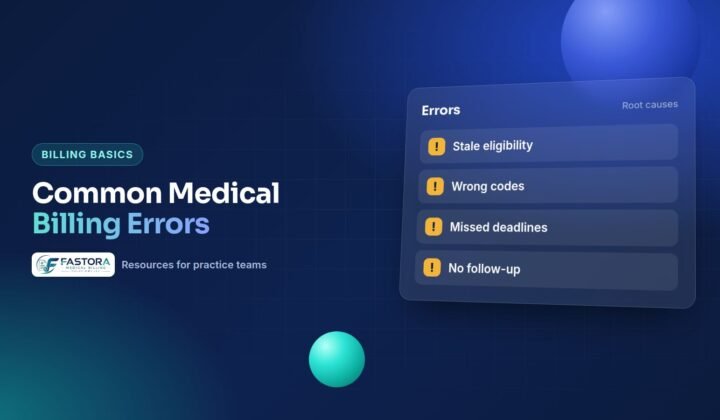
Common secondary billing errors
| Error | What happens | Fix |
|---|---|---|
| Wrong primary payer | Primary denies for COB; secondary denies because no primary adjudication | Confirm the order with the patient and both payers, update records, rebill the correct primary |
| Primary detail missing from the 837 | Secondary rejects or pends the claim | Rebuild the claim with claim- and line-level primary payments and adjustments |
| Adjustments copied incorrectly | Secondary pays the wrong amount | Match group codes, CARCs and amounts to the primary remittance exactly |
| Duplicate after crossover | Secondary denies as a duplicate | Check the Medicare remittance for crossover before submitting |
| Patient billed too early | Patient pays an amount the secondary would have covered | Hold patient statements until every plan has processed |
Getting secondary balances collected
Secondary balances often sit unworked because they look small line by line. Fastora's payment posting team posts primary remittances, sends secondary claims with complete adjudication data and tracks crossover follow-up, with certified billing professionals reviewing exceptions. A free billing assessment can show how much secondary A/R is waiting in your system.
Checklist
Frequently asked questions
Can I bill primary and secondary insurance at the same time?
Generally no. The secondary payer needs the primary payer's adjudication to decide what it owes, so a secondary claim sent before the primary processes is usually denied or pended. Bill the primary first, post the result, then send the secondary claim with the primary payment and adjustment detail.
What is a Medicare crossover claim?
It is a claim Medicare forwards automatically to a supplemental insurer after Medicare processes it. CMS runs this through its COBA crossover program. If the remittance shows the claim crossed over, wait for the supplemental payer to process it instead of submitting a duplicate.
How do I know if Medicare is primary or secondary?
Ask the patient about employment-based coverage, workers' compensation and accident claims at intake, often with an MSP questionnaire, and check Medicare eligibility data for other insurance on file. If records are wrong, the beneficiary or provider contacts the Benefits Coordination & Recovery Center to correct them.
When can I bill the patient after a secondary claim?
After every plan has processed the claim. The remaining balance should match the patient responsibility left after the secondary and any tertiary payer. Billing earlier can lead to patient overpayments and credit balances that later need refunds.