
How Texas Medicaid billing works
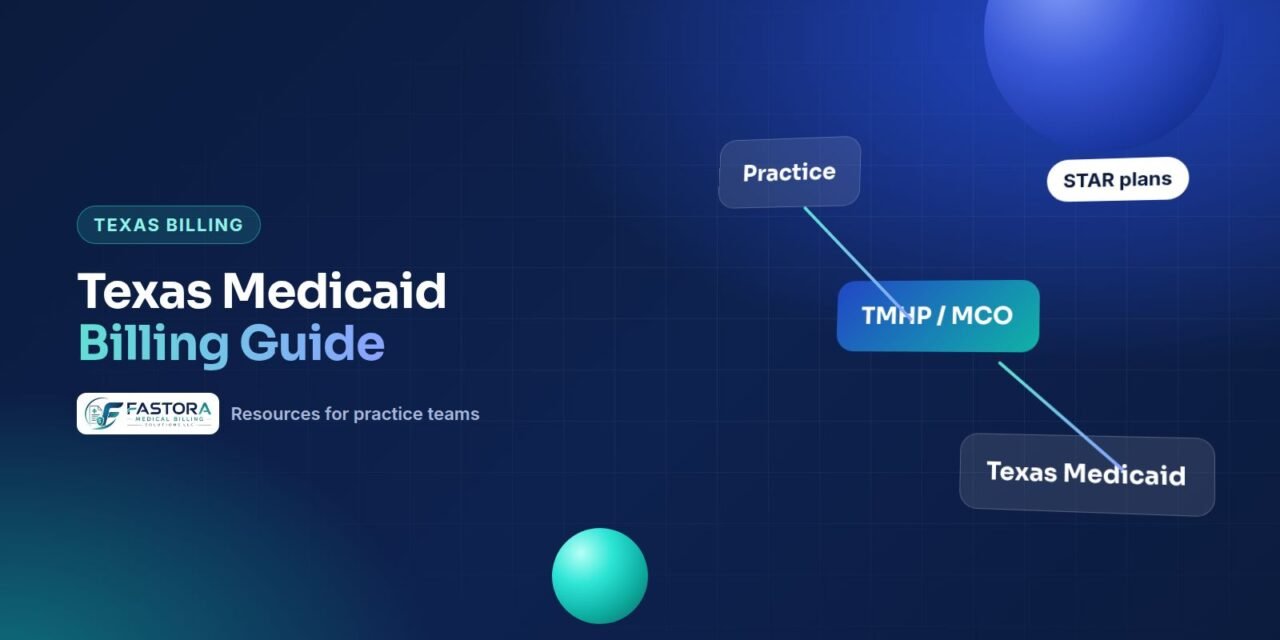
Texas Medicaid billing has two tracks. The Texas Health and Human Services Commission (HHSC) runs the program, and the Texas Medicaid & Healthcare Partnership (TMHP) acts as its claims administrator for fee-for-service Medicaid. Most Medicaid clients, however, are enrolled in managed care, so their claims go to a managed care organization (MCO) rather than to TMHP.
That means a practice has to do three things well: enroll with Texas Medicaid through TMHP, credential with each MCO it wants to serve, and send every claim to the payer responsible for that client on the date of service. This guide covers each step, the filing deadlines and where to find payment rates. The Texas Medicaid Provider Procedures Manual (TMPPM) on the TMHP website is the controlling reference, and it is updated monthly.
Texas Medicaid provider enrollment through TMHP
Texas Medicaid provider enrollment starts with TMHP. New enrollments, changes and revalidations are handled online in the Provider Enrollment and Management System (PEMS). A provider must be enrolled in Texas Medicaid before an MCO can contract with them for Medicaid members.
- Confirm the clinician's Texas license and the group's NPI, taxonomy and tax ID match across every record.
- Create a PEMS account and submit the enrollment for the individual provider and, for a group, the group and its performing providers.
- Complete the ownership, disclosure and screening sections, and upload the documents PEMS requests.
- Respond quickly to any deficiency notice, since an open request stops processing.
- Once enrolled, record the Texas Provider Identifier (TPI) and effective date.
- Apply to the MCOs that serve your patients in your service area.
TMHP provider enrollment is not a one-time step. HHSC requires periodic revalidation, and changes such as a new address, new ownership or a provider leaving the group must be reported through PEMS. For how Medicaid fits with Medicare and commercial credentialing, see the provider credentialing guide.
The STAR programs and Texas Medicaid managed care billing
HHSC delivers most Medicaid benefits through managed care programs. Each program serves a different population and is offered by a set of MCOs in each service area.
| Program | Who it serves | Where claims go |
|---|---|---|
| STAR | Most children, pregnant women and low-income families on Medicaid | The member's STAR MCO |
| STAR+PLUS | Adults with disabilities and adults age 65 and older, including many with Medicare | The member's STAR+PLUS MCO (Medicare pays first for dual-eligible members) |
| STAR Kids | Children and young adults with disabilities | The member's STAR Kids MCO |
| STAR Health | Children and youth in state conservatorship (foster care), served statewide by one MCO | The STAR Health MCO |
| Traditional (fee-for-service) Medicaid | Clients not enrolled in a managed care plan, and services carved out of managed care | TMHP |
For Texas Medicaid managed care billing, the MCO's provider manual and contract control prior authorization lists, claim forms, electronic payer IDs and appeal steps. STAR Medicaid billing to one MCO can look different from billing to another MCO for the same service, so keep a payer-by-payer reference sheet.
Superior HealthPlan billing and credentialing
Superior HealthPlan is one of the larger Texas Medicaid MCOs and is the statewide plan for STAR Health. Superior HealthPlan credentialing follows its own application process after TMHP enrollment is in place, and Superior HealthPlan billing goes to the plan using its payer ID and portal, not to TMHP. Check which Superior products you are contracted for, since participation in one program does not always cover the others.
BCBS Texas billing for Medicaid members
Blue Cross and Blue Shield of Texas also offers Medicaid managed care in certain service areas. BCBS Texas billing for a Medicaid member goes to the BCBSTX Medicaid plan under that product's rules, which can differ from the same company's commercial plans. Confirm the member's product on the ID card before billing.
Eligibility checks before the visit
Texas Medicaid eligibility can change month to month, and members can switch MCOs. Verify eligibility and the assigned plan for the date of service at every visit, not just at intake.
- Check eligibility through TMHP tools or the MCO portal, and note the program (STAR, STAR+PLUS, STAR Kids, STAR Health or traditional Medicaid).
- Ask for the Your Texas Benefits Medicaid card and any MCO card, but rely on the electronic check for the date of service.
- Identify other insurance, including Medicare, since Medicaid is the payer of last resort.
- Check whether the service needs prior authorization from the MCO or TMHP before the visit.
TMHP claims submission for fee-for-service Medicaid
TMHP billing applies to clients in traditional Medicaid and to services carved out of managed care. Professional claims use the CMS-1500 format or the electronic 837P transaction. TMHP claims submission can be done through TexMedConnect, TMHP's online claims portal, or through EDI using billing software or a clearinghouse. Paper claims are accepted but process more slowly.
Claims must include the provider's NPI and the information TMHP uses to match the enrolled provider, such as taxonomy and service location. A mismatch between the claim and the PEMS enrollment record is a common reason for rejections. TMHP reports claim outcomes on its Remittance and Status (R&S) report, which also starts the clock for appeals.
Texas Medicaid timely filing
The TMPPM claims filing section sets the basic Texas Medicaid timely filing rule: claims must be received by TMHP within 95 days from the date of service. HHSC's managed care contract rules require MCOs to allow at least the same 95 days for providers to file, but check each MCO contract for its exact deadline and method of counting.
| Situation | Deadline to watch | Where to check |
|---|---|---|
| Fee-for-service claim to TMHP | 95 days from the date of service | TMPPM Vol. 1, Section 6: Claims Filing |
| Claim to a Medicaid MCO | At least 95 days from the date of service, per contract | MCO provider manual and contract |
| Medicare crossover or other insurance paid first | Separate deadline measured from the primary payer's disposition | TMPPM Section 6 and the MCO manual |
| Appeal of a TMHP claim decision | Deadline counted from the R&S report date | TMPPM appeals section |
Ninety-five days is short compared with Medicare, so Medicaid claims should go out first in the work queue. Our article on timely filing limits compares deadlines across payer types.
Texas Medicaid fee schedule lookup
TMHP publishes the Texas Medicaid fee schedule for fee-for-service claims in two ways: static fee schedules by provider type and the Online Fee Lookup (OFL) tool, both on the TMHP fee schedules page. Rates change through the year as HHSC adopts updates, so look up the rate for your date of service rather than using a saved copy.
MCOs pay according to their contracts with each provider. Many MCO contracts are tied to the Medicaid fee schedule, but the terms differ, so compare MCO payments with your contract and flag underpayments. TMPPM Section 2 explains the methods Texas Medicaid uses to set fee-for-service reimbursement.
Specialty notes: therapy and behavioral health
Texas Medicaid physical therapy billing
Texas Medicaid physical therapy billing follows the therapy services rules in the TMPPM and each MCO's policy. Expect requirements for an evaluation, a plan of care signed by the ordering physician or allowed practitioner, and prior authorization for ongoing treatment. Units must match documented treatment time, and authorization periods must cover every date billed. More detail on coding is in our page on physical therapy billing.
Texas Medicaid speech therapy billing
Texas Medicaid speech therapy billing works the same way, with its own evaluation and treatment codes and authorization rules. Many pediatric speech clients are in STAR or STAR Kids, so the MCO's authorization process and visit limits usually govern.
Texas Medicaid behavioral health billing
Texas Medicaid behavioral health billing covers services such as psychiatric evaluation, psychotherapy and psychological testing by enrolled practitioners, including psychiatrists, psychologists, LCSWs, LPCs and LMFTs. Most behavioral health benefits are provided through the MCOs, some of which use a separate behavioral health vendor. Check the TMPPM Behavioral Health and Case Management Services Handbook and each MCO's rules on license types, supervision and authorization. See behavioral health billing for practice-level considerations.
Common Texas Medicaid denials and how to avoid them
- Claim sent to TMHP for a member enrolled in an MCO, or to the wrong MCO after a plan change.
- Provider not enrolled, not revalidated or not linked to the group in PEMS.
- Rendering provider not credentialed with the MCO for that program.
- Missing or expired prior authorization for the date of service.
- Claim received after the filing deadline.
- Other insurance or Medicare not billed first.
- Taxonomy, NPI or service location on the claim not matching the enrollment record.
Most of these are preventable at the front desk or in enrollment, which is why eligibility checks and an accurate PEMS record matter as much as coding.
Getting help with Texas Medicaid claims
Fastora is based in Austin and handles TMHP and MCO claims, credentialing and follow-up for practices across Texas through its claims management service. A free billing assessment can show where Medicaid claims are being rejected or filed late.
Working with a Texas Medicaid billing company
A Texas Medicaid billing company should know the TMHP landscape from daily work: Medicaid managed care plans with their own authorization portals, prior authorization rules that differ by plan, provider enrollment through TMHP with revalidation on a calendar, and the timely filing limits that vary across plans. For practices new to Texas Medicaid, the first two checks are enrollment status and which managed care plans your patients actually carry — claims built on the wrong plan are the most common Texas Medicaid denial. See our Texas medical billing services page, our credentialing and enrollment team handles TMHP enrollment, see billing for small practices.
Checklist
Frequently asked questions
What is the timely filing limit for Texas Medicaid?
TMHP requires fee-for-service claims to be received within 95 days from the date of service. Medicaid MCOs must allow at least 95 days under HHSC contract rules, but check each MCO contract. Different deadlines apply when Medicare or another insurer pays first.
Do I bill TMHP or the MCO?
Bill the payer responsible for the member on the date of service. Members in STAR, STAR+PLUS, STAR Kids or STAR Health are billed to their MCO. Traditional Medicaid clients and carved-out services are billed to TMHP.
Do I need to enroll with TMHP before joining a Medicaid MCO?
Yes. A provider must be enrolled in Texas Medicaid through TMHP before an MCO can contract with them to serve Medicaid members. MCO credentialing is a separate step after TMHP enrollment.
Where do I find Texas Medicaid rates?
Use the static fee schedules or the Online Fee Lookup tool on the TMHP fee schedules page for fee-for-service rates. MCO payment rates are set by your contract with each plan.



2 comments