Physical Therapy Billing
Medicare no longer places a hard cap on outpatient therapy, but it does set an annual dollar threshold. Once a patient’s therapy charges pass it, every claim must carry the KX modifier, and claims without it are denied automatically. For physical therapy, occupational therapy and speech-language pathology practices with Medicare patients, tracking that threshold is a routine part of billing.
This guide explains the 2026 KX modifier threshold amounts, how the threshold accrues, when to append KX, what documentation supports it, how the targeted medical review threshold works, and how the KX modifier fits with the other therapy modifiers.
Key takeaways
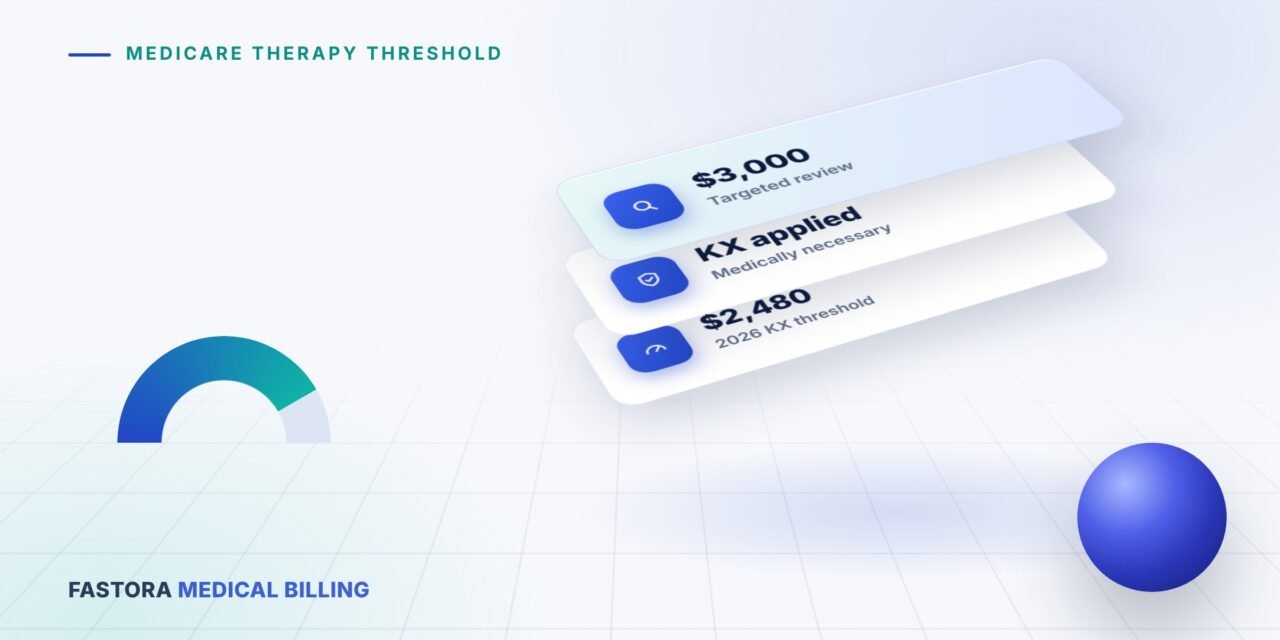
- 2026 KX threshold: $2,480 for PT and speech therapy combined, and a separate $2,480 for OT.
- Claim lines above the threshold without the KX modifier are denied automatically.
- Claims above $3,000 can be selected for targeted medical review.
In this guide
- 01The 2026 Medicare therapy threshold amounts
- 02What the KX modifier means
- 03How the threshold accrues
- 04When to append the KX modifier
- 05Documentation that supports the KX modifier
- 06The $3,000 targeted medical review threshold
- 07When services are not medically necessary
- 08How KX fits with the other therapy modifiers
- 09Medicare Advantage and other payers
- 10A KX tracking workflow for therapy clinics
- 11Frequently asked questions
The 2026 Medicare therapy threshold amounts
For calendar year 2026, CMS set the KX modifier threshold at:
| Discipline | 2026 KX modifier threshold | Targeted medical review threshold |
|---|---|---|
| Physical therapy and speech-language pathology, combined | $2,480 | $3,000 |
| Occupational therapy | $2,480 | $3,000 |
Two details matter here. First, PT and speech therapy share one threshold, while OT has its own. Second, the threshold is measured in Medicare allowed amounts, not in your billed charges.
CMS updates the KX threshold every year. The 2026 figures come from the CMS therapy services page and the CMS annual threshold transmittal; check them again at the start of each year.
What the KX modifier means
When you append KX to a therapy claim line, you are attesting that:
- The services are medically necessary, and
- The medical record contains documentation that justifies continued therapy above the threshold.
It is not a formality. Applying KX automatically to every claim above the threshold, without a review of necessity, is a compliance risk. The modifier should reflect a clinical judgment the documentation supports.
How the threshold accrues
The threshold applies per beneficiary, per calendar year, and counts therapy services from every provider and outpatient setting that bills them under Medicare Part B, including private practices, hospital outpatient departments and other clinics. A new patient who saw another therapist earlier in the year may already be close to, or above, the threshold when they arrive.
That is why the threshold check belongs at intake:
- Check the patient’s Medicare eligibility through your Medicare Administrative Contractor’s portal or eligibility service, which reports the therapy amounts already applied for the year.
- Record the amount used for PT/SLP and for OT separately.
- Estimate how many visits remain before the patient reaches the threshold, based on your typical allowed amount per visit.
- Flag the account so claims are reviewed for KX once the threshold is reached.
Remember that other providers may continue to bill during the year, so the amount used can grow even between your own visits.
When to append the KX modifier
Append KX to each therapy claim line for services furnished after the patient’s accrued allowed amount exceeds the threshold for that discipline, when continued therapy is medically necessary and documented. Claim lines above the threshold without KX are denied.
Practical rules most clinics follow:
- Add KX to all therapy lines on the visit where the threshold is crossed and on every later visit in that calendar year for that discipline group.
- Keep the discipline modifier (GP, GO or GN) on every line as well.
- Review the plan of care and progress reports before the first KX claim to confirm that the record supports continued treatment.
Documentation that supports the KX modifier
Continued therapy above the threshold is easier to defend when the record shows:
- A current, certified plan of care with measurable functional goals.
- Progress reports showing objective, measurable progress, or a clear clinical reason why continued skilled therapy is needed despite slower progress.
- Why the patient still needs the skills of a therapist rather than a home program alone.
- Any complexities, such as comorbidities, a new injury or a post-surgical course, that explain the need for more care.
The $3,000 targeted medical review threshold
Medicare keeps a separate medical review threshold of $3,000 for PT/SLP combined and $3,000 for OT. Claims above it are not reviewed automatically. Instead, CMS uses targeted review, selecting claims based on factors such as provider billing patterns. A practice whose patients routinely exceed $3,000 should expect a higher chance of review and should make sure documentation is complete before each claim goes out.
When services are not medically necessary
If a patient wants to continue therapy above the threshold but the therapist does not believe it is medically necessary, the KX modifier should not be used. In that situation, the practice can issue an Advance Beneficiary Notice of Noncoverage (ABN) before providing the services, so the patient knows they may be responsible. Claims for those services are then billed with the GA modifier to show a valid ABN is on file, and without KX. A properly executed ABN is required to hold the patient financially responsible.
How KX fits with the other therapy modifiers
| Modifier | Meaning | When used |
|---|---|---|
| GP | Services delivered under an outpatient physical therapy plan of care | Every PT line |
| GO | Services delivered under an outpatient occupational therapy plan of care | Every OT line |
| GN | Services delivered under an outpatient speech-language pathology plan of care | Every SLP line |
| KX | Requirements specified in the medical policy have been met | Lines above the annual threshold, when medically necessary |
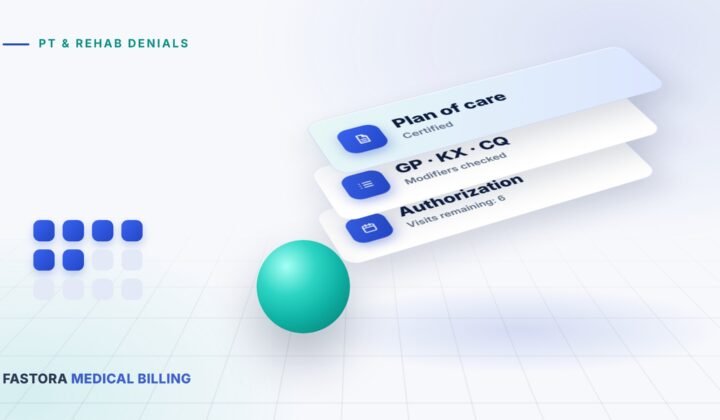
| CQ | Outpatient PT services furnished in whole or in part by a physical therapist assistant | PTA services; Medicare pays these lines at a reduced rate |
| CO | Outpatient OT services furnished in whole or in part by an occupational therapy assistant | OTA services; reduced rate |
| GA | Waiver of liability statement (ABN) issued as required | Services the therapist expects Medicare not to cover |
| 59 or XU, XS, XE, XP | Distinct procedural service | Only when needed to bypass a correct coding edit with documented, distinct services |
A single line can carry several modifiers, for example GP, CQ and KX. Check your clearinghouse’s ordering requirements and your Medicare contractor’s instructions.
Medicare Advantage and other payers
The KX threshold is a traditional Medicare (Part B) rule. Medicare Advantage plans may require KX, may use their own visit limits or authorization rules instead, or both. Medicaid and commercial plans generally do not use the KX threshold, but many have their own annual visit limits. Treat each payer’s therapy limits as a separate setting in your billing system.
A KX tracking workflow for therapy clinics
- Intake: check the therapy amounts already applied this year for PT/SLP and OT.
- Scheduling: estimate remaining visits before the threshold and flag the account.
- Each visit: update the running allowed total from remittances.
- At the threshold: confirm the plan of care and latest progress report support continued care; add KX to subsequent claims.
- Approaching $3,000: run a documentation quality check before claims go out.
- January: reset the counters and update the threshold amounts.
Frequently asked questions
Is the KX threshold a cap on Medicare therapy?
No. Since 2018, Medicare has not had a hard cap. Services above the threshold are covered when they are medically necessary and the claim carries the KX modifier.
Do PT and OT share the same threshold?
No. PT and speech-language pathology share one combined threshold, and OT has a separate threshold of the same amount.
What happens if I forget the KX modifier?
Claim lines above the threshold without KX are denied. If the services were medically necessary and documented, correct the claim with KX through your Medicare contractor’s reopening or correction process.
How do I know how much therapy a patient already used this year?
Medicare eligibility responses and your Medicare contractor’s portal report the therapy amounts applied for the year. Check at intake and periodically, because other providers’ claims can add to the total.
Does the KX modifier apply to Medicare Advantage patients?
It depends on the plan. Some Medicare Advantage plans follow the threshold and require KX; others use their own authorization or visit limits. Check each plan’s policy.
Work with Fastora
Keep Medicare therapy claims moving past the threshold
The KX modifier is easy to apply and easy to forget. Clinics that avoid KX denials treat the threshold as a tracked number from the first visit, not something discovered on a remittance.
Fastora Medical Billing Solutions supports PT and rehab practices with eligibility verification, threshold tracking, modifier review before submission, denial management and A/R follow-up. Learn more about our physical therapy billing services, see how timed units are calculated in our 8-minute rule guide, or contact Fastora.