Medical Billing Outsourcing
Most practices stay with a billing company longer than they should, because switching feels risky. The fear is reasonable: a poorly managed transition can leave claims unworked, payments unposted and denials unanswered for weeks. A well-managed one does not have to interrupt cash flow at all.
This guide covers the signs that it is time to switch medical billing companies, what to check in your current contract, the data you need before you leave, and a step-by-step transition plan that protects collections during the changeover.
Key takeaways
- Switch on patterns, not one bad month: rising old A/R, unexplained denials, no reporting.
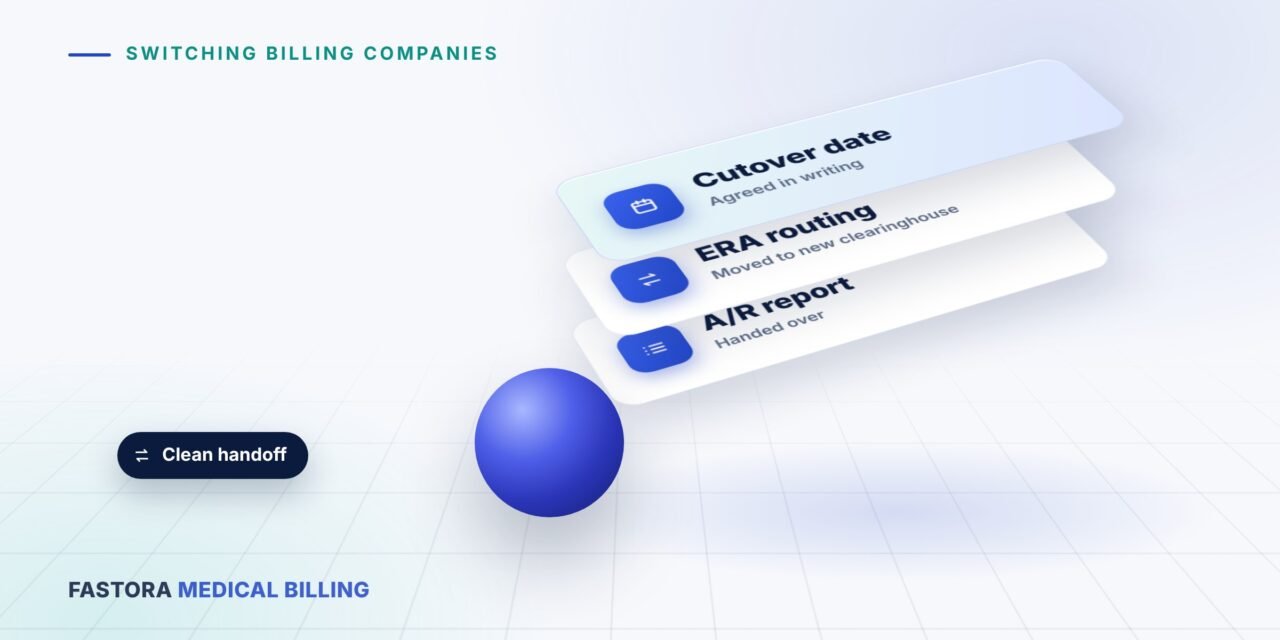
- Agree in writing who works claims submitted before the cutover date.
- Plan ERA re-routing early so payments are not missed during the change.
In this guide
Signs it may be time to switch billing companies
A bad month is not a reason to switch. A pattern is. Watch for these warning signs:
- Growing old A/R. The share of receivables older than 90 days keeps rising.
- Denials without explanations. You cannot get a clear answer on why claims are denied or what is being done about them.
- No regular reporting. You don’t receive, or cannot interpret, monthly reports on charges, collections, denials and A/R aging.
- Slow or no responses. Questions about specific claims take days or go unanswered.
- Collections falling while volume is steady. You are seeing the same number of patients but depositing less.
- Specialty mistakes. Repeated errors with rules specific to your specialty, such as time-based psychotherapy codes, carve-out payers, therapy modifiers or authorization tracking.
- Credentialing lapses. Providers dropped from panels, or new clinicians seeing patients before they are enrolled.
- Patient complaints. Confusing statements or billing errors that reach your patients.
Before deciding, ask your current company for a full A/R aging report and a denial summary by reason code. Their response, and how long it takes, will tell you a lot.
Check your current contract first
Your existing agreement decides how smooth the exit can be. Review it for:
| Contract term | What to look for |
|---|---|
| Notice period | How many days’ written notice are required, and how notice must be delivered |
| Termination fees | Early termination penalties or fees for data export |
| Run-out (tail) terms | Whether the old company keeps working claims for dates of service before the cutover, for how long, and whether it keeps earning a fee on those collections |
| Data ownership | Confirmation that the practice owns its patient, claim and financial data, and the format in which it will be returned |
| System access | Whether the billing software belongs to you or to the vendor, and when your access ends |
| Business associate agreement | Obligations for returning or destroying protected health information at termination |
Decide early whether the old company will work its run-out claims or whether the new company will take over everything on day one. Either can work. What causes problems is leaving it undefined, so neither side works the older claims.
Data and documents to collect before you leave
Request these in writing, with a delivery date before your notice period ends:
- A/R aging report by payer and by patient, with claim-level detail
- Open denials and pending appeals, with deadlines
- Unbilled charges and claims on hold, with the reason for each hold
- Patient balances and payment plans
- Payer contracts and fee schedules
- Credentialing files: CAQH logins, payer enrollment confirmations, effective dates, revalidation dates
- Authorization logs for active patients
- Payer portal usernames, ideally created under the practice’s own accounts
- Clearinghouse and ERA enrollment details
- Historical reports for the last 12 months: charges, payments, adjustments, denials
If the old company used its own billing system, also ask for a full data export of patient demographics, insurance details and transaction history in a usable format.
A step-by-step transition plan
- Set a baseline. Record current days in A/R, A/R over 90 days, denial rate, monthly charges and monthly collections. You need this to measure the new company’s performance.
- Choose a cutover date. Pick the date of service, or claim submission date, from which the new company takes over. The start of a month keeps reporting clean.
- Give notice. Send written notice according to the contract, with the cutover date and the data you need returned.
- Set up clearinghouse and ERA routing. If the new company uses a different clearinghouse, electronic remittance (ERA) enrollments must be moved payer by payer. During that window, some remittances may arrive as paper EOBs or through the old route. Plan for it so payments are not missed.
- Confirm EFT stays put. Electronic funds transfer goes to your bank account, not to the billing company, so it usually does not change. Confirm that no payer is depositing to an account controlled by the old vendor.
- Transfer system access. Give the new team access to your EHR or practice management system and payer portals. Remove the old company’s access on the agreed date.
- Hand over open work. Transfer open denials with deadlines, pending appeals, authorizations and claims on hold, and prioritize anything close to a timely filing or appeal deadline.
- Run a short parallel period. For the first few weeks, compare charges entered, claims submitted and payments posted against your own records.
- Update patient-facing details. Change the billing phone number and address on patient statements so patients reach the right team.
- Review at 30, 60 and 90 days. Compare results with your baseline. Expect the new company to spend early weeks on cleanup, so focus on trends and on whether old A/R is shrinking.
Transition timeline at a glance
| When | Practice | New billing company |
|---|---|---|
| Before notice | Review contract; record baseline; request reports | Review sample data; agree on scope and cutover date |
| Notice period | Give written notice; collect data and documents | Set up system access, clearinghouse and ERA enrollments |
| Cutover | Remove old vendor access; update statements | Begin charge entry, claims and posting; take over open denials |
| First 30 days | Compare daily activity with your records | Work urgent deadlines first; report weekly |
| 30 to 90 days | Review results against baseline | Old A/R cleanup; denial trend reporting |
Specialty considerations
Behavioral health practices should make sure the new team has a complete list of carve-out payers, active authorizations with session counts, telehealth rules by payer, and the credentialing status of every clinician, including newer associates.
Physical therapy and rehab clinics should hand over active plans of care and certification dates, progress-report due dates, authorization visit counts, Medicare therapy threshold amounts for current patients, and any open workers’ compensation or auto claims with adjuster contacts.
Mistakes to avoid
- Giving notice before you have your data, or a firm date for receiving it.
- Leaving run-out claims unassigned.
- Forgetting ERA enrollment changes, so payments arrive but are never posted.
- Letting payer portal logins stay under the old vendor’s employees’ names.
- Judging the new company on its first two weeks instead of its first 90 days.
Frequently asked questions
How long does it take to switch medical billing companies?
It depends on your notice period, data access and how many payer enrollments need to change. Many transitions are planned over several weeks. Your contract’s notice period is often the longest part.
Will switching billing companies interrupt my cash flow?
It can if ERA routing, run-out claims or system access are not planned. With a defined cutover date, a plan for older claims and early clearinghouse setup, collections can continue through the change.
Who works claims submitted before the switch?
Whoever the agreement says. Some practices let the old company finish its run-out claims; others move everything to the new company immediately. Put the decision in writing.
Do I need to re-credential my providers when I change billing companies?
No. Credentialing is between your providers and the payers, not the billing company. You do need the credentialing records and logins so the new team can maintain them.
Can a new billing company recover old denied claims?
Often, if the claims are still within the payer’s appeal or timely filing limits. That is why open denials with deadlines should be handed over first.
Work with Fastora
Make the switch on your terms
Switching medical billing companies is a project, not a leap. With the contract reviewed, data collected, a cutover date agreed and remittance routing planned, most of the risk goes away.
Fastora Medical Billing Solutions works with practices moving from in-house billing or another billing company, including behavioral health, mental health, psychiatry and physical therapy practices. Our services cover eligibility, prior authorization, credentialing, coding, claims, payment posting, denial management and A/R follow-up. Learn more about our medical billing services, review what medical billing costs, or contact Fastora to plan a transition.