
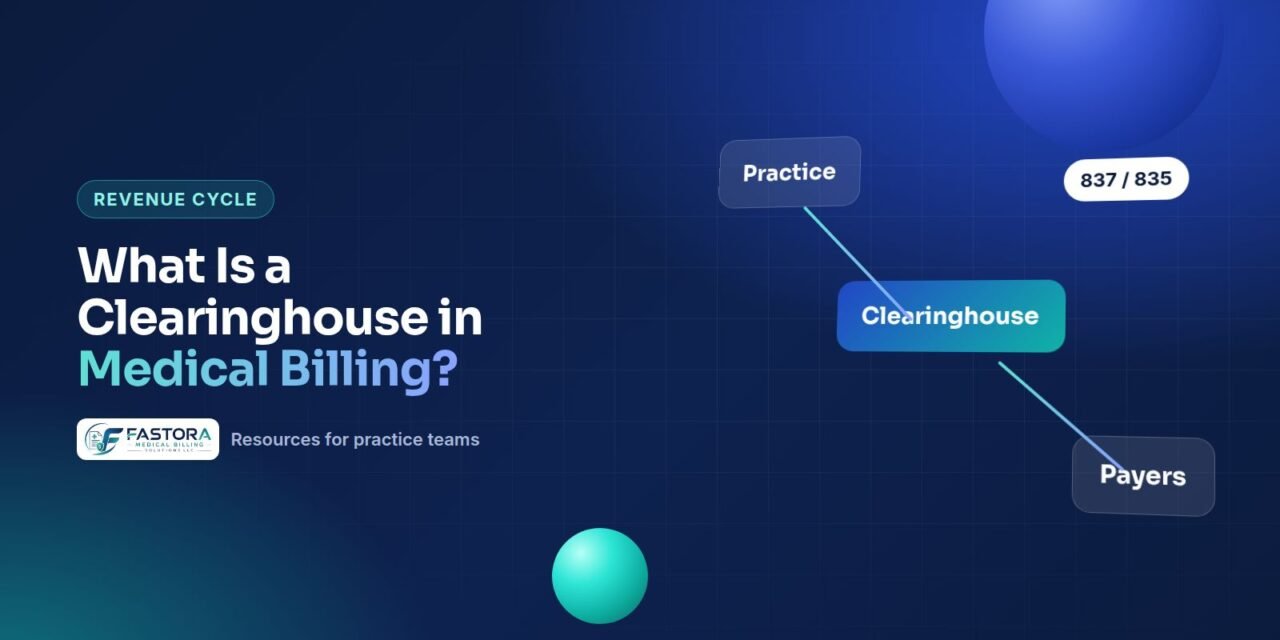
What is a clearinghouse in medical billing?
New practice owners often ask what is a clearinghouse in medical billing, and why every claim seems to pass through one. A medical billing clearinghouse is the intermediary between your practice management system and the many payers you bill: it checks claims, converts them into the formats each payer accepts, routes them and returns the responses.
Under HIPAA, a health care clearinghouse is a covered entity. HHS describes it as an entity that processes nonstandard health information into a standard electronic format or data content, or the reverse. In practice, that means your PM system can send one batch of claims to the clearinghouse instead of building a separate connection to every insurer.
Knowing what the clearinghouse does, and what it does not do, helps you tell where a claim is stuck and who needs to fix it.
What a medical billing clearinghouse does
Most of a clearinghouse's work involves standard electronic transactions defined by X12. Several of them are adopted as HIPAA standards, which health plans, clearinghouses and covered providers must use when they conduct these transactions electronically.
| Transaction | What it carries | Direction |
|---|---|---|
| 837 | The claim: professional claims use the 837P, institutional claims the 837I | Practice to payer |
| 999 | Implementation acknowledgment: confirms whether the file was accepted or rejected for format and syntax | Clearinghouse or payer to practice |
| 277CA | Claim acknowledgment: shows whether each claim was accepted into the payer's system or rejected, with the reason | Payer or clearinghouse to practice |
| 835 | Electronic remittance advice: payments, adjustments and reason codes for each claim line | Payer to practice |
| 270 / 271 | Eligibility and benefits inquiry and response | Practice to payer and back |
| 276 / 277 | Claim status inquiry and response | Practice to payer and back |
The 999 and the 277CA are easy to confuse. X12 guidance explains that a 999 confirms only that the file is syntactically acceptable, while acceptance of the claim from a business standpoint is reported in a transaction such as the 277CA. A clean 999 does not mean the payer has accepted your claims.
Many clearinghouses also offer extra tools on top of these transactions, such as claim editing, rejection work queues, eligibility screens, ERA enrollment help and reporting. What is included varies by vendor and plan.
How a claim moves through the clearinghouse
- Your PM system creates the claim from coded charges and sends it to the clearinghouse as an 837 file.
- The clearinghouse checks the file format and returns a 999 acknowledgment.
- The clearinghouse runs its claim edits. Claims that fail are rejected back to you for correction.
- Claims that pass are converted to each payer's requirements and forwarded.
- The payer runs its own front-end checks and returns a 277CA accepting or rejecting each claim.
- The payer adjudicates accepted claims and sends payment details in an 835 remittance, which the clearinghouse passes back for posting.
At any point, a 276 claim status request can be sent to ask the payer where a claim stands. HIPAA-covered entities must also follow federally mandated operating rules for claim status and several other transactions, in addition to the X12 standards.
Clearinghouse edits vs payer edits
Claims are checked twice before they are paid, by different parties using different rules.
- Clearinghouse edits focus on completeness and format: missing or invalid fields, invalid NPIs, subscriber ID formats, date logic, code validity and, depending on the vendor, some payer-specific rules. Many clearinghouses let you add custom edits for problems your practice sees often.
- Payer edits apply the payer's own rules: eligibility on the date of service, coverage, authorization, medical policy, frequency limits and bundling. For Medicare, bundling edits follow CMS's National Correct Coding Initiative. Commercial payers may use NCCI or their own edit sets.
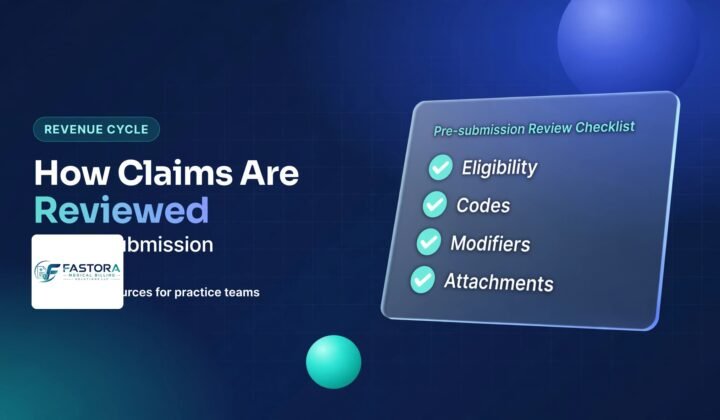
A claim can pass every clearinghouse edit and still be denied by the payer. That is why a strong pre-submission review checks payer-specific rules as well as format. In specialties such as radiology, for example, professional and technical component modifiers and authorization numbers need to be right before the claim leaves the practice.
Rejections vs denials
The two words are often used interchangeably, but they mean different things and are handled differently.
| Aspect | Rejection | Denial |
|---|---|---|
| When it happens | Before the claim enters adjudication | After the payer adjudicates the claim |
| Where you see it | Clearinghouse report, 999 or 277CA | 835 remittance or paper EOB |
| Typical causes | Missing or invalid data, format errors, wrong payer ID, subscriber not found | Eligibility, authorization, medical necessity, bundling, timely filing |
| What to do | Correct and resubmit as a new claim | Correct and resubmit, or appeal, following the payer's rules |
| Main risk | A rejected claim was never received, so the filing clock keeps running | Appeal windows close if the denial is not worked |
Rejections are the more dangerous of the two when they are ignored, because the payer has no record of the claim. Someone should review rejection reports every working day. For Medicare fee-for-service, the filing limit is one calendar year after the date of service, and many commercial contracts set shorter deadlines.
Daily clearinghouse habits that prevent lost claims
Most clearinghouse problems are not technical. They come from reports nobody reads and claims nobody reconciles. A few simple routines close most of the gaps.
- Reconcile every batch. Match the number of claims sent with the number acknowledged on the 999 and accepted or rejected on the 277CA. A claim that appears on neither is missing.
- Work rejections the same day. Correct the data, resubmit, and note the cause so the registration or charge entry step can be fixed.
- Check payer IDs. Payers merge, change IDs or route some plans through a separate processor. An outdated payer ID sends claims to the wrong place.
- Confirm ERA enrollment. If a payer's remittances are not arriving electronically, check enrollment before assuming the claims are unpaid.
- Watch for silent claims. Run a claim status check on anything with no response after a reasonable period for that payer.
These checks take minutes a day and protect against the most expensive outcome: a claim that was never received, discovered only after the filing deadline has passed.
Choosing a clearinghouse
Many PM systems come with a preferred or built-in clearinghouse, and switching is not always practical. If you do have a choice, compare these points.
- Payer connections: does it reach all your payers electronically, including local Medicaid plans and smaller commercial payers?
- PM integration: do claims, acknowledgments, ERAs and status responses flow into your PM system automatically?
- Edits: how current are its payer-specific edits, and can you add your own?
- Rejection handling: are rejections shown clearly, with plain-language reasons and a work queue?
- ERA and EFT enrollment: does it help enroll with payers for electronic remittances and payments?
- Eligibility tools: can front-desk staff run eligibility checks from the same system?
- Pricing: is it per provider, per claim or a flat fee, and are eligibility checks and ERAs charged separately?
- Security and contingency: will it sign a business associate agreement, and what is your fallback if it goes offline?
The last point matters. The 2024 cyberattack on Change Healthcare caused significant disruption to claims and payments for many practices. Knowing how you would submit claims through an alternative route is part of basic planning.
Fastora is not a clearinghouse
Fastora is a medical billing and revenue cycle management company, not a clearinghouse, and does not sell clearinghouse services. The team works with the clearinghouse your practice already uses, inside your existing EHR/PM system, with no software to install.
Our claims management team runs Advanced Pre-Submission Claim Review before claims reach the clearinghouse, works rejections and denials, and follows up on claim status. To see how your current rejection and denial patterns look, start with a free billing audit.
Claim review happens before a claim reaches the clearinghouse; see how claims are reviewed before submission for the checks applied at that stage.
Related reading
Clearinghouse edits are only the first layer of review. Our overview of AI in medical billing explains where automated checks help, where they stop, and why human review still matters before a claim goes out.
Frequently asked questions
Do I need a clearinghouse to bill insurance?
Not strictly. Some payers accept direct electronic submission or portal entry. In practice, most practices use a clearinghouse because it gives them one connection to many payers.
Is a clearinghouse the same as a billing company?
No. A clearinghouse transmits and checks transactions. A billing company does the billing work: coding, claim review, follow-up, denials, payment posting and patient billing. Billing companies use clearinghouses to send claims.
Why was my claim accepted by the clearinghouse but not paid?
Clearinghouse acceptance means the claim passed format and data checks and was forwarded. The payer can still reject it at its front end or deny it after adjudication for eligibility, authorization or coverage reasons.
What is the difference between a 999 and a 277CA?
A 999 confirms that a file met X12 format and syntax rules. A 277CA reports whether each claim was accepted into the payer's system or rejected.
1 comment