The claim that costs a practice the most is not always the one that comes back denied. Often it is the one that never comes back at all — submitted, then quiet. No remittance. No denial. Just a balance in accounts receivable while the filing and appeal clocks keep moving.
Claim status follow-up finds those claims before they age into write-offs. This guide explains the status layers a claim passes through, how to build a follow-up work queue, how to set a check cadence per payer, and how to document every touch so no claim is chased twice — or lost once.
What a “silent claim” actually is
A silent claim is a submitted claim with no payer response inside the window your practice expects for that payer: no payment, no denial, no status change. Silence is not a status; it is a signal the claim is stuck at a layer you have not looked at yet. It may have been rejected at the clearinghouse and never worked (so the payer never received it), it may simply be in process longer than usual, or the payer may have pended it — paused it for information that never reached the person who can answer. Each cause needs a different fix.
The status layers a claim passes through
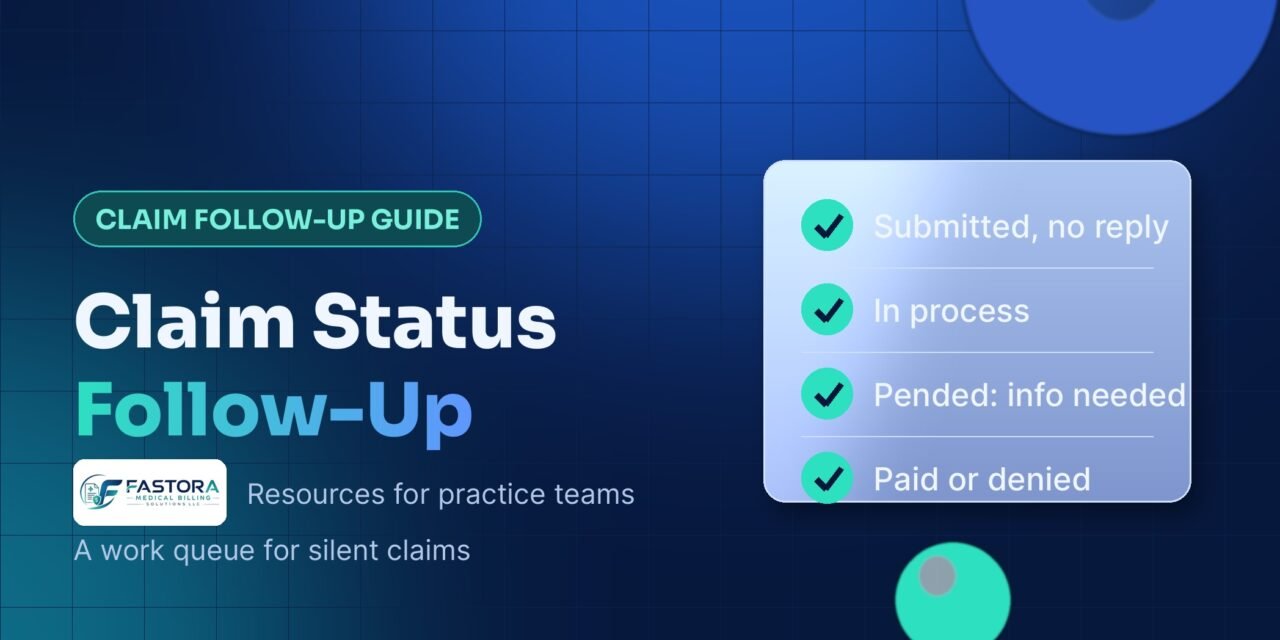
A claim does not move from “sent” to “paid” in one step. Each layer proves something different:
- Submitted. Your system created the claim and sent it out. This proves work left your office — nothing more.
- Clearinghouse acknowledged. A file-level acknowledgment (the 999) confirms the batch was readable; a claim-level acknowledgment (the 277CA) reports whether each claim was accepted forward or rejected, and why.
- Payer received. The payer’s front end accepted the claim into its system. This layer matters for timely filing: until a claim is received, the payer has no record of it.
- In process. The payer is adjudicating — applying coverage, authorization, coding, and contract rules.
- Pended or information requested. The payer has paused the claim and needs something: documentation, a corrected detail, or information from another payer. A pended claim sits indefinitely until someone responds.
- Finalized. The claim has been paid or denied, reported on the remittance.
No single channel shows every layer for every payer — status arrives through clearinghouse dashboards, payer portals, and electronic claim status inquiry in a mix that varies by payer. The electronic check has a standard form: the 276 claim status inquiry and its 277 response (276/277 claim status). An acknowledgment is not an outcome; a claim accepted at every early layer can still be denied at adjudication. For what to do once an outcome arrives, see claim rejection vs denial.
The clearinghouse sits in the middle of several layers, so its reports matter to follow-up. Fastora’s overview of what a medical billing clearinghouse does explains how acknowledgments, rejections, and status responses flow through it.
Build the follow-up queue
Follow-up fails when it lives in memory or a general aging report. It works as a queue: each claim carries enough information for the next person to act without re-researching it.
Which claims enter. Any submitted claim with no remittance and no status change inside your follow-up window for that payer. Entry is automatic: if the window passes in silence, the claim joins the queue.
What each item carries. Payer, date submitted, date of service, billed amount, last known status, date of last touch, next action date, and owner of the next step — plus the payer’s claim reference number as soon as one exists. The queue then answers the owner’s questions at a glance: how many claims are silent, how old the silence is, who is working it, what happens next.
Set the cadence from the payer’s own pattern
There is no universal day count at which a claim becomes “late.” Processing windows differ by payer, plan, and claim type, so this guide will not present one number as a standard. Instead, record your own norm: from recent clean, paid claims, note how long each major payer takes from receipt to remittance, and check status when a claim passes the far edge of that range. Refresh the norms periodically, and set the next action date at every check based on the status returned — in process earns a later recheck than pended for information you still owe. A claim with no next date has been silently dropped.
Work the queue in order
Sequence matters more than effort. Work each claim in this order:
- Confirm receipt first. With no evidence the payer received the claim — no claim number, no acceptance on the acknowledgments — the claim is not late; it is missing. Check the clearinghouse reports, correct any unworked rejection, and resubmit properly. Learning how to follow up on unpaid claims starts here, because a claim the payer never received cannot be status-checked.
- Read the status before calling. A claim status inquiry often answers the question outright: in process, pended, or finalized with a remittance on its way. Call when the electronic status is unclear, contradictory, or too old to trust — with claim identifiers, dates, and prior reference numbers already in hand.
- Check status before ever resubmitting. Resubmitting a claim the payer already has creates a duplicate, and duplicates deny. Resubmit as a new claim only when the evidence shows the payer never received it or rejected it before adjudication. If the payer has it and something is wrong, use that payer’s corrected-claim route instead.
- Escalate with a paper trail. When repeated checks show the same status with no movement, escalate with your documented history: dates checked, statuses returned, reference numbers given. The trail shortens escalation calls considerably.
If the volume of quiet claims exceeds what your team can work this way, that workload — status checks, queue discipline, escalation — is core to Fastora’s claims management service, which follows each submitted claim until it is paid or resolved.
Document every touch
Note every check the same day: date, channel (portal, clearinghouse, electronic inquiry, phone), status received, any reference number given, action taken, and next follow-up date. Good notes stop repeat calls, prove the timelines that filing and appeal discussions turn on, and make the queue — not one person’s memory — the follow-up program. Keep them short: “in process, reference given, recheck [date]” is complete.
Close the loop weekly
Once a week, group the queue by payer and status. A cluster at one payer, all in process, points to a payer-side slowdown — escalate there instead of calling claim by claim. A cluster rejected at the clearinghouse and never worked is an internal miss: same-day rejection review, plus a fix at the step that produced the bad data. A cluster pended for information points upstream to documentation, authorization, or eligibility. Feed each cause back to that step; follow-up finds silent claims, the weekly loop stops the next batch.
Illustrative example only. Two claims are equally quiet. The first never left the clearinghouse — an unread rejection report flagged a subscriber-ID format the payer no longer accepts; its fix is correction and clean resubmission. The second was received, then pended for documentation sitting in the chart; its fix is sending the documentation and setting a recheck date. Same silence, opposite actions — the status check always comes before the remedy.
Conclusion
Silent claims are a workflow gap, not a payer mystery. They go quiet at identifiable layers — never received, in process beyond that payer’s norm, or pended for information — and each layer has a correct next step. An automatic queue, a per-payer cadence, status before any resubmission, and a note on every touch will surface them while they can still be paid.
Not sure how many of your submitted claims are silent right now, or at which layer? Fastora’s free billing assessment traces submitted claims to their current status and shows where follow-up has stopped. No obligation — just what to work first.
Frequently asked questions
How soon should a practice check claim status?
When a claim passes the far edge of that payer’s normal processing window with no remittance and no status change. Build the window from your own recent paid claims per payer, and recheck on the next action date set at each touch.
What is the difference between a rejection and a claim the payer never received?
A rejection is an answer: the clearinghouse or payer front end returned the claim with a reason, before adjudication. A claim the payer never received has no payer record at all — usually an unworked clearinghouse rejection. Only a received claim can be status-checked with the payer.
Should you resubmit a claim with no response?
Not until a status check shows why. If the payer already has it, resubmitting creates a duplicate that will deny. Resubmit as new only when the payer never received it or rejected it before adjudication; otherwise use that payer’s corrected-claim process.
What should a follow-up note contain?
Date, channel, status received, any reference number given, action taken, and next follow-up date — short and factual, so the next person can act without repeating the check.
When does a silent claim become an accounts receivable problem?
When it ages unworked. Past its payer’s normal window with no touch, no note, and no next date, it is already an A/R problem — and drifting toward a filing or appeal deadline makes it harder to recover.