
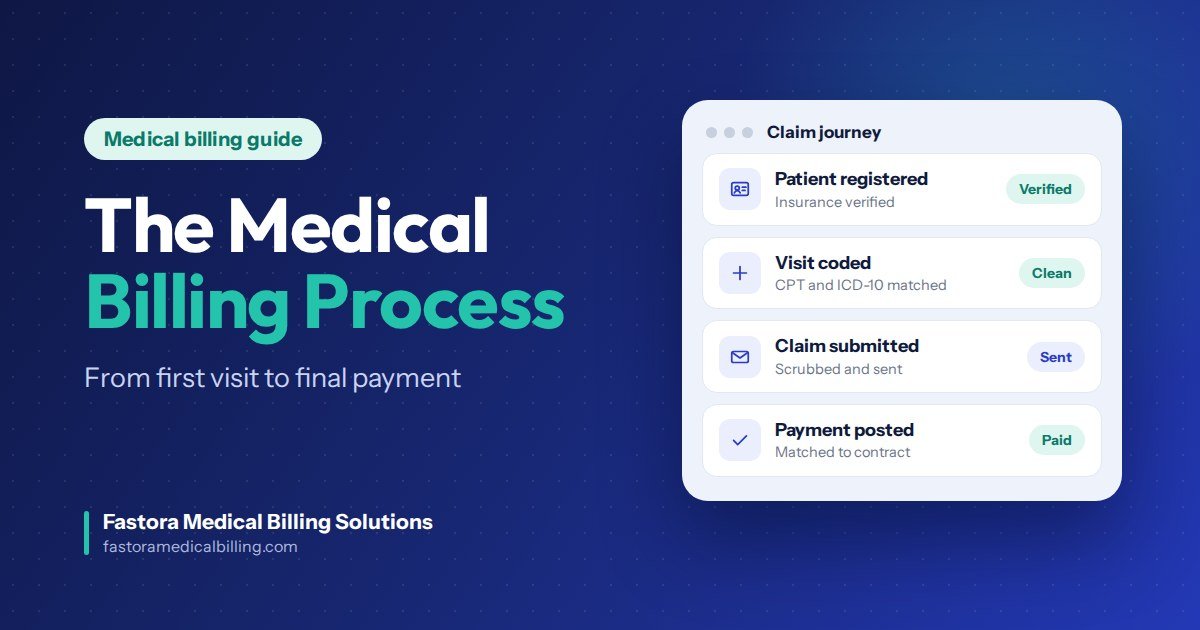
The medical billing process, from first visit to final payment
See how a patient visit becomes a paid claim. Then learn where practices lose revenue and how to keep cash flow steady.
Every patient visit tells two stories. First, there is the clinical story: a diagnosis, a treatment plan, and a patient who leaves feeling better. Then there is the financial story. It is a chain of codes, claims, payer rules, and payments that decides whether your practice gets paid for the care it delivered.
When that second story goes wrong, the effects ripple outward. For example, claims get denied, accounts receivable grows, and staff spend hours on hold with insurers. As a result, cash flow becomes unpredictable. However, billing problems are rarely a sign of poor care. Instead, they usually point to a system that has become too complex to manage casually.
At Fastora Medical Billing Solutions LLC, we help healthcare providers untangle that complexity every day. In this guide, we walk through the medical billing process step by step. As a result, you will see what happens to a claim after the patient leaves, where revenue slips away, and how to protect it.
What is medical billing?
Medical billing is the process of turning healthcare services into payment. In practice, the medical billing process covers everything from collecting insurance details to submitting claims. It also includes posting payments, appealing denials, and billing patients for any balance they owe.
It works hand in hand with medical coding, but the two are different jobs:
- Medical coding translates the provider’s documentation into standardized codes that describe the diagnosis and the services performed.
- Medical billing then uses those codes to build claims, send them to payers, and follow each claim until it is paid.
In other words, coding writes the invoice in a language insurers understand. Billing, on the other hand, makes sure that invoice is delivered, processed, and paid. In a small practice, one person may do both. Larger organizations, however, usually split them into specialized roles.
Where billing fits in the revenue cycle
The medical billing process is one part of a larger system called revenue cycle management (RCM). The revenue cycle starts the moment a patient books an appointment. It ends only when the last dollar is collected. For that reason, it is easiest to understand in three phases.
Front-end
Before the visit
- Scheduling and registration
- Insurance eligibility checks
- Prior authorizations
- Patient cost estimates
Mid-cycle
During and right after the visit
- Clinical documentation
- Charge capture
- Medical coding
- Charge review
Back-end
After the visit
- Claim submission
- Payment posting
- Denials and appeals
- Patient billing and reporting
A common mistake is treating billing as purely a back-office task. In reality, many denials trace back to the front desk. For example, a misspelled name, an inactive policy, or a missing authorization can stop a claim. Therefore, a healthy revenue cycle depends on getting every phase right.
The code sets behind every claim
Payers don’t read clinical notes line by line. Instead, they read codes. Three code sets appear on most claims, and each one answers a different question.
CPT codes
What did the provider do?
ICD-10-CM codes
Why was the care necessary?
HCPCS Level II codes
What drugs, supplies, or equipment were used?
How the codes work together on a claim
A claim is only as strong as the link between its diagnosis codes and its procedure codes. For example, imagine a patient with knee osteoarthritis and diabetes who receives an office visit and a steroid injection. Here is how those services might look on a professional claim.
| 24ADate of service | 24BPlace of service | 24DCPT / HCPCS | 24DModifier | 24EDiagnosis pointer | 24FCharges | 24GUnits |
|---|---|---|---|---|---|---|
| 09/08/2026 | 11 | 99213 | 25 | A, B | $185.00 | 1 |
| 09/08/2026 | 11 | 20610 | RT | A | $210.00 | 1 |
| 09/08/2026 | 11 | J3301 | – | A | $48.00 | 4 |
Each diagnosis pointer ties a service back to the condition that justifies it. So if the diagnosis doesn’t support the service, the claim is likely to be denied. Similarly, a missing modifier can lead to an underpayment.
Common HCPCS Level II categories
| Prefix | What it covers | Typical use |
|---|---|---|
| A codes | Transportation, medical and surgical supplies | Ambulance services, dressings, supplies |
| C codes | Temporary codes for the Hospital Outpatient Prospective Payment System | Hospital outpatient billing to Medicare |
| E codes | Durable medical equipment | Wheelchairs, walkers, CPAP devices |
| G codes | Procedures and professional services | Medicare-specific services and quality reporting |
| J codes | Drugs usually administered other than by mouth | Injections and infusions given in a clinical setting |
| Q codes | Temporary codes assigned by CMS | Drugs, biologicals, and services awaiting permanent codes |
| S codes | Temporary national codes for non-Medicare use | Commercial payers and some Medicaid programs |
Modifiers add the details
Modifiers are two-character additions to CPT or HCPCS codes. They tell the payer more about how a service was performed. For instance, a modifier can show which side of the body was treated. Because they carry so much meaning, missing or misused modifiers are a frequent cause of denials and underpayments.
The medical billing process, step by step
Here is how a typical claim moves through the medical billing process, from the front desk to a zero balance. Keep in mind that skipping or rushing any step is where most revenue leaks begin.

Before the visit
Register the patient
Accurate billing starts with accurate data. First, confirm the patient’s legal name, date of birth, address, and phone number. Next, record primary and secondary insurance, including member ID and group number. Also scan the insurance card and a photo ID, and collect signed consent and financial policy forms. After all, one typo in a member ID can delay payment for weeks.
Verify eligibility and benefits
Before the appointment, confirm that coverage is active and the provider is in network. Then check the patient’s copay, coinsurance, and remaining deductible. In addition, confirm the planned service is covered and whether a referral is needed. As a result, you can give patients an accurate estimate, which makes collecting later much easier.
Secure prior authorization
Many payers require approval before advanced imaging, specialty drugs, surgeries, and some therapy visits. Without that approval, the claim often ends in a denial that can’t be overturned. For this reason, track authorization numbers, approved visit counts, and expiration dates.
During and right after the visit
Document the encounter and capture charges
Complete documentation typically includes the chief complaint, history, exam findings, test results, assessment, plan, and procedures. Charge capture then makes sure every billable service in that note is recorded. Otherwise, a missed charge becomes revenue that never reaches a claim.
Code the services
Next, certified coders assign ICD-10-CM, CPT, and HCPCS codes, plus any modifiers, based on the documentation. Coding above what the record supports (upcoding) creates compliance risk. On the other hand, coding below it (undercoding) leaves earned revenue on the table.
Build and scrub the claim
Your team then combines codes, charges, patient details, and provider information into a claim. Before it goes out, a claim scrubber checks for invalid code pairs, missing modifiers, mismatched demographics, and payer rule violations.
After the visit
Submit the claim
Most practices send claims electronically through a clearinghouse as an ANSI X12 837P (professional) or 837I (institutional) file. Paper claims, by contrast, use the CMS-1500 or UB-04 form and are slower to track. Every payer also sets a timely filing limit. For example, Medicare generally allows 12 months from the date of service. However, commercial payers often allow much less, sometimes 90 to 180 days.
Payer adjudication
The payer reviews eligibility, coverage, medical necessity, coding accuracy, contract terms, and possible duplicates. Then it decides what to pay. The chart below shows the possible outcomes.
Post payments and reconcile
Payments arrive with an Explanation of Benefits (EOB) or an Electronic Remittance Advice (ERA, also called an 835 file). First, post each payment and adjustment to the right account. Then compare it with the contracted rate, and pursue any underpayment instead of writing it off.
Work denials and appeals
Every denial deserves a response. Start by finding the root cause. Then send a corrected claim or a documented appeal before the payer’s deadline. Finally, track denial trends so you can fix the problem at its source.
Bill the patient
Once insurance has paid, bill the patient for copays, coinsurance, deductibles, or non-covered services. To improve collections, send clear statements that show what insurance paid. In addition, offer online payments, payment plans for larger balances, and friendly reminders.
Report and improve
Regular reports on claim volume, denials, collections, and aging accounts show where your revenue cycle is healthy. They also reveal where it’s leaking money. In this way, the last step feeds directly back into step one.
Rejection or denial: what happens after you submit
These two words get used interchangeably, but they mean different things and need different fixes.
Failed basic data or format checks and never entered the payer’s system. Correct the error and resubmit quickly.
Enters the payer’s system for adjudication, where coverage, coding, and medical necessity are reviewed.
Post the payment and confirm it matches the contracted rate.
Review adjustments and bill the patient’s share.
Processed but refused. Send a corrected claim or file an appeal.
Is your denial rate creeping up?
Fastora can review your recent claims and show you where revenue is slipping.
Understanding your payers
Each payer type has its own rules, fee schedules, and documentation requirements. So knowing who you’re billing is half the battle.
| Payer type | Who it covers | What billers should know |
|---|---|---|
| Commercial insurance | Individuals, families, and employer groups, such as Aetna, Cigna, UnitedHealthcare, and Blue Cross Blue Shield plans | Policies, fee schedules, and authorization rules vary by plan and contract |
| Medicare | Adults 65 and older, plus certain younger people with disabilities or end-stage renal disease | Strict documentation and coding rules; an Advance Beneficiary Notice may be needed for services likely to be non-covered |
| Medicare Advantage | Medicare beneficiaries enrolled in private plans | Follows Medicare rules but often adds its own authorization and network requirements |
| Medicaid and CHIP | Low-income individuals, families, and children; eligibility varies by state | Rules and rates differ by state; Medicaid is usually the payer of last resort |
| TRICARE and VA programs | Service members, veterans, and their families | Separate enrollment, authorization, and claim procedures |
| Workers’ compensation | Employees with work-related injuries or illnesses | Needs claim numbers, employer details, and injury documentation; state rules apply |
| Auto insurance (PIP) | People injured in motor vehicle accidents | Personal Injury Protection is often billed before health insurance, up to policy limits |
| Self-pay patients | Uninsured patients or those not using insurance | Under the No Surprises Act, they’re entitled to a good faith estimate for scheduled care |
Managed care also adds another layer. For example, HMOs usually require in-network care and referrals to see specialists. PPOs, however, allow more flexibility, including out-of-network care at a higher cost. Meanwhile, third-party administrators (TPAs) process claims for self-funded employer plans without taking on the insurance risk.
Compliance rules every practice must follow
Billing mistakes don’t just cost money. In some cases, they also carry legal consequences. For that reason, every practice should understand these regulations.
| Regulation | What it does | Why it matters for billing |
|---|---|---|
| HIPAA | Protects the privacy and security of patient health information and sets standards for electronic transactions | Every claim contains protected health information; billing partners must sign a Business Associate Agreement |
| False Claims Act | Creates liability for false or fraudulent claims to federal programs | Upcoding, unbundling, and billing for services not rendered can bring major penalties |
| Anti-Kickback Statute | Bars offering or receiving anything of value in exchange for federal program referrals | Affects referral relationships, marketing, and some patient discounts |
| Stark Law | Limits physician self-referrals for certain services to entities they have a financial relationship with | Improper referrals can make related claims non-payable |
| No Surprises Act | Protects patients from many unexpected out-of-network bills and requires good faith estimates for uninsured and self-pay patients | Changes how out-of-network services and patient estimates are handled |
| CMS and payer policies | Coverage determinations, National Correct Coding Initiative (NCCI) edits, and payer-specific rules | Decide what’s covered and which code combinations are allowed |
A strong compliance program includes regular coding audits, ongoing staff training, and written policies. It also needs a clear process for finding and returning any overpayments.
Why claims get denied, and how to prevent it
Fortunately, most denials are preventable with a well-run medical billing process. Below are the most common causes we see, along with practical fixes.
| Common denial reason | How to prevent it |
|---|---|
| Inactive coverage or eligibility issues | Verify eligibility before every visit, not only for new patients |
| Missing or expired prior authorization | Keep an authorization log with visit counts and expiration dates |
| Incorrect patient or policy information | Scan insurance cards and IDs at every visit and double-check key fields |
| Coding errors or missing modifiers | Use certified coders, claim scrubbing software, and routine audits |
| Lack of medical necessity | Use specific diagnosis codes that the documentation fully supports |
| Duplicate claims | Check claim status before resubmitting anything |
| Timely filing limit missed | Submit within 24 to 48 hours of the encounter and watch aging reports |
| Coordination of benefits issues | Confirm the order of primary and secondary coverage at registration |
| Non-covered services | Check benefits in advance and get signed waivers or ABNs when appropriate |
Billing KPIs worth tracking
You can’t improve what you don’t measure. These six numbers give a quick read on the health of your revenue cycle. Keep in mind that the targets are common industry benchmarks. Your own goals depend on your specialty, payer mix, and patients.
Clean claim rate
95% or higherShare of claims accepted on first submission with no errors.
First-pass resolution rate
90% or higherShare of claims paid on the first submission.
Denial rate
Below 5% to 10%Share of claims denied by payers.
Days in A/R
Under 30 to 40 daysAverage number of days it takes to collect payment.
A/R over 90 days
Below 15% to 20%Share of receivables older than 90 days.
Net collection rate
95% or higherShare of collectible revenue your practice actually collects.
In-house vs. outsourced medical billing
Practices generally either run billing internally or partner with a professional billing company. Both options can work well. However, the right choice depends on your size, resources, and goals.
| Factor | In-house billing | Outsourced billing |
|---|---|---|
| Control | Direct oversight of staff and processes | Shared oversight through reporting and regular check-ins |
| Cost | Salaries, benefits, training, software, and clearinghouse fees | Usually a percentage of collections or a set fee |
| Expertise | Limited to what your current team knows | A team experienced across many payers and specialties |
| Staffing risk | Vacations, turnover, and sick days can stall billing | Coverage is built into the service |
| Regulatory updates | Your team must track every code and policy change | Staying current is part of the partner’s job |
| Scalability | Growth usually means hiring | Scales as patient volume grows |
| Technology | You buy and maintain the tools | Often includes billing and analytics tools |
In general, outsourcing your medical billing process makes the most sense when denials are rising or A/R is aging. It also helps when staff turnover disrupts billing or providers spend evenings on paperwork instead of patient care.
The future of medical billing
Billing is changing quickly. Here are the trends that will shape the next few years.
AI and automation
Artificial intelligence now helps with eligibility checks, coding suggestions, claim scrubbing, denial prediction, and payment posting. Automation takes over repetitive work, but experienced people are still essential for complex cases, appeals, and compliance oversight.
Faster, digital prior authorization
Federal rules from CMS are pushing Medicare Advantage, Medicaid, CHIP, and ACA marketplace plans toward faster, electronic authorization decisions. As a result, providers should gradually see fewer delays.
A better patient financial experience
Because patients now pay more out of pocket, practices are adopting upfront estimates, digital statements, and mobile payments. Flexible payment plans also make bills clearer and collections smoother.
Value-based care
More reimbursement is now tied to quality and outcomes. Therefore, accurate documentation, risk adjustment coding, and quality reporting matter as much as traditional fee-for-service billing.
Cloud-based, connected systems
Cloud platforms link the EHR, practice management system, and billing tools. As a result, practices get real-time, secure visibility into their revenue cycle from anywhere.
Medical billing glossary
Quick definitions for the abbreviations you’ll see most often.
- ABN
- Advance Beneficiary Notice of Noncoverage
- A/R
- Accounts receivable
- CARC
- Claim Adjustment Reason Code
- CMS
- Centers for Medicare & Medicaid Services
- COB
- Coordination of benefits
- CPT
- Current Procedural Terminology
- DME
- Durable medical equipment
- DOS
- Date of service
- EFT
- Electronic funds transfer
- EHR / EMR
- Electronic health record / electronic medical record
- E/M
- Evaluation and management
- EOB
- Explanation of Benefits
- ERA
- Electronic Remittance Advice
- HCPCS
- Healthcare Common Procedure Coding System
- HIPAA
- Health Insurance Portability and Accountability Act
- ICD-10-CM
- International Classification of Diseases, 10th Revision, Clinical Modification
- NCCI
- National Correct Coding Initiative
- NPI
- National Provider Identifier
- PHI
- Protected health information
- POS
- Place of service
- RARC
- Remittance Advice Remark Code
- RCM
- Revenue cycle management
- TIN
- Taxpayer Identification Number
- TPA
- Third-party administrator
Frequently asked questions
What are the main steps in the medical billing process?
The main steps are patient registration, insurance verification, prior authorization, documentation, coding, claim scrubbing, and claim submission. After that come payer adjudication, payment posting, denial management, patient billing, and reporting.
What’s the difference between medical billing and medical coding?
Coding converts clinical documentation into standardized codes. Billing uses those codes to create claims, submit them to payers, and follow up until payment is received.
How long does it take to get paid on a medical claim?
Clean electronic claims are often paid within about two to four weeks, though timing varies by payer. Claims with errors, denials, or appeals can take much longer.
What is a clean claim?
A clean claim has no errors or missing information, so the payer can process it without asking for corrections or extra documentation.
Can a denied claim still be paid?
Yes. In many cases, a corrected claim or an appeal can overturn a denial. However, you need to act before the payer’s deadline, and the documentation must support the service.
Is outsourcing medical billing HIPAA compliant?
Yes, as long as the billing company follows HIPAA privacy and security rules. In addition, it must sign a Business Associate Agreement with your practice.
How Fastora Medical Billing Solutions LLC can help
Medical billing is detailed, deadline-driven work, and small mistakes add up over time. That’s why Fastora takes the pressure off your team, so you can focus on patients. Whether you’re a solo provider or a multi-location group in Texas, we build a medical billing process around your specialty, payers, and goals.
- End-to-end revenue cycle management
- Accurate coding by certified professionals
- Claim scrubbing and electronic submission
- Denial management and appeals
- A/R recovery for aging accounts
- Clear, patient-friendly billing
- Transparent performance reporting
- HIPAA-compliant processes
Get paid for the care you already deliver
Let Fastora handle the claims, follow-ups, and paperwork. We’ll start by reviewing where your practice is losing revenue today.
This article is for general informational purposes only and is not legal, compliance, or financial advice. Coding rules, payer policies, and regulations change often, so always confirm current requirements with the payer or a qualified professional. Code examples and charges shown are illustrative.
На данном веб-сайте вы сможете найти важную информацию.
https://kart1na.ru/entry/103-peterburgskie-gimnastki-sobrali-rekordnye-34-medali-na-vserossiyskom-etape-pamyati-eleny-shushunovoy/