Running a healthcare practice means balancing two very different jobs at once: caring for patients and keeping the business financially healthy. Behind every office visit, therapy session, or procedure sits a long chain of administrative work — insurance verification, eligibility checks, medical coding, charge entry, claim submission, claim follow-up, denial management, appeals, payment posting, accounts receivable, prior authorization, and provider credentialing. Each step has to be done correctly, on time, and in compliance with payer-specific rules, or reimbursement gets delayed, reduced, or denied altogether.
For many physicians, therapists, and practice administrators, this administrative burden has grown faster than their staff or systems can keep up with. Payer requirements change often, documentation standards keep tightening, and even a single coding error can trigger a denial that takes weeks to resolve. That is why a growing number of practices — from solo providers to multi-location clinics — are taking a closer look at working with a third party medical billing company instead of managing every billing function internally.
This is where Fastora Medical Billing Solutions comes in. Fastora provides expert medical billing and coding solutions, helping healthcare providers maximize revenue, ensure compliance, and streamline operations, so their internal staff can spend more time on patient care and less time chasing claims. This article walks through what outsourced billing actually involves, why providers consider it, what to look for in a billing partner, and how Fastora’s approach fits into that picture.
What Is a Third-Party Medical Billing Company?
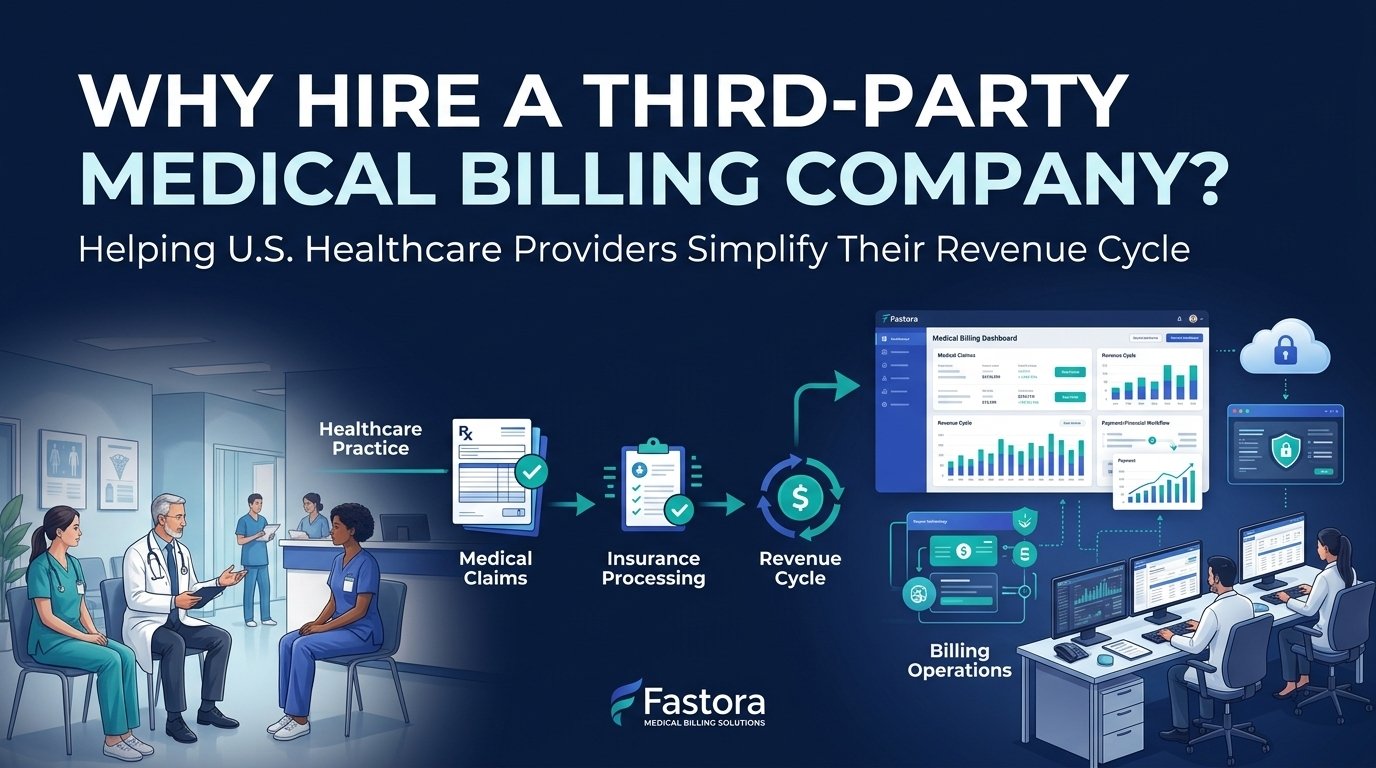
A third party medical billing company is an outside organization that manages some or all of a healthcare practice’s billing and revenue cycle functions on its behalf, rather than those tasks being handled by employees inside the practice. Instead of hiring, training, and managing an in-house billing department, a practice contracts with a specialized billing team that already has the coding knowledge, payer relationships, and claims infrastructure in place.
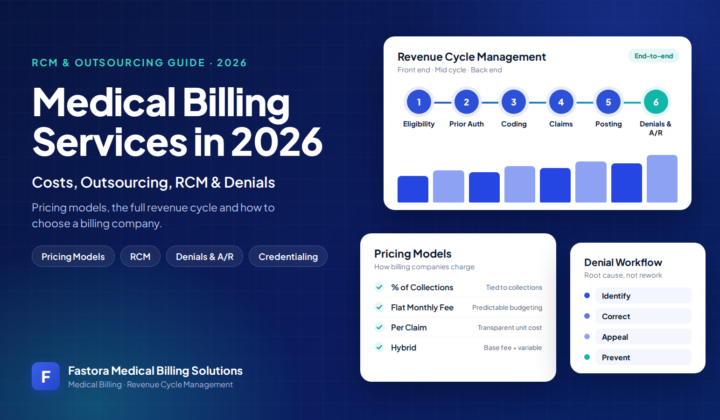
Outsourced billing can work in a few different ways. Some practices hand off their entire revenue cycle — from patient eligibility checks through final payment posting. Others choose a more targeted approach, outsourcing only specific functions such as denial management, credentialing, or aging accounts receivable, while keeping the rest of their billing in-house. The right structure depends on the practice’s size, specialty, existing staff, and where the biggest bottlenecks are.
The core difference between in-house and outsourced billing comes down to who owns the day-to-day execution. With in-house billing, the practice is responsible for hiring staff, keeping up with coding and payer changes, and maintaining billing software. With a medical billing company, that operational responsibility shifts to a team whose sole focus is billing — while the practice retains oversight and visibility into performance.
Why Are Healthcare Providers Outsourcing Medical Billing?
The decision to pursue medical billing outsourcing usually isn’t about any single problem — it’s about the cumulative weight of several ongoing challenges:
- Rising administrative workload. Front-desk and billing staff are often stretched across scheduling, patient intake, insurance verification, and billing all at once.
- Complex, ever-changing payer requirements. Each insurer has its own submission rules, timely filing limits, and documentation expectations, and those rules shift regularly.
- Coding accuracy demands. Incorrect or outdated codes are one of the leading causes of claim denials and delayed reimbursement.
- Denial volume. Denied claims require research, correction, and resubmission — work that can pile up quickly without dedicated staff.
- Aging accounts receivable. Claims that sit unworked for 60, 90, or 120+ days become harder to collect the longer they age.
- Prior authorization and referral tracking. Missed or delayed authorizations can result in non-payment for services already rendered.
- Documentation and compliance pressure. Billing has to align precisely with clinical documentation to withstand audits and payer scrutiny.
When these pressures accumulate, practices often reach a point where hiring more internal staff isn’t the most efficient answer — bringing in a specialized outside team is.
Benefits of Outsourcing Medical Billing
When implemented well, outsourced medical billing services can address several of the pain points above at once. Here’s how, broken down by function.
Reduce Administrative Workload
Shifting billing tasks off your internal team’s plate frees up front-desk and administrative staff to focus on patients rather than paperwork, phone calls with payers, and claim corrections.
Improve Claim Follow-Up
A dedicated billing team can track every submitted claim through to resolution, rather than letting claims sit untouched because internal staff are pulled in other directions.
Support Denial Management
Specialized billers are used to identifying denial patterns, correcting root causes, and resubmitting or appealing claims promptly instead of letting them stall.
Manage Accounts Receivable
Consistent A/R follow-up — including aging claim reports and targeted outreach to payers — helps prevent revenue from getting stuck in the 90+ day bucket.
Access Specialized Billing Expertise
Billing companies typically work across multiple specialties and payers, which means their teams stay current on coding updates and payer-specific quirks that a single in-house biller might not encounter often enough to master.
Support Practice Growth
As patient volume grows, billing needs scale with it. An outsourced team can typically absorb that growth without the practice needing to recruit and train additional billing staff.
What Services Does a Medical Billing Company Provide?
The scope of medical billing services offered by a modern billing partner generally spans the full revenue cycle, including:
- Eligibility and insurance verification
- Prior authorization and referral support
- Medical coding and charge review
- Charge entry and electronic claims submission
- Claim tracking and proactive follow-up
- Rejection and denial management
- Corrected claims and appeals
- Payment posting, including EOB and ERA processing
- Patient statement generation
- Accounts receivable and aging A/R follow-up, backed by regular practice billing audits
- Provider credentialing, re-credentialing, and payer enrollment
- Revenue cycle reporting and analytics
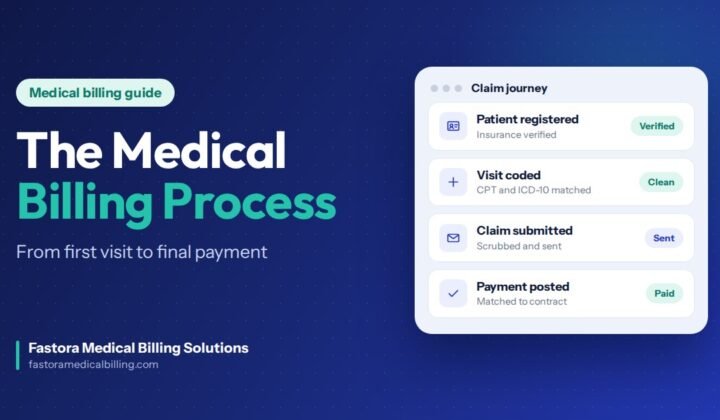
A comprehensive medical billing outsourcing company typically offers these as a connected workflow rather than isolated tasks, so that a claim moves smoothly from initial eligibility check through final payment without gaps where things fall through the cracks. Fastora structures its services this way — spanning billing audits, A/R management, analytics and reporting, and credentialing and enrollment — while also allowing practices to bring in specific pieces of support where they need it most.
Medical Billing Outsourcing vs. In-House Billing
Neither model is automatically the right fit for every practice. The table below compares the two approaches across the areas that typically matter most when practices are weighing this decision.
| Factor | In-House Billing | Outsourced Medical Billing |
|---|---|---|
| Staffing | Practice hires, trains, and manages billing staff directly | Billing company provides an experienced team; practice does not manage day-to-day staffing |
| Training | Ongoing internal responsibility to stay current on coding and payer changes | Training and continuing education are handled by the billing partner |
| Administrative Workload | Billing tasks compete with front-desk and clinical support duties | Billing work is handled separately from day-to-day clinical operations |
| Claim Follow-Up | Dependent on internal staff bandwidth | Dedicated follow-up as part of the core service |
| Denial Management | Handled as time allows, often reactively | Typically proactive, with dedicated denial workflows |
| A/R Management | Can accumulate if staff are stretched thin | Ongoing aging A/R review is part of standard service |
| Scalability | Requires hiring additional staff as volume grows | Generally scales with patient volume without new hires |
| Reporting | Depends on internal systems and staff capacity to generate reports | Revenue cycle analytics and reporting are typically built into the service |
| Workflow Management | Practice designs and maintains its own billing workflow | Billing partner brings established, repeatable workflows |
| Practice Control | Full direct control over every step | Oversight and visibility retained, execution shared with a partner |
Some practices — particularly larger organizations with robust internal billing departments — are well-served by keeping billing in-house. Others, especially smaller or growing practices, find that outsourcing some or all of these functions frees up resources that are better spent elsewhere. The right choice depends on your practice’s size, specialty, current staffing, and how much administrative capacity you have available.
How to Choose the Best Medical Billing Company
Not every billing partner is the right fit for every practice, so it’s worth evaluating candidates carefully. When searching for the best medical billing company for your situation, consider the following:
- Specialty experience. Does the company understand the coding and payer nuances of your specialty specifically?
- Scope of services. Can they support the full revenue cycle, or only certain pieces of it?
- Communication. How responsive and transparent is their team when questions come up?
- Reporting. Do they provide clear, regular visibility into claims, denials, and A/R status?
- Claim follow-up practices. How actively do they pursue unpaid or underpaid claims?
- Denial management approach. Is denial resolution proactive, or does it depend on the practice flagging issues?
- Accounts receivable handling. How do they manage and reduce aging A/R over time?
- Credentialing support. Can they help with initial credentialing, re-credentialing, and payer enrollment?
- Security and privacy practices. How is patient and billing data protected?
- Technology and workflow fit. Does their process integrate reasonably well with your existing systems?
- Experience with payer requirements. Do they stay current with the specific payers your practice works with most?
- Transparent agreements. Are pricing, scope, and terms clearly laid out before you commit?
Fastora’s approach to these questions centers on specialty-aware billing support, clear communication with practices, and a revenue cycle workflow that covers eligibility through payment posting, A/R management, and credentialing — the same categories worth evaluating in any billing partner you’re considering.
Medical Billing Services for Physicians and Small Practices
Independent physicians and smaller practices often feel administrative pressure differently than larger organizations do. With a limited number of staff wearing multiple hats, billing can easily become the task that gets pushed to “later” — until claim volume grows, A/R starts aging, and denials pile up faster than anyone has time to work them.
Medical billing services for physicians in this position typically focus on taking the entire claims cycle off the practice’s plate: verifying eligibility before the visit, submitting clean claims promptly, following up consistently, and keeping aging receivables from slipping through the cracks. For a solo or small-group physician, this can mean the difference between administrative work eating into evening hours and having a dedicated team handling it in the background.
A medical billing company for small practices also needs to be realistic about scale — offering support that fits a smaller patient volume and budget without sacrificing the same level of follow-up and denial management that larger practices receive. As those practices grow, the billing partner should be able to scale alongside them rather than requiring a complete process overhaul.
Specialty Medical Billing Services
Billing requirements vary meaningfully by specialty — different code sets, documentation standards, session-based billing rules, and payer policies all come into play. A billing partner needs specialty-specific familiarity to bill accurately and follow up effectively.
Behavioral Health Billing
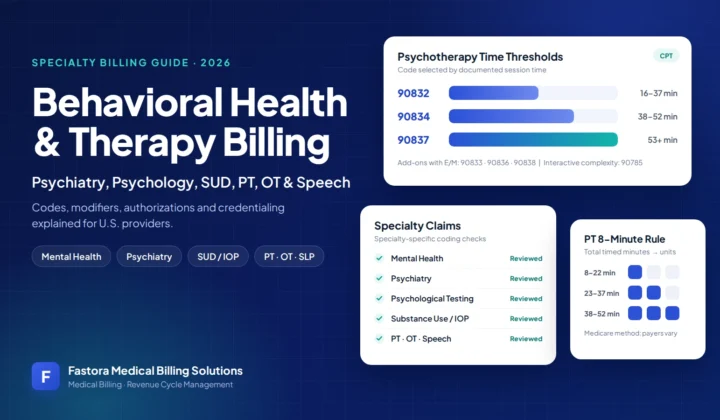
Behavioral health practices deal with unique billing considerations, including session-based coding, authorization requirements that can vary significantly by payer, and documentation standards tied to treatment plans. A behavioral health billing company needs to understand these nuances to reduce denials tied to authorization gaps or coding mismatches.
Mental Health Billing
Mental health providers — including psychiatrists, psychologists, and licensed counselors — often face frequent prior authorization renewals, varying session limits, and payer-specific rules around telehealth billing. Mental health billing services designed around these realities help reduce the administrative back-and-forth that can otherwise consume a provider’s time between sessions.
Physical Therapy Billing
Physical therapy practices commonly deal with time-based and unit-based coding, therapy cap considerations, and documentation requirements tied to functional progress. A physical therapy billing company that understands these specifics can help reduce claim errors related to units billed, modifiers, and medical necessity documentation.
Fastora supports billing for behavioral health, mental health, and physical therapy providers, along with other specialties — including EMS billing services — with workflows built around the coding and payer requirements specific to each.
Why Choose Fastora Medical Billing Solutions?
Fastora Medical Billing Solutions LLC provides expert medical billing and coding solutions, helping U.S. healthcare providers maximize revenue, ensure compliance, and streamline operations. As a medical billing company USA providers can work with directly, Fastora’s team focuses on the practical, day-to-day work that keeps a revenue cycle moving: verifying eligibility, submitting accurate claims, following up on outstanding balances, managing denials, and keeping receivables from aging out.
What sets a healthcare billing company like Fastora apart isn’t a single feature — it’s the combination of specialty awareness, consistent claim follow-up, and clear communication with the practices it serves. As a revenue cycle management company, Fastora’s role spans practice billing audits, A/R management, analytics and reporting, and credentialing and enrollment — supporting the full billing lifecycle from the first eligibility check to the final posted payment, so practices have a partner accountable for the process rather than a vendor handling isolated tasks.
Whether you’re an independent physician, a growing multi-provider group, or a behavioral health, mental health, or physical therapy practice, Fastora’s billing team works to fit into your existing operations rather than requiring you to reshape your practice around a rigid process.
Is Medical Billing Outsourcing Right for Your Practice?
Outsourcing isn’t the right move for every practice at every stage, but it’s worth evaluating seriously if several of the following sound familiar:
- Billing workload has grown faster than your staff’s capacity to manage it
- Accounts receivable is aging and becoming harder to collect
- Denials are frequent, and there isn’t enough staff time to resolve them promptly
- Claims are going unworked for weeks at a time
- Your billing team is limited to one or two people covering everything
- Insurance follow-up and payer phone calls are falling behind
- Your practice is expanding and billing needs to scale with it
- You need specialty-specific billing knowledge your current staff doesn’t have
If several of these apply, it may be worth having a conversation with a billing partner to see whether outsourcing some or all of your revenue cycle functions makes sense for where your practice is right now.
How Fastora Medical Billing Solutions Can Help
Fastora’s billing team supports the core functions that keep a practice’s revenue cycle running: practice billing audits, coding and charge entry, claims submission, denial management, payment posting, A/R management, analytics and reporting, and credentialing and enrollment — tailored to your specialty and practice size.
If your practice is dealing with growing administrative workload, aging receivables, or frequent denials, it may be worth a conversation about your specific billing and revenue cycle needs.
No obligation — tell Fastora about your current billing setup and where the friction is.
Frequently Asked Questions About Medical Billing Outsourcing
What is a third-party medical billing company?
A third-party medical billing company is an outside organization that manages some or all of a healthcare practice’s billing and revenue cycle tasks — such as claims submission, denial management, and accounts receivable follow-up — instead of those tasks being handled entirely by in-house staff.
Why do healthcare providers outsource medical billing?
Providers typically outsource billing to reduce administrative workload, improve claim follow-up, manage denials more effectively, keep accounts receivable from aging, and access specialized billing expertise without hiring and training additional in-house staff.
Is medical billing outsourcing suitable for small practices?
Yes. Many small and independent practices outsource billing because they have limited internal staff and can benefit from a dedicated team handling claims, follow-up, and denial management without adding full-time billing employees.
What services does a medical billing company provide?
Services typically include eligibility verification, medical coding, charge entry, claims submission, claim follow-up, denial and rejection management, payment posting, patient statements, accounts receivable follow-up, and credentialing support.
How does outsourced medical billing work?
A practice contracts with a billing company to manage part or all of its revenue cycle. The billing company typically handles claim submission, tracks claims through to payment, follows up on denials, and reports back to the practice on performance and outstanding balances.
How should a practice choose a medical billing company?
Practices should evaluate specialty experience, scope of services, communication practices, reporting transparency, claim follow-up and denial management approach, data security practices, and the clarity of the service agreement before choosing a billing partner.
What is the difference between medical billing and revenue cycle management?
Medical billing generally refers to the process of submitting and following up on claims for payment. Revenue cycle management is broader, covering the entire financial process from patient eligibility and scheduling through final payment and reporting.
Can behavioral health practices outsource their medical billing?
Yes. Behavioral health, mental health, and psychiatric practices can outsource billing to a partner familiar with session-based coding, authorization requirements, and the documentation standards specific to behavioral health claims.