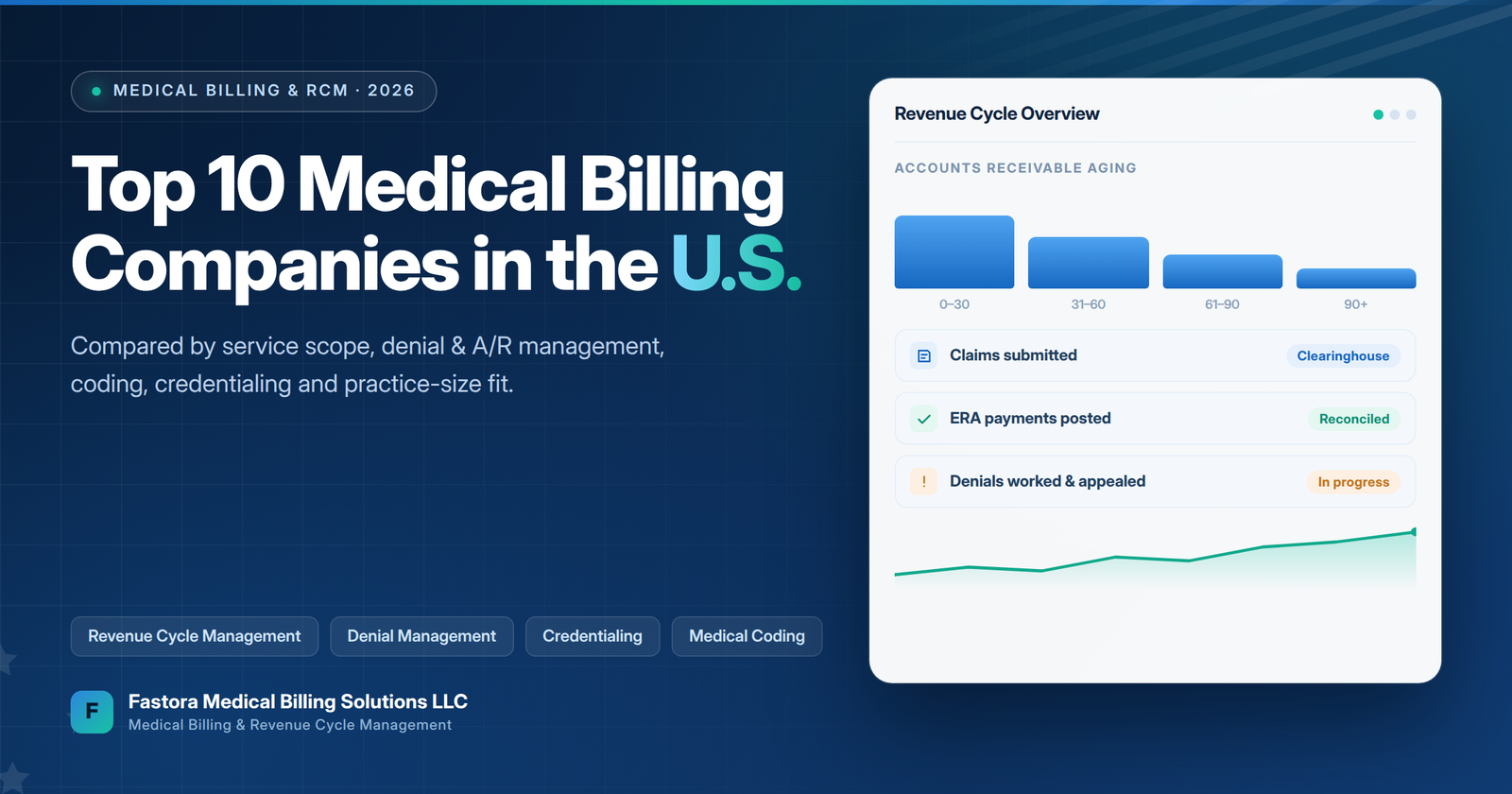
Top 10 Medical Billing Companies in the U.S. in 2026
Choosing between medical billing companies is one of the few operational decisions that touches every dollar a practice earns. The right partner shortens the distance between the day a patient is seen and the day the claim is paid. The wrong one quietly builds an aging accounts receivable report that nobody has time to work.
This guide compares the top medical billing companies in USA practices can hire in 2026 — ten established medical billing and revenue cycle management organizations that provide outsourced medical billing services to U.S. healthcare providers. Every company profiled here is a billing and RCM service company with people working claims, not a software platform or clearinghouse that sells licences and leaves the billing to your staff. That distinction matters: practice management systems and clearinghouses are tools, while medical billing companies are the teams that use them on your behalf.
The market is wide. Some medical billing companies run revenue cycle operations for multi-hospital health systems; others are dedicated physician billing services built for independent practices, where the value is a named team working your claims, denials and payer enrollments. These are not interchangeable. So instead of a generic “best medical billing companies” roundup, this guide explains its criteria first, then places each of the ten medical billing companies where it belongs by service scope, specialty expertise, denial and A/R management depth and practice-size fit.
Editorial disclosure. This ranking of medical billing companies is published by Fastora Medical Billing Solutions LLC, and Fastora is included in it at #6. It is our own editorial assessment based on the methodology described below and on publicly available information from each company’s website — it is not an independent industry award, certification or accreditation. Other publishers using different criteria publish different lists. Verify current details directly with any vendor before signing a contract.
What this guide covers
- How we selected the top medical billing companies
- Top 10 medical billing companies at a glance
- The top 10 medical billing companies in the U.S.
- #6 — Fastora Medical Billing Solutions LLC
- How to choose the right medical billing company
- Medical billing services vs. full-service RCM
- Benefits of outsourcing medical billing
- Questions to ask before hiring
- Frequently asked questions
- Sources and references
How we selected the top medical billing companies
There is no official register of the top medical billing companies in the USA. Published lists differ because their methodologies differ — some rank medical billing companies by size, some by software capability, some by the publisher’s own commercial relationships. Several 2026 lists also mix software vendors and clearinghouses in with genuine medical billing services companies. We evaluated the medical billing companies below against eight criteria that map to what actually determines whether a practice gets paid.
Editorial methodology · 2026
Eight criteria used to rank the medical billing companies on this list
Service scope
Full revenue cycle coverage versus a defined slice of billing tasks.
Coding & compliance
ICD-10-CM, CPT and HCPCS accuracy, modifiers and charge review.
Denials & A/R
Root-cause medical denial management, appeals and disciplined A/R follow-up.
Credentialing & enrollment
Medicare, Medicaid and commercial enrollment, CAQH and revalidations.
Technology & EHR fit
Practice management, EHR, clearinghouse and payer portal integration.
Specialty expertise
Physician, hospital-based and behavioral health specialty experience.
Reporting transparency
Claim-level visibility, denial categories and A/R aging without asking.
Practice-size fit
Solo and small practices, mid-sized groups, or hospitals and systems.
Not measured: price, audited financial results, or self-reported performance metrics. Where a company publishes its own numbers, we identify them as company-stated rather than presenting them as verified. Statements about services reflect what each company describes publicly as of September 2026.
Top 10 medical billing companies in the USA at a glance
The table below summarizes all ten medical billing companies, what each one focuses on, and the type of healthcare organization it tends to suit. Detailed profiles follow.
| # | Medical billing company | Best suited for | Core focus | Notable capabilities |
|---|---|---|---|---|
| 1 | R1 RCM | Large health systems, hospitals, large physician groups | End-to-end revenue cycle operations at enterprise scale | Phare OS platform, AI agents with human oversight, front-end to back-end services |
| 2 | Ensemble Health Partners | Hospitals, health systems, affiliated physician practices | Operating-partner RCM for facility and professional billing | Denial and underpayment reduction, patient access, EHR optimization |
| 3 | Omega Healthcare | Hospitals, ambulatory groups, payers | AI-assisted RCM outsourcing across the full cycle | Patient access, mid-cycle, business office, health data services |
| 4 | AGS Health | Health systems and coding-intensive provider organizations | Medical coding, patient access and A/R at scale | Autonomous and computer-assisted coding, CDI, prior authorization technology |
| 5 | Savista | Hospitals, health systems, physician practices | Broad RCM outsourcing and eligibility services | Coding, denials management, A/R, eligibility and enrollment, registries |
| 6 | Fastora Medical Billing Solutions LLC | Solo providers, small and mid-sized multi-specialty practices, behavioral health, hospital-based physician groups | Outsourced medical billing, RCM, coding and credentialing with a dedicated account team | Full-cycle billing, denial and aging A/R management, appeals, credentialing and payer enrollment across 19 specialties |
| 7 | Coronis Health | Specialty groups, hospitals, FQHCs, EMS agencies | Specialty-specific billing and RCM | Anesthesia, radiology, pathology, emergency medicine and behavioral health billing |
| 8 | Med-Metrix | Hospital systems and physician groups | RCM services combined with its own technology stack | Patient intake, revenue integrity, denials management, business insights |
| 9 | Neolytix | Independent practices and multi-specialty groups | Outsourced medical billing for smaller provider organizations | Coding review, claim edits, denial follow-up, credentialing, published pricing |
| 10 | Medical Billers and Coders (MBC) | Physician practices and multi-specialty groups nationwide | Physician billing services across many specialties | Billing, coding audits, denial management, old A/R recovery, credentialing |
Ranking reflects this article’s editorial methodology, not an independent industry award. Company details are drawn from each organization’s public website as of September 2026.
The top 10 medical billing companies in the U.S. in 2026
R1 RCM
Overview. R1 RCM is one of the largest healthcare revenue cycle management companies in the United States. It describes its offering as a “revenue operating system” combining agentic AI with human expertise, and states that it processes roughly 280 million transactions each year.
Primary strengths. Depth and scale. R1’s Phare OS platform is organized around front-end access and financial clearance, mid-cycle claim integrity, and back-end A/R follow-up and denial resolution. For organizations whose revenue cycle spans hundreds of physicians and multiple facilities, that layered coverage — plus operating partnerships in which R1 manages revenue cycle staff day to day — is difficult to replicate in house.
Best suited for and services. Large health systems, sizable physician groups and critical access hospitals seeking an enterprise operating partner rather than a billing vendor. Capabilities span patient access, coding and claim integrity, claims management, denial resolution, A/R follow-up and analytics.
Ensemble Health Partners
Overview. Ensemble Health Partners provides end-to-end revenue cycle management for hospitals, health systems and affiliated physician practices, built around operating partnerships in which Ensemble manages revenue cycle functions and reports performance back to the health system.
Primary strengths. Facility-side complexity. Its service lines emphasize denial and underpayment reduction, collections acceleration, patient financial experience, payer strategy and EHR optimization — including work inside Epic environments, which matters when the revenue cycle problem is as much a build-and-workflow problem as a billing one. The company states it has been ranked #1 in KLAS for end-to-end RCM services in recent years; that is a company-reported distinction readers can verify directly.
Best suited for and services. Hospitals, integrated delivery networks and health systems with employed physician groups needing facility and professional billing handled together — through revenue integrity, denial and underpayment management, patient access and analytics.
Omega Healthcare Management Services
Overview. Omega Healthcare provides outsourced revenue cycle management and healthcare operations services to providers, payers and life sciences organizations, combining AI-assisted automation with large service teams.
Primary strengths. Whole-cycle coverage at volume, organized around end-to-end RCM, patient access, mid-revenue cycle and business office operations. The company reports a 2026 Best in KLAS award for Ambulatory RCM Services and recognition as a Star Performer in Everest Group’s revenue cycle management assessment — useful third-party signals for buyers evaluating large medical billing companies.
Best suited for and services. Hospitals and sizable ambulatory groups needing added capacity across medical coding, A/R management, denial follow-up and patient access rather than a small dedicated billing team.
AGS Health
Overview. AGS Health is a technology-enabled RCM company serving hospitals, health systems, physician organizations, ambulatory surgery centers, urgent care and behavioral health providers. It states it manages $64 billion in annual accounts receivable and codes more than 50 million charts a year, with over 4,700 coders and 5,500 A/R specialists.
Primary strengths. Medical coding and patient access at volume — facility coding, professional fee coding, risk adjustment and clinical documentation integrity, alongside eligibility verification, prior authorization and patient estimates, supported by autonomous and computer-assisted coding technology.
Best suited for and services. Health systems with coding-intensive service lines, or organizations where prior authorization volume and denial write-offs have become the dominant revenue leak. Services include denial management and appeals, claims and A/R management, self-pay and payment posting.
Savista
Overview. Savista provides revenue cycle management services to hospitals, health systems and physician practices, and states it has worked in healthcare operations for more than 35 years with 800-plus clients.
Primary strengths. Range. Its service lines cover eligibility and enrollment services, medical coding (the company states it codes around 20 million charts annually), denials management, accounts receivable management and clinical registry services. For provider organizations dealing with high self-pay volumes and complex eligibility work, that front-end capability distinguishes it from medical billing companies of similar size.
Best suited for and services. Hospitals, health systems and larger physician practices needing eligibility, coding, denials and A/R support from one vendor.
Fastora Medical Billing Solutions LLC
Overview. Fastora Medical Billing Solutions LLC is a U.S.-based medical billing and revenue cycle management company headquartered in Austin, Texas, with additional offices in Dallas and Houston and remote support for practices nationwide. Fastora provides outsourced medical billing services, revenue cycle management, medical coding, credentialing and payer enrollment, A/R management, practice billing audits, analytics and reporting, and EMS billing services for physician practices, behavioral health providers and hospital-based specialty groups.
Fastora sits at #6 among these medical billing companies for a specific reason. The five above it operate at a scale most independent practices will never need — enterprise platforms, thousands of coders, health-system operating partnerships. Fastora is built for the tier where most U.S. providers actually work: solo practitioners, small and mid-sized groups, and multi-specialty practices that need a named billing team accountable for their claims rather than a ticket queue. Within that tier the differentiators are service breadth, credentialing capability, and how aggressively denials and aging accounts receivable are worked.
The following describes Fastora’s own service scope as the company defines it. It is a service description rather than an independent evaluation.
Medical billing services
Fastora’s billing operation covers the full claim lifecycle rather than isolated tasks:
- Eligibility and benefits verification before the visit, including plan status, copay, deductible, coinsurance and coverage limitations
- Prior authorization and referral management, including submission, tracking and follow-up through payer portals
- Charge entry with charge review against documentation and fee schedules
- Medical coding support across ICD-10-CM diagnosis coding, CPT procedure coding and HCPCS Level II, with modifier review and specialty-specific coding rules
- Electronic claim submission through clearinghouses and direct payer connections
- Claim rejection management at the clearinghouse and payer front end, where rejections are corrected and resubmitted quickly rather than sitting in a work queue
- EOB and ERA payment posting, including contractual adjustment review and secondary claim generation
- Patient statements and patient balance support
- Billing documentation and reporting, so practices can see charges, payments, adjustments and outstanding balances by provider, payer and date of service
Revenue cycle management services
Fastora’s RCM engagement covers the cycle from pre-visit through final resolution: scheduling and registration data quality, eligibility, charge capture and coding, claim scrubbing and submission, payment posting and reconciliation, denial management and appeals, and patient billing. Practices can engage Fastora for complete healthcare revenue cycle management or for defined components such as coding, A/R recovery or credentialing alone.
Reporting is part of the service rather than an add-on request: charge and payment summaries, A/R aging by payer and bucket, denial categories and trends, and collections performance by provider.
Denial management and A/R management
Denials are where most practice revenue is lost quietly. Industry data underlines the scale of the problem — KFF’s analysis of federal transparency data found that Marketplace insurers denied 19% of in-network claims in 2024, and that fewer than 1% of those denials were ever appealed. Fastora’s approach to medical denial management and accounts receivable work includes:
- Denial management with root-cause categorization — eligibility, authorization, coding, medical necessity, bundling, coordination of benefits, timely filing and registration errors — so recurring causes get fixed upstream instead of reappearing next month
- Appeals and corrected claims, including payer-specific appeal formats, supporting documentation and reconsideration requests
- Accounts receivable follow-up on open claims by aging bucket, with direct payer and portal follow-up rather than passive resubmission
- Aging A/R management and timely filing control, prioritizing claims approaching filing deadlines and working old A/R that in-house staff rarely have capacity to touch
- Underpayment review against contracted rates and fee schedules
Credentialing and payer enrollment
Credentialing is a common bottleneck for new providers, new locations and growing groups, and a common source of avoidable denials when enrollment lapses. Fastora’s credentialing and enrollment services include:
- Provider credentialing and recredentialing with commercial and government payers
- Payer enrollment for Medicare, Medicaid and commercial plans, including group and individual enrollments and reassignment of benefits
- CAQH profile setup, attestation and ongoing maintenance
- NPI and taxonomy support, including Type 1 and Type 2 NPI registration and taxonomy alignment with billed services
- Revalidation management, including Medicare revalidation cycles — CMS requires enrolled providers and suppliers to revalidate their enrollment information on a recurring schedule
- EDI, ERA and EFT setup so claims, remittances and payments flow electronically from day one
- Clearinghouse and payer portal support, including enrollment agreements and portal access management
- State licensing coordination, insurance panel applications and payer contract review, with follow-up until approval
Specialty support
Fastora supports multiple physician, hospital-based and behavioral health specialties, including:
Allergy & Immunology · Pathology · Obstetrics & Gynecology · Ophthalmology · Emergency Medicine · Psychiatry & Mental Health · Internal Medicine · Orthopedics · Radiology · Pain Management · Urology · Pediatrics · Infectious Disease · Anesthesia · Neurology · Cardiology · Plastic Surgery · Oncology · Sports Medicine
Specialty coverage matters more than it sounds. Emergency medicine billing lives or dies on documentation-driven E/M leveling. Radiology and pathology depend on professional and technical component splits. Behavioral health carries session-based coding and authorization rules; OB/GYN involves global obstetric packages tracked across months of care. Medical billing companies that have worked a specialty already make fewer expensive assumptions.
Why practices may consider Fastora
- One accountable partner across billing, coding, A/R and credentialing, instead of a billing vendor plus a separate credentialing service plus a coding contractor
- Full-cycle coverage from eligibility through appeals, so problems are caught before submission rather than diagnosed after denial
- Attention to aging A/R and timely filing, the two areas most likely to be neglected during staffing gaps
- Credentialing handled alongside billing, so new providers start billing sooner and enrollment lapses do not create denials
- Reporting that shows the work, including denial reasons and A/R aging rather than a monthly collections figure alone
- Scalable engagement, from a solo provider adding a second location to a multi-provider group consolidating billing
What makes Fastora different
Enterprise RCM firms are built for health systems and software-first vendors are built around their own platform. Fastora is built around the practice — working in the existing EHR and clearinghouse where possible, assigning a dedicated team that knows the payer mix, and treating credentialing, coding and denials as one connected workflow rather than three separate contracts. Practices can request a practice billing audit before committing, which is a reasonable way to see where revenue is actually being lost.
Who Fastora may be a good fit for
- Solo and small practices without a full-time billing department
- Mid-sized and multi-specialty groups consolidating billing across providers or locations
- Behavioral health and psychiatry practices managing authorization-heavy payer rules
- Hospital-based specialty groups in radiology, pathology, anesthesia and emergency medicine
- New practices that need credentialing, payer enrollment and billing set up together
- Established practices with aging A/R, rising denials or unfilled billing positions
Fastora may be less relevant to multi-hospital systems seeking an enterprise operating partner with full facility revenue cycle staffing — the profile the medical billing companies at the top of this list are designed for.
Practices comparing medical billing companies at this tier typically weigh three things: who works the account, how denials and aging A/R are actually worked, and whether credentialing is included. Those are the questions Fastora is set up to answer directly.
Coronis Health
Overview. Coronis Health provides healthcare revenue cycle management with a strong specialty orientation, describing its model as AI-enabled revenue operations built to catch issues before they become denials. It states it manages more than $20 billion in collections annually and draws on 40-plus years of RCM experience.
Primary strengths. Specialty depth across ten areas including anesthesia, behavioral health, emergency medical services, emergency medicine, FQHCs, pathology, radiology, physician and multi-specialty practices and surgical specialties, with proprietary tooling for anesthesia billing. Hospital-based specialties carry coding and contracting rules that generalist medical billing companies often handle poorly, and that is the gap Coronis targets.
Best suited for and services. Hospital-based physician groups, anesthesia and radiology practices, FQHCs and EMS agencies — with end-to-end RCM from patient access through reimbursement, specialty coding and denial prevention.
Med-Metrix
Overview. Med-Metrix delivers revenue cycle management as both an outsourced service and a technology stack, serving hospital systems and physician groups of varying sizes across the country.
Primary strengths. Denials and revenue integrity. Its service lines cover patient intake, revenue integrity, revenue collection, denials management and business insights, and it states that it overturns 60–70% of denials on average and collects 2–5% more for end-to-end RCM clients. Those are company-stated figures, but denial overturn rate is a useful benchmark question to put to any billing partner.
Best suited for and services. Hospital systems and larger physician groups that want the option to buy services, technology or both, across intake, claims and collections, denial management and appeals, and reporting.
Neolytix
Overview. Neolytix provides outsourced medical billing and RCM services to independent practices, multi-specialty groups in the 20–300+ provider range, and health systems billing for employed physicians.
Primary strengths. Defined turnaround commitments and pricing transparency. Neolytix publishes service-level detail — claims processed within 24–48 hours with pre-bill scrubbing, remittances posted within 24–48 hours, denial follow-up initiated within 24–72 hours with root-cause trend analysis — and states typical pricing of 4–8% of collections.
Best suited for and services. Independent practices and mid-sized groups that want measurable turnaround commitments in the contract, across coding review, claim edits, payment posting, denial management, A/R follow-up, patient statements and credentialing.
Medical Billers and Coders (MBC)
Overview. Medical Billers and Coders is a long-established U.S. medical billing company serving physician practices, multi-specialty groups and health systems, operating since 1999.
Primary strengths. Specialty breadth and reach — 32-plus medical specialties across all 50 states, with medical claims billing, coding audits, denial management with appeals, accounts receivable follow-up, old A/R recovery, physician credentialing and RCM dashboard reporting. The company publishes performance figures including a 98.4% first-pass acceptance rate; these are company-stated and not independently verified here.
Best suited for. Practices seeking a specialty-experienced billing vendor with a long operating history, particularly those needing old A/R recovery alongside current billing.
How to choose the right medical billing company
The best medical billing companies for a 400-provider health system and for a two-physician practice have almost nothing in common. Work through these dimensions in order.
- Start with your actual failure point. Pull three numbers first: days in A/R, percentage of A/R over 90 days and first-pass acceptance rate. If denials are the problem, prioritize denial management depth. If new providers wait months to bill, credentialing is your bottleneck, not billing.
- Match scope to staffing. Many practices keep front-desk eligibility and patient collections and outsource coding, submission, denials and A/R. That split works — but only if the handoffs are written into the agreement.
- Check specialty fit. Ask for specifics on your specialty’s coding rules. Medical billing companies that have worked orthopedics know global periods and modifier 25 scrutiny; those that have worked behavioral health know authorization thresholds and telehealth policy variation.
- Confirm technology compatibility. Will the company work inside your existing EHR and clearinghouse, or does the engagement require migrating systems? Migration should be a decision, not a surprise.
- Insist on readable reporting. Monthly collections alone is not reporting. You want A/R aging by payer, denial reasons by category and claim-level status visibility.
- Understand pricing in full. Percentage of collections is the most common model among medical billing companies, but confirm what it covers — clearinghouse fees, statements, credentialing and coding are sometimes billed separately.
- Verify compliance posture. HIPAA compliance, a signed Business Associate Agreement, access controls and breach procedures are baseline requirements, not differentiators.
Medical billing services vs. full-service RCM
The terms are used interchangeably in marketing, but the scope difference is real and it shows up in your denial rate and A/R aging.
Scope comparison
What medical billing services cover versus full-service RCM
Medical billing services
Transactional — charge entry to payment posting- Charge entry and claim creation
- Claim scrubbing and electronic submission
- Rejection handling and resubmission
- EOB and ERA payment posting
- Eligibility, benefits and prior authorization
- Root-cause denial management and appeals
- Aging A/R follow-up and timely filing control
- Credentialing and payer enrollment
Full-service RCM
End to end — scheduling to final account resolution- Everything in medical billing services
- Registration data quality and patient access
- Eligibility, benefits and prior authorization
- Medical coding and charge review
- Denial management, appeals and corrected claims
- A/R follow-up, aging recovery and underpayment review
- Patient statements and balance resolution
- Credentialing, payer enrollment and performance reporting
A practical rule: map your last 90 days of denials by category. If they cluster in eligibility, authorization and registration, you need full-service RCM. If they cluster in coding and claim edits, focused medical billing services may be sufficient.
Medical billing services typically begin at charge entry and end at payment posting: claims are scrubbed, submitted and posted, with some rejection handling. For a practice with strong front-office processes that can be enough.
Full-service revenue cycle management covers the lifecycle end to end — patient access, eligibility, prior authorization, charge capture, coding, submission, posting, denial management, appeals, A/R follow-up, patient balances and reporting. Crucially it includes the front end, where most denials originate: eligibility errors, missing authorizations and registration mistakes cannot be fixed by a good scrubber downstream. KFF’s analysis of 2024 federal data makes the point — administrative issues accounted for a quarter of in-network Marketplace denials, and missing prior authorization or referral for almost a tenth.
Why denials happen · KFF analysis of 2024 data
Reasons Marketplace insurers denied in-network claims
Marketplace insurers denied 19% of in-network claims in 2024, and fewer than 1% of those denials were appealed. Source: KFF, published March 2026.
The medical billing and RCM workflow, end to end
Whichever scope you buy, the underlying workflow is the same. Understanding it makes vendor conversations far more productive, because you can ask which stages the company actually owns.
Revenue cycle management
Eight stages of the medical billing and RCM cycle
Scheduling & registration
Accurate demographics, insurance capture and clean patient data at intake.
Eligibility & prior authorization
Benefits verification, copay and deductible checks, authorizations and referrals.
Charge entry & medical coding
Charge review with ICD-10-CM, CPT and HCPCS coding and modifier accuracy.
Claim scrubbing & submission
Payer edits, rejection correction at the clearinghouse and electronic submission.
EOB / ERA payment posting
Posting, contractual adjustment review, reconciliation and secondary claims.
Denial management & appeals
Root-cause categorization, corrected claims, appeals and upstream fixes.
A/R follow-up & timely filing
Aging A/R worked by bucket, filing deadlines protected, underpayments reviewed.
Patient statements & reporting
Patient balances, statements and reporting on denials, A/R and collections.
Runs alongside the cycle: provider credentialing, payer enrollment, CAQH maintenance, revalidations and EDI / ERA / EFT setup.
Benefits of outsourcing medical billing
Outsourcing is not automatically better than in-house billing. It is better under specific conditions — and those conditions describe a lot of U.S. practices in 2026.
- Continuity. A single biller’s resignation or medical leave should not stop cash flow. Outsourced medical billing teams provide coverage a one- or two-person billing department cannot.
- Specialized denial and appeals capability. Working a denial correctly means knowing the payer’s appeal pathway, deadline and documentation expectations. Medical billing companies handling denials across many practices build that knowledge faster than a generalist biller can.
- Cost that scales with revenue. Percentage-of-collections pricing converts a fixed payroll cost into a variable one, helping growing practices absorb volume without hiring ahead.
- Coding and compliance depth. Coders who follow annual ICD-10-CM and CPT updates and payer policy changes reduce both underpayment and audit exposure.
- Faster credentialing. When credentialing sits with the same partner as billing, enrollment gaps and lapsed revalidations are caught before they turn into denials.
- Measurable administrative savings. The 2025 CAQH/DataSpring Index identified roughly $21 billion in annual savings still available from closing automation gaps in administrative transactions.
- Reporting visibility. Practices that outsource well often gain more financial visibility than they had in house, because reporting becomes a contracted deliverable.
The trade-offs are real: less direct control and dependence on a vendor’s responsiveness. These are managed through the contract and a named account contact, not assumed away.
Questions to ask before hiring a medical billing company
- Who specifically will work my account, and how do I reach them?
- What is your process for claims denied for eligibility, authorization, medical necessity and timely filing?
- At what A/R age do you escalate, and how do you work claims over 90 and 120 days?
- Do your coders hold current coding credentials, and who is responsible for coding accuracy?
- Will you work inside my current EHR and clearinghouse, or is a migration required?
- What reports do I receive, how often, and can I see claim-level status on demand?
- Exactly what does your percentage cover, and what is billed separately?
- Do you handle credentialing, payer enrollment, CAQH maintenance and revalidations?
- How do you handle patient billing questions and statements?
- What are your HIPAA safeguards, and will you sign a Business Associate Agreement?
- What happens to my data, open claims and A/R if I terminate the agreement?
- Can you provide references from practices of my size in my specialty?
Frequently asked questions about medical billing companies
What are the top medical billing companies in the U.S.?
Based on this article’s methodology, the top medical billing companies in the USA in 2026 include R1 RCM, Ensemble Health Partners, Omega Healthcare, AGS Health, Savista, Fastora Medical Billing Solutions LLC, Coronis Health, Med-Metrix, Neolytix and Medical Billers and Coders. There is no official national ranking of medical billing companies, so the useful question is not which company ranks highest overall, but which one fits your specialty, practice size and payer mix.
What does a medical billing company do?
Medical billing companies convert clinical services into paid claims. That typically includes eligibility and benefits verification, prior authorization support, charge entry, medical coding review, claim scrubbing and electronic submission, payment posting from EOBs and ERAs, denial management and appeals, accounts receivable follow-up, patient statements and financial reporting. Full-service RCM companies also handle patient access work and, often, provider credentialing and payer enrollment.
How much does outsourced medical billing cost?
Most outsourced medical billing in the U.S. is priced as a percentage of collections — Neolytix, for example, publishes typical pricing of 4–8%. Rates vary with claim volume, average reimbursement, specialty complexity and how much of the revenue cycle the vendor handles, and some medical billing companies use flat monthly or per-claim pricing instead. When comparing quotes, confirm whether coding, credentialing, statements and clearinghouse fees are included or billed separately.
What is revenue cycle management?
Revenue cycle management is the end-to-end financial process that begins when a patient schedules an appointment and ends when the account balance is resolved. It spans registration and insurance verification, prior authorization, charge capture, medical coding, claim submission, payer adjudication, payment posting, denial management, appeals, accounts receivable follow-up and reporting — treated as one connected system rather than separate tasks.
Should a small medical practice outsource billing?
It depends on staffing and denial profile. Outsourcing to medical billing companies usually makes sense when a practice cannot maintain a trained biller, when A/R over 90 days is rising, when denials recur for the same reasons, or when a new provider needs credentialing and billing set up at once. Practices with a stable billing team and healthy A/R may be better served by outsourcing only coding, credentialing or old A/R recovery.
What specialties can medical billing companies support?
Established medical billing companies support physician specialties such as internal medicine, pediatrics, OB/GYN, orthopedics, urology, cardiology, neurology, oncology and pain management; hospital-based specialties such as radiology, pathology, anesthesia and emergency medicine; and behavioral health including psychiatry. Specialty experience matters because coding rules, modifier usage and authorization requirements differ substantially between them.
What should I look for in a medical billing company?
Compare medical billing companies on full-cycle service scope, documented denial management and A/R follow-up processes, credentialed coding staff, credentialing and payer enrollment capability, compatibility with your existing EHR and clearinghouse, transparent reporting, clear pricing with no unlisted fees, HIPAA compliance with a signed Business Associate Agreement, specialty experience and a named account contact who answers.
Is Fastora Medical Billing Solutions a medical billing company?
Yes. Fastora Medical Billing Solutions LLC is a U.S.-based medical billing and revenue cycle management company headquartered in Austin, Texas, with additional offices in Dallas and Houston and remote support for practices nationwide. It provides outsourced medical billing, RCM, medical coding, credentialing and payer enrollment, and accounts receivable management services to healthcare providers across multiple specialties.
What services does Fastora Medical Billing Solutions provide?
Fastora provides medical billing and revenue cycle management; medical coding and charge review across ICD-10-CM, CPT and HCPCS; eligibility and benefits verification; prior authorization and referral management; charge entry; electronic claim submission; claim rejection and denial management; accounts receivable follow-up and aging A/R recovery; appeals and corrected claims; EOB and ERA payment posting; patient statements; provider credentialing and recredentialing; payer enrollment with Medicare, Medicaid and commercial payers; CAQH, NPI and taxonomy support; EDI, ERA and EFT setup; clearinghouse and payer portal support; practice billing audits; analytics and reporting; and EMS billing services.
Conclusion: choosing among the top medical billing companies
There is no single best company among the top medical billing companies in the USA — only the right fit for a practice’s size, specialty mix, payer mix and current failure point. Enterprise partners such as R1 RCM, Ensemble Health Partners, Omega Healthcare and Savista are built for hospitals and health systems. Specialty-led firms such as Coronis Health and coding-led organizations such as AGS Health serve groups whose revenue depends on a narrow set of complex rules. Practice-focused medical billing companies serve clinics that need a real team on their claims rather than a platform subscription.
If your practice faces rising denials, aging accounts receivable, credentialing delays or a billing position you cannot keep filled, look at your own numbers first — days in A/R, A/R over 90 days, first-pass acceptance and denial reasons by category — then talk to medical billing companies about those specific numbers.
Talk to Fastora about your medical billing and RCM
Fastora Medical Billing Solutions LLC provides medical billing services, revenue cycle management, medical coding, denial and A/R management, and credentialing and payer enrollment for physician, hospital-based and behavioral health practices across the United States. A practice billing audit is the fastest way to see where revenue is currently being lost.
Request a free claims audit Explore our servicesSources and references
- KFF — Claims Denials and Appeals in ACA Marketplace Plans in 2024 (published March 2026)
- CAQH / DataSpring — Index Report 2025
- CMS — Revalidations (Renewing Your Enrollment)
- Company websites: r1rcm.com, ensemblehp.com, omegahms.com, agshealth.com, savistarcm.com, coronishealth.com, med-metrix.com, neolytix.com, medicalbillersandcoders.com
- Fastora Medical Billing Solutions LLC — fastoramedicalbilling.com
Company descriptions reflect publicly available information as of September 2026. Performance figures published by individual companies are identified as company-stated and have not been independently verified. This article is Fastora Medical Billing Solutions LLC’s own editorial assessment and does not represent an independent industry ranking, certification or endorsement.