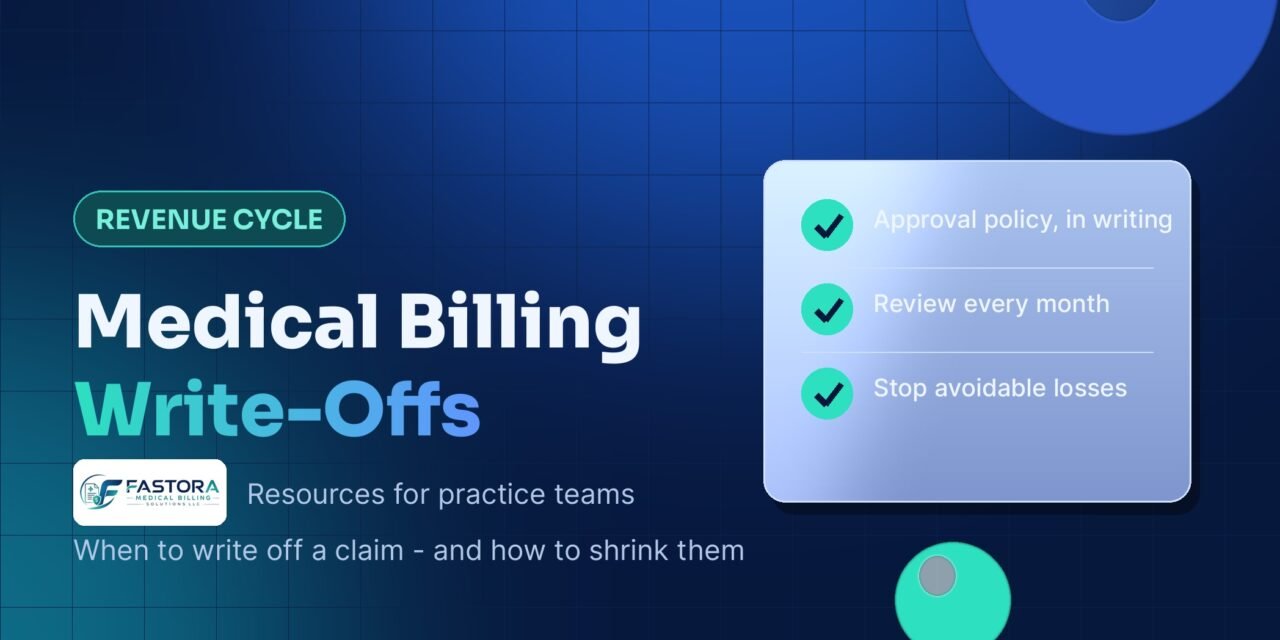
Medical Billing Write-Offs: When to Write Off a Claim and How to Reduce Them
Every practice writes off some revenue. The difference between a healthy practice and one quietly losing money is whether those write-offs are deliberate decisions or silent leaks. A $40 patient balance nobody follows up on, a denied claim that aged past the appeal window, a timely filing miss that nobody owned — each feels small, but together they can drain a meaningful share of what the practice earned.
This guide explains what medical billing write-offs are, when writing off a claim is the right call, and how to shrink the write-offs that should never have happened.
What counts as a write-off (and what doesn’t)
Not every amount removed from a bill is a write-off in the true sense. Mixing the categories up makes your reports misleading and your trends impossible to read. The four categories below cover most of what appears on a practice’s adjustment report:
- Contractual adjustments — the difference between your billed charge and the payer’s contracted allowed amount. This is expected and agreed-upon; it is not a loss the practice failed to collect.
- Bad debt write-offs — balances that were legitimately owed but became uncollectible after real collection effort, most often patient responsibility.
- Small-balance write-offs — tiny balances where the cost of collecting exceeds the balance. Practices usually set a dollar threshold in policy.
- Administrative or policy write-offs — amounts removed for practice decisions: timely filing losses from internal error, courtesy adjustments, billing mistakes that cannot be corrected.
Labeled example — the distinction that matters most:
| Contractual adjustment | True write-off | |
|---|---|---|
| Cause | Payer contract terms | Uncollectible balance or internal error |
| Expected? | Yes, on every contracted claim | No — signals something to fix or a decision to make |
| Collectible? | Never was | Was (or should have been) |
| Needs approval? | Automatic | Should require a person with authority |
If contractual adjustments and true write-offs are lumped into one “adjustments” number, you cannot see whether your billing operation is improving or bleeding. Report them separately.
The write-offs that should worry you
Some write-offs are the cost of doing business. Others show something in the revenue cycle is broken. These are the ones to treat as red flags:
- Timely filing write-offs. The claim was never submitted, or a denial was never worked, before the payer’s filing deadline. When the miss is the practice’s error, most payer contracts do not allow billing the patient — the practice absorbs the loss. Every one of them should trigger a review of who owned the claim and why the deadline was missed.
- Eligibility and authorization write-offs. The patient was not actually covered on the date of service, or the service needed an authorization that was never obtained. These are front-end failures. They are almost entirely preventable with eligibility and benefits verification before every visit.
- Credentialing write-offs. The rendering provider was not enrolled with the payer when the service was delivered. Claims for those dates of service are typically denied outright and cannot be recovered.
- Denied claims that were never appealed. A denial is not a final answer until the appeal window closes. Claims written off while an appeal was still available are write-offs by neglect.
- Patient balances written off without a collection process. If no statement went out and no payment option was offered, the balance was never really worked. Patient responsibility now makes up a large share of practice revenue and needs the same disciplined follow-up as insurance balances.
When any of these categories grows, the fix is not better write-off reporting — it is fixing the upstream workflow. Our guide on reducing claim denials covers where most of these start.
Put the write-off decision in writing
The most effective control is a written write-off policy. Without one, staff make judgment calls under time pressure and the numbers drift. A workable policy covers:
- Who can approve a write-off. Define dollar thresholds: staff can approve small balances within policy, a manager approves mid-range amounts, and anything large requires the practice owner or administrator. No one should write off their own mistakes without review.
- What must happen before a claim is written off. Spell out the minimum effort: the claim was worked, denials were appealed within the window, patient balances went through the full statement and reminder cycle. A write-off should be a documented decision, not an absence of one.
- Separation of categories. Code contractual adjustments, bad debt, small balances, and administrative write-offs separately so each trend is visible.
- How often the report is reviewed. Monthly, by the person who can act on it. Look at write-offs by reason, by payer, and by staff member — and give every item that moved the wrong way an owner and a next step.
- Financial assistance and charity policy. Balances forgiven under a documented financial assistance policy are a different category from bad debt. Having the policy written keeps the reporting honest.
The Texas Medical Association’s practice guidance makes the point well: there is no universal rule of thumb for when to write off a patient balance. It is a practice decision — which is why it should be documented, not ad hoc.
How to reduce write-offs
Reducing write-offs is mostly about preventing them upstream rather than managing them after the fact:
- Verify eligibility and benefits before every visit, including for returning patients whose coverage may have changed. Confirm the payer, the plan, and whether authorization is required.
- Obtain authorizations before the service is delivered, and track them against scheduled visits so services do not outrun approved dates or units.
- Submit clean claims fast. Every day between the visit and submission is risk. Review charges for missing modifiers, diagnosis pointers, and units before the claim goes out.
- Work clearinghouse rejections daily. A rejected claim never reached the payer, so the clock runs without anyone knowing.
- Appeal denials within days, not weeks. Each denial needs a decision: correct and resubmit, or appeal with documentation. Track denial reasons by payer and fix the top causes at the source.
- Watch every filing and appeal deadline. Flag claims approaching timely filing limits and appeal windows before they close, not after.
- Run a real patient collection cycle. Send the first statement as soon as insurance pays, offer online payment and payment plans, and follow up on a written schedule.
- Review the aging report weekly, working the oldest, highest-value balances first. Our guide on reducing days in A/R walks through the full recovery sequence.
When follow-up keeps falling behind new billing, that is usually the point at which outside help pays for itself. A billing assessment can show exactly where the write-offs are coming from.
Review write-offs like an owner
Once a month, sit with the write-off report and ask four questions:
- Are true write-offs growing? The trend matters more than any single month.
- Which reasons dominate? Timely filing at the top means a workflow ownership problem; bad debt at the top means the patient collection cycle needs work.
- Which payers produce the most write-offs? A payer that repeatedly generates uncollectible balances may need a contract review or an escalation to provider relations.
- Would an audit find the same thing? If your own report cannot explain why each category moved, an outside billing audit will surface what the internal numbers hide.
FAQs
Is a contractual adjustment a write-off?
No. A contractual adjustment is the expected difference between your billed charge and the payer’s contracted allowed amount. A write-off is an amount that was collectible and was removed — bad debt, small balances, administrative adjustments. Track them separately.
When is it safe to write off a patient balance?
After the balance went through your documented collection process: accurate statements, reminders on schedule, payment options offered, and any financial assistance screening the practice provides. Put the rule in writing so it is applied consistently.
Can I write off a timely filing denial?
If the filing deadline passed because of the practice’s error, the claim generally cannot be recovered or billed to the patient under most payer contracts — the loss lands on the practice. Record it as an administrative write-off and fix the workflow that let the deadline pass.
Who should approve write-offs?
Someone with authority and accountability. Set dollar thresholds: staff for small balances within policy, a manager for mid-range amounts, and the owner or administrator for large write-offs. The person who made the error should not approve writing it off.
How do I know if my write-offs are too high?
Compare your own trend over time, broken out by reason: bad debt, small balances, administrative, and contractual adjustments separately. A growing share of true write-offs, or one reason that keeps climbing, is the signal.
A deliberate write-off policy protects your revenue
Write-offs will never be zero, and they should not be — a practice that never writes anything off is probably letting uncollectible balances clog its books. The goal is that every write-off is a conscious, authorized decision made after real effort. Separate the categories, put approvals and thresholds in writing, review the report monthly, and fix the upstream workflows that produce the avoidable ones.
If write-offs are growing and the report cannot explain why, Fastora’s free billing assessment reviews your denial and adjustment patterns and shows where the leakage is coming from. For a deeper look, our guide on what a medical billing audit checks explains how an outside review finds write-off patterns that internal reports miss.