What changed for therapists and counselors in 2024
For years, licensed marriage and family therapists and licensed counselors could not bill Medicare directly, even though many of their clients were Medicare beneficiaries. The Consolidated Appropriations Act, 2023 added marriage and family therapists (MFTs) and mental health counselors (MHCs) as Medicare Part B practitioners, starting with services on or after January 1, 2024.
That opened Medicare billing for LMFT and LMHC clinicians who enroll and meet the federal requirements. This article covers who qualifies, how to enroll, which codes apply and the payment rules that differ from commercial insurance.
Who qualifies under Medicare's definitions
Medicare uses its own definitions of MFT and MHC. A clinician's state license title does not have to match exactly, but the clinician must meet all of the federal criteria. According to CMS guidance, an MFT or MHC must:
- Hold a master's or doctor's degree that qualifies for licensure or certification as an MFT or MHC under state law where services are performed.
- Be licensed or certified as an MFT or MHC by that state.
- Have at least two years or 3,000 hours of post-degree clinical supervised experience in marriage and family therapy or mental health counseling.
The MHC category is broad. CMS has said it can include licensed professional counselors, licensed mental health counselors, licensed clinical professional counselors and, if they meet the same requirements, addiction counselors. Clinicians who are still pre-licensed or in supervised practice cannot enroll on their own.
Can LPCs bill Medicare?
Yes, an LPC can bill Medicare when they meet the MHC requirements above and are enrolled. In Texas, for example, a Licensed Professional Counselor with the required degree, full licensure and post-degree supervised experience would enroll as a mental health counselor. An LPC Associate working under supervision would not qualify to enroll independently.
The same logic applies to other titles such as LMHC or LCPC. Medicare looks at the degree, the state license and the supervised experience, not the abbreviation.
Enrolling in Medicare as an MFT or MHC
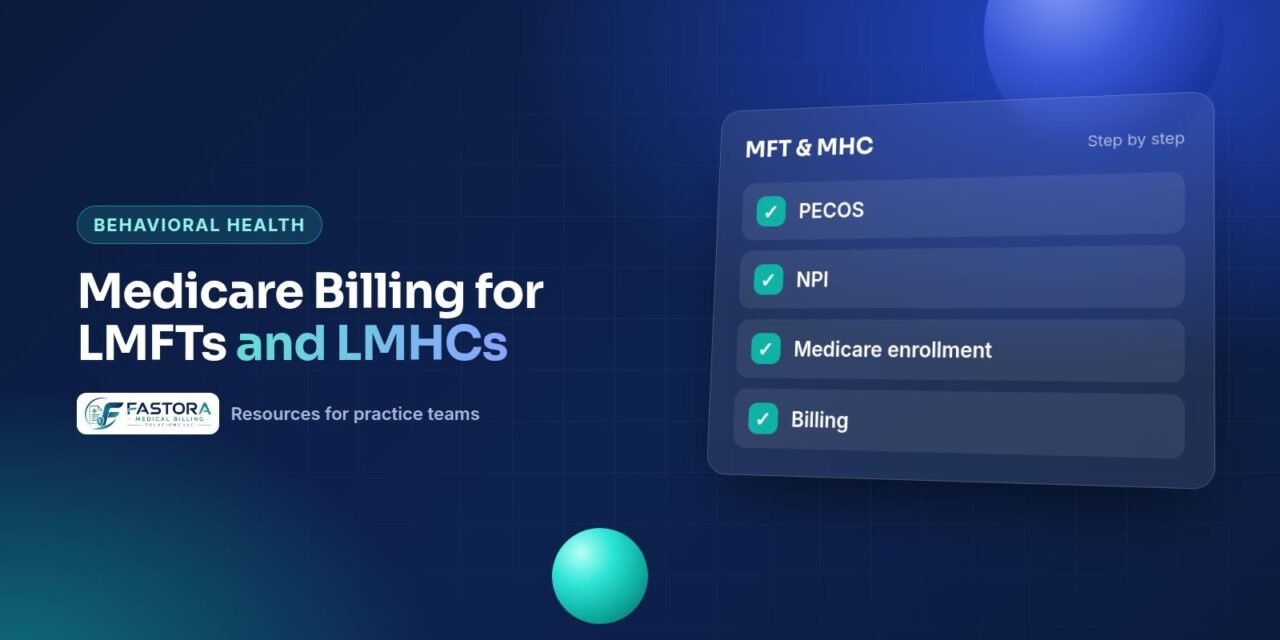
Enrollment follows the standard Medicare process for individual practitioners. Most clinicians use PECOS, the online enrollment system, instead of paper forms.
- Confirm your NPPES record shows the right taxonomy. CMS lists 106H00000X for marriage and family therapists and 101YM0800X for mental health counselors.
- Submit the CMS-855I individual enrollment in PECOS with your license, degree and supervised experience details.
- If you work for a group, reassign your benefits to the group so it can bill under its NPI and tax ID. The group must also be enrolled.
- Set up electronic funds transfer with the CMS-588 form if you bill as a solo practitioner.
- Wait for approval and record your effective date and Medicare details before billing.
Clinicians who do not want to bill Medicare can opt out with an affidavit and contract privately with Medicare patients. An opt-out lasts two years and has its own rules, so read the CMS requirements before choosing it. For the full enrollment sequence across all payers, see our provider credentialing guide.
Medicare billing for mental health counselors and MFTs: codes
MFTs and MHCs bill the same core psychotherapy and assessment codes used by clinical social workers. Time thresholds for psychotherapy follow CPT rules, and documentation must support the time billed. Our mental health CPT code guide covers each code in more depth.
| CPT code | Service |
|---|---|
| 90791 | Psychiatric diagnostic evaluation (without medical services) |
| 90832 | Psychotherapy, 30 minutes with patient |
| 90834 | Psychotherapy, 45 minutes with patient |
| 90837 | Psychotherapy, 60 minutes with patient |
| 90839 / 90840 | Psychotherapy for crisis, first 60 minutes / each additional 30 minutes |
| 90846 | Family psychotherapy without the patient present, 50 minutes |
| 90847 | Family psychotherapy with the patient present, 50 minutes |
| 90853 | Group psychotherapy (other than of a multiple-family group) |
Codes that include medical services, such as 90792, evaluation and management codes and the psychotherapy add-on codes used with E/M visits, are outside the scope of MFTs and MHCs. CMS has also allowed these practitioners to bill health behavior assessment and intervention codes; check the current Medicare physician fee schedule list of eligible practitioners before adding them. See the 90837 code guide for the 53-minute rule and documentation tips.
How Medicare pays MFTs and MHCs
By statute, Medicare pays MFT and MHC services at 75 percent of the physician fee schedule amount for the same service furnished by a clinical psychologist, the same basis used for clinical social workers. The dollar amount varies by code, year and geographic locality, so look up the current rate in the CMS Physician Fee Schedule search tool rather than relying on a figure from a prior year.
- Assignment is mandatory: you accept the Medicare-approved amount as payment in full and cannot balance bill.
- The patient's Part B deductible and coinsurance apply, and you collect them from the patient or a secondary payer.
- For patients with both Medicare and Medicaid, Medicare pays first and Medicaid may pay as secondary according to state rules.
- Medicare Advantage plans must cover these services, but each plan credentials and contracts with providers separately, so Original Medicare enrollment does not make you in network.
Telehealth and place of service
Medicare allows mental health services by telehealth, including to patients at home, and MFTs and MHCs can furnish them. Report the correct place of service code and any telehealth modifier the current CMS instructions require. Medicare telehealth rules for mental health have changed several times since 2020, including rules about in-person visits, so check the current CMS guidance before setting your telehealth billing defaults.
MFTs and MHCs can also furnish services in rural health clinics and federally qualified health centers, which bill under their own payment systems. If you work in one of these settings, follow the clinic's Medicare billing rules rather than the physician fee schedule.
Common Medicare claim errors for new MFT and MHC billers
- Billing for dates before the Medicare effective date.
- Rendering NPI not linked to the group through reassignment.
- Taxonomy in NPPES that does not match the enrollment.
- Psychotherapy time not documented, or below the CPT threshold for the code billed.
- Billing codes outside the MFT or MHC scope, such as E/M or medical add-on codes.
- Collecting more than the deductible and coinsurance from the patient.
- Sending a Medicare Advantage member's claim to the Medicare contractor instead of the plan.
Getting Medicare billing set up
Adding Medicare means new enrollment steps, a new payer in the practice management system and Medicare-specific patient cost sharing. Fastora supports billing for therapists and counselors, including Medicare enrollment and claims, and offers a free billing assessment for practices that want their setup reviewed before submitting the first claims.
Can LMFTs bill Medicare?
Yes — LMFTs (and LMHCs) became eligible to bill Medicare for psychotherapy services starting January 2024 under the Consolidated Appropriations Act. They must enroll in PECOS, meet Medicare\u2019s requirements, and bill the standard psychotherapy codes. Practices adding LMFTs to their Medicare panel should complete enrollment before scheduling Medicare patients to avoid non-covered claim denials.
Frequently asked questions
When did Medicare start covering LMFTs and LMHCs?
Medicare Part B began covering services by marriage and family therapists and mental health counselors on January 1, 2024, under the Consolidated Appropriations Act, 2023. Clinicians must enroll and meet the federal degree, licensure and supervised experience requirements.
Can a pre-licensed counselor bill Medicare?
No. Medicare requires state licensure or certification and at least two years or 3,000 hours of post-degree supervised experience. Pre-licensed clinicians cannot enroll as MFTs or MHCs on their own.
Do I need to accept assignment?
Yes. Medicare requires assignment for MFT and MHC services, so you accept the Medicare-approved amount as payment in full and collect only the patient's deductible and coinsurance.
Can I opt out of Medicare instead?
Yes. MFTs and MHCs can file an opt-out affidavit and contract privately with Medicare patients. Opt-out has specific rules and lasts two years, so review the CMS requirements before choosing it.