What Texas ground ambulance balance billing law covers
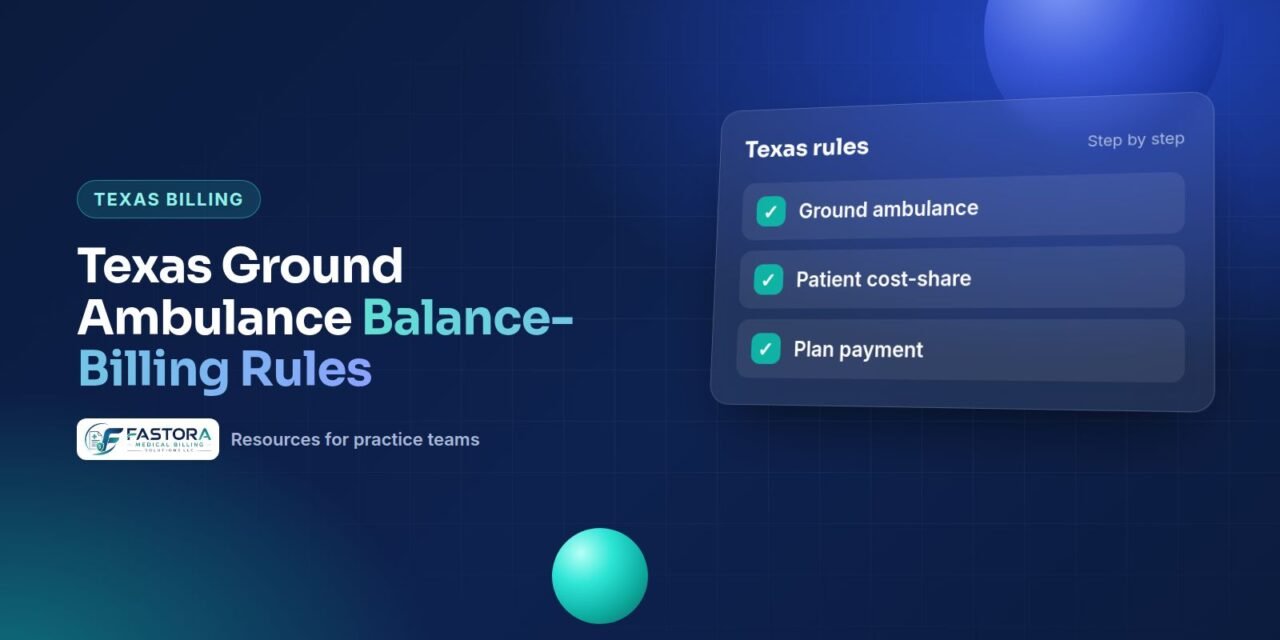
Texas ground ambulance balance billing rules limit what a patient can be billed after their health plan pays an out-of-network ground ambulance claim. The protections come from Senate Bill 2476, passed by the 88th Legislature in 2023, and they apply to ground ambulance services provided by Texas political subdivisions, such as cities, counties, emergency services districts and hospital districts, to members of state-regulated health plans. TDI's bulletin on the law says the changes apply on or after January 1, 2024.
Before this law, a municipal EMS agency without a network contract could bill the patient for the difference between its charge and what the plan paid. That difference, the balance bill, is what SB 2476 removes for covered patients. The patient pays only the in-network cost sharing their plan would apply, and the plan pays the ambulance provider a rate set under the statute.
The law sits alongside the state's broader surprise billing protections from SB 1264 (2019), which cover emergency care and certain out-of-network services at in-network facilities. Our Texas Prompt Pay Act article explains that law and how payment deadlines work for state-regulated plans.
Which transports and plans the protections apply to
Two conditions must both be true: the ground ambulance service was provided by a political subdivision, and the patient is covered by a health plan regulated by the Texas Department of Insurance (TDI). Billers need to check both before deciding whether a balance can go to the patient. TDI's provider page on balance billing describes the protection as covering emergency ground ambulance services, so confirm with the statute or your counsel how a scheduled non-emergency transport is treated before applying the rule to it.
| Coverage type | Texas balance billing protection? | What to check |
|---|---|---|
| Fully insured HMO, PPO or EPO regulated by TDI | Yes, for political subdivision ground transports | Member ID card; many state-regulated cards show 'TDI' or 'DOI' |
| Self-funded employer plan (ERISA) | Generally no, because federal law governs these plans | Plan documents; some self-funded plans opt in to state protections |
| Medicare and Medicare Advantage | Not under this law; Medicare assignment and Medicare Advantage rules apply | Medicare billing rules on patient liability |
| Texas Medicaid and CHIP | Not under this law; Medicaid rules already bar billing members for covered services | TMHP and MCO rules |
| Private, non-governmental ambulance provider | Not under SB 2476 as enacted | Whether the provider is a political subdivision or acts under contract with one; get legal advice on contract arrangements |
The federal No Surprises Act does not cover ground ambulance services. It does cover air ambulance services for most private plans, which is a separate set of rules. A federal advisory committee has recommended ground ambulance protections at the national level, but as of this writing no federal ground ambulance ban is in force, so state law is what governs.
How the plan pays a political subdivision ambulance provider
Under SB 2476, the plan pays the ambulance provider a rate tied to what the local government has set, not whatever the plan chooses to allow. TDI's Commissioner's Bulletin B-0012-23 describes the structure: political subdivisions submit the rates they have set or approved for ground ambulance services to a TDI database, and plans pay that rate. When no rate has been submitted, the bulletin says the plan pays the lesser of the provider's billed charge or 325 percent of the Medicare rate.
Because the payment rule depends on the rate filing, a political subdivision that has not submitted its rate to TDI may receive the statutory alternative rather than its own rate. Agencies should confirm that their current rates are on file and match the charges on their claims.
Annual rate adjustments after the 2025 changes
According to the House committee analysis of SB 916 (89th Legislature, 2025), the original law required plans to increase rates each year by the lesser of a Medicare inflation measure or 10 percent. SB 916 moved that authority to political subdivisions, which may adjust the rates they submit by no more than the lesser of the Medicare Ambulance Inflation Factor or 10 percent each year.
The same analysis notes that the Department of State Health Services may revoke or suspend an EMS provider's license for intentionally submitting incorrect billing rate information or violating the balance billing requirements. Rate filings are therefore a compliance task, not just a payment question.
Expiration date and the SB 916 extension
SB 2476 was enacted with an expiration date of September 1, 2025. SB 916, passed by the 89th Legislature, postponed that expiration to September 1, 2027, applying to services provided on or after its effective date of September 1, 2025, according to the bill analysis.
Because the protections are temporary, check the current status with TDI and the Texas Legislature before relying on them for dates of service after September 1, 2027, and watch for further legislation in the 2027 session. Billing systems should be set up so the rule can be switched off or on by date of service.
What the patient can and cannot be billed
For a covered transport, the patient owes the deductible, copayment or coinsurance their plan would apply if the ambulance provider were in network. The provider cannot bill the patient for the difference between its charge and the plan's payment, and it cannot send that difference to collections.
- Can bill: in-network cost sharing shown on the plan's explanation of benefits.
- Can bill: amounts for non-covered services, where the plan denied them for a reason other than network status and your policy allows patient billing.
- Cannot bill: the balance between billed charges and the plan payment for a covered transport.
- Check first: whether the plan is state-regulated, and whether the date of service falls inside the period the law is in effect.
When the plan underpays relative to the filed rate, the dispute is between the provider and the plan. Work it as an underpayment recovery issue with the plan, citing the filed rate, rather than passing the shortfall to the patient.
A billing workflow for Texas EMS agencies
Agencies that apply these rules consistently usually build the check into the claim workflow rather than relying on staff to remember it at statement time.
- Identify the plan type at registration and record whether it is state-regulated, self-funded, Medicare, Medicaid or another program.
- Confirm the agency's current rates are on file in the TDI database and match the chargemaster.
- Submit the claim with the correct level-of-service, mileage and origin and destination codes, as explained in our ambulance billing guide.
- When the remittance arrives, compare the payment to the filed rate and flag any shortfall for appeal.
- Post the patient responsibility as in-network cost sharing only, and suppress balance-bill statements for covered transports.
- Keep a dated record of which rule version was applied, in case the law changes or a complaint is filed.
Patient complaints about ambulance bills often go to TDI, so clear statements that show the plan payment and the in-network cost sharing help avoid disputes.
Support for Texas EMS billing
Texas ground ambulance balance billing rules change how statements, underpayment follow-up and rate filings are handled. Fastora's EMS billing services include plan-type checks, transport coding and denial follow-up for municipal and private agencies, with workflows aligned with HIPAA and HITECH.
Frequently asked questions
Can a Texas city ambulance service balance bill a patient?
Not for a member of a state-regulated health plan, while the SB 2476 protections are in effect. The patient owes only in-network cost sharing, and the plan pays a rate based on what the political subdivision filed with TDI. Patients in self-funded employer plans may not be protected the same way.
Does the No Surprises Act cover ground ambulances?
No. The federal No Surprises Act covers air ambulance services but not ground ambulance services. In Texas, ground ambulance protections come from state law, SB 2476 as extended by SB 916, and apply only to state-regulated plans and political subdivision providers.
When do the Texas ground ambulance protections expire?
SB 2476 originally expired September 1, 2025. SB 916 extended the protections to September 1, 2027, according to the bill analysis. Confirm current status with TDI before relying on the rule for later dates of service.
How does a patient know if their plan is state-regulated?
Many state-regulated plans show 'TDI' or 'DOI' on the member ID card. If the card does not say, the plan or employer can confirm whether the coverage is fully insured and regulated by TDI or self-funded and regulated under federal law.