What the Texas Prompt Pay Act requires
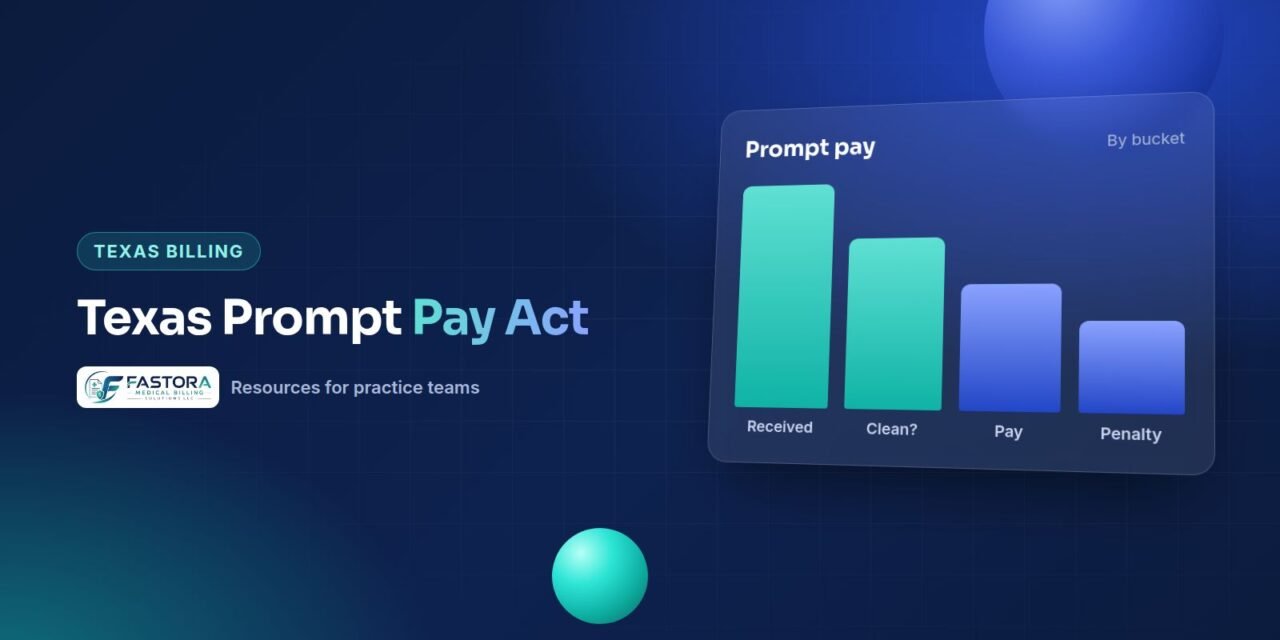
The Texas Prompt Pay Act is the set of Texas Insurance Code provisions that sets deadlines for state-regulated health plans to pay clean claims from contracted providers, and penalties when they pay late. The rules sit in Chapter 1301 for preferred provider benefit plans (PPOs and EPOs) and Chapter 843 for HMOs. They were strengthened by SB 418 in 2003, which is why the Texas Department of Insurance (TDI) still titles its provider FAQ after that bill.
The law works in both directions. Providers must file within a set time, and plans must pay or deny a clean claim within a set time. Knowing both sides lets a billing team spot late payments that are owed a penalty, instead of just waiting on the plan.
Which plans the act covers
The act applies to fully insured HMO and PPO/EPO coverage regulated by TDI. It does not govern self-funded employer plans, which fall under federal ERISA, or Medicare. Texas Medicaid and CHIP managed care plans follow their own payment terms set by the state Medicaid program. Before you count days on a late claim, confirm that the plan is state-regulated; many such ID cards carry a "TDI" or "DOI" mark, but the plan can confirm it.
Filing and payment deadlines under Texas prompt pay rules
TDI's prompt pay FAQ summarizes the core timelines. The payment clock starts the day after the plan receives a clean claim, so keep clearinghouse acceptance reports and certified-mail receipts as proof of the receipt date.
| Step | Deadline | Statute (PPO / HMO) |
|---|---|---|
| Provider files the claim | Within 95 days after the date of service | §1301.102 / §843.337 |
| Plan pays or denies an electronic clean claim | 30 calendar days after receipt | §1301.103 / §843.338 |
| Plan pays or denies a non-electronic (paper) clean claim | 45 calendar days after receipt | §1301.103 / §843.338 |
| Plan pays an electronic pharmacy claim | 21 days after the claim is adjudicated (non-electronic pharmacy claims have different timing) | §1301.104 / §843.339 |
| Plan completes an audit of a claim it paid under audit | Within 180 days after receiving the clean claim | Chapter 1301 / Chapter 843 audit provisions |
Missing the 95-day filing window generally means the provider forfeits the right to payment, so this deadline matters as much as the plan's. Your contract may set different terms only where the statute allows it; the article on timely filing limits explains how filing windows vary across payers outside Texas law.
Paying under audit
A plan that wants to audit a claim before final payment cannot simply hold it. Under the audit provisions, the plan must notify the provider and pay the contracted amount within the normal deadline, then complete the audit within 180 days and refund or collect the difference afterward. A claim held without payment and without a valid audit notice is a late claim.
What counts as a Texas prompt pay clean claim
The deadlines only run on a clean claim. TDI rules at 28 TAC §21.2803 list the data elements a professional claim must contain, mapped to the fields of the CMS-1500 or the 837P electronic transaction. A Texas prompt pay clean claim is one that includes every required element in the proper format.
- Patient and subscriber identification: name, date of birth, member ID and relationship to the subscriber.
- Plan information, including group number where it applies, and other coverage information for coordination of benefits.
- Dates of service, place of service and the procedure codes (CPT or HCPCS) with any modifiers.
- ICD-10-CM diagnosis codes linked to each service line, and billed charges per line.
- Rendering and billing provider identification, including NPI and tax ID, and the provider's signature or attestation.
- Prior authorization or referral numbers when the plan required them.
If a claim is missing an element, the plan can treat it as deficient and notify the provider, and the payment deadline does not start until a complete claim is received. The fastest way to protect the clock is to scrub claims against the payer's required fields before submission, which is the core of clean claims management.
Late-payment penalties under the Texas Prompt Pay Act
When a plan pays a clean claim late, Insurance Code §1301.137 (PPO) and §843.342 (HMO) require it to pay the contracted rate plus a penalty. For a preferred provider, the penalty grows with how late the payment is.
| When the plan pays | Penalty on a fully unpaid clean claim (§1301.137) |
|---|---|
| Within 45 days after the payment deadline | Lesser of 50 percent of the difference between billed charges and the contracted rate, or $100,000 |
| 46 to 90 days after the deadline | Lesser of 100 percent of that difference, or $200,000 |
| 91 days or more after the deadline | The 46-to-90-day penalty plus 18 percent annual interest, accruing until the claim and penalty are paid in full |
When a plan pays only part of the claim on time, the penalty is figured on the underpaid amount instead, which the statute calculates with its own formula: the lesser of 50 percent of the underpaid amount or $100,000 when paid within 45 days of the deadline, rising to the lesser of 100 percent or $200,000 after that. Institutional providers are treated differently, including how the penalty is split, so read the statute that matches your provider type.
A worked example
A PPO practice bills $400 for a service with a $150 contracted rate and submits a clean electronic claim. The plan must pay by day 30. If it pays on day 50, which is within 45 days of the deadline, the penalty is 50 percent of the $250 difference, or $125, on top of the $150 contracted rate. For a non-institutional provider the penalty is paid to the provider, which makes accurate charge masters and receipt dates worth the effort.
How to track and enforce prompt pay in your practice
- Flag each claim's plan type at registration so state-regulated HMO and PPO claims can be filtered.
- Store the clearinghouse or payer acceptance date as the receipt date.
- Run a weekly report of state-regulated claims older than 30 days (electronic) or 45 days (paper) with no remittance.
- For late payments, compare the remittance to the contracted rate and check whether a penalty was included.
- Ask the plan in writing for any missing penalty, citing the statute, and keep the correspondence.
- If the plan does not respond, file a complaint with TDI, which enforces the prompt pay rules.
A clean AR follow-up process catches most of these claims before they age. Underpayments against the contracted rate are a separate problem, handled through contract review and appeals.
Texas surprise billing law and balance billing limits
Prompt pay rules govern network claims. The Texas surprise billing law, SB 1264 (86th Legislature, 2019), covers out-of-network care. For state-regulated plans, it bars balance billing for emergency care and for care at an in-network facility when the patient did not choose the out-of-network provider, for services on or after January 1, 2020. The plan pays the out-of-network provider directly, and the patient owes only in-network cost sharing.
Payment disputes under SB 1264 go to TDI's process: arbitration for physicians and other individual providers, and mediation for facilities. The federal No Surprises Act adds similar protections for many plans that Texas law does not reach, such as self-funded employer plans. A narrow exception lets a patient knowingly choose an out-of-network provider at an in-network facility after receiving the required disclosure.
The Texas balance billing law was later extended to ground ambulance services provided by political subdivisions. That change is covered in our article on Texas ground ambulance balance billing.
Getting help with Texas claim follow-up
Prompt pay enforcement depends on clean submissions, accurate receipt dates and steady follow-up. If you want an outside review of how your state-regulated claims are being paid, Fastora offers a free medical billing audit handled by certified billing and coding professionals. The medical billing process guide covers the full claim cycle.
Frequently asked questions
How long does an insurance company have to pay a claim in Texas?
For state-regulated HMO and PPO plans, a clean claim must be paid or denied within 30 days of receipt if it was filed electronically and 45 days if filed on paper. Electronic pharmacy claims must be paid within 21 days after they are adjudicated. Self-funded employer plans, Medicare and Medicaid follow different rules.
How long do providers have to file a claim under Texas prompt pay rules?
A contracted provider must file within 95 days after the date of service under Insurance Code §1301.102 for PPOs and §843.337 for HMOs. Missing the window generally forfeits the right to payment, except in narrow circumstances the statute allows.
Do Texas prompt pay penalties apply to out-of-network providers?
The prompt pay deadlines and penalties are written mainly for contracted (preferred or network) providers. Out-of-network emergency and facility-based claims are governed by the surprise billing rules from SB 1264, which set how the plan pays and how disputes are resolved.
Who enforces Texas prompt pay rules?
The Texas Department of Insurance enforces these rules for the plans it regulates. Providers can file complaints with TDI about late payments or missing penalties, and should keep proof of the claim receipt date and copies of correspondence with the plan.