
A psychotherapy session, a psychiatric medication visit, a neuropsychological evaluation, an intensive outpatient day and a physical therapy visit are billed in very different ways. Time thresholds, add-on codes, modifiers, authorizations and payer carve-outs change by specialty, and many denials in these practices come from those differences.
This guide walks through how billing works for each of these specialties, where claims commonly go wrong, and what credentialing requires for therapists and other mental health providers. For general topics such as pricing models, outsourcing and choosing a billing partner, see our companion guide to medical billing services, costs and RCM.
A note on coding accuracy: CPT and HCPCS codes, time rules and modifier requirements are updated each year, and payer policies vary. The code examples in this article reflect commonly used 2026 conventions and are for education only. Confirm codes and descriptors against the current AMA CPT code set, CMS guidance and each payer’s policies before billing.
Key takeaways
- Behavioral health billing depends on time-based codes, carved-out benefits and authorizations.
- Psychiatry combines E/M with psychotherapy add-on codes; psychological testing separates administration from evaluation.
- Addiction treatment often uses HCPCS H-codes, per diem billing and level-of-care authorizations.
- PT, OT and speech therapy each have their own codes, modifiers and Medicare threshold rules.
- Therapists must be credentialed with each payer, with CAQH kept current, before billing in-network.
What Is Behavioral Health Medical Billing?
Behavioral health medical billing is the process of coding, submitting and collecting payment for mental health and substance use services, including psychiatric evaluations, psychotherapy, medication management, psychological testing and addiction treatment. It differs from general billing because many codes are time-based, benefits are often carved out to separate plans, and authorizations and session limits are common.
Mental health and behavioral health billing overlap heavily. “Behavioral health” is the broader term, adding substance use disorders to conditions such as depression and anxiety. Payers often manage both under one benefit, but substance use treatment brings extra codes, levels of care and confidentiality rules.
Behavioral Health Billing Services for Mental Health Providers
Behavioral health billing services cover the full claim lifecycle for outpatient mental health practices: benefits checks, authorizations, coding review, claims, payment posting, denials and AR follow-up. What makes mental health medical billing different is less the steps than the details inside them:
- Carved-out benefits – a separate behavioral health organization may manage claims, authorizations and networks.
- Time-based codes – documented start and stop times determine the code.
- Visit limits and authorizations – some plans cap sessions or require approval after initial visits.
- Many license types – psychiatrists, psychologists, NPs, LCSWs, LPCs and LMFTs each have different payer rules.
- High-volume, low-dollar claims – weekly therapy means small error rates add up fast.
Good mental health billing services track these per patient, not just per claim. Behavioral health revenue cycle management connects intake, benefits, authorizations and documentation so problems are caught before billing, not after denial. Fastora’s behavioral and mental health billing supports counseling, social work, marriage and family therapy, psychology and psychiatry practices.
Therapist Billing for LPC, LCSW and LMFT Providers
Therapist billing services for licensed professional counselors (LPCs), licensed clinical social workers (LCSWs) and licensed marriage and family therapists (LMFTs) center on psychotherapy codes, clean enrollment records and accurate benefits information. The same session can pay differently depending on the payer and the clinician’s license.
| Credential | Billing points to confirm |
|---|---|
| LPC (and other licensed counselors) | License title varies by state (LPC, LMHC, LPCC). Medicare began enrolling mental health counselors in 2024; Medicaid and commercial eligibility vary by state and plan. |
| LCSW | Widely enrolled with Medicare, Medicaid and commercial plans. Confirm the taxonomy code and that the clinician is linked to the group’s billing NPI. |
| LMFT | Medicare began enrolling marriage and family therapists in 2024. Family psychotherapy codes (90846, 90847) are common; confirm payer coverage for sessions without the patient present. |
| Pre-licensed or associate clinicians | Many payers will not credential associates. Whether supervised services can be billed under a supervisor depends on the payer and state rules; get it in writing before billing. |
Common issues across all three: codes longer than documented time supports, missing telehealth modifiers, services before a credentialing effective date and untracked session limits.
Psychiatry Billing Services
Psychiatry billing services handle a mix of evaluation and management (E/M) services, psychotherapy and diagnostic evaluations. Psychiatric medical billing is often more complex than therapy billing because physicians and psychiatric nurse practitioners can bill E/M codes, and many visits combine medical management with psychotherapy.
Common psychiatric codes
- 90792 – psychiatric diagnostic evaluation with medical services (used by prescribers; 90791 is the evaluation without medical services)
- 99202–99215 – office or outpatient E/M visits, selected by medical decision making or total time
- 90833, 90836, 90838 – psychotherapy add-on codes (about 30, 45 and 60 minutes) billed with an E/M service on the same day
E/M with psychotherapy add-on billing
When a psychiatrist manages medication and also provides psychotherapy in the same visit, the E/M code and the psychotherapy add-on can be reported together. The two services must be significant and separately identifiable, and time spent on the E/M service cannot also count toward psychotherapy time. When the E/M level is selected by time, psychotherapy time is excluded from that total. Documentation should make both components clear.
Medication management billing
Medication management billing for a follow-up visit generally uses an E/M code chosen by medical decision making: the number and complexity of problems, data reviewed and risk of treatment. Medication management alone is not billed with a psychotherapy code. Collaborative care and behavioral health integration codes may also apply when a psychiatric consultant works with primary care, subject to payer coverage.
Telepsychiatry billing
Telepsychiatry billing uses the same E/M and psychiatric codes with the place of service code and modifier each payer requires (see the telehealth section below). Prescribing controlled substances via telehealth is governed by DEA rules that have been extended several times; confirm current requirements separately from billing rules.
Fastora provides psychiatry billing services for psychiatrists and psychiatric nurse practitioners, including coding and charge review for combined E/M and psychotherapy visits.
Psychology Billing and Psychological Testing
Psychology billing services cover psychotherapy and, for many practices, psychological and neuropsychological testing. Psychology medical billing does not use E/M codes, since psychologists do not bill medical management services. Testing is where psychology practices face the most complex coding.
How are psychological testing services billed?
Psychological testing billing separates two kinds of work: test administration and scoring and evaluation services (interpreting results, integrating data, clinical decision making, report writing and feedback). Each is billed with its own codes, usually by time, and often across more than one date of service.
| Code | Service (summarized) | Unit |
|---|---|---|
| 96130 | Psychological testing evaluation services by a physician or qualified health care professional | First hour |
| 96131 | Psychological testing evaluation services, each additional hour (add-on to 96130) | Each additional hour |
| 96132 / 96133 | Neuropsychological testing evaluation services, first hour / each additional hour | Hour |
| 96136 | Test administration and scoring by a physician or qualified health care professional, two or more tests | First 30 minutes |
| 96137 | Each additional 30 minutes (add-on to 96136) | 30 minutes |
| 96138 / 96139 | Test administration and scoring by a technician, first 30 minutes / each additional 30 minutes | 30 minutes |
These psychological testing CPT codes are paired correctly only when documentation shows who performed each component and for how long. Neuropsychological testing billing follows the same structure with 96132 and 96133 for evaluation services. Many payers require prior authorization for testing and may limit total hours, so the requested hours should match what the evaluation plan needs.
A psychologist billing company should also know that evaluation codes are commonly reported on the date the work is completed, which may differ from the administration date; confirm each payer’s convention. Fastora’s psychology billing covers both therapy and testing claims.
Substance Abuse and Addiction Treatment Billing
Substance abuse billing services, often called SUD billing, cover outpatient counseling, intensive outpatient programs (IOP), partial hospitalization programs (PHP), withdrawal management and medication for opioid use disorder. Addiction treatment billing differs from routine outpatient billing in several ways:
- HCPCS codes. Many Medicaid and commercial plans use HCPCS Level II codes, including H-codes (such as H0001 for alcohol and/or drug assessment and H0015 for alcohol and/or drug intensive outpatient services) and some S-codes, often with state-specific modifiers.
- Per diem billing. IOP billing and PHP billing are frequently per day, with a minimum number of service hours required for the day to be billable. Medicare and some payers bill these programs on institutional claims with revenue codes rather than on professional claims.
- Level of care authorizations. Payers commonly authorize a level of care (often based on ASAM criteria) for a set number of days and require concurrent reviews to continue.
- Detox billing. Withdrawal management is billed differently depending on whether it is ambulatory, residential or inpatient, and whether it is delivered in a licensed facility.
- Confidentiality. Records from federally assisted SUD programs are protected by 42 CFR Part 2, which affects how information is shared for authorizations and appeals.
State Medicaid SUD billing manuals often differ from commercial plans, so programs with several levels of care should keep a payer-by-service matrix of codes, modifiers, claim types and authorizations. Fastora supports substance use and addiction treatment billing for outpatient programs and clinics.
Physical Therapy Billing Services
Physical therapy billing services must handle timed codes, discipline modifiers, plan-of-care requirements and payer visit limits. Physical therapy medical billing is unit-driven: most treatment codes are billed in 15-minute units, so how minutes convert to units directly determines payment.
What is the 8-minute rule in physical therapy?
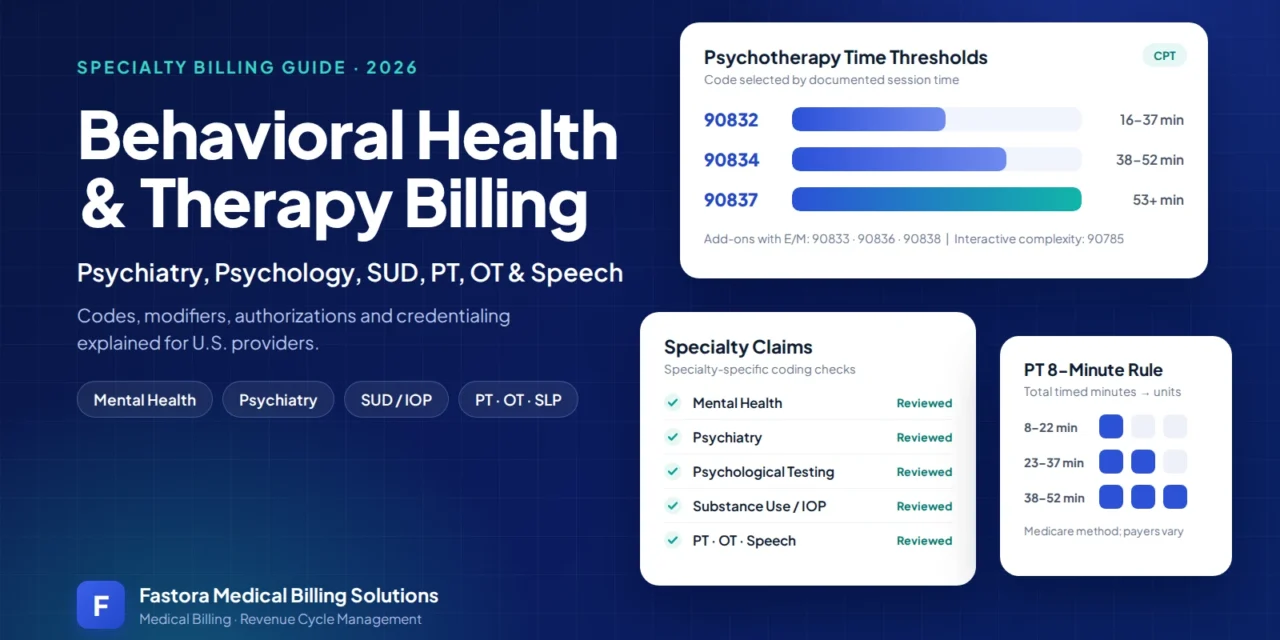
Physical therapy 8-minute rule billing is the Medicare method for converting total timed treatment minutes into units. A timed service must last at least 8 minutes to bill one unit. Total timed minutes determine the units: 8–22 minutes is one unit, 23–37 minutes two units, 38–52 three, and so on. Many commercial payers follow different rules.
Timed codes include services such as therapeutic exercise (97110), neuromuscular reeducation (97112), manual therapy (97140) and therapeutic activities (97530). Untimed codes, such as PT evaluations (97161–97163), are billed once regardless of duration. When total timed minutes support more units than individual codes, units are assigned to the services with the most minutes, following CMS instructions.
GP, KX and CQ modifiers
- GP modifier – identifies services delivered under a physical therapy plan of care. Occupational therapy uses GO and speech-language pathology uses GN.
- KX modifier – for Medicare, attests that therapy above the annual threshold amount is medically necessary and documented. The threshold is updated yearly, so confirm the current amount.
- CQ modifier – marks services furnished in whole or in part by a physical therapist assistant. Medicare pays these services at a reduced rate. The occupational therapy assistant equivalent is CO.
Medicare also requires a plan of care certified by a physician or qualified non-physician practitioner, with recertification when the plan changes or at least every 90 days, plus periodic progress reports. Missing certifications are a common reason for PT denials on audit. Fastora offers physical therapy billing as a PT billing company that works with outpatient clinics and private practices.
Occupational Therapy and Speech Therapy Billing
Rehab therapy billing services apply many of the same principles across disciplines, but each discipline has its own codes and modifiers. Rehabilitation billing for multidisciplinary clinics must keep plans of care, modifiers and therapy thresholds straight for each patient and discipline.
Occupational therapy billing services
Occupational therapy billing uses OT evaluation codes (97165–97167 by complexity, 97168 for re-evaluation) with the GO modifier, and many of the same timed treatment codes as PT, such as 97530 and 97535 (self-care/home management training). Under Medicare, occupational therapy has its own annual therapy threshold, separate from the combined PT and speech-language pathology threshold, and services at other providers during the year count toward it, so a patient’s therapy history elsewhere can affect when the KX modifier is needed.
Speech therapy billing services and SLP billing
Speech therapy billing services differ because several common SLP codes are untimed. Treatment of speech, language, voice and communication disorders (92507) is billed per session rather than in 15-minute units. SLP evaluation codes (92521–92524 for speech and language, 92610 for swallowing function) and swallowing treatment (92526) also have their own rules. SLP billing uses the GN modifier, and pediatric speech therapy is often subject to Medicaid or commercial authorization and visit limits.
Fastora supports rehab therapy billing for physical, occupational and speech therapy practices and PM&R groups.
Telehealth Mental Health Billing
Telehealth mental health billing uses the same CPT codes as in-person care, plus a telehealth place of service code and, for many payers, a modifier. Medicare uses POS 02 for telehealth outside the patient’s home and POS 10 for telehealth in the patient’s home. Modifier requirements for video and audio-only services vary by payer.
Confirm for each plan:
- Modifiers – many commercial plans use 95 for audio-video; Medicare uses 93 for audio-only where allowed.
- Audio-only coverage – Medicare permits it for mental health in certain situations; other payers vary.
- In-person requirements – Medicare’s in-person visit rules for mental health telehealth have been delayed several times; check current status.
- Licensure – the clinician must be licensed where the patient is located.
Mental Health CPT Codes Providers Should Understand
These are the mental health CPT codes most outpatient practices use. Psychotherapy codes are selected by the actual documented face-to-face time, and the AMA’s time ranges below are the commonly applied thresholds.
| Code | Description (summarized) | Commonly applied time range |
|---|---|---|
| 90791 | Psychiatric diagnostic evaluation (no medical services) | Not time-based |
| 90792 | Psychiatric diagnostic evaluation with medical services | Not time-based |
| 90832 | Psychotherapy, 30 minutes | 16–37 minutes |
| 90834 | Psychotherapy, 45 minutes | 38–52 minutes |
| 90837 | Psychotherapy, 60 minutes | 53 minutes or more |
| 90833 / 90836 / 90838 | Psychotherapy add-on codes with an E/M service | 16–37 / 38–52 / 53+ minutes |
| 90785 | Interactive complexity add-on | Not time-based |
| 90846 / 90847 | Family psychotherapy without / with the patient present | At least 26 minutes |
| 90853 | Group psychotherapy | Per session |
| 90839 / 90840 | Psychotherapy for crisis, first 60 minutes / each additional 30 minutes | 30–74 minutes for 90839 |
Interactive complexity 90785 is an add-on for sessions where communication factors complicate delivery, such as managing caregivers with conflicting goals, or using play equipment or interpreters to overcome barriers. It is added to diagnostic evaluation, psychotherapy and group psychotherapy codes, and it is not reported with crisis psychotherapy. Documentation should describe the specific factor.
Payers often review 90837 closely because it pays more than 90834; documented start and stop times protect the claim.
Insurance Eligibility and Prior Authorization for Behavioral Health and Therapy
For behavioral health and therapy practices, eligibility checks should answer specialty-specific questions, not just confirm active coverage:
- Is mental health or substance use care carved out to a separate behavioral health plan?
- Is the rendering clinician in network with that plan, not just the medical plan?
- Are there annual session or visit limits, and how many have been used?
- Does the plan require authorization for psychotherapy after a set number of visits, for psychological testing, IOP/PHP or therapy beyond an initial evaluation?
- For therapy, does the plan require a physician referral or signed plan of care?
Tracking authorizations by approved units and dates is critical. An authorization for 12 therapy visits through a specific date needs a reauthorization request before either limit is reached. Fastora’s eligibility verification and prior authorization support includes this tracking.
Denial Management for Behavioral Health and Therapy Claims
Behavioral health and therapy denials cluster around a few causes: medical necessity and documentation, time or unit mismatches, missing or exceeded authorizations, credentialing gaps, telehealth modifier errors, and claims sent to the medical plan instead of the behavioral health carve-out. Parity law, the Mental Health Parity and Addiction Equity Act, can also support appeals when a plan applies stricter limits to mental health or substance use benefits than to comparable medical benefits.
The most effective approach groups denials by reason, fixes the underlying process and appeals where documentation supports payment. Fastora’s denial management handles rejections, denials, corrected claims and appeals for these specialties.
AR Recovery and Payment Posting
Many small claims mean unposted remittances and unworked balances pile up quickly. EOB/ERA posting should flag underpaid sessions and secondary claims, and aging AR work should start with claims nearest their timely filing limits, which can be short for some Medicaid and behavioral health plans. Fastora provides AR follow-up and payment posting for these practices.
Specialty billing support
Behavioral health or therapy denials piling up?
Fastora works with mental health, psychiatry, psychology, substance use and rehab therapy practices on coding review, authorizations, denials and AR.
Request a Free Claims AuditInsurance Credentialing for Therapists and Mental Health Providers
How does therapist credentialing work?
Insurance credentialing for therapists means applying to each insurance plan to join its network. The plan verifies license, education, work history, malpractice coverage and other details, then offers a contract. Once the contract has an effective date, the therapist can bill in-network. The process commonly takes several months per payer.
Mental health credentialing services and mental health provider credentialing typically include choosing target payers, preparing applications, following up, reviewing contracts and confirming effective dates and group linkage. For each discipline, the details differ:
- LCSW credentialing – usually straightforward with Medicare, Medicaid and commercial plans, but group linkage and taxonomy must be correct.
- LPC credentialing – depends on state license titles and each payer’s accepted provider types. Medicare enrollment for mental health counselors has been available since 2024.
- LMFT credentialing – similar to LPCs, with Medicare enrollment available since 2024 and commercial acceptance varying by plan.
Many plans will not pay claims for services before the effective date, so it is important to begin credentialing well before a new clinician starts seeing insured clients.
CAQH, Payer Enrollment and Getting Paneled With Insurance
To get paneled with insurance, most therapists need to complete these steps:
- Obtain an NPI (Type 1 for the individual) and choose the correct taxonomy code.
- Complete CAQH setup for therapists in CAQH ProView: education, licenses, work history, malpractice, practice locations, and authorization for payers to view the profile.
- Re-attest in CAQH every 120 days and keep documents such as licenses and malpractice certificates current.
- Apply to each payer, including separate behavioral health organizations where benefits are carved out, and to Medicare through PECOS and state Medicaid where applicable.
- Review and sign contracts, noting the effective date and fee schedule.
- Link the clinician to the group if billing under a group NPI and tax ID.
- Set up EDI, ERA and EFT so claims and payments flow electronically.
Fastora’s mental health credentialing support covers CAQH, NPI and taxonomy, applications, payer portals and EDI/EFT setup.
Common Billing Problems by Specialty
| Specialty | Common problem | Prevention |
|---|---|---|
| Mental health therapy | Session time does not support the psychotherapy code billed | Document start and stop times; code by actual time |
| Psychiatry | E/M and psychotherapy add-on not separately documented | Separate documentation and time for each component |
| Psychology | Testing hours exceed authorization, or components billed to the wrong provider type | Authorize the full testing plan; document who performed each component |
| Substance use treatment | Level of care or concurrent review lapses | Track authorized days and review dates daily |
| Physical therapy | Units do not match total timed minutes; missing plan of care certification | Apply timed-code rules; track certification and recertification dates |
| Occupational therapy | Therapy threshold reached without the KX modifier | Track each Medicare patient’s OT spending against the OT threshold, separately from PT/SLP |
| Speech therapy | Untimed codes billed as timed units | Train staff on untimed SLP codes; check units in claim edits |
| All specialties | Clinician not credentialed or linked to the group | Confirm effective dates before scheduling insured patients |
Why Specialty-Specific Medical Billing Matters
Generic claim edits rarely catch these problems. They take someone who knows that a 50-minute session is not 90837, that PTA minutes need a CQ modifier, that an IOP day has minimum hours, and that a carve-out needs its own eligibility check.
Fastora Medical Billing Solutions focuses on behavioral health, mental health, psychiatry, psychology, counseling, social work, marriage and family therapy, substance use treatment, physical therapy, occupational therapy, speech therapy, rehabilitation and PM&R. For information on pricing models and how outsourcing works, see our guide to medical billing services and RCM.
Frequently Asked Questions
What is behavioral health billing?
The coding, claims and collections process for mental health and substance use services, shaped by time-based codes, carved-out benefits and frequent authorizations.
What is the difference between mental health and behavioral health billing?
Behavioral health billing is broader: it adds substance use treatment, with its HCPCS codes, levels of care and 42 CFR Part 2 rules. Many payers manage both under one benefit.
What does a psychiatry billing company do?
It codes and bills E/M visits, psychiatric evaluations and psychotherapy add-ons, verifies benefits, manages authorizations and works denials and AR for psychiatric prescribers.
What is psychology billing?
Billing for psychotherapy and psychological or neuropsychological testing by psychologists, with separate time-based codes for test administration and evaluation.
How are psychological testing services billed?
Evaluation with 96130/96131 (or 96132/96133 for neuropsychological testing); administration and scoring with 96136/96137 or 96138/96139, depending on who did the work and for how long.
What is substance abuse billing?
Billing for outpatient counseling, IOP, PHP, withdrawal management and medication for addiction treatment, often with HCPCS H-codes, per diem rates and level-of-care authorizations.
How does PT billing work?
Untimed evaluation codes plus timed treatment codes in 15-minute units, the GP modifier and a certified plan of care, with KX and CQ modifiers for Medicare where they apply.
What is the 8-minute rule in physical therapy?
Medicare’s method for converting total timed minutes to units: 8 minutes for one unit, 23 for two, 38 for three. Some commercial payers differ.
Why do therapists need insurance credentialing?
Without credentialing and a contract, a therapist cannot bill in-network, and clients cannot use their in-network benefits.
How does CAQH credentialing work?
Providers maintain one CAQH ProView profile that payers can review, re-attesting every 120 days. Each payer still requires its own application.
How does telehealth mental health billing work?
Telehealth uses the same CPT codes as in-person care, plus a telehealth place of service (POS 02 or 10) and, for many payers, a modifier such as 95 or 93.
Work with Fastora
Specialty billing that knows your codes
Talk with Fastora Medical Billing Solutions about billing, authorizations and credentialing for your behavioral health or therapy practice.
Request a Free Claims AuditTalk to our team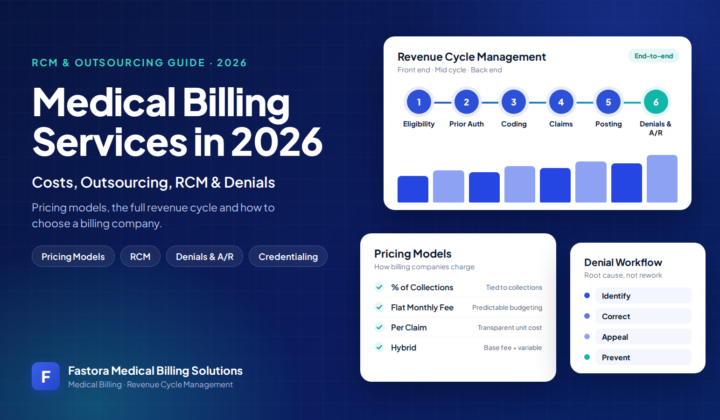
This is very informational