What mental health credentialing involves
Mental health credentialing is the process of proving a clinician's qualifications to insurance plans and enrolling them so the plan will pay their claims. It covers two related steps: credentialing, where the plan verifies licenses, education, training and history, and enrollment or contracting, where the plan loads the clinician into its network and payment system.
For therapists, counselors, social workers, psychologists and psychiatric prescribers, the process repeats with every payer. Each plan has its own application, timeline and rules about which license types it accepts, so a clear, organized file saves weeks. The broader provider credentialing guide covers the same steps for all specialties; this article focuses on behavioral health.
NPI Type 1 vs Type 2
Every clinician who bills insurance needs a National Provider Identifier, issued free through the CMS National Plan and Provider Enumeration System (NPPES).
| NPI type | Who gets it | How it is used |
|---|---|---|
| Type 1 (individual) | Each individual clinician, such as a psychologist, LCSW, LPC, MFT or psychiatrist | Identifies the rendering provider on claims. A clinician keeps one Type 1 NPI for life, even when changing employers. |
| Type 2 (organization) | Group practices, clinics and incorporated entities | Identifies the billing entity. A group bills under its Type 2 NPI and tax ID, with each clinician's Type 1 NPI as rendering provider. |
A solo clinician who bills under their own name and Social Security number may need only a Type 1 NPI. A solo clinician who has formed a business entity often needs a Type 2 NPI for that entity as well. Keep the NPPES record current, since payers compare it with the application.
Taxonomy codes
A taxonomy code describes the clinician's type and specialty. It is selected in NPPES and reported on applications and often on claims. The code should match the clinician's license and the way the payer has them enrolled.
For example, CMS enrollment guidance for marriage and family therapists and mental health counselors lists taxonomy 106H00000X for marriage and family therapists and 101YM0800X for mental health counselors. Psychologists, clinical social workers and psychiatric prescribers each have their own codes. A mismatch between NPPES, the payer file and the claim is a frequent cause of enrollment delays and claim rejections.
CAQH ProView
Most commercial plans collect credentialing data through CAQH ProView, a shared online profile. The clinician enters education, licenses, work history, malpractice coverage and practice locations once, uploads supporting documents and authorizes plans to view the profile.
- Re-attest when prompted. CAQH notifies providers to confirm their information every 120 days (180 days for providers practicing in Illinois).
- Upload renewed licenses and malpractice certificates before the old ones expire.
- Authorize each plan you apply to, or allow access to all plans you are affiliated with.
- Keep practice addresses, hours and telehealth details consistent with your applications.
An expired attestation or document can stall an application without any notice to the clinician, so a regular review of the profile is part of the routine.
Medicare enrollment through PECOS
Medicare enrollment is separate from CAQH. Individual clinicians enroll through the Provider Enrollment, Chain, and Ownership System (PECOS) or with the paper CMS-855I, and those who work for a group also reassign their benefits to that group.
Psychologists and clinical social workers have long been eligible to enroll. Since January 1, 2024, Medicare Part B also pays marriage and family therapists and mental health counselors. According to CMS guidance, these clinicians need a master's or doctoral degree, state licensure or certification, and at least two years or 3,000 hours of post-degree supervised clinical experience. Clinicians who choose not to enroll can file an opt-out affidavit instead, which lasts two years and renews automatically unless ended.
Counselors and family therapists new to Medicare can find the eligibility rules, codes and enrollment steps in our article on Medicare for LMFTs and LMHCs.
Medicaid and commercial insurance panels for therapists
Medicaid enrollment varies by state
Each state runs its own Medicaid enrollment, and many states also contract with managed care organizations that credential providers separately. License types accepted, application portals and supervision rules for pre-licensed clinicians vary widely, so check your state Medicaid agency and each managed care plan.
Commercial panels and closed panels
Commercial plans decide which clinicians to add based on network needs. A panel may be closed to a license type or in a geographic area, especially where the plan already has many therapists. When a panel is closed, clinicians sometimes succeed by highlighting a specialty the network lacks, such as a language, a population served or a treatment approach, and by asking to be placed on a waiting list.
Optum behavioral health credentialing
UnitedHealthcare plans commonly manage mental health benefits through United Behavioral Health, operating under the Optum brand, so therapists apply to Optum rather than the medical plan. Applications start on Optum's Provider Express site, which has a Join Our Network section with state-specific pages showing where the network is accepting applications. Optum behavioral health credentialing draws on your CAQH ProView profile, so attest and authorize Optum before applying. Openings vary by state and license type, and some Medicaid and Medicare Advantage products have their own rules.
Also confirm whether the plan manages mental health itself or through a behavioral health vendor. Applying to the medical plan when behavioral health is carved out wastes time.
How to get credentialed with insurance companies as a therapist
Credentialing moves faster when the steps happen in the right order. Each later step depends on data from an earlier one, and a correction late in the process can restart a payer's review.
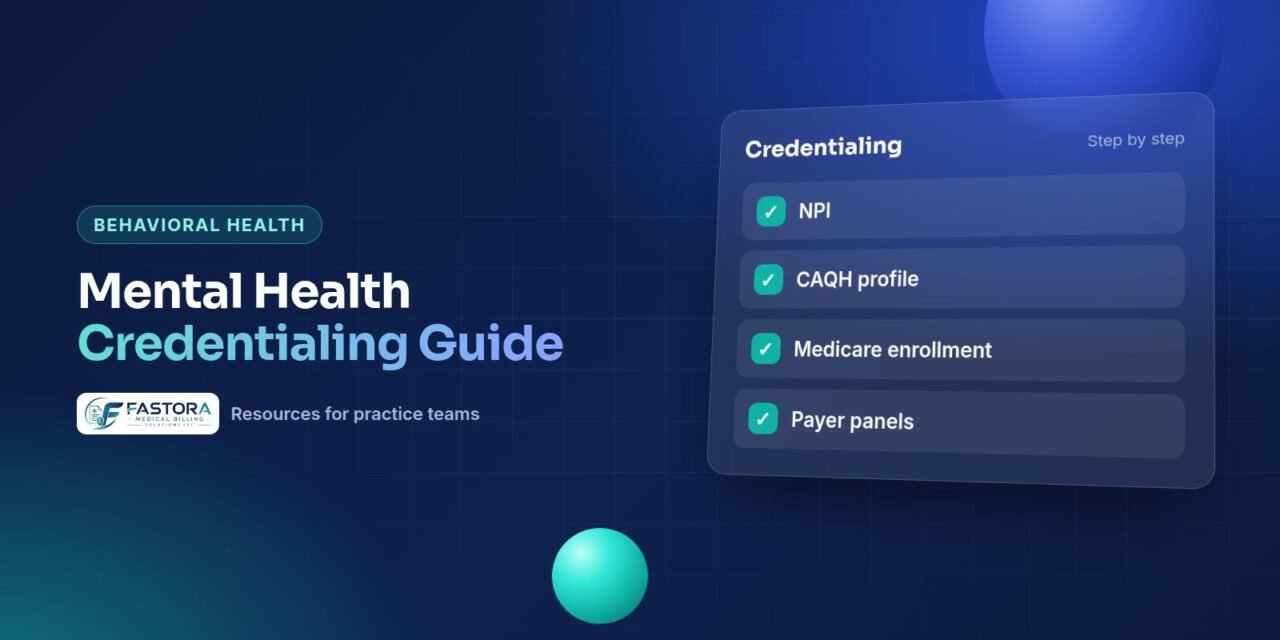
- Confirm the clinician's license is active in every state where patients will be located, including for telehealth.
- Obtain or update the Type 1 NPI, and the group's Type 2 NPI, with the correct taxonomy and practice address.
- Build or update the CAQH ProView profile, upload documents and attest.
- Submit Medicare enrollment in PECOS, including reassignment to the group if applicable.
- Apply to Medicaid and managed care plans in your state.
- Apply to commercial plans and behavioral health vendors, starting with those most of your patients use.
- Follow up on each application on a set schedule and record reference numbers.
- Review each contract and fee schedule before signing, then confirm the effective date and provider ID.
- Load the payer IDs and effective dates into your practice management system before scheduling.
Processing times vary by payer, state and time of year, and incomplete applications are the most common reason for delay. Start early for any new clinician, ideally well before their first scheduled day.
Adding a clinician to an existing group
When a group already holds contracts, a new clinician still has to be credentialed and linked to the group with each payer. Group contracts do not automatically cover new hires. Most plans require an individual application or roster update, and the group's billing staff should hold claims until the payer confirms the clinician is active under the group's tax ID.
When a clinician leaves, notify each payer and end their Medicare reassignment. Leftover linkages can misroute payments and complicate the clinician's next enrollment.
Revalidation and ongoing maintenance
Enrollment is not a one-time task. Medicare requires most providers to revalidate their enrollment every five years, and CMS publishes due dates on its revalidation list. Commercial plans re-credential on their own cycles, commonly every three years.
- Report changes of address, group affiliation or ownership to each payer within their deadlines.
- Track license, DEA (for prescribers) and malpractice expiration dates.
- Keep CAQH attested and documents current.
- Watch for revalidation and re-credentialing requests; missing one can end billing privileges.
What to prepare before you apply
- State license (and any board certification) with numbers and expiration dates
- Type 1 NPI, and Type 2 NPI for the group if applicable
- Tax ID and IRS documentation for the billing entity
- Malpractice insurance certificate and claims history
- Education, supervised experience and work history with explanations for gaps
- Practice locations, telehealth details and hours
- CAQH ProView login and current attestation
- For groups: bank information for payment and an authorized official to sign
Why you cannot bill until enrolled
Claims for services provided before a clinician's effective date with a payer are usually denied, and in network contracts the patient generally cannot be billed for the difference. That is why scheduling insured patients should wait for written confirmation of the effective date.
Retroactive effective dates vary. Under federal rules, Medicare can allow physicians and nonphysician practitioners to bill for services up to 30 days before their filing date when circumstances prevented enrollment in advance, or up to 90 days in a Presidentially declared disaster. Commercial plans and Medicaid programs set their own rules, and many do not backdate at all, so get the effective date in writing before seeing patients under that plan.
Credentialing support for mental health practices
Fastora runs credentialing as a tracked nine-stage process, from consultation and document collection through NPI and CAQH setup, payer applications, follow-ups and final approval, until the clinician is ready to bill. Learn more about our credentialing and payer enrollment service, our work with therapists and counselors, or request a free medical billing assessment.
Therapists comparing routes into networks should also read how to get on insurance panels as a therapist, which covers panel selection and application order.
Checklist
Frequently asked questions
Can marriage and family therapists bill Medicare?
Yes. Since January 1, 2024, Medicare Part B pays marriage and family therapists and mental health counselors who meet CMS requirements and enroll through PECOS or the CMS-855I.
Do I need both a Type 1 and Type 2 NPI?
Every clinician needs a Type 1 NPI. A group practice or a clinician who bills through a business entity also needs a Type 2 NPI for the organization.
How often do I need to update CAQH?
CAQH prompts providers to re-attest every 120 days (180 days in Illinois). Update documents such as licenses and malpractice certificates whenever they renew.
Can I see insured patients while my application is pending?
You can, but claims for that plan are usually denied until your effective date, and retroactive dates vary by payer. Many practices wait for written confirmation before scheduling.
How do I join the Optum behavioral health network?
Start on Optum's Provider Express website, in the Join Our Network section, and check the page for your state to see whether applications are open for your license type. Keep your CAQH ProView profile attested and authorize Optum to view it, because the application draws on that data.