
For most U.S. practices, a strong month and a stressful month usually have similar patient volume. The difference is whether claims leave the office clean, get paid on the first pass, and whether someone follows up on the ones that don’t. This guide explains what medical billing services include, how revenue cycle management works from registration to final payment, what outsourcing costs, and how to evaluate a billing partner before you sign a contract.
It is written for practice owners, administrators and office managers comparing in-house billing with a partner such as Fastora Medical Billing Solutions. If you run a behavioral health, therapy or rehab practice, read it alongside our specialty guide to behavioral health and therapy medical billing, which covers the coding and payer rules unique to those specialties.
Key takeaways
- Medical billing services cover the full claim lifecycle, from eligibility checks to denials and AR follow-up.
- Revenue cycle management connects front-end accuracy with back-end collections.
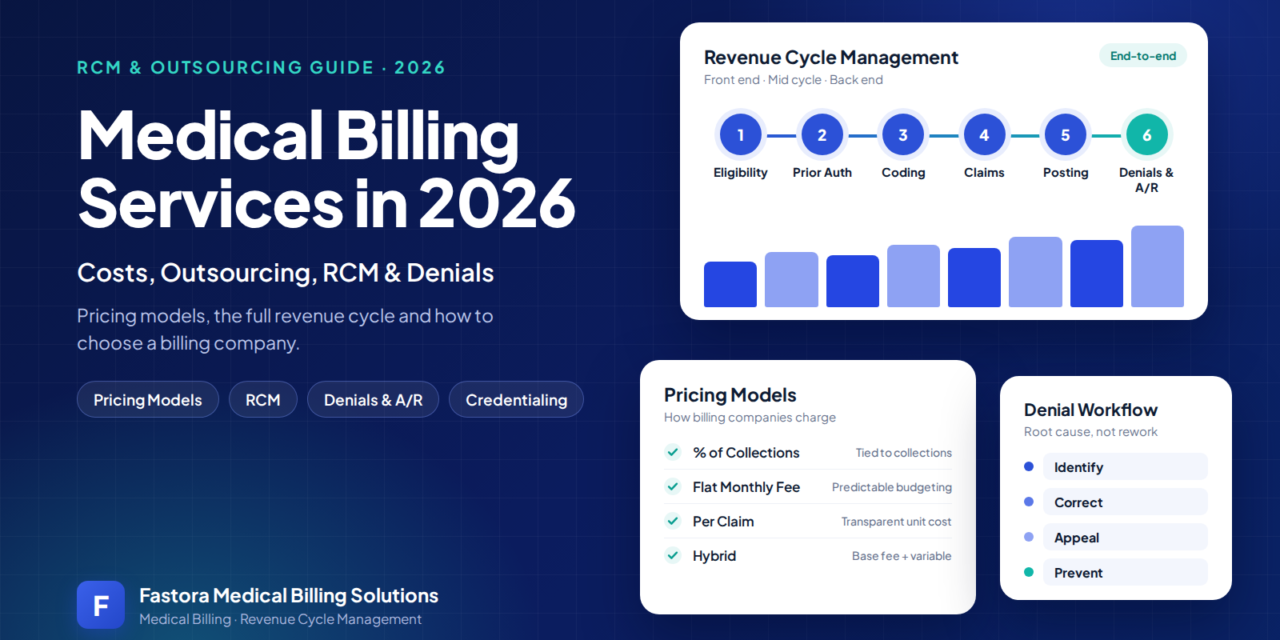
- Most billing companies charge a percentage of collections; flat-fee, per-claim and hybrid models are also common.
- Compare scope, reporting and specialty experience, not just the headline rate.
- A billing audit shows where revenue is leaking before you change partners.
What Are Medical Billing Services?
Medical billing services turn patient visits into payment. They cover verifying insurance, coding and entering charges, submitting claims, posting payments, working denials and following up on unpaid balances until each account is resolved. A practice can handle this work with its own staff or outsource it to a medical billing company.
The claim itself is one step. Most revenue is won or lost before it (eligibility, authorization, documentation) or after it (posting, denials and AR), which is why two practices on the same software can collect very differently.
Physician billing services mostly handle professional claims (the CMS-1500 form or electronic 837P), which depend on CPT and HCPCS codes, modifiers, place of service and rendering-provider details. Facility-based programs may also bill institutional claims (UB-04 or 837I).
What Does a Full-Service Medical Billing Company Do?
A full-service medical billing company manages the whole claim lifecycle, not just claim submission. That typically includes eligibility checks, prior authorizations, coding and charge review, electronic claims, ERA/EOB payment posting, denial and appeal work, patient statements, aging AR follow-up and reporting that shows where money is stuck.
Not every vendor offers the same scope, so it helps to know which level you are buying.
| Service level | What is usually included | Tends to fit |
|---|---|---|
| Claim submission only | Charge entry, claim scrubbing and electronic submission | Practices with a strong front desk and their own AR staff |
| Billing and follow-up | Claims plus payment posting, rejection and denial work, AR follow-up | Practices that handle eligibility and authorizations in-house |
| Full-service medical billing | The full revenue cycle: eligibility, authorizations, coding review, claims, posting, denials, appeals, patient statements, credentialing support and reporting | Practices that want one accountable partner for the revenue cycle |
Fastora supports practices across that full scope, including coding and charge review, eligibility verification, prior authorization and referrals, charge entry, electronic claims, denial and rejection management, corrected claims and appeals, EOB/ERA payment posting, patient statements, timely filing and aging AR follow-up, credentialing and reporting. See Fastora’s medical billing services for how these fit together.
Medical Billing Services for Small and Private Practices
Medical billing services for small practices solve a different problem than enterprise billing. In a one- or two-provider office, billing often depends on a single person. When that person is out, leaves, or falls behind during a payer policy change, claims stop moving and AR grows quietly.
Private practice billing services and solo practice medical billing should address four risks that are common in small offices:
- Single point of failure. If only one person knows the payer portals and follow-up status, there is no backup.
- No separation of duties. When one person enters charges, posts payments and adjusts balances, errors are hard to catch.
- Owner time. Many solo clinicians work denials at night, a real cost that never appears on payroll.
- Limited payer knowledge. A small team sees fewer denial patterns and often learns payer rules through lost revenue.
When comparing options, small practices should look for a named point of contact, a partner that can work inside the existing EHR or practice management system, and monthly reporting in plain language. Fastora works with small and private practices as well as larger outpatient clinics; our guide to outsourcing medical billing explains what the transition involves.
What Is Revenue Cycle Management in Healthcare?
Revenue cycle management (RCM) is the process of managing a patient account’s financial life from scheduling and insurance verification through coding, claims, payment, denials and final balance collection. In healthcare, RCM connects the front office, clinical documentation and back-office billing so services are captured, billed correctly and paid.
People often ask what is revenue cycle management compared with billing. Billing is part of RCM. RCM medical billing adds the front-end steps that prevent problems (registration, eligibility, authorizations) and the analysis that finds recurring issues. When vendors advertise revenue cycle management services or RCM services, they usually mean end-to-end ownership of that cycle rather than claim submission alone.
Practices can outsource revenue cycle management entirely or in parts. A common split is keeping scheduling and check-in in-house while outsourcing coding review, claims, posting, denials and AR. Fastora’s revenue cycle management services can be scoped either way.
The Complete RCM Process
Every practice’s workflow differs slightly, but the revenue cycle generally follows these steps:
- Scheduling and registration – accurate demographics and insurance details; many denials start with a typo here.
- Eligibility and benefits verification – active coverage, network status and patient cost-sharing, before the visit.
- Prior authorization and referrals – approvals obtained and approved units and dates tracked.
- Clinical documentation – the note must support the codes billed.
- Coding and charge review – CPT, HCPCS, ICD-10-CM codes and modifiers checked against documentation and payer rules.
- Charge entry – correct rendering provider, place of service and dates.
- Claim scrubbing and submission – edits, then electronic submission through a clearinghouse.
- Rejection handling – correct and resubmit claims that fail front-end edits.
- Adjudication and remittance – the payer returns an ERA (835 transaction) or paper EOB.
- Payment posting and reconciliation – payments, adjustments and underpayments identified.
- Denial management and appeals – correct, resubmit or appeal, and fix the root cause.
- Patient statements – clear bills for patient responsibility.
- AR follow-up – unpaid claims worked before timely filing limits expire.
- Reporting – performance by payer, provider and denial reason, fed back to the front end.
These are the metrics most worth tracking. Industry benchmarks vary by specialty and payer mix, so trend your own numbers month over month rather than chasing a generic target.
| Metric | What it tells you |
|---|---|
| Clean claim rate | How often claims pass edits on first submission |
| Denial rate (by reason and payer) | Where front-end or coding processes break down |
| Days in AR | How long, on average, it takes to get paid |
| AR over 90 and 120 days | How much revenue is at risk of becoming uncollectible |
| Net collection rate | How much of the collectible amount is actually collected |
Claims, Payment Posting, Denials and AR Recovery
What is the difference between a claim denial and a rejection?
A rejected claim failed front-end edits at the clearinghouse or payer, so it was never processed; it must be corrected and resubmitted. A denied claim was processed and adjudicated but judged unpayable. Denials require a corrected claim, a reconsideration or a formal appeal, depending on the reason and the payer.
The distinction matters because rejections do not stop the timely filing clock. A claim that was rejected and never resubmitted is, from the payer’s point of view, a claim that was never filed.
Payment posting services
Payment posting services record each ERA or EOB at the line level: allowed amounts, contractual adjustments and patient responsibility. Good posting also reads adjustment reason codes (CARCs and RARCs), flags underpayments, triggers secondary claims and routes zero-pay lines into the denial workflow.
Denial management services and denial prevention
Claim denial management in medical billing has two jobs: recover the money on denied claims and stop the same denial from happening again. Effective denial management services group denials by root cause, such as:
- Eligibility and coverage (inactive plan, wrong payer, coordination of benefits)
- Authorization and referral (missing, expired or exceeded units)
- Coding and modifiers (invalid combinations, missing modifiers, diagnosis not supporting the service)
- Medical necessity and documentation
- Credentialing (provider not enrolled or not linked to the group)
- Timely filing and duplicates
Denial prevention is the payoff. If a payer repeatedly denies the same service for missing authorization, the fix belongs at scheduling, not in the appeals queue. Appeals management covers the rest: tracking payer appeal levels and deadlines, attaching documentation, and deciding when a corrected claim (commonly submitted with frequency code 7 on professional claims) is the faster route than an appeal. Fastora’s denial management team handles denials, rejections, corrected claims and appeals.
AR recovery services and aging AR cleanup
Accounts receivable management services keep current claims moving. AR recovery services, sometimes sold as old AR recovery services, are a different job: a project to resolve a backlog of aged claims, often after staff turnover or a system change. Aging AR cleanup usually works claims by age bucket (0–30, 31–60, 61–90, 91–120 and 120+ days) and by dollar value, starting with claims closest to their timely filing deadline.
Timely filing limits vary. Medicare generally allows one calendar year from the date of service, while many commercial and Medicaid plans set shorter limits in their provider contracts. A good AR recovery project checks each payer’s limit first, then separates claims that can still be worked from those that need proof of timely filing or a write-off decision. Fastora provides AR follow-up, aging AR work and payment posting.
Prior Authorization and Insurance Eligibility Verification
Eligibility verification confirms that a patient has active coverage and what the plan pays for. Prior authorization is a separate step: the plan’s advance approval for a specific service before it is delivered. A patient can be fully eligible and the claim can still deny if a required authorization was not obtained.
Insurance eligibility verification services and benefits verification should confirm more than “active”:
- Plan type and network status for the rendering provider
- Deductible, copay and coinsurance, and how much deductible remains
- Visit or session limits for the benefit year
- Carve-outs, such as behavioral health managed by a separate company
- Coordination of benefits when more than one plan applies
Prior authorization services (also called pre-authorization services) handle determining whether authorization is required, submitting clinical information, following up, and tracking approved units and dates so visits beyond the approval are caught before they are billed. Reauthorizations need the same discipline; an expired authorization is one of the most avoidable denial reasons. Fastora provides eligibility verification and prior authorization and referral support.
Medical Credentialing and Payer Enrollment
Credentialing is how a payer verifies a provider’s licenses, education, work history and malpractice coverage. Payer enrollment (provider enrollment) is the process of joining the payer’s network and linking the provider to a billing entity so claims can be paid. Both must be complete before in-network claims will pay.
Medical credentialing services and payer enrollment services typically cover:
- NPI and taxonomy. Type 1 (individual) and Type 2 (group) NPIs, with taxonomy codes that match across NPPES, payer files and claims.
- CAQH. Many commercial payers pull data from CAQH ProView, which requires re-attestation every 120 days.
- Government enrollment. Medicare through PECOS and state Medicaid, each with its own revalidation cycle.
- Contracting. Reviewing agreements and confirming effective dates.
- EDI and EFT enrollment. Electronic claims, ERAs and payments with each payer.
- Recredentialing. Plans recredential on a multi-year cycle, commonly every three years; a missed request can end participation.
Credentialing is a billing issue as much as an administrative one. Claims for services before the effective date, or claims where the rendering provider is not linked to the group, are denied. Fastora supports credentialing, CAQH, NPI and taxonomy, EDI/EFT setup and payer portal access.
In-House vs. Outsourced Medical Billing
The in-house vs outsourced medical billing decision is less about which is “better” and more about which risks your practice is equipped to manage.
| Factor | In-house billing | Outsourced medical billing services |
|---|---|---|
| Cost structure | Salaries, benefits, training, software, clearinghouse fees and turnover costs, paid whether or not claims are collected | Usually a fee tied to collections, claims or a flat monthly amount |
| Coverage | Depends on who is in the office; vacations and resignations create gaps | A team covers the work, so absences should not stop claims |
| Payer and specialty knowledge | Limited to what current staff have seen | Built from many practices and payers, if the vendor has relevant specialty experience |
| Control and visibility | Direct oversight of every task | Depends on reporting quality and system access; ask for both in writing |
| Scalability | Hiring needed to add providers or locations | Scales with volume, subject to contract terms |
Medical billing outsourcing works best when the practice stays involved through front-desk accuracy, timely documentation and monthly report reviews. To outsource medical billing well, treat the billing company as an extension of your team, not a black box.
How Much Do Medical Billing Services Cost?
Medical billing services cost depends on the pricing model, specialty, claim volume and scope. Most companies charge a percentage of collections; published industry pricing guides frequently cite roughly 4% to 10% of collections. Flat-fee and per-claim pricing are also common. Actual quotes vary with the services included.
Treat any published range as a starting point. A low rate that excludes eligibility, authorizations or denial work may cost more in lost revenue than a higher rate that includes them. Fastora prices by scope, specialty and volume rather than a single public rate; see Fastora pricing or request a quote for your practice.
Percentage of Collections vs. Flat-Fee vs. Per-Claim Pricing
| Model | How it works | Advantages | What to clarify |
|---|---|---|---|
| Percentage of collections | Fee equals a percentage of the money actually collected | The vendor is paid when you are paid, which aligns incentives | Whether the base is net insurance collections or also includes patient payments; how old AR and refunds are treated |
| Flat-fee medical billing | Fixed monthly fee, often per provider or per practice | Predictable budgeting | Volume limits, which services are excluded, and how extra work is billed |
| Per-claim | Fee charged for each claim submitted | Transparent unit cost for high-volume practices | Whether resubmissions and corrected claims count as new claims; whether follow-up is included |
| Hybrid | A base fee plus a lower percentage or per-claim charge | Balances predictability with incentives | How the components interact at low and high volume |
Hypothetical example (not Fastora pricing and not a market quote): a practice collects $60,000 a month from insurance on 600 claims. At a hypothetical 6% medical billing percentage of collections, the monthly fee would be $3,600. At a hypothetical $6 medical billing cost per claim, it would also be $3,600. Now suppose collections rise to $75,000 on the same 600 claims because denials are worked better: the percentage fee rises to $4,500 while the per-claim fee stays flat. Neither model is automatically cheaper; the right comparison depends on your claim values, volume and the services each quote includes.
What Affects Medical Billing Costs?
- Specialty complexity – time-based codes, authorizations and modifiers add work per claim.
- Payer mix – Medicaid managed care, carve-outs and regional payers each add rules and portals.
- Average claim value – low-dollar claims (common in therapy) need as much follow-up as high-dollar ones.
- Scope – credentialing, authorizations, patient calls and AR projects may be priced separately.
- Backlog and systems – aged AR and system migrations add setup effort.
- Documentation quality – incomplete notes create coding queries and denials.
Read the contract as closely as the rate: setup fees, minimum monthly fees, termination notice, who owns the data, and who works claims still in process after termination.
How a Medical Billing Audit Can Identify Revenue Leakage
Revenue leakage is money a practice earned but never collected: missed charges, underpaid claims, unworked denials and write-offs that should not have happened. Medical billing audit services find where it happens. Many billing companies offer a free medical billing audit or billing performance review as a first step; ask exactly what it covers.
A thorough revenue leakage audit usually reviews:
- Charge capture – completed appointments compared with charges entered.
- Coding patterns – code distribution by provider and whether documentation supports it.
- Denials – volume and value by reason and payer, and how many were never worked.
- AR aging – balances by age and payer, especially claims near timely filing limits.
- Underpayments – paid amounts compared with contracted rates.
- Credentialing and write-offs – incomplete enrollments and avoidable adjustments.
The useful output is a prioritized list: which problems cost the most, which can still be recovered, and which process change prevents each one. Fastora’s reporting is built around the same questions. To have Fastora look at your numbers, request a billing performance review.
Free claims audit
Not sure where your claims are getting stuck?
Fastora can review your denials, AR aging and charge capture and show you which balances are still recoverable.
Request a Free Claims AuditHow to Choose a Medical Billing Company
To choose a medical billing company, compare specialty experience, scope, reporting transparency, technology fit, communication, compliance and contract terms, not just the rate. The right partner understands your payers and codes, works in your systems, reports clearly every month and makes it easy to see where every claim stands.
Use this medical billing company checklist when comparing proposals:
- Experience with your specialty and your main payers, including Medicaid plans and carve-outs
- A written list of included and excluded services
- Ability to work in your current EHR/PM, or a clear migration plan
- Monthly reports covering collections, denials by reason, AR aging and open issues
- A named account contact and defined response times
- A signed HIPAA business associate agreement
- Your continued access to your own data, during and after the contract
- A defined onboarding plan, including how existing AR will be handled
- Clear termination terms and a transition plan for claims in process
Questions to Ask Before Hiring a Billing Company
These questions to ask a billing company reveal how the work is actually done:
- Which specialties and payers do you bill for most often?
- What exactly is included in your fee, and what is billed separately?
- Who works my account day to day, and how do I reach them?
- How quickly are claims submitted after a visit?
- How do you handle denials and prevent repeat denials?
- How is old AR handled at onboarding, and is it priced separately?
- What reports will I receive, and will I have direct system access?
- What happens to my data and open claims if we part ways?
- Do you support credentialing and new-provider enrollment?
When Outsourcing Medical Billing Makes Sense
Outsourcing tends to make sense when one or more of these is true:
- AR over 90 days is growing, or no one is sure what is in it
- Denials are piling up faster than staff can work them
- Billing depends on one person, or the practice has had biller turnover
- The practice is adding providers, locations or service lines such as telehealth or group therapy
- The owner or clinical staff are doing billing after hours
- A system migration or payer change has disrupted cash flow
If a well-staffed in-house team is already performing well, targeted help such as an AR project or credentialing support may be enough.
Why Specialty-Specific Billing Matters When Choosing a Partner
General billing knowledge covers the process; specialty knowledge prevents the denials. Psychotherapy codes are time-based, psychological testing has its own code families, physical therapy units follow timed-code rules, and addiction treatment often uses HCPCS codes and per-diem billing. A partner unfamiliar with these rules will learn them on your claims.
Fastora focuses on behavioral health, mental health, psychiatry, psychology, counseling, social work, marriage and family therapy, substance use treatment, outpatient clinics, physical therapy, occupational therapy, speech therapy, rehabilitation and PM&R. For the coding and payer details, see our guide to behavioral health and therapy billing and Fastora’s behavioral health billing and physical therapy billing pages.
Frequently Asked Questions
How much do medical billing services cost?
It depends on the pricing model, specialty, volume and scope. Published industry guides often cite roughly 4% to 10% of collections for percentage pricing; flat and per-claim fees are alternatives. Compare what each quote includes, not just the rate.
How do medical billing companies charge?
Usually a percentage of collections, a flat monthly fee, a per-claim fee or a hybrid. Projects such as credentialing or old AR recovery may be priced separately.
Is outsourced medical billing cheaper than in-house billing?
Not always. Compare the full in-house cost (salaries, benefits, training, software, turnover) with the outsourced fee plus any change in collections.
What does a full-service medical billing company do?
It manages the whole revenue cycle, from eligibility and authorizations through coding, claims, posting, denials, patient statements, AR follow-up and reporting.
What is RCM in medical billing?
Revenue cycle management is the end-to-end process of getting paid for patient care. Billing is one part of it.
What is included in a medical billing audit?
Typically charge capture, coding patterns, denials, AR aging, underpayments, credentialing status and write-offs, with a prioritized list of fixes.
What should a practice ask before hiring a billing company?
Ask about specialty experience, what the fee includes, who works your account, how denials and old AR are handled, reporting, and what happens to your data if the contract ends.
What is AR recovery in medical billing?
A focused effort to collect aged unpaid claims, prioritized by value and timely filing deadline, with corrections, resubmissions or appeals where possible.
Work with Fastora
Get a clearer view of your revenue cycle
Talk with Fastora Medical Billing Solutions about billing, RCM, denials, AR and credentialing for your practice.
Request a Free Claims AuditTalk to our team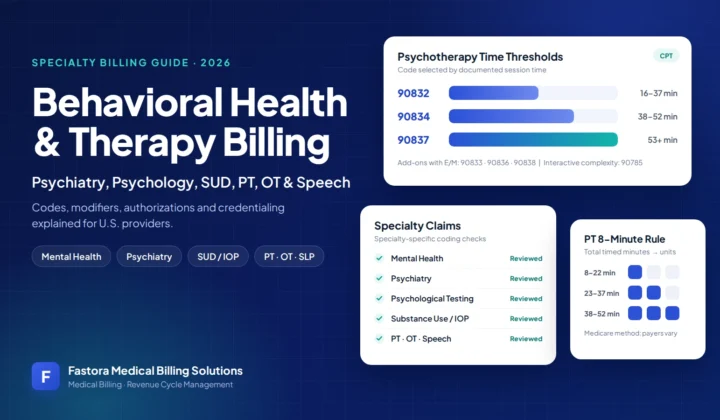

1 comment