In most dental practices, billing is handled by the front desk between check-ins, phone calls, and scheduling. It works — until it doesn’t. Claims start coming back with cryptic codes, the accounts-receivable report gets longer, and nobody is quite sure which denials are worth fighting. Dental billing services take that work off the front desk and run it like a discipline: verify before the visit, code the claim correctly the first time, follow up on everything that doesn’t pay, and keep patient balances moving. This guide explains what those services do, where dental billing differs from medical billing, and how to tell whether your practice needs help.
What dental billing services do
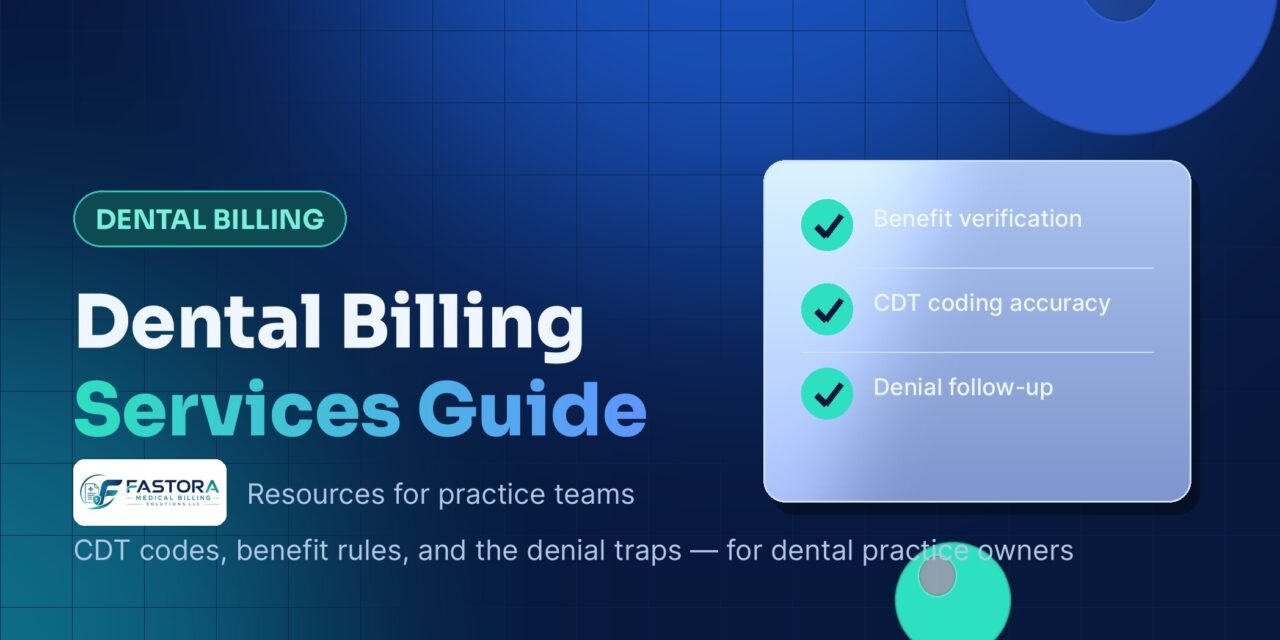
A dental billing service manages the full insurance revenue cycle for a dental practice. In a typical arrangement, the service handles benefit verification, CDT coding review (procedure codes matched to tooth numbers, surfaces, and quadrants against the clinical notes), claim submission on the standard dental claim form with required narratives and radiographs, payment posting so the practice can see write-offs and underpayments line by line, denial management (sorting correctable errors, documentation requests, and payer-policy rejections), patient billing and statements, and credentialing support to keep provider enrollment and payer contracts current.
Some services offer all of these as a bundle; others sell them individually. Either way, the value is the same: every claim gets worked, nothing sits unattended, and the practice owner gets reporting instead of surprises.
Why dental billing is different from medical billing
Dental and medical billing look similar from the outside, but the rules are genuinely different:
- Different code sets. Dental claims use CDT (Current Dental Terminology) codes, not the CPT/ICD system — and tooth numbers, surfaces, and quadrants are part of nearly every procedure line.
- Different benefit structures. Dental plans run on annual maximums, frequency limitations, waiting periods for major work, and fee schedules that pay a percentage of the allowed amount.
- Downgrades are routine. Many plans pay for the least expensive covered alternative (LEAT). A composite filling on a back tooth may be reimbursed at the amalgam rate — if the claim and the patient estimate don’t reflect that, the patient gets an unexpected bill.
- Missing-tooth and pre-existing rules. Some plans won’t cover replacing a tooth already missing when coverage began. These rules live in plan documents most practices read only after a denial arrives.
- Medical cross-coding — with guardrails. Surgical extractions, trauma-related work, sleep apnea appliances, and TMJ treatment can sometimes be billed to medical insurance when the documentation supports medical necessity. It’s a real opportunity, but it requires medical coding and an entirely different claims process.
Because of these differences, a biller who only knows medical billing will stumble on dental claims — and vice versa.
The dental billing workflow, step by step
Whether you keep billing in-house or outsource it, the routine that keeps a dental practice paid looks like this:
1. Verify benefits before treatment. Verifying benefits before treatment — confirming eligibility, the remaining annual maximum, frequency limits, waiting periods, and network status — is the single highest-leverage step in dental billing: most preventable denials are really verification failures.
2. Build an accurate treatment estimate. Translate the dentist’s plan into covered vs. patient-responsibility amounts, accounting for downgrades and frequency limits. Patients who see an honest estimate before treatment pay faster and dispute less.
3. Submit a clean claim. Clean claim submission means sending it electronically with correct CDT codes, tooth numbers, surfaces, provider NPI and taxonomy, and place of service. Attach narratives and images when the procedure requires them — crowns, implants, and surgical procedures nearly always do.
4. Post payments and review explanations. Record every payment, contractual adjustment, and denial reason, and compare what was paid against the plan’s fee schedule. Underpayments on dental claims are common and worth catching.
5. Work every denial. A disciplined denial management routine sorts denials into fix-and-resubmit (wrong tooth number, missing narrative), appeal-with-documentation (frequency-limit denials with clinical justification), and absorb (contractual downgrades). Never let a denial sit without a decision.
6. Bill the patient promptly and clearly. Send the statement soon after insurance adjudication, showing what insurance paid, what was adjusted, and what the patient owes — in plain language, with payment options visible.
7. Follow up on aging balances. Work both insurance and patient balances in age order. In dental, small balances die quietly; a routine that touches every balance before it ages out is what keeps collections steady.
The denial traps that cost dental practices the most
A few denial patterns account for a disproportionate share of lost dental revenue:
- Wrong or missing tooth/surface data. A single wrong tooth number turns a payable claim into an automatic denial — and the payer’s explanation rarely tells you which field was wrong.
- Missing narratives and radiographs. Crowns, buildups, and periodontal work are routinely held or denied without supporting documentation. Attach it the first time.
- Frequency-limit denials. The same procedure on the same tooth inside the limitation window gets denied. Verification should have caught this before treatment.
- Downgrades without patient communication. When a plan pays the LEAT rate, the balance lands on the patient. Practices that don’t explain this up front end up with collection problems that look like billing problems.
- Timely filing lapses. Claims that sit unworked quietly expire under payer filing deadlines.
- Uncredentialed providers. If a new associate isn’t credentialed with the practice’s plans, their claims get rejected. Credentialing should be finished before the associate’s first patient.
Most of these are process failures, not payer unfairness — which is exactly why a defined billing routine (or a service that runs one) pays for itself.
When a dental practice should consider outsourcing billing
Outsourcing isn’t right for every practice. But a few signs point toward it: the front desk is drowning (billing becomes the work that waits); days in AR are climbing on both insurance and patient balances; denied claims from the last 90 days were never resubmitted or appealed — recoverable revenue sitting on the table; the practice is adding locations or associates; or credentialing keeps slipping. A good partner should also tell you when you’re not ready — a practice with a handful of claims a week and a capable office manager may not need one.
What to look for in a dental billing partner
If you decide to outsource, evaluate partners on the things that actually predict performance: dental-specific experience (ask how much of their workload is dental — CDT coding, dental denial codes, and dental plan rules aren’t things a generalist learns on your claims); a defined denial process (how they categorize denials, how fast correctable claims get resubmitted, what appeals look like); transparent reporting (collections, denial rates, days in AR, adjustments — readable in ten minutes); credentialing support as part of the service, not an afterthought; patient-facing communication standards (if the service touches patient billing, their tone becomes your practice’s reputation — ask to see a sample statement); and clear pricing in writing (typically a percentage of collections or a flat per-claim fee). Ask for references from practices of a similar size and specialty mix.
FAQ
How is dental billing different from medical billing?
Dental billing uses CDT procedure codes (plus tooth numbers, surfaces, and quadrants) instead of CPT codes, and dental plans work differently from medical plans — annual maximums, frequency limitations, waiting periods, and downgrade policies are the rules that drive most dental denials. Claims also go through a different claim form and often different payer systems.
What are CDT codes?
CDT — Current Dental Terminology — is the standard code set for dental procedures, maintained by the American Dental Association and updated annually. Every dental claim lists CDT codes for the procedures performed, along with the tooth, surface, or quadrant each code applies to.
Can dental procedures be billed to medical insurance?
Sometimes. Procedures with a medical diagnosis behind them — surgical extractions, trauma-related dental work, sleep apnea appliances, TMJ treatment, biopsies — can qualify for medical billing when the documentation supports medical necessity. The claim then follows medical billing rules: medical codes, medical claim forms, and medical payer policies.
How long do dental insurance claims take to pay?
Clean electronic dental claims are often adjudicated within days to a couple of weeks. Claims needing manual review or documentation take longer — and the bigger risk isn’t slow payment, it’s denied claims that are never followed up on.
What does it cost to outsource dental billing?
Most dental billing services charge either a percentage of insurance collections or a flat fee per claim. The percentage model aligns the service’s incentives with the practice’s collections, but the exact rate varies with claim volume, services included, and practice size. Get the fee structure in writing before signing.
Does outsourcing billing mean losing control of my revenue cycle?
It shouldn’t. A well-run arrangement gives you more visibility, not less — regular reporting on collections, denials, and AR, plus access to the team working your claims.
The bottom line
Dental billing has its own codes, plan rules, and denial patterns — and practices that treat it as a defined process, rather than leftover front-desk work, collect more of what they earn. Whether you tighten the routine in-house or hand it to a billing service, the fundamentals are the same: verify before treatment, code cleanly, work every denial, and keep balances from aging quietly.
If claims are piling up or denials are going unworked, a free billing assessment is a practical starting point. Fastora reviews your claims, denials, and AR and shows you exactly where revenue is slipping — request your free billing assessment.
What a dental billing company and dental RCM company handle
A dental billing company handles the parts of the dental revenue cycle that eat front-desk hours: benefit verification before the appointment, CDT claim submission, attachment handling for x-rays and narratives, and follow-up on the claims payers stall. As an RCM company for dental practices, we go further — credentialing with PPO networks, fee schedule review, patient estimates, and monthly reporting that shows production against collections. Dental practices that bill medical for qualifying procedures get both sides coordinated so neither claim set falls through the gap. Related: dental credentialing services, revenue cycle management, free medical billing audit.