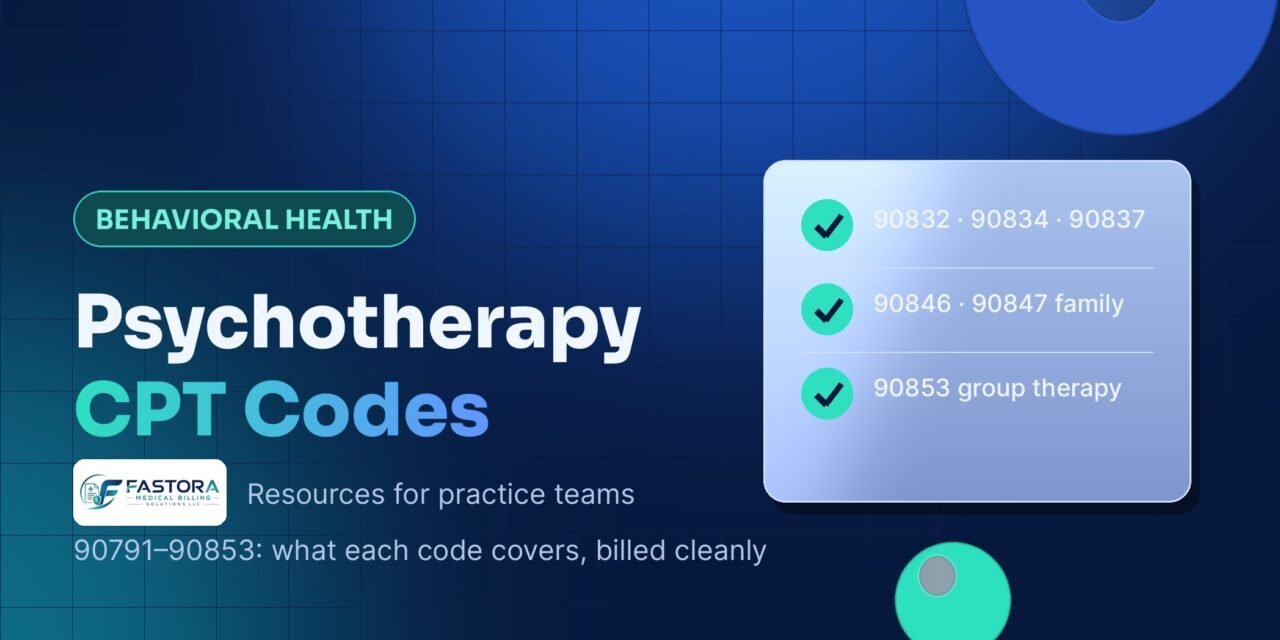
Psychotherapy codes look simple from the outside: a handful of numbers in the 90791–90853 range, and most of a practice's revenue runs through them. Inside, they are time-based, license-restricted, and payer-sensitive in ways that quietly cost practices money — the 45-minute session billed with the 60-minute code, the family session the plan never covered, the group session documented with a single shared note. This guide walks the whole psychotherapy code family one code at a time, explains what each one covers, and shows how to bill each of them so the claim survives first-pass review. For ICD-10 pairing, modifiers, Medicaid and telehealth rules, see our complete mental health CPT codes guide.
The psychotherapy code family at a glance
Every code below comes from the psychiatry section of the CPT code set, which is the controlling source — check the current year's edition when your 2026 files are loaded. Descriptors are summarized in plain language.
| Code | Service (summary) | Billing note |
|---|---|---|
| 90791 | Psychiatric diagnostic evaluation (no medical services) | Intake/evaluation; no set time; once per day per patient |
| 90792 | Psychiatric diagnostic evaluation with medical services | Prescribers only (MD, NP, PA within scope) |
| 90832 | Individual psychotherapy, 30 minutes | 16–37 minutes face-to-face |
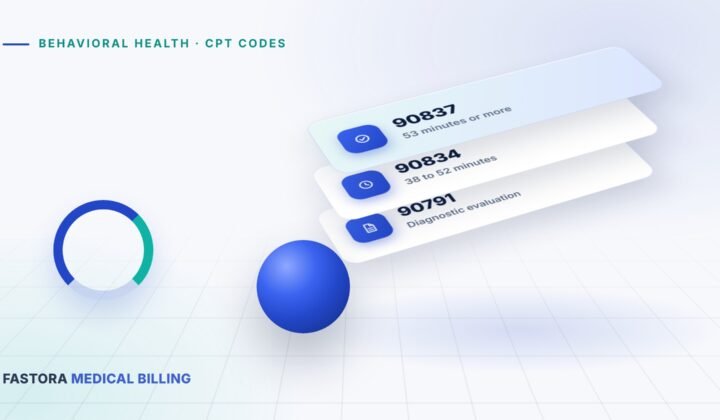
| 90834 | Individual psychotherapy, 45 minutes | 38–52 minutes; the standard session for most payers |
| 90837 | Individual psychotherapy, 60 minutes | 53+ minutes; extra payer scrutiny at some plans |
| 90833 / 90836 / 90838 | Psychotherapy add-ons with an E/M visit | Never standalone; pair with the E/M code |
| 90785 | Interactive complexity (add-on) | With an eligible primary code only, when communication factors complicate the service |
| 90839 / 90840 | Psychotherapy for crisis, first 60 / each added 30 | Urgent crisis work, not just a long routine session |
| 90846 | Family psychotherapy, patient NOT present | 50 minutes; coverage varies by plan |
| 90847 | Family psychotherapy, patient present | 50 minutes; conjoint session |
| 90853 | Group psychotherapy | Billed per patient; each patient needs their own note |
Deep dives on the most-billed codes already live on the site: our guides to the 90791 intake evaluation, the 90837 60-minute code, 90834 vs 90837, and the 90833 add-on with E/M visits. The sections below concentrate on the codes that still cause the most billing questions: 90832, 90792, 90785, the crisis pair, family 90846/90847, and group 90853.
Diagnostic evaluations: 90791 vs 90792
90791 is the psychiatric diagnostic evaluation used for the intake or a reassessment — history, mental status, and recommendations, without medical services. It carries no time component, may include communication with family or other sources, and can only be reported once per day for a patient.
90792 is the same evaluation with medical services included, such as a medication review. It is reserved for clinicians whose scope includes medical services — typically physicians, psychiatric nurse practitioners, and physician assistants. Non-prescribing therapists bill 90791, not 90792. Before billing either code, confirm the clinician is credentialed with the plan; a perfectly coded evaluation still denies when the rendering provider is not in the plan's behavioral health network.
Individual psychotherapy: 90832, 90834, and 90837
These three codes are chosen by face-to-face time with the patient: 90832 for 16–37 minutes, 90834 for 38–52 minutes, and 90837 for 53 minutes or more. Choose the code closest to the actual time — not the scheduled appointment length — and do not count documentation, scheduling, or E/M work in the minutes.
Two realities trip up practices. First, some payers treat 90834 as the standard session, so 90837 draws extra review; the note should say why the longer session was needed. Our 90834 vs 90837 comparison walks the boundary between them. Second, the note must support the code billed: start and stop times, interventions, and progress toward treatment goals. To bill 90837 without denials, the cleanest defense is consistent — real times, a note that explains the clinical need for the longer session, and a pre-bill check that the code matches the documented minutes. And 90832 earns its place for genuinely shorter sessions; billing a 30-minute session as 90834 because 'that's what we always bill' is exactly the pattern that triggers audits.
The add-ons: 90785, and 90833/90836/90838
90785 (interactive complexity) is an add-on reported with a primary psychotherapy or diagnostic code when specific factors complicate communication or delivery — play therapy with a young child, an interpreter in the session, a caregiver interfering with treatment, a discussion about a mandated report, or maladaptive communication among participants. It is never billed alone, never billed just because a session ran long, and not reported with the crisis codes 90839/90840.
The 90833, 90836, and 90838 add-ons cover psychotherapy delivered alongside an E/M visit by a prescriber, such as a medication management visit that also includes therapy. The psychotherapy must be distinct and separately identifiable, its minutes cannot also count toward E/M time, and modifier 25 goes on the E/M code. You cannot bill 90832, 90834, or 90837 on the same day as these add-ons.
Family psychotherapy: 90846 vs 90847
90846 is family psychotherapy with the patient not present — for example, meeting with parents to coach them on managing a child's behavior. 90847 is family (conjoint) psychotherapy with the patient taking part. Both describe 50-minute services, and both must address the identified patient's treatment; a general family counseling session unrelated to the patient's care supports neither code.
Check two things before billing. First, coverage of 90846 varies more between plans than 90847 — read the plan's behavioral health policy before scheduling a patient-absent session, since some payers limit or exclude it. Second, the note should show who attended, their relationship to the patient, how the session addressed the patient's treatment goals, and the time spent. A thin note on a family code reads as a routine visit to a reviewer, and that is where these claims get denied.
Group psychotherapy: 90853
90853 is billed once per patient for each group session — the practice does not bill a single code for the whole group. Each member needs an individual note recording attendance, participation, and progress toward their own treatment goals, and some payers cap the group size. A single shared group note copied across charts is a classic audit finding.
Check the plan's group therapy policy for session limits and authorization requirements, and confirm each patient's diagnosis supports group treatment. Groups that drift from the documented treatment plan are the ones that draw medical-necessity denials.
How to bill psychotherapy codes so they pay the first time
Codes are only half the claim. These checks keep psychotherapy claims out of the denial queue:
- Verify behavioral health benefits separately. Many plans carve mental health out to a separate behavioral health organization with its own payer ID, portal, and authorization rules. Confirm copay or coinsurance, deductible status, visit limits, and whether the intake or ongoing therapy needs authorization.
- Match code to documented time, every line. Record start and stop times in the note. Never bill the scheduled length when the session ran short, and never round a 50-minute session up to 90837.
- Pair the right diagnosis. Every claim pairs the CPT code with an ICD-10 diagnosis that supports it, usually from the F01–F99 chapter, coded to the highest specificity the note supports. Z codes can add context, but many payers will not accept one as the primary diagnosis for psychotherapy.
- Get modifiers and place of service right. Telehealth sessions need the modifier and place-of-service code each payer requires (many plans use modifier 95 with POS 10 or 02), and rules differ between Medicare, Medicaid, and commercial plans. A missing modifier produces a quick, repeatable denial.
- Scrub before submission. Most psychotherapy denials are front-end errors: time-code mismatches, add-ons without their E/M pair, 90792 billed by a non-prescriber, or a missed authorization. Our breakdown of common psychotherapy claim denials lists the patterns and how each one is prevented.
FAQ
Can a practice bill 90834 and 90837 on the same day for one patient?
No — report one individual psychotherapy code per session based on the total face-to-face time. Billing two timed psychotherapy codes for a single session will deny as a duplicate.
Does insurance cover family therapy when the patient is not there (90846)?
Sometimes. Coverage of 90846 varies more by plan than 90847, and some payers limit or exclude it. Verify the plan's behavioral health policy first, and document who attended and how the session addressed the patient's treatment.
How many patients can be in a 90853 group session?
Payer rules differ, and some plans cap group size. What matters for billing is the per-patient rule: 90853 is billed once per patient per session, and every patient needs their own note showing attendance, participation, and progress.
What is the difference between 90791 and 90792?
90791 is a psychiatric diagnostic evaluation without medical services, billable by therapists, psychologists, and prescribers. 90792 adds a medical assessment and is reserved for clinicians whose scope includes medical services, such as physicians and psychiatric NPs.
Do telehealth therapy sessions use the same CPT codes?
Yes — use the same psychotherapy code as the in-person session and add the telehealth modifier and place-of-service code the payer requires. Confirm each plan's current telehealth policy first.
Why did our 90837 claim deny when 90834 always pays?
Some payers treat 90834 as the standard session and review 90837 more closely. Check that the documented time actually reached 53 minutes, that the note explains why the longer session was needed, and that no same-day E/M add-on conflict exists. If the time was really 45 minutes, the correct code is 90834.
Conclusion
The psychotherapy code family rewards precision: the right code for the actual time, the right family code for who was in the room, the right note for every group member, and a benefits check that respects the behavioral health carve-out. If coding reviews, denial patterns, or authorization backlogs are eating into your week, Fastora's behavioral health billing team handles the full revenue cycle for therapy practices — and a free billing assessment will show exactly where your psychotherapy claims are leaking before you commit to anything.