Running an applied behavior analysis (ABA) practice means running two operations at once: the clinical program and the billing operation that funds it. ABA therapy billing has its own coding system, its own authorization cycle, and its own documentation demands — and they look very little like typical medical billing. This guide explains how ABA claims work, where they break, and what keeps payments moving.
Why ABA billing is harder than typical office billing
In a primary care office, a claim usually follows a simple path: the visit happens, the visit is coded, the claim goes out. In ABA, almost every claim sits on top of three extra layers:
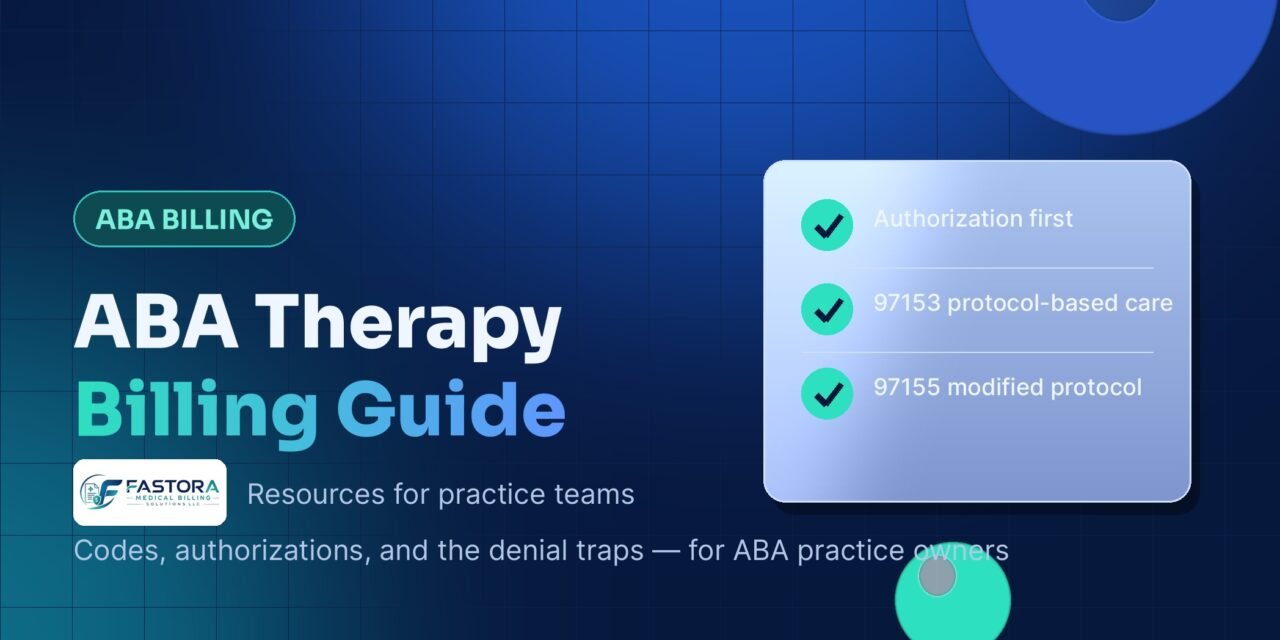
Authorizations drive everything. Most payers require prior authorization before treatment begins, approving a specific number of hours, specific codes, and a specific date range. Services delivered outside that approved window — even by one day — are routinely denied.
The codes are time-based. Many ABA codes are billed in 15-minute units, so the session note must support exactly the number of units billed. Start and stop times are the evidence the claim is built on.
Two provider levels do the work. A registered behavior technician (RBT) often delivers the treatment while a board-certified behavior analyst (BCBA) supervises and modifies the protocol. The billing must reflect who delivered what, because different codes apply.
For general behavioral health claims, see our behavioral health billing guide.
The ABA billing codes practices use most
ABA uses a dedicated set of CPT codes in the 97151–97158 range, plus a few Category III codes. The ones that show up on most ABA claims:
- 97151 — Behavior identification assessment. The BCBA evaluates the client, observes behavior, interviews caregivers, and develops the treatment plan.
- 97152 — Behavior identification supporting assessment. Technician-administered assessment work under the supervising clinician.
- 97153 — Adaptive behavior treatment by protocol. One-on-one therapy delivered by a technician following an established protocol, billed in 15-minute units.
- 97154 — Group adaptive behavior treatment. Protocol-based treatment in a group setting.
- 97155 — Adaptive behavior treatment with protocol modification. Treatment delivered directly by the BCBA, with changes to the protocol during the session based on data and observation.
- 97156 — Family adaptive behavior treatment guidance. Structured caregiver training led by the BCBA — teaching intervention techniques, not just giving a progress update.
- 97157 — Multiple-family group guidance. Group caregiver training for more than one family.
- 97158 — Group treatment with protocol modification. Group treatment in which the BCBA modifies the protocol.
Two Category III codes cover complex cases: 0362T for assessments requiring multiple staff or high-acuity oversight, and 0373T for treatment needing two or more technicians because of severe or high-risk behaviors. Confirm the payer recognizes them before billing.
On the diagnosis side, the claim is built around the qualifying diagnosis — most often autism spectrum disorder — coded to the highest specificity, with relevant co-occurring conditions included to support medical necessity.
The authorization cycle — the part that breaks most ABA claims
More ABA revenue is lost in the authorization cycle than anywhere else. Here is how it normally works and where it fails:
The initial packet. To start services, the practice submits a diagnosis, the assessment, a treatment plan with goals, and clinical documentation showing medical necessity — built to that payer’s written requirements, not to a generic template.
The approval. The payer authorizes a set number of hours per code over a defined date range. That approval is the ceiling — billing above the approved hours, or in an unapproved quantity, invites denials.
The renewal. Before the authorization expires, the practice submits progress data and a reauthorization request. The danger window is the gap between expiry and renewal: any session delivered while no authorization is active cannot be billed successfully. Tracking every active authorization’s end date — and starting renewals early — avoids the most expensive denial pattern in ABA billing.
Because this cycle is so central, dedicated prior authorization support exists precisely for practices whose schedules leave no room to track it by hand.
Documentation that actually supports ABA claims
Notes that support clean claims consistently include:
- Start and stop times, so billed units match documented minutes.
- The intervention used and the client’s response, tied to the treatment-plan goals — not just “session completed.”
- The technician’s credentials and the supervising BCBA’s name, since 97153 is technician-delivered by definition.
- When 97155 is billed, what changed — what the BCBA altered and why. Otherwise the code looks like a duplicate of 97153 to a reviewer.
- Family training attendance and participation for 97156 and 97157.
A payer questioning a series of 97153 claims asks for the session notes first; without times, goals, or credentials, the claim has no foundation.
The denials ABA practices see most
Across ABA practices, the same handful of denial reasons shows up again and again:
Expired or exceeded authorization. The session fell after the authorization’s end date, or billed units pushed past the approved total. This is the number-one pattern — and entirely preventable with an authorization calendar.
Wrong code for the provider level. A 97153 claim for a session the BCBA delivered directly, or a 97155 claim with no documented modification, reads as a coding mismatch.
Missing or inconsistent session times. Billed units that don’t match documented minutes are denied on audit — and increasingly at first pass.
Credentialing and enrollment gaps. The BCBA or the practice must be credentialed and enrolled with the payer. A new hire whose enrollment is still pending can generate weeks of unbillable sessions.
Timely filing. Long authorization cycles and high session volumes make it easy for a claim to age past the payer’s filing deadline. Once the window closes, the revenue is gone.
A well-run claims management process — denials sorted by reason, not just counted — shows which of these patterns costs the practice most.
A simple pre-claim routine for ABA practices
Before a batch of ABA claims goes out, five checks catch most preventable denials:
- Authorization active and sufficient — covering this date, this code, and the units billed.
- Units match minutes — documented start and stop times support the units billed.
- Code matches provider level — technician code for technician-delivered sessions; documented modification behind every 97155.
- Provider enrolled — the billing provider is credentialed with this payer, with no gap.
- Filing window open — the date of service is still within the payer’s timely filing limit.
Run that routine on every batch and the preventable denials fall — because the predictable failures get caught before the payer sees them.
When ABA billing needs outside help
When billing volume outruns the team — renewals slip, notes pile up unbilled, and the A/R aging report tells the story — it is time for an independent look. A free billing assessment maps where revenue is leaking so the practice knows exactly what to fix.
FAQ
Do all payers require prior authorization for ABA therapy?
Nearly all commercial payers and Medicaid plans require prior authorization before ABA treatment starts and again for continued care. Which codes need authorization, how many hours are approved, and how often reauthorization is needed vary by payer and plan — always work from that plan’s written policy.
Who can bill CPT code 97153?
CPT 97153 is reported by the practice for adaptive behavior treatment by protocol, delivered by a technician such as an RBT under BCBA supervision. The supervising analyst should be enrolled with the payer and named in the session record.
What is the difference between CPT 97153 and 97155?
CPT 97153 covers technician-delivered treatment following an established protocol, billed in 15-minute units. CPT 97155 covers treatment delivered directly by the BCBA that includes protocol modification during the session. Both can appear on the same day from different providers at non-overlapping times — but the 97155 note must document what changed and why.
How do authorizations work in ABA billing?
The practice submits a diagnosis, assessment, and treatment plan; the payer approves a set number of hours per code over a date range; and reauthorization must be secured before expiry. Sessions delivered without active authorization are generally denied.
What diagnosis code do ABA claims use?
The claim typically carries the client’s qualifying diagnosis — most often autism spectrum disorder, coded to the highest specificity — along with relevant co-occurring conditions that support the medical necessity of the services billed.
Can ABA sessions be billed through telehealth?
Many payers allow telehealth ABA, typically by appending a modifier such as 95 or GT to the base code. Which codes are eligible differs by payer — check the plan’s rules before scheduling remote sessions.
Conclusion
ABA therapy billing rewards three disciplines: keeping every authorization active and inside its limits, documenting time and interventions precisely, and matching each code to the provider who delivered the service. Get those right and most of the specialty’s denial patterns disappear.