Every visit a provider delivers has to travel a long way before it turns into payment. Insurance has to be verified, services have to be coded correctly, claims have to meet each payer’s rules, and denials have to be worked before filing deadlines pass. When any step slips, revenue sits in accounts receivable instead of the practice’s bank account.
That is the job of medical billing services: managing the steps between patient care and reimbursement. This guide covers what medical billing includes, how coding and billing work together, when outsourcing makes sense, and how to choose a billing partner, whether you practice in Austin, elsewhere in Texas, or anywhere in the U.S.
What Are Medical Billing Services?
Medical billing services are the processes and people that turn documented patient care into submitted claims, collected payments, and resolved balances. A practice can run these functions with in-house staff, outsource them to a medical billing company, or use a mix of both.
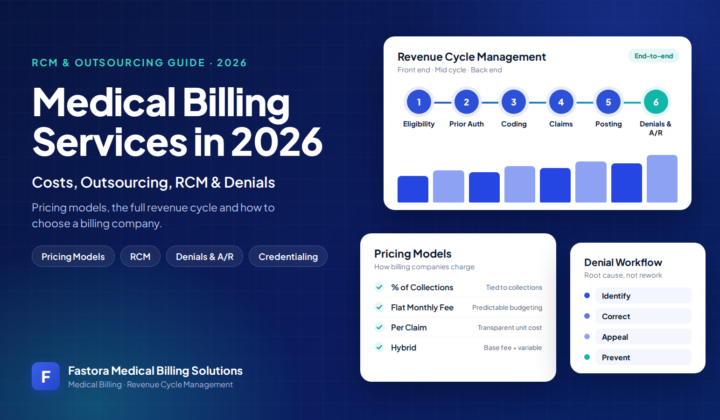
Medical billing is one part of the broader revenue cycle, which starts before the patient arrives and ends only when the account reaches a zero balance. It runs from registration and eligibility verification, through prior authorization, documentation, and medical coding, to claims submission, payment posting, denial management, appeals, and accounts receivable (AR) follow-up.
Professional medical billing services focus on keeping that chain intact, so a problem at the front desk does not quietly become a denied claim 60 days later.
What Does a Medical Billing Company Do?
The scope varies by contract, but a full-service medical billing company generally handles the work that sits between the provider’s documentation and the final payment. Common responsibilities include the following.
Front-End Revenue Cycle Tasks
- Eligibility and benefits verification: Checking coverage before the visit reduces eligibility denials and supports accurate patient cost estimates.
- Prior authorization and referral support: Tracking which services need approval, submitting requests, and following up so claims are not denied for missing authorization.
- Charge entry: Entering services, codes, units, modifiers, and provider details accurately into the practice management system.
Claim Preparation and Submission
- Pre-submission claim review: Checking claims for missing information, code and modifier conflicts, payer-specific edits, and demographic errors before they go out. Catching an error here is far cheaper than reworking a denial later.
- Claims submission: Sending clean claims through a clearinghouse and monitoring rejections, which are claims that never reached payer processing and need correction.
Back-End Follow-Up
- Payment posting: Posting payments and adjustments from electronic remittance advice (ERA) and explanation of benefits (EOB) documents.
- Denial and rejection management: Identifying why claims were denied, correcting what can be fixed, and tracking patterns so the root cause gets addressed.
- Appeals and corrected claims: Preparing appeals with supporting documentation and resubmitting corrected claims within payer timelines.
- AR follow-up: Working unpaid claims by age and dollar value, contacting payers, and escalating stalled accounts.
- Patient statements: Sending clear statements for patient responsibility balances and answering billing questions.
- Reporting: Providing regular visibility into claims volume, collections, denials, and aging AR.
Many billing companies also support provider credentialing, CAQH profile maintenance, NPI setup, and payer enrollment. These tasks are easy to overlook, but a provider who is not properly enrolled with a payer cannot be paid by that payer, no matter how clean the claim is.
Medical Coding and Billing: How They Work Together
People often use “medical billing and coding” as a single phrase, and the two functions are closely linked. They are, however, different jobs.
| Function | Medical Coding | Medical Billing |
|---|---|---|
| Primary purpose | Translate clinical documentation into standardized codes | Use those codes to create claims and secure payment |
| Key code sets and forms | ICD-10-CM diagnoses, CPT and HCPCS Level II procedures, modifiers | CMS-1500 / 837P claims, ERA (835) remittances, payer portals |
| Main question | Does the code accurately reflect what was documented? | Will the payer accept and pay this claim correctly? |
| Common risks | Undercoding, overcoding, missing modifiers, weak documentation support | Eligibility errors, missed deadlines, unworked denials, aging AR |
Coding feeds billing. If a diagnosis does not support medical necessity for the procedure, or a required modifier is missing, billing inherits a denial. When billers spot a recurring denial tied to documentation, that feedback must reach coders and providers. That is why coordinated medical coding services and billing matter: shared information reduces avoidable denials and keeps claims defensible in an audit.
Why Practices Choose Medical Billing Outsourcing
Outsourcing medical billing is not right for every practice. Some have strong internal teams. Others reach a point where billing work competes with patient care, and an outside partner becomes a practical billing solution.
Practices typically consider medical billing outsourcing when they experience one or more of these situations:
- Staffing gaps: A single in-house biller leaves, goes on leave, or is stretched across front-desk and billing duties.
- Growing AR: Claims older than 60 or 90 days keep accumulating because nobody has time to work them.
- Repeated denials: The same denial reasons appear month after month without a clear fix.
- Practice growth: New providers, new locations, or new service lines add volume and payer complexity.
- Limited visibility: Owners cannot easily answer basic questions about collections, denial trends, or what is outstanding.
- Credentialing delays: New providers are ready to see patients but are not yet enrolled with key payers.
A capable outsourced billing team can provide dedicated follow-up capacity, specialty knowledge, and consistent processes, and it can scale as the practice grows without hiring and training for every new role.
The difference often comes down to the people. An experienced billing specialist knows which payers require which modifiers, recognizes a denial pattern after the second occurrence rather than the twentieth, and works aging claims before timely filing limits expire. That frees front-desk and clinical staff from hold queues and payer portals. Some practices start smaller with medical billing consulting services, such as a one-time claims or workflow review, before deciding whether full outsourcing is needed.
Results depend on your starting point, payer mix, and documentation quality. Be cautious of any company that guarantees a revenue increase before reviewing your data.
What Is a Third-Party Medical Billing Company?
A third-party medical billing company is an independent organization that manages billing and revenue cycle functions on behalf of a healthcare provider. The provider remains the billing entity; payments go to the practice’s accounts, and the billing company acts as an authorized business associate under HIPAA.
In a typical arrangement:
- The practice and billing company sign a service agreement and a Business Associate Agreement (BAA).
- The billing team receives secure access to the practice management system, EHR, clearinghouse, and payer portals as needed.
- The practice continues scheduling, patient care, and documentation, while the billing team handles agreed tasks such as verification, charge entry, claims, posting, and follow-up.
- Both sides agree on communication routines, escalation paths, and regular reporting.
A good third-party relationship feels like an extension of your staff, not a black box: you should always be able to see your own data.
Medical Billing Services in Texas and Austin
Practices searching for medical billing services in Texas often face a payer environment with its own details. A billing team supporting Texas providers should be comfortable with areas such as:
- Texas Medicaid and CHIP: Much of Texas Medicaid is delivered through managed care programs, which means claims, authorizations, and appeals may go to a managed care organization rather than directly to the state’s claims administrator. Each plan can have its own rules.
- Medicare administrative contractor rules: Texas Medicare Part B claims are processed by the regional Medicare Administrative Contractor, and local coverage determinations can affect medical necessity requirements for certain services.
- Behavioral health carve-outs: Some plans route mental health benefits through a separate behavioral health administrator, which affects eligibility checks and claim routing.
For practices looking at medical billing services in Austin, TX, or searching for “practice management near me,” the key question is less about the billing company’s zip code and more about whether the team understands your payers, specialty, and systems. Remote billing teams can work well when communication is responsive and reporting is clear. If in-person meetings matter to you, ask about that directly.
Fastora Medical Billing Solutions LLC supports healthcare providers with revenue cycle management services that can be adapted to Texas payer requirements, including eligibility verification, prior authorization support, claims follow-up, and credentialing.
Specialty-Specific Medical Billing Services
Billing rules differ significantly by specialty. A team that works well for primary care may miss details that matter in therapy, allergy, or procedure-based practices.
Behavioral Health and Mental Health Billing
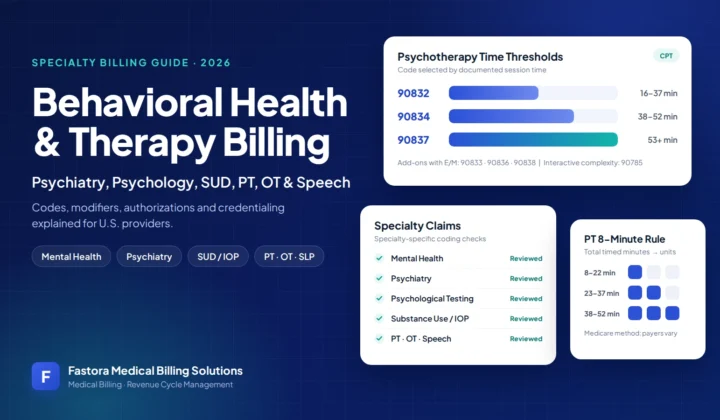
Psychotherapy codes are often time-based, so documentation must support session length. Practices also deal with intake codes, add-on codes such as interactive complexity, telehealth place-of-service and modifier rules, and plans that carve out behavioral health benefits to separate administrators. Authorization and visit limits are common. Learn more about behavioral health billing and mental health billing services.
Allergy and Immunology Billing
Allergy billing services require close attention to units and quantities. Allergy testing codes are generally reported per test, antigen preparation is billed by dose, and payers can define a billable dose differently. Practices also need to handle evaluation and management visits billed on the same day as testing or injections, which may require appropriate modifier use and supporting documentation. Errors in units or dose counts can lead to denials, underpayments, or overpayment requests. See Fastora’s allergy billing services for more detail.
Physical Therapy Billing
Physical therapy relies heavily on timed codes, and Medicare applies specific rules for counting units of timed services. Practices must also track plan-of-care certifications, therapy thresholds that require the KX modifier for Medicare patients, and visit limits under commercial plans. Explore physical therapy billing.
Pain Management and Orthopedics
Interventional pain procedures often require prior authorization and clear documentation of conservative treatment history. Orthopedic billing involves global surgical periods, which affect whether follow-up visits are separately payable, plus modifiers for staged, related, or unrelated procedures during the global period.
Before choosing a partner, ask how many practices in your specialty the billing team currently supports and what specialty-specific edits they apply before claims are submitted.
Medical Billing Collections and Accounts Receivable
Medical billing collections is the structured work of securing payment on balances owed by payers and patients, not a scramble at month’s end.
Effective accounts receivable management typically includes:
- Aging review: Sorting open claims into age buckets such as 0–30, 31–60, 61–90, and 90+ days, then prioritizing by age, dollar amount, and filing deadlines.
- Claim status checks: Using payer portals and calls to find pending, lost, or stalled claims.
- Underpayment review: Comparing payments against expected reimbursement.
- Denial work: Correcting and resubmitting claims when the fix is clear, and preparing appeals when the payer’s decision should be challenged.
- Timely filing management: Tracking payer-specific deadlines for initial submission, corrected claims, and appeals.
- Patient balance follow-up: Sending clear statements, answering questions, and applying the practice’s financial policies consistently.
Strong denial management goes beyond reworking individual claims. It looks for patterns, such as a front-desk registration issue, a missing authorization workflow, or a coding habit, and fixes the process that created them.
How to Choose a Medical Billing Company
Choosing a medical billing company affects cash flow, compliance, and staff workload for years. Use these factors to compare options.
- Experience: How long has the team handled billing for practices like yours, and who will actually work your account?
- Specialty knowledge: Can they explain the billing rules that commonly affect your specialty without looking them up?
- Coding and claim review: Do they review claims before submission, and how do they handle coding questions with your providers?
- Denial management: Do they track denial reasons and report root causes, or only resubmit claims?
- AR follow-up: How often is aging AR worked, and how are older or high-dollar claims prioritized?
- Payer experience: Are they familiar with your main commercial, Medicare, Medicaid, and managed care payers?
- Reporting: What reports will you receive, how often, and can you access your data at any time?
- Communication: Will you have a dedicated point of contact, and what response times should you expect?
- Technology: Can they work in your existing practice management system and EHR, or will you need to switch?
- Compliance: Will they sign a BAA, and how do they protect patient information and access credentials?
- Transparent processes: Is pricing clear, is the scope of work written down, and what happens to your data if the relationship ends?
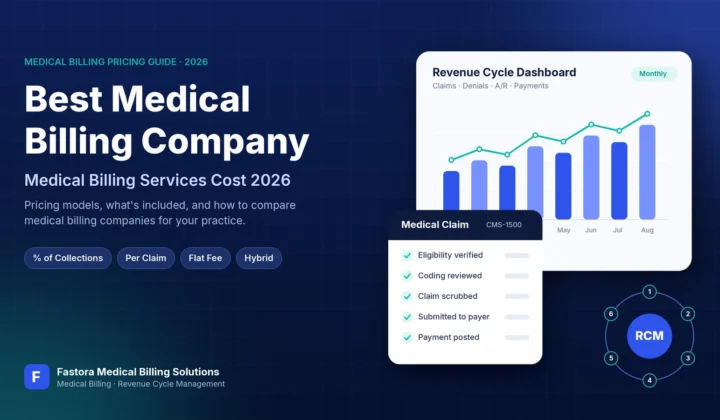
Consider asking for a review of your current claims or AR before signing; your own data tells you more than a sales presentation. If you are comparing pricing models, Fastora’s guide to medical billing services cost explains percentage-of-collections, per-claim, flat-fee, and hybrid arrangements.
How Fastora Medical Billing Solutions Supports Healthcare Providers
Fastora Medical Billing Solutions LLC is a medical billing and revenue cycle management company that works with physicians, behavioral health and mental health practices, outpatient clinics, and specialty providers. Its services cover medical billing and claims submission, advanced pre-submission claim review, eligibility and benefits verification, prior authorization and referral support, charge entry, EOB/ERA payment posting, denial and rejection management, AR follow-up, appeals and corrected claims, patient statements, and credentialing, including CAQH support and NPI and payer enrollment.
If your practice is dealing with rising denials, aging AR, or stretched billing staff, contact Fastora Medical Billing Solutions to talk through your current workflow and request a claims review.
Frequently Asked Questions About Medical Billing
What are medical billing services?
They cover the tasks required to get paid for patient care: eligibility verification, charge entry, claims submission, payment posting, denial management, AR follow-up, and patient statements.
What does a medical billing company do?
It manages some or all of a practice’s revenue cycle, from verification and authorizations through claims, posting, appeals, collections, credentialing, and reporting.
What is medical billing outsourcing?
It means hiring an outside company to perform billing tasks instead of, or alongside, in-house staff. The practice keeps ownership of its revenue and data.
What is the difference between medical billing and medical coding?
Medical coding converts clinical documentation into standardized diagnosis and procedure codes. Medical billing uses those codes to create claims, submit them to payers, and follow up until payment is received or the balance is resolved.
When should a practice outsource medical billing?
Common signs include growing AR, recurring denials, staff turnover in billing roles, rapid practice growth, credentialing delays, or a lack of clear financial reporting. A claims or AR review can help determine whether outsourcing would address the actual problem.
How does a third-party medical billing company work?
The practice signs a service agreement and BAA and grants secure system access. The billing company handles the agreed tasks and reports back regularly.
What should I look for in a medical billing company?
Specialty experience, pre-submission claim review, structured denial and AR follow-up, payer familiarity, clear reporting, responsive communication, HIPAA compliance, and transparent pricing.
What are medical billing collections?
The follow-up work that secures payment on outstanding balances: unpaid insurance claims, denial appeals, underpayment review, and patient balances.
Are medical billing services available in Texas and Austin?
Yes. Practices in Austin and across Texas can work with local or remote billing teams. What matters most is familiarity with Texas Medicaid managed care, Medicare contractor rules, and your commercial payers.
Why do people search for “medcial billing” or “mediacal billing”?
They are common misspellings of “medical billing.” Search engines usually recognize the intended term and return the same results.