
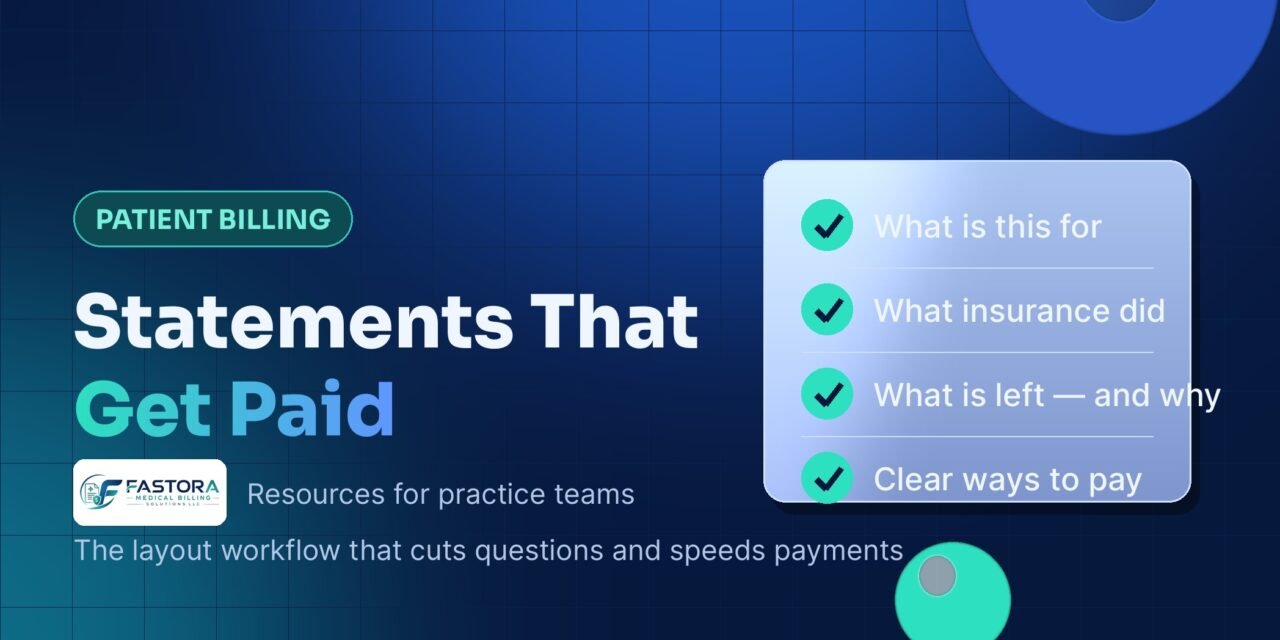
Most patient billing statements fail in the same quiet way. They arrive at the patient’s home, the patient looks at the columns of numbers, and one of two things happens: the bill gets set aside “for later,” or the patient calls the practice with questions. Both slow down payment, and both add work for your staff.
A good statement answers the patient’s questions before they are asked. Every effective patient statement answers three questions, in this order: what is this for, what did insurance do, and what is left for me to pay — and why. If your statements do that clearly, payments come faster and the phone rings less.
This guide walks through the patient billing statements best practices that make that happen: how to lay the statement out, how to handle insurance amounts that are still being decided, when to send statements, and how to tell whether your statements are working.
Start with the Three Questions Every Statement Must Answer
Before changing fonts or adding payment options, check that your statement answers these three questions in the order a patient reads:
- What is this for? The service and the date of service, in plain words the patient recognizes — not just a code. “Office visit, October 2” beats “99213” every time.
- What did insurance pay or adjust? Show the billed amount, what the insurance paid, and what was written off under the contract. Patients get confused when insurance adjustments look like charges; label each line so the difference is obvious.
- What is left, and why? The patient’s balance, clearly separated from everything else, with a short reason: deductible, copay, or coinsurance. One clear “What you owe” figure does more than three columns of totals.
If a patient has to hunt for any one of these, the statement is generating calls instead of payments. Fix the order before you fix anything else.
Design the Layout So the Eye Lands on the Balance
Statement design is not decoration — it is direction. The best practice is to put the most important information where the eye naturally goes first.
- Balance and due date at the top. Prominently display the total patient balance and the due date near the top of the page. Larger type and bold text here tell the patient what to do.
- Separate insurance adjustments from patient responsibility. Use distinct rows or sections so the patient can see at a glance what the insurance handled and what is theirs. Blending them is the single most common cause of “I don’t understand this bill” calls.
- Keep the language plain. Replace billing shorthand with words patients use. Write “your share of the cost” alongside or instead of “coinsurance.” A short line explaining “adjusted per your insurance contract” prevents more disputes than any font choice.
- Include how to get help. Put a billing contact name and phone number on the statement itself. A patient who can reach a person with a question is far less likely to let the bill sit.
A modern, clean layout with readable type costs nothing extra and pays for itself in fewer confused calls.
Illustrative Example: One Statement Section, Before and After
Clearly labeled example — illustrative layout, not real patient data.
| Before (generates calls) | After (generates payments) |
|---|---|
| “99213 — $220” | “Office visit, Oct 2 — $220” |
| “Adjustment: $110” | “Insurance adjustment per contract: −$110” |
| “Ins paid: $88” | “Insurance paid: $88” |
| “Patient resp: $22” | “What you owe: $22 (copay)” |
| No payment info | “Pay online, by phone, or by mail — see payment options” |
Same account, same numbers. The after version answers the three questions in order.
What to Show When Insurance Hasn’t Finished Deciding
One of the trickiest parts of any patient statements workflow is the account where the payer’s decision is still pending. The worst thing you can do is present a balance as final when it isn’t — that is how disputes and distrust start.
Best practice for pending payer decisions:
- Mark the statement clearly. Say plainly, “We are waiting for your insurance company’s decision on part of this visit.” Then show what is decided and what is not.
- Show only confirmed balances as due. If a portion is still under review or appeal, do not fold it into “amount due” with the rest. Separate lines: one for the confirmed balance, one labeled as pending.
- Explain what happens next. One sentence: “If insurance pays more, your balance will go down. We will send an updated statement.” Patients accept waiting far better than they accept surprises.
This is one of the places where accuracy upstream matters most. Many statement questions trace back to coverage that was never confirmed before the visit. A solid eligibility verification checklist at scheduling and registration prevents the “but I was told I was covered” conversation later.
Send Statements on a Steady, Predictable Schedule
Timing is part of the workflow, not an afterthought. Statements that go out irregularly train patients to ignore them; statements on a steady schedule train patients to pay them.
- Send promptly after the claim is resolved. The statement should go out soon after the insurance explanation of benefits is processed — not weeks later. A bill that arrives while the visit is still fresh in the patient’s mind gets paid faster.
- Keep a consistent cadence. Regular statements with regular follow-ups outperform irregular ones every time. Patients should know when to expect a statement and when a reminder will follow.
- Follow up before accounts age. Statements alone are not enough for every balance. Build a simple follow-up routine — a reminder, then a second reminder — so no account quietly slides from “just billed” to “forgotten.”
If a growing share of your receivables sits past 60 or 90 days, the problem is usually not the statement design but the follow-up behind it. That is the kind of pattern a look at your key billing numbers will show clearly.
Offer More Than One Way to Pay
Patients pay fastest through the method that is easiest for them — and the easiest method differs from person to person. Patient billing statements best practices all include this point: make paying simple and flexible.
- List every payment option on the statement. Online portal, phone, mail, in-office. If you offer payment plans, say so right on the statement — many patients who cannot pay a large balance in full would pay it monthly if they knew that was an option.
- Make the online option obvious. A clearly labeled payment link or portal address, near the balance, with simple instructions. The fewer steps between “I should pay this” and the payment itself, the better.
- Explain the plan option simply. If a balance is large, one line — “Payment plans are available; call us to set one up” — turns a balance that would go to collections into a balance that gets paid over time.
Every payment option you list is one fewer reason for the patient to set the bill aside.
Review Statements the Way Your Patients See Them
Once or twice a year, pull your own statement template and read it as if you had never seen it before. Ask the three questions from the top: can I tell what this was for, what insurance did, and what is left and why? If the answer requires effort, your patients are making that same effort — and many of them will call you instead of paying.
If you work with a billing service, ask them to send you their statement template for review. Reviewing the statement from the patient’s point of view is one of the simplest ways a practice owner can reduce billing friction. It is also a natural place to start if you are evaluating patient billing services — the quality of the statements they send is the quality your patients will associate with your practice.
Frequently Asked Questions
What should be included in a patient billing statement?
At a minimum: the practice name and billing contact, patient name, date and description of services, the billed amount, insurance payments and adjustments shown separately, the clearly labeled patient balance, the due date, and the payment options. Anything less creates questions; anything much more creates clutter.
How can we make our patient statements easier to understand?
Answer three questions in order: what the visit was for, what insurance paid or adjusted, and what is left for the patient and why. Use plain language instead of billing shorthand, show the balance and due date prominently, and put a billing contact on the statement so patients can get help quickly.
What should a statement show when insurance hasn’t finished the claim?
Mark it as pending in plain words, show only confirmed amounts as due, and explain what happens next — if insurance pays more, the balance goes down and an updated statement follows. Never present a pending balance as final.
How often should we send patient statements?
On a steady, predictable schedule — send promptly after the insurance claim is processed, then follow up with reminders on a regular cadence. Consistency beats frequency: irregular statements train patients to ignore them, while a regular rhythm keeps balances moving.
Why do so many patients call with questions after receiving a statement?
Usually because the statement blended insurance adjustments with patient responsibility, used billing shorthand the patient didn’t recognize, or showed a balance the patient didn’t expect. Most statement-driven calls trace back to layout and language — or to coverage that was never verified before the visit.
How do we know if our statements are working?
Watch two things: the number of billing questions your staff fields after statements go out, and how your accounts receivable moves. If statement questions are dropping and balances aren’t aging past 60 or 90 days, the statements are doing their job. If not, the statement — or the follow-up behind it — needs attention.
Conclusion
Patient billing statements work when they respect the reader. Answer the three questions — what this is for, what insurance did, what is left and why — in plain language, on a steady schedule, with clear ways to pay and a human being to call. Practices that do this get fewer confused calls and faster payments, with no new technology required.
If your statements are generating questions instead of payments, the fastest way to see the full picture is a free billing assessment. We review how your statements, follow-up, and patient billing workflow are performing and show you exactly where the friction is — so you can fix it with confidence.
1 comment