Most unpaid patient balances are not refusals to pay. They are reminders that never got sent, statements that confused the reader, or follow-ups that arrived two months late and sounded like a threat. A practice does not need an aggressive collections team to fix that. It needs a simple, consistent payment-reminder workflow: tell patients what they owe, why, and how to pay — in a tone that keeps the relationship intact.
Why patient balances sit unpaid
Balances usually go unpaid for one of four ordinary reasons:
- Forgotten. A statement sits in a pile of mail and never surfaces. These are the easiest balances to collect — they just need a nudge.
- Confusing. The patient cannot tell what the charge was for, what insurance paid, or whether the amount is final. Confusing bills get set aside. Fix the statement first — a clear statement layout makes every reminder that follows more effective.
- Hard to pay. No online option, no payment link, a phone line with long holds. Every extra step between reading the reminder and paying is a chance to put it off.
- Bad timing. The patient is short on cash this month. These patients often will pay over time — if someone offers a plan instead of sending the same demand three times.
Most of this has nothing to do with unwillingness. Treat the typical patient as someone who will pay when the process is clear and easy.
What every payment reminder should include
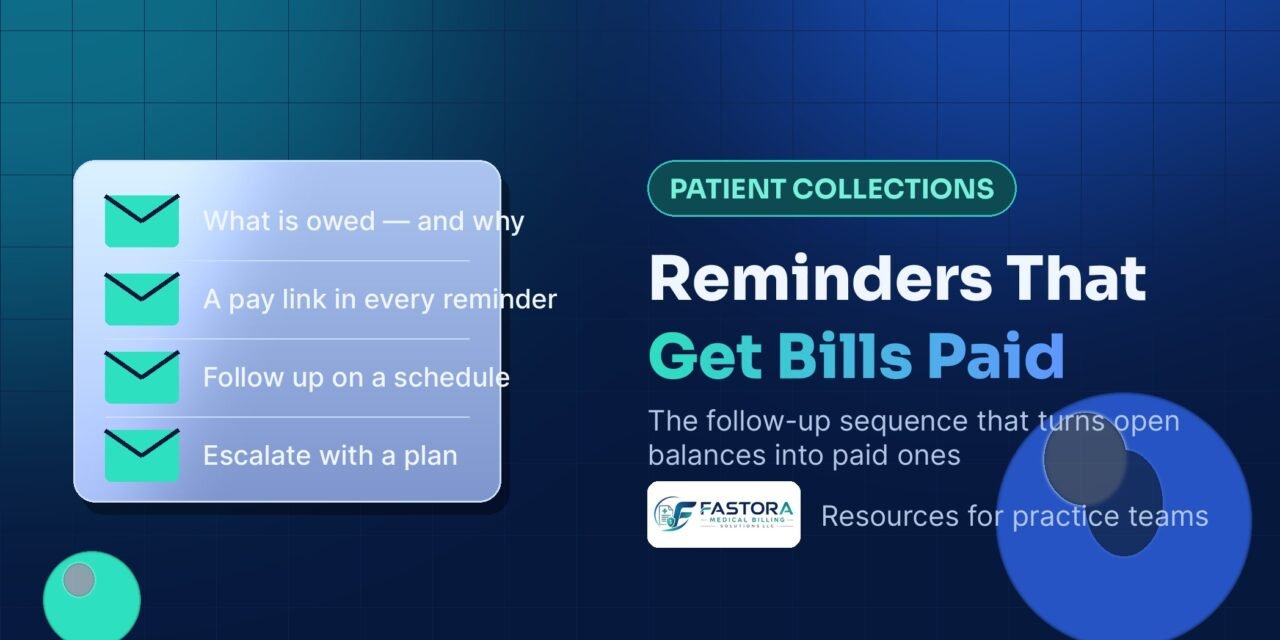
Every reminder should answer four questions in the first few seconds:
- How much is owed. The exact amount, in plain type, unmissable.
- What it is for. The visit date and service in ordinary language, plus what insurance already covered. “Office visit, October 3 — insurance paid $120, your share is $60” beats a line of billing codes.
- How to pay. The easiest path right there: an online payment link, a phone number, the portal if you use one. Never make someone go looking for how to pay.
- Who to call with questions. A name or department and a number. Patients who are confused but cannot reach anyone either ignore the bill or pay the wrong amount.
Read your reminder as a patient who has never seen your billing system. Send only what survives that read.
A reminder cadence that collects without annoying anyone
Consistency matters more than volume. Three polite reminders at predictable intervals get taken seriously. Nothing for two months followed by a threatening letter makes the practice look disorganized — and invites a dispute.
- First, the statement. The sequence begins when the balance is known and the first statement goes out. Nothing else should reach the patient until the statement has had a chance to arrive.
- A gentle nudge. After a few weeks with no payment, send the first reminder — email or text — with a friendly tone: the amount, what it covers, the payment link. Frame it as a courtesy.
- A firmer follow-up. If the next interval passes, send a second reminder that is direct but still respectful, and add payment-plan language for larger balances: “If the full amount is difficult right now, we can set up a monthly plan.”
- A personal call. After a couple of unanswered written reminders, a real person should call. Many balances resolve here — not because the patient was hiding, but because the call answers the question the reminders could not.
- A decision. If reminders and a call produce nothing, it is time for a deliberate escalation decision — not another identical reminder. The same message a fifth time trains the patient to ignore you.
Write your intervals down and apply them to every balance, every time. And the moment payment posts, the reminders must stop — a reminder for a bill paid last week destroys trust, so make sure whoever processes payments can halt the sequence the same day.
Tone that collects without damaging the relationship
The patient who owes you $60 is also the patient who decides where their family gets care next year. Firm-but-kind is the tone that collects:
- Instead of “Your account is past due. Remit payment immediately” — try “A balance of $60 from your October 3 visit is still open. You can pay online here in under a minute — or call us if anything looks wrong.”
- Instead of “Failure to pay will result in collections action” — try “We want to help you get this resolved. If the full amount is a stretch right now, we offer monthly payment plans — just reply or call.”
Say what the bill is for, not just the amount. Always offer the next step (link, phone, plan) rather than just the demand. Save anything that sounds like a consequence for the stage where one is genuinely next. Early threats do not speed up payment — they start arguments.
Make payment effortless from the reminder
The reminder with a payment link always outperforms the one without. Patients pay from their phones, in minutes, at hours when your office is closed.
- Link every digital reminder to payment. Email and text reminders should open directly to a secure payment page. Every extra screen between the reminder and the pay button costs you collections.
- Offer more than one way to pay. Online, by phone, in person, by mail. Patients have habits; the practice that accepts all of them collects more.
- Offer payment plans before patients ask. One line — what the monthly amount would be, who to call — turns balances that would never be paid in full into balances paid over time.
- Use card-on-file where you can. With authorization, small residual balances settle automatically once the patient portion is known, with a receipt sent the same day. No reminder needed at all.
When reminders stop working: how to escalate
A reminder workflow needs a defined end. Without one, staff either give up after the second reminder or keep sending identical ones forever.
- The personal call is the real escalation. Assign it to someone who can see the full account history and answer questions. Many “uncollectible” balances turn out to be a wrong phone number, a misunderstood deductible, or an insurance issue the patient never reported.
- Document every attempt. Date, channel, what was said, what was promised. The record makes later decisions defensible — and keeps staff from calling patients who already responded.
- Put the final-notice policy in writing. After how many reminders and what time period is a balance seriously delinquent, and what happens next? Staff should not improvise the hard calls, and patients should not be surprised by them.
- Outside collections are a last resort. They recover a fraction of balances, cost a share of what is recovered, and end the patient relationship. Practices that want the whole sequence — reminders, calls, escalation — run consistently can lean on professional patient billing and collections support; before any referral, ask whether a plan, a hardship review, or one more personal call was really exhausted.
How to know the workflow is working
A reminder workflow is not working just because reminders are going out. Watch three measures:
- Days from statement to payment. If the typical lag is shrinking, the workflow is pulling payments forward.
- Share of balances paid after the first or second reminder. A healthy workflow resolves most balances early; if everything needs a call, the reminders themselves are the problem.
- Aging of patient receivables. Balances should be moving younger, not older. When the 60- and 90-day buckets stop growing, the cadence is doing its job.
Review these the way you review your other medical billing KPIs — a small monthly look at the trends keeps the workflow honest.
Frequently asked questions
How often should we send payment reminders?
Consistency beats frequency: statement, a reminder after a few weeks, a firmer follow-up, then a personal call. Same schedule for every balance, and stop the sequence the moment payment posts.
Are text message reminders acceptable for patient billing?
Yes, and patients increasingly expect them. Keep texts brief and secure — amount, payment link, contact number — without clinical detail, and make sure you have proper consent before texting about balances.
Should the reminder include a way to pay?
Always. Every digital reminder needs a direct payment link; every mailed reminder needs the payment phone number and website. A reminder without a payment path is a notification of debt; with one, it is a collections tool.
What if the patient says they never received the first bill?
Resend it immediately, confirm the contact details on file, and log the re-send — then restart the sequence from that point. Many “disputed” balances resolve when the bill simply reaches the right person in readable form.
When should we call instead of sending another reminder?
After a couple of unanswered written reminders. A call answers the question the messages could not and shows the practice is paying attention. Assign it to someone who can see the full account history.
Should we offer payment plans in reminders?
Yes, for larger balances. One line — the monthly amount, who to call — turns balances that would never be paid in full into balances paid over time. Offering the plan earlier collects more than repeating the demand louder.
The short version
Balances get paid when the process respects the patient’s time: a bill that is easy to understand, reminders on a predictable schedule in a courteous tone, a payment link in every message, and a plan for anyone who needs one. Most practices do not have a collections problem — they have a follow-up problem, and that is one of the cheapest problems a practice can fix.
If patient balances are aging on your books and reminders go out whenever someone remembers, start with an outside look at the whole workflow. Fastora offers a free billing assessment that reviews how your practice bills, follows up, and collects — so the revenue you have already earned actually reaches your account.