
A patient arrives for their appointment. Your team provides the care, submits the claim — and weeks later it comes back denied because the coverage had lapsed, the visit needed an authorization nobody requested, or the patient owed a deductible that was never collected at check-in.
Almost every one of those denials was preventable before the patient ever walked in.
Eligibility and benefits verification is the front end of your revenue cycle. Done well, it protects the clinical work your team already did. Done poorly — or skipped on a busy day — it turns into denials, write-offs, awkward patient conversations, and A/R that grows for reasons that have nothing to do with the quality of care.
This guide gives you a practical insurance eligibility verification checklist your front-desk or billing team can run before every appointment, plus what to do when the check turns up something unexpected.
Why eligibility verification matters more than it used to
Coverage is not static. Patients change jobs, plans reset in January, deductibles climb, and payers quietly update authorization rules. A patient who was “covered” three months ago may not be covered for today’s visit type, today’s provider, or today’s procedure.
Verifying eligibility before the appointment catches:
- Inactive or terminated coverage — before the service is rendered, not after the denial
- Deductible and out-of-pocket status — so balances can be collected or explained up front
- Wrong plan or wrong payer — the card in the chart is not always the plan that is active
- Authorization requirements — flagged while there is still time to request them
- Out-of-network status — so the patient hears it from you, not from a denied claim
Front-end errors are among the most common causes of claim denials, and they are the most avoidable kind. A few minutes of verification protects hours of downstream rework.
When to run the check
The short answer: before the appointment, every time — not just for new patients.
A workable cadence for most practices:
- At scheduling — capture accurate insurance information and run an initial check.
- 48–72 hours before the visit — run the full checklist below; this leaves time to fix problems and request authorizations.
- The day before (or morning of) — re-run a real-time eligibility check for high-value visits, new patients, and anyone whose coverage recently changed.
The 48–72 hour window is the one that matters most. It is close enough that coverage is unlikely to change, and far enough out that your team can still act on what it finds.
The eligibility verification checklist
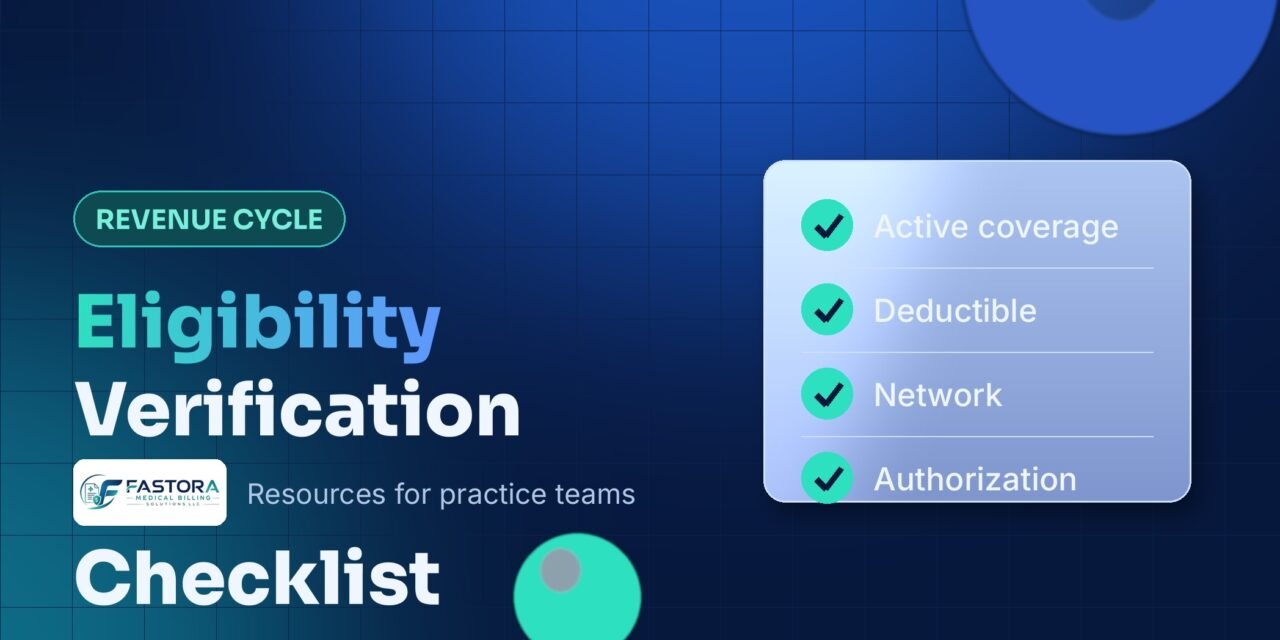
Work through these eight items for every patient, every visit. Document the result in the chart — a check you cannot show later is a check that will be questioned later.
1. Confirm active coverage for the date of service
Verify the policy is active on the actual date of the appointment, not just “active today.” Coverage that terminated at the end of last month will not pay for this month’s visit.
2. Confirm the plan type and payer
Match the patient’s card to the plan that is actually in force: HMO, PPO, EPO, Medicare Advantage, Medicaid managed care, and so on. Plan type drives referral rules, network rules, and authorization rules — getting it wrong poisons every step after it.
3. Review deductible and out-of-pocket status
Note whether the individual and family deductibles are met, and how much out-of-pocket remains. If a large deductible is unmet, the practice can set expectations and collect per its financial policy at check-in instead of chasing the balance for months afterward.
4. Check copay and coinsurance for this visit type
Benefit amounts differ by service type — a primary care copay is not a specialist copay, and therapy, imaging, and procedures often carry coinsurance instead of a flat copay. Pull the amount for the actual visit being scheduled.
5. Confirm in-network status for the rendering provider
Eligibility is not just about the patient; it is about the pairing of patient plan and rendering provider. Confirm the specific provider (and, where it matters, the location) is in network for that plan on that date.
6. Flag authorization and referral requirements
Note whether the visit, procedure, or diagnosis requires prior authorization or a referral, and start the request immediately if it does. Services rendered before an authorization is approved are services you may never be paid for.
If authorizations regularly pile up, this is the handoff point to a dedicated workflow — see how Fastora handles prior authorization before visits, not after denials.
7. Check visit limits and benefit maximums
For therapy, behavioral health, and other visit-limited benefits, confirm how many visits are authorized or remaining. Running past a benefit limit without telling the patient creates a balance nobody expected.
8. Note coordination of benefits
If the patient has more than one policy, determine which payer is primary. Submitting to the wrong payer first guarantees a denial and restarts the clock.
Document everything: date and time of the check, who ran it, the confirmation or reference number, and the benefit details quoted. Write it where the biller will find it when — not if — a payer pushes back.
A short worked example
A therapy practice schedules a returning patient for Tuesday. On Friday — inside the 48–72 hour window — staff run the checklist and find the patient’s plan changed in January: the deductible reset, it is unmet, and the visit now carries coinsurance instead of the old flat copay. The provider is still in network, and no authorization is needed.
Because the check happened on Friday, the practice can call the patient before Tuesday: explain the new cost share, collect appropriately at check-in per policy, and submit a claim that matches the actual benefits. Without that check, the practice would have billed the old copay, under-collected by the full coinsurance amount, and spent weeks working the balance — or writing it off.
Same visit. Same care. Completely different financial outcome, decided three days earlier at the front desk.
What to do when the check finds a problem
A problem found before the visit is a solvable problem:
- Coverage inactive — contact the patient for updated insurance before the appointment; reschedule non-urgent care if needed.
- Authorization required — start it now; do not let the appointment outrun the approval.
- Out of network — tell the patient plainly, with their options, before any billable service happens.
- Large unmet deductible — set the expectation early and follow your financial policy consistently.
When front-end misses still slip through, the pattern usually shows up downstream — our guide on how to reduce claim denials walks through reading those denials by root cause.
Keeping the process consistent
The checklist only works if it runs the same way on a calm Tuesday and a chaotic Monday. A few habits keep it reliable:
- Use one written checklist, not individual memory. If it lives in people’s heads, it leaves when they do.
- Verify at scheduling AND before the visit. One check is a snapshot; two checks catch changes.
- Audit a small sample weekly. Pull a few charts and confirm the verification note is complete. What gets checked gets done.
- Close the loop with billing. When a denial traces back to a front-end miss, tell the front desk what was missed so the checklist grows teeth.
This front-end discipline is exactly what Fastora’s eligibility verification service is built around — checks run before appointments, so claims go out with a clean-claim mindset.
Conclusion
Eligibility verification is unglamorous work, and it decides a surprising share of whether your claims get paid. An active-coverage check, deductible and copay review, network confirmation, and authorization flag — run 48–72 hours before every appointment and written down where billing can find them — prevents the most avoidable denials in your revenue cycle.
If your team is spending more time fixing front-end denials than preventing them, it may be worth a fresh look at how the workflow is staffed. Fastora’s free billing assessment reviews your current process — including where eligibility and authorization issues are turning into denials — and shows you what we would tighten first. No obligation; just a clear picture of where the revenue is leaking.
Frequently asked questions
How early should eligibility be verified before an appointment?
At scheduling, and again 48–72 hours before the visit. The pre-visit check is the critical one: close enough that coverage is current, early enough to fix problems or request authorizations.
What is the difference between eligibility verification and prior authorization?
Eligibility verification confirms the patient has active coverage and what the benefits are. Prior authorization is separate payer approval for a specific service. Verification tells you whether an authorization is required; it does not replace requesting one.
Should established patients be re-verified, or only new patients?
Every patient, every visit. Coverage changes with jobs, plan years, and payer rules — a long-time patient’s benefits can change more often than a new patient’s.
What if a patient’s coverage shows inactive but they insist they are covered?
Ask for the current insurance card or the new plan’s details and re-run the check against that information. If it still shows inactive, contact the patient before the appointment so the visit is not rendered against coverage that will not pay.
What should we document from each eligibility check?
The date and time, who ran it, the payer’s confirmation or reference number, and the benefit details quoted (deductible status, copay/coinsurance, authorization requirements). If a claim is later disputed, that note is your evidence.
2 comments