Physical therapy practices bill a small set of CPT codes over and over — but the billing rules behind those codes are some of the trickiest in outpatient care. Timed codes, untimed codes, the 8-minute rule, evaluation tiers, and modifiers like GP and KX all sit between your documentation and a paid claim. Get any piece wrong and the claim comes back denied, downcoded, or paid at a fraction of what the visit was worth.
This guide walks through the CPT codes physical therapy practices bill most often, what each one covers, and how to bill them so claims go out clean.
The codes a PT practice bills every day
Physical therapy CPT codes fall into three buckets: evaluations, therapeutic procedures, and modalities. The single most important distinction in PT billing is whether a code is timed (billed in units based on minutes of one-on-one time) or untimed (billed once per session regardless of duration).
Evaluation codes: 97161, 97162, 97163
Every new PT patient starts with an evaluation, and Medicare replaced the old flat evaluation code with three tiered codes based on complexity:
- 97161 — PT evaluation, low complexity
- 97162 — PT evaluation, moderate complexity
- 97163 — PT evaluation, high complexity
The tier is determined by the documented history, the examination, and the clinical decision-making involved — not by how long the visit lasted. Choosing the right tier matters twice: under-coding the evaluation leaves money on the table on every new patient, and over-coding invites payer scrutiny. If your practice defaults to the same tier for every evaluation, that pattern is worth a hard look.
- 97164 — PT re-evaluation. Billed when an established patient's condition changes significantly or isn't responding to the plan as expected. It needs its own documentation justifying the re-evaluation — it is not a progress note.
Many payers require prior authorization for the first PT visit, so the evaluation often triggers the auth cycle. Confirming benefits before that first appointment prevents the most common front-end PT denial: a patient treated before authorization was in place.
Timed therapeutic codes: 97110, 97112, 97116, 97140, 97530
These are the workhorse codes of outpatient PT. Each is billed in 15-minute units based on direct, one-on-one time with the patient:
- 97110 — Therapeutic exercises. Strength, endurance, range of motion, and flexibility work: resistance exercises, stretching programs, functional strengthening. This is the most frequently billed code in most PT practices.
- 97112 — Neuromuscular re-education. Balance, coordination, proprioception, motor control, and postural work — for example, gait drills, balance training, or movement-pattern retraining after a stroke or joint replacement.
- 97116 — Gait training. Includes stair climbing. Document the gait deviations addressed and the surfaces or assistive devices involved.
- 97140 — Manual therapy. Joint mobilization and manipulation, manual traction, connective-tissue massage, and soft-tissue techniques performed with hands. Document the technique, the body region, and the clinical rationale — "manual therapy" alone doesn't support the code.
- 97530 — Therapeutic activities. Dynamic, functional activities that improve performance in real tasks — think lifting, carrying, reaching, or simulated work and home activities. The documentation must show the functional task, the patient's response, and how the activity connects to the goals in the plan of care. This is the code auditors examine most closely: exercises done on equipment are 97110; only functional, task-based work supports 97530.
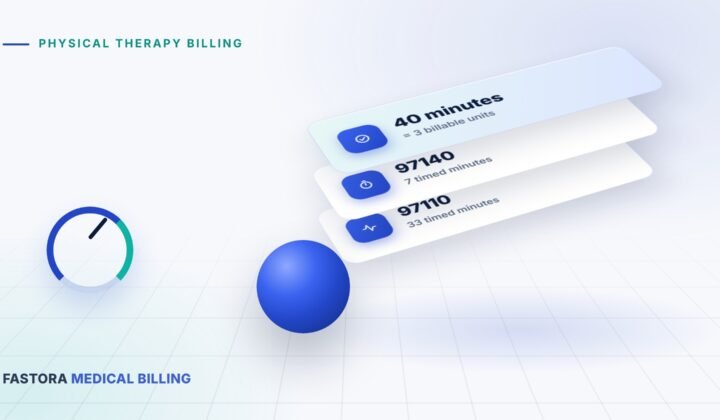
How timed units work. Medicare's 8-minute rule sets the unit math: a timed code needs at least 8 minutes to bill one unit, 23 minutes for two units, 38 for three, and so on. The minutes from different timed codes are combined to figure out the total billable units, and each code must have its own documented intervention and time. A common mistake is counting the same minutes twice — for example, documenting 30 minutes of "therapeutic exercise" and also billing 97140 for manual therapy that happened within those same 30 minutes. One visit, one set of minutes, one unit count.
Untimed and service-based codes
Not every PT code runs on the clock:
- 97150 — Therapeutic procedure in a group setting. When a therapist works with two or more patients at the same time. Billed as one unit regardless of duration, and the note should document the purpose of the group and the skilled activity provided.
- 97035 — Ultrasound therapy; 97012 — Mechanical traction; 97014 — Electrical stimulation (unattended); 97032 — Electrical stimulation (manual).
Note that some payers treat certain modalities — hot or cold pack application (97010), for example — as bundled or non-billable. Check payer policies before routine modality billing; billing modalities every visit without a documented clinical reason is one of the fastest ways to attract payer attention.
Modifiers that make or break PT claims
Two modifiers are part of almost every PT claim, and missing or misusing them is a top cause of PT denials:
- GP modifier — marks the service line as physical therapy under an outpatient therapy plan of care. Medicare requires it on every PT service line; most commercial payers follow suit.
- KX modifier — confirms medical necessity for therapy services above Medicare's annual therapy threshold. When a patient's PT (and speech, combined) spending passes the threshold for the year, claims without the KX modifier are rejected automatically. Missing it is a completely avoidable denial.
- 59 modifier — distinguishes separate, distinct procedures when a modality is billed alongside therapeutic procedures on the same day — but only when the documentation genuinely supports two separate services.
Modifier discipline separates PT billing that pays on first pass from billing that lives in the denial queue. If you're seeing rejections you can't explain, modifier placement is the first place to look.
What documentation has to support
Every code on a PT claim needs a note behind it that answers three questions: what was done, why it was skilled, and — for timed codes — how long it took. A note that reads like exercise supervision rather than skilled care is the note that gets denied.
Build each note around the plan of care: the measurable functional goals, the intervention delivered, the patient's response, and the time. Practices that align each code with its note before the claim goes out see measurably fewer coding denials — and our guide to PT claim denials walks through the common denial causes and how to prevent them.
Three PT billing mistakes that cost real money
1. Defaulting to one evaluation tier. Practices that bill 97161 for every evaluation — or 97163 for every evaluation — are either underbilling systematically or overbilling systematically. Neither pattern survives an audit well, and the underbilling version quietly costs money on every new patient.
2. 97530 without a functional story. Billing therapeutic activities for what the documentation describes as exercises on equipment is the most audited PT coding pattern there is. If the note can't describe the functional task and tie it to a goal in the plan of care, the code belongs as 97110 or 97112.
3. Losing track of the therapy threshold. The annual therapy threshold creeps up on practices, and the first sign is usually a batch of Medicare rejections. Watch cumulative PT spending per beneficiary through the year so the KX modifier is on the claim before the threshold, not after the rejection.
FAQs
Which CPT code is billed most often in physical therapy? CPT 97110 (therapeutic exercises) is typically the highest-volume code in outpatient PT practices, followed by 97140 (manual therapy) and 97530 (therapeutic activities). Most PT claims include two or three timed codes per visit.
What is the difference between CPT 97110 and 97530? CPT 97110 covers therapeutic exercises for strength, endurance, range of motion, and flexibility. CPT 97530 covers dynamic, functional activities that improve performance in real-world tasks. The difference is functional context: 97530 must tie the activity to the patient's goals in the plan of care.
How does the 8-minute rule work for physical therapy billing? Medicare's 8-minute rule sets how timed PT codes convert to billable units: 8–22 minutes supports one unit, 23–37 minutes supports two units, 38–52 minutes supports three, and so on. Minutes from all timed codes in a visit are combined for the total unit count, and the same minutes can't be counted twice.
What is the difference between CPT 97161, 97162, and 97163? These are PT evaluation tiers by complexity: 97161 (low), 97162 (moderate), 97163 (high). The tier is set by the documented history, examination, and clinical decision-making — not the visit length. Selecting the right tier on every evaluation matters for both revenue and audit risk.
When do you add the KX modifier to physical therapy claims? The KX modifier is added to Medicare outpatient therapy claims once a beneficiary's therapy spending exceeds the annual therapy threshold for the year (PT and speech therapy share one threshold). It certifies that the services remain medically necessary. Claims above the threshold without the KX modifier are automatically rejected.
Can a physical therapy practice bill 97110 and 97530 on the same visit? Yes, when the visit genuinely includes both therapeutic exercises and functional activities, with separate documented minutes and distinct interventions for each. The note must show what was 97110 work and what was 97530 work — the same minutes can't support both codes.
The bottom line
Physical therapy billing runs on a small code set with demanding rules. Mastering the evaluation tiers, the timed-code unit math, and the GP/KX modifier basics covers most of what keeps PT claims paid — and the rest is documentation that ties every code to the plan of care.
If your PT claims are coming back denied or underpaid and the coding might be part of the problem, a free billing assessment can show exactly where revenue is leaking — from evaluation tiers to unit counting to modifiers — and what to fix first. For practices that would rather hand the whole cycle over, our physical therapy billing services cover coding, claims submission, and denial follow-up.