Psychiatry Billing
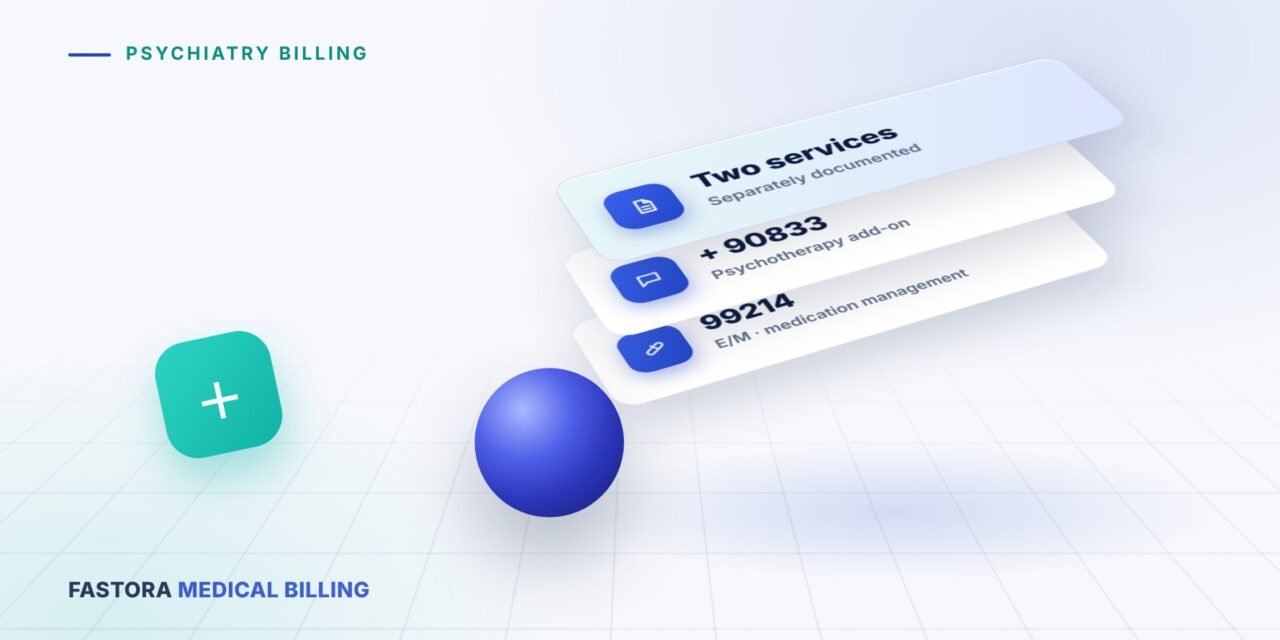
Psychiatric visits often combine two services: medical management, such as reviewing symptoms, side effects and prescriptions, and psychotherapy. CPT lets prescribers bill both in the same visit, but only in a specific way. Getting the combination wrong is one of the most common sources of underpayment and denials in psychiatry billing.
This guide explains how psychiatrists, psychiatric nurse practitioners and physician assistants code a visit that includes an evaluation and management (E/M) service plus psychotherapy, how to select the E/M level, how much psychotherapy time each add-on code needs, and what documentation keeps the two services clearly separate.
Key takeaways
- Medication management only: bill the E/M alone. With 16 or more minutes of psychotherapy: E/M plus 90833, 90836 or 90838.
- Psychotherapy minutes never count toward E/M time, so most combined visits are leveled by medical decision making.
- Document the E/M and the psychotherapy as two separately identifiable services.
In this guide
- 01Three ways to bill a psychiatric follow-up visit
- 02The psychotherapy add-on codes
- 03How to choose the E/M level when psychotherapy is added
- 04Keeping the two services separately identifiable
- 05A worked example
- 06Initial visits: 90792 or a new patient E/M?
- 07Interactive complexity with E/M visits
- 08Psychiatric nurse practitioners and physician assistants
- 09Common psychiatry billing errors
- 10Frequently asked questions
Three ways to bill a psychiatric follow-up visit
For an established patient, a prescriber usually lands in one of three billing scenarios:
| What happened in the visit | What to bill |
|---|---|
| Medication management only (symptom review, side effects, prescription decisions) | E/M code alone (99212 to 99215) |
| Medication management plus at least 16 minutes of separate psychotherapy | E/M code plus psychotherapy add-on (90833, 90836 or 90838) |
| Psychotherapy only, with no medical E/M work | Standalone psychotherapy code (90832, 90834 or 90837) |
A prescriber should not bill a standalone psychotherapy code (90832, 90834 or 90837) together with an E/M code for the same visit. When both services happen, the psychotherapy is reported with the add-on code.
The psychotherapy add-on codes
The add-on codes follow the same time brackets as the standalone psychotherapy codes, but they can only be reported with an E/M service on the same day.
| Add-on code | Descriptor | Psychotherapy time required |
|---|---|---|
| 90833 | Psychotherapy, 30 minutes, with patient, with E/M | 16 to 37 minutes |
| 90836 | Psychotherapy, 45 minutes, with patient, with E/M | 38 to 52 minutes |
| 90838 | Psychotherapy, 60 minutes, with patient, with E/M | 53 minutes or more |
Psychotherapy under 16 minutes is not separately reportable. In that case, bill the E/M alone and let the E/M level reflect the work performed.
How to choose the E/M level when psychotherapy is added
Office and outpatient E/M levels can be selected either by medical decision making (MDM) or by total time on the date of service. When psychotherapy is also billed, the time spent in psychotherapy cannot be counted toward the E/M. That makes MDM the practical choice for most combined visits.
MDM is based on three elements, and two of the three must be met for a given level:
- Number and complexity of problems addressed. A stable chronic condition is lower complexity; a chronic condition with exacerbation or side effects of treatment is higher.
- Amount and complexity of data reviewed and analyzed. Ordering or reviewing labs, reviewing outside records, or obtaining history from an independent historian such as a parent.
- Risk of complications from patient management. Prescription drug management is generally considered moderate risk. Drug therapy that requires intensive monitoring for toxicity, or decisions about hospitalization, can support high risk.
Because prescription drug management supports moderate risk, many medication management visits for a chronic psychiatric condition reach 99214 when the problem element also supports it. That is not automatic; the note has to show the problems addressed and the management decisions made.
If you select the E/M by time
If you choose the E/M level by time, count only the time spent on E/M activities, such as reviewing records, examining, counseling about medication and documenting the E/M portion. Exclude every minute of psychotherapy. Many practices find this harder to document cleanly than MDM.
Keeping the two services separately identifiable
Payers expect the note to show two distinct services. A reviewer should be able to see where the E/M ends and the psychotherapy begins.
- E/M section: interval history, symptom and side-effect review, mental status examination, assessment of each problem, and medication decisions (start, stop, adjust, continue, with rationale).
- Psychotherapy section: the psychotherapy time on its own line, the modality and interventions (for example, supportive therapy, CBT techniques, motivational interviewing), the focus of the session, and the patient’s response.
- Time: record psychotherapy minutes explicitly. “Psychotherapy 25 minutes” is clear; “total visit 45 minutes” without a split is not.
Medication education that is part of the E/M does not count as psychotherapy. Psychotherapy should use therapeutic techniques aimed at changing thoughts, feelings or behaviors.
A worked example
An established patient with major depressive disorder reports partial improvement and new insomnia. The psychiatrist reviews symptoms and side effects, adjusts the dose of one medication, and orders no labs. Then the psychiatrist spends 28 minutes on cognitive behavioral techniques for sleep and negative thinking.
- Problems: one chronic illness with side effects of treatment (moderate).
- Risk: prescription drug management (moderate).
- E/M level by MDM: 99214, if the documentation supports both elements.
- Psychotherapy: 28 minutes, which falls in the 16 to 37 minute bracket, so 90833.
- Claim: 99214 plus 90833, both linked to the depression diagnosis.
If the same visit had included 40 minutes of psychotherapy, the add-on would be 90836. If it had included 12 minutes, the psychiatrist would bill 99214 alone.
Initial visits: 90792 or a new patient E/M?
For a first visit, prescribers can bill a psychiatric diagnostic evaluation with medical services (90792) or a new patient E/M code (99202 to 99205). They are alternatives, not a pair: do not bill both on the same day. Some practices choose based on payer reimbursement and frequency limits; others use 90792 when the visit is a full diagnostic assessment and a new patient E/M when it is a medical visit for a referred patient with an established diagnosis. Whichever is used, the documentation must support it.
A psychotherapy add-on can be reported with a new patient E/M code if separately identifiable psychotherapy is provided. It is not reported with 90792.
Interactive complexity with E/M visits
Interactive complexity (90785) can be added when a psychotherapy add-on code is billed and a qualifying communication factor is documented, such as a caregiver whose behavior interferes with implementing the treatment plan. It cannot be reported with an E/M code alone, so a medication management visit without psychotherapy does not qualify.
Psychiatric nurse practitioners and physician assistants
Psychiatric mental health nurse practitioners (PMHNPs) and physician assistants use the same E/M and add-on codes as psychiatrists. How the claim is billed affects payment:
- Under their own NPI: Medicare generally pays nurse practitioners and physician assistants 85% of the physician fee schedule amount. Commercial plans set their own rates, which may or may not be reduced.
- Incident-to billing under a supervising physician: Medicare allows this only in limited circumstances, generally for established patients with an existing physician plan of care, under the required level of physician supervision, in the office setting. New problems and new patients do not qualify. Supervision requirements have changed in recent years, so confirm current CMS policy before relying on incident-to billing.
Commercial payers vary widely on incident-to rules, and many do not recognize it. Bill under the rendering clinician’s NPI unless the payer’s policy clearly allows otherwise.
Common psychiatry billing errors
| Error | Result | Fix |
|---|---|---|
| E/M plus 90834 instead of E/M plus 90836 | Psychotherapy line denied | Use add-on codes with E/M |
| Psychotherapy minutes counted toward E/M time | E/M overcoded; audit risk | Select E/M by MDM, or exclude psychotherapy minutes |
| No separate psychotherapy time in the note | Add-on denied on review | Document psychotherapy minutes on their own line |
| 90792 and 99204 on the same date | One line denied | Choose one |
| 90785 with E/M alone | Add-on denied | Only with a psychotherapy code |
| Every visit billed at the same E/M level | Pattern flagged by payers | Level each visit on its own MDM |
Frequently asked questions
Do I need modifier 25 when billing E/M with 90833?
Generally not, because the psychotherapy add-on codes are designed to be reported with an E/M. A few commercial payers still ask for it, so follow each payer’s written policy.
Can a psychiatrist bill 90837 instead of 99214 plus 90838?
Only if no E/M service was performed. If the psychiatrist addressed medications or other medical issues, the visit should be billed as an E/M plus the add-on code.
Can the E/M be billed by time when psychotherapy is also billed?
Yes, but only E/M time counts toward the E/M level, and psychotherapy minutes must be excluded. Most practices find MDM simpler and easier to defend for combined visits.
Is medication management a separate CPT code?
Not for psychiatrists and psychiatric NPs. Medication management is part of the E/M service. An add-on code for pharmacologic management with psychotherapy exists (90863) for certain non-physician prescribers in states that allow it, but Medicare does not pay it and many payers do not cover it.
What if the patient’s visit is by telehealth?
The same codes apply. The place of service and any telehealth modifiers change according to the payer’s rules. See our guide to telehealth billing for mental health.
Work with Fastora
Get paid for both services you provide
Psychiatric visits that combine medication management and psychotherapy are worth more when billed correctly, and riskier when billed carelessly. The rules come down to choosing the right code pair, leveling the E/M on its own merits, and documenting psychotherapy time separately.
Fastora Medical Billing Solutions supports psychiatric practices with coding review, claim submission, denial management and A/R follow-up. For more on how we work with prescribers, see our psychiatry billing services, read our reference on mental health CPT codes, or contact Fastora.