
Denial Management
A denied therapy claim is rarely a one-time event. The same root cause, such as a missing authorization, a carve-out payer or a time-based coding error, tends to repeat across dozens of claims before anyone notices. By then, some of those claims may be past the payer’s appeal or timely filing window.
This guide explains why mental health claims get denied, how to read the denial codes on your remittances, and what a prevention workflow looks like for outpatient behavioral health practices. It applies to therapists, counselors, social workers, psychologists and psychiatric practices billing commercial plans, Medicare and Medicaid.
Key takeaways
- Rejections, denials and pended claims need different fixes, so track them separately.
- Carve-out payers, authorizations and credentialing cause denials before the session even happens.
- Group denials by reason code every week so one fix stops a whole pattern.
In this guide
- 01Denied, rejected and pending: know which problem you have
- 02The most common reasons mental health claims are denied
- 03Reading the denial codes on your remittance
- 04Corrected claim, reconsideration or appeal?
- 05Medical necessity documentation that holds up
- 06A denial prevention workflow for behavioral health practices
- 07Frequently asked questions
Denied, rejected and pending: know which problem you have
Before fixing a claim, confirm what actually happened to it:
- Rejected: the claim failed a format or data check at the clearinghouse or payer front end and was never processed. Fix the data and resubmit; there is no appeal.
- Denied: the payer processed the claim and decided not to pay all or part of it. You will see a claim adjustment reason code (CARC) on the ERA or EOB. The fix may be a corrected claim, a reconsideration or a formal appeal.
- Pending: the payer is holding the claim, often waiting for information such as coordination of benefits from the patient or medical records from you.
Treating a rejection like a denial, or the reverse, wastes days. Track them separately.
The most common reasons mental health claims are denied
1. Eligibility and coverage problems
The client’s plan terminated, changed, or does not include the service. A frequent version in behavioral health: the client changed jobs between sessions and nobody rechecked eligibility. Another is billing a plan that does not cover a particular service, such as family therapy without the identified patient present.
2. Billing the wrong payer for a carved-out benefit
Many health plans hand mental health benefits to a separate managed behavioral health organization. If the claim goes to the medical plan named on the card instead of the behavioral health administrator, it is denied or bounced. The fix is to find out who administers mental health benefits during verification, not after the first denial.
3. Missing, expired or exceeded authorization
When a plan requires authorization, claims are denied if there is no authorization on file, if the sessions fall outside the approved dates, or if the approved number of sessions has been used. Psychological testing, intensive outpatient programs and some Medicaid plans are the most common places this occurs.
4. Provider credentialing and enrollment issues
The rendering clinician is not credentialed with the plan, the effective date has not started yet, the clinician has not been linked to the group’s contract, or a CAQH attestation has lapsed. For newer clinicians, the most expensive version is seeing clients for weeks before credentialing is complete.
5. Time-based coding errors
Psychotherapy codes depend on documented time: 90832 for 16 to 37 minutes, 90834 for 38 to 52 minutes and 90837 for 53 minutes or more. Denials and post-payment recoveries follow when the code does not match the documented time, when the note has no time at all, or when 90837 is used routinely without a clinical reason.
6. Code combinations that cannot be billed together
Examples include a diagnostic evaluation (90791) and psychotherapy on the same day by the same provider, a standalone psychotherapy code with an E/M code instead of the add-on code, or interactive complexity (90785) with crisis psychotherapy. These are caught by correct coding edits and denied as bundled or invalid combinations.
7. Diagnosis that does not support medical necessity
A diagnosis code the payer does not consider covered for psychotherapy, a Z code as the primary diagnosis, or a diagnosis on the claim that does not match the treatment plan can all produce a medical necessity denial. Unspecified codes are not always denied, but they invite questions when the documentation supports a more specific diagnosis.
8. Telehealth place of service and modifier errors
Telehealth rules differ between Medicare, Medicaid and commercial plans. Using place of service 11 for a video session, leaving off a modifier a commercial plan requires, or billing audio-only without the payer’s required indicator can all lead to denials or incorrect payment.
9. Coordination of benefits
When a client has two plans, the primary must pay first. If the payer’s records show another primary coverage, or the client has not updated their coordination of benefits information, the claim is denied until the order is resolved.
10. Timely filing and duplicates
Claims submitted after the payer’s filing limit are denied and are very hard to overturn. Duplicate denials happen when a claim is resubmitted as new instead of as a corrected claim, or when it is sent again while the original is still processing.
Reading the denial codes on your remittance
Claim adjustment reason codes (CARCs) tell you why a payer reduced or denied a claim, and remittance advice remark codes (RARCs) add detail. The group code in front of a CARC matters: “CO” (contractual obligation) usually means you cannot bill the client, while “PR” (patient responsibility) means the amount can be billed to the client.
| Code | General meaning | Typical cause in a therapy practice | First step |
|---|---|---|---|
| CO-16 | Claim lacks information or has billing errors | Missing NPI, authorization number or other required field | Check the RARC, correct and resubmit |
| CO-27 | Expenses incurred after coverage terminated | Client’s plan ended before the session | Recheck eligibility; bill new coverage or client |
| CO-22 | Care may be covered by another payer (coordination of benefits) | Another plan is primary | Confirm primary coverage with client and payer |
| CO-109 | Not covered by this payer; send to the correct payer | Behavioral health benefit is carved out | Identify the behavioral health administrator |
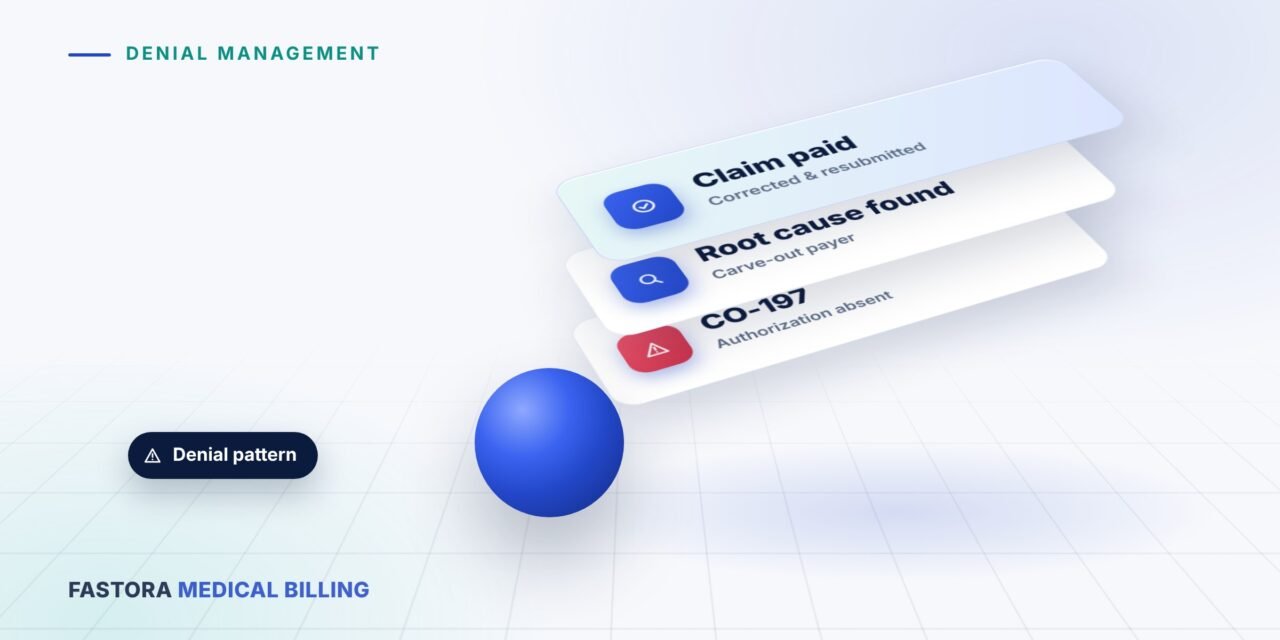
| CO-197 | Precertification or authorization absent | No authorization on file for the date of service | Check retro-authorization options; appeal if obtained |
| CO-B7 | Provider not certified or eligible to be paid for this service on this date | Credentialing not complete or provider not linked | Confirm effective date and enrollment |
| CO-11 | Diagnosis inconsistent with the procedure | Diagnosis not covered for psychotherapy | Review documentation and diagnosis coding |
| CO-50 | Not deemed medically necessary by the payer | Documentation does not support the service | Review records; appeal with supporting notes |
| CO-97 | Service included in another service already paid | Code combination bundled | Review correct coding rules for the pair |
| CO-18 | Exact duplicate claim or service | Resubmitted as new instead of corrected | Check original claim status |
| CO-29 | Time limit for filing has expired | Claim submitted too late | Appeal only with proof of timely submission |
CARC and RARC definitions are maintained nationally, but each payer can apply them slightly differently. Use the RARC and the payer’s portal notes, not just the CARC, to decide on the fix.
Corrected claim, reconsideration or appeal?
- Corrected claim: use when you made an error on the original claim, such as the wrong code, units or diagnosis. On electronic claims, this is a replacement claim with the original claim number, not a new claim.
- Reconsideration or reopening: many payers offer a simpler first-level review for clerical errors or straightforward disputes.
- Formal appeal: use when you disagree with the payer’s decision, such as a medical necessity denial. Include a cover letter that states what you are appealing and why, the relevant notes and treatment plan, the authorization if there was one, and any payer policy that supports your position.
Every payer sets its own appeal deadlines and levels. Log the deadline for each denial the day it posts.
Medical necessity documentation that holds up
When a payer questions medical necessity, the note and treatment plan are the whole case. Documentation is strongest when it shows:
- A diagnosis supported by the assessment, coded to the appropriate specificity.
- Current symptoms and functional impairment, not just the diagnosis label.
- A treatment plan with measurable goals, reviewed at regular intervals.
- Interventions in each session that connect to those goals.
- The client’s response and progress, or the reason for continued treatment if progress has stalled.
- Accurate session time for every time-based code.
A denial prevention workflow for behavioral health practices
| Stage | What to check | Denials it prevents |
|---|---|---|
| Intake | Active coverage, behavioral health administrator, network status, authorization rules, telehealth coverage | Eligibility, wrong payer, authorization |
| Before each session | Coverage still active; authorization dates and sessions remaining | Terminated coverage, expired authorization |
| Clinician onboarding | Credentialing effective dates; linkage to group contracts; CAQH current | Provider not eligible |
| After the session | Note signed; time recorded; code matches time; diagnosis matches treatment plan | Coding and medical necessity |
| Before submission | Code combinations, place of service, modifiers, NPIs, authorization number | Bundling, telehealth, missing information |
| Weekly | Denials grouped by reason code and payer; aging report | Repeat denials, timely filing |
The weekly review matters most. When denials are worked one at a time, the same cause keeps generating new ones. When they are grouped by reason, the fix often turns out to be a single change, such as updating one payer’s telehealth modifier rule in the billing system.
Frequently asked questions
What is the most common reason therapy claims are denied?
It varies by practice and payer mix, but eligibility, authorization and credentialing problems are frequent causes in behavioral health because they happen before the session and are invisible until the claim is processed.
Can I bill the client when a claim is denied?
It depends on the reason and your contract. Denials with a “CO” group code are generally contractual and cannot be billed to the client. Amounts assigned to patient responsibility (“PR”) can be. Some plans also require advance written notice before billing a client for a non-covered service.
How long do I have to appeal a denied mental health claim?
Each payer sets its own deadline, and they differ widely. Check the payer’s provider manual or the denial notice, and record the deadline when the denial posts.
Should I resubmit a denied claim or appeal it?
Resubmit as a corrected claim when the original claim had an error. Appeal when the claim was correct and you disagree with the payer’s decision. Sending a new claim for a denied service usually produces a duplicate denial.
Do denials for 90837 mean I should bill 90834 instead?
No. Bill the code that matches the documented time. If a payer denies or questions 90837, the answer is documentation that shows the time and the clinical reason for the longer session, not downcoding.
Work with Fastora
Stop the same denials from coming back
Mental health claim denials are expensive less because of any single claim and more because of the pattern behind them. The practices that keep denial rates low check eligibility and authorizations before sessions, review claims before they go out, and look at denials as data every week.
Fastora Medical Billing Solutions helps behavioral health practices with eligibility verification, prior authorization, Advanced Pre-Submission Claim Review, denial management and appeals, and A/R follow-up. If denials are piling up, learn more about our denial management services or contact Fastora to review where your claims are getting stuck.
1 comment