Telehealth Billing
Telehealth is now a routine part of mental health care, but the billing rules behind it are anything but uniform. Medicare, Medicaid and commercial plans each use different place of service codes, modifiers and coverage rules, and some of Medicare’s rules have changed more than once since 2020 as temporary flexibilities were extended.
This guide explains how telehealth mental health billing works in 2026: which codes stay the same, which details change, what Medicare currently requires, how commercial plans differ, and what documentation every virtual session needs. Telehealth policy changes frequently, so confirm the current rules with each payer before relying on any single point.
Key takeaways
- Telehealth visits use the same CPT codes; the place of service code and modifiers change.
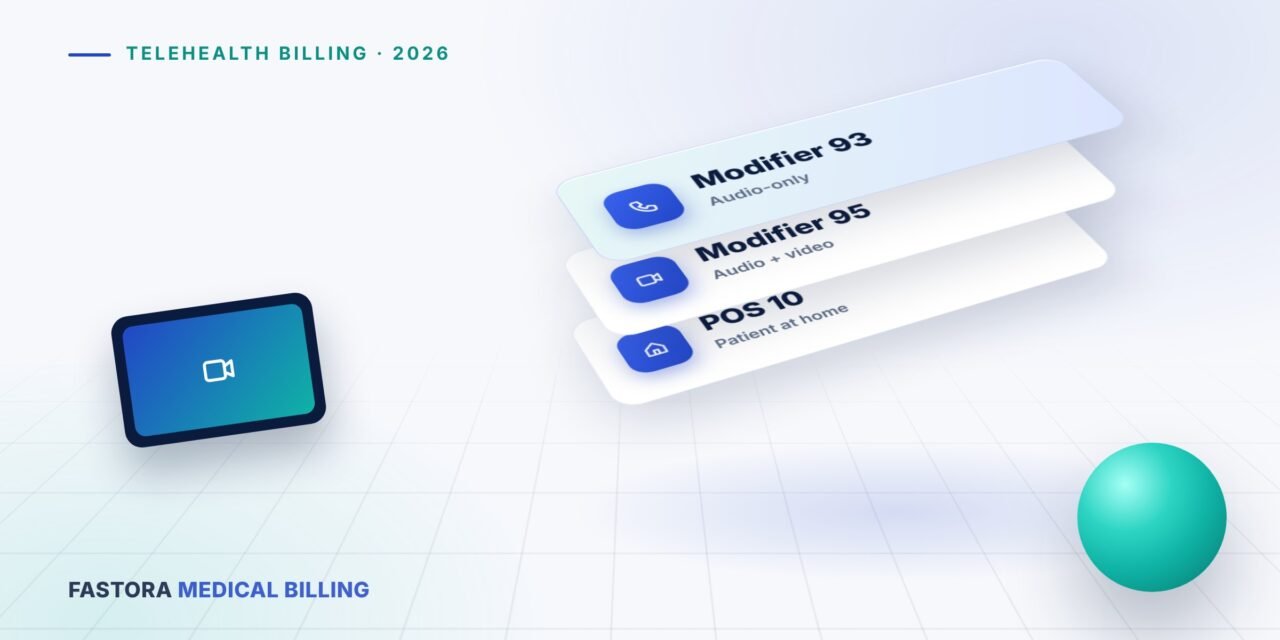
- Medicare: POS 10 for patients at home (non-facility rate), POS 02 elsewhere, modifier 93 for audio-only.
- Medicare’s in-person requirement for mental health telehealth does not apply until January 1, 2028.
In this guide
- 01What stays the same and what changes
- 02Place of service codes 02 and 10
- 03Telehealth modifiers: 95, 93, GT and FQ
- 04Medicare telehealth rules for mental health in 2026
- 05Commercial insurance telehealth billing
- 06Medicaid telehealth billing
- 07Licensure across state lines
- 08Documentation for every telehealth session
- 09Telehealth billing quick reference
- 10Common telehealth billing errors
- 11Frequently asked questions
What stays the same and what changes
A virtual therapy or psychiatry visit is billed with the same CPT codes as an in-person visit: 90791 for an intake, 90832 to 90837 for individual psychotherapy, E/M codes plus add-ons for prescribers, and so on. The service is the same; the delivery is different.
What changes on a telehealth claim:
- Place of service (POS) code: tells the payer the visit was telehealth and where the patient was.
- Modifier: some payers require a modifier to identify telehealth or audio-only delivery.
- Coverage rules: whether the payer covers telehealth for that service, that provider type and that patient location.
Place of service codes 02 and 10
| POS code | Meaning | Typical use |
|---|---|---|
| 10 | Telehealth provided in the patient’s home | The patient joins from home or another private residence |
| 02 | Telehealth provided other than in the patient’s home | The patient joins from a clinic, school, workplace or other non-home location |
| 11 | Office | In-person visits; some commercial payers still ask for 11 plus a telehealth modifier |
For Medicare, the POS code matters for payment as well as reporting. Since 2024, Medicare has paid telehealth services billed with POS 10 at the non-facility rate (the same as an office visit) and services billed with POS 02 at the lower facility rate. Choosing the code that reflects where the patient actually was is both a compliance and a revenue issue.
Telehealth modifiers: 95, 93, GT and FQ
| Modifier | Meaning | Where it is used |
|---|---|---|
| 95 | Synchronous telemedicine using real-time audio and video | Required by many commercial and Medicaid plans; Medicare generally relies on the POS code for professional claims |
| 93 | Synchronous telemedicine using audio only | Medicare and many other payers for audio-only behavioral health services |
| GT | Interactive audio and video telecommunications | Older modifier; a few payers and programs still require it |
| FQ | Service furnished using audio-only communication | Used by rural health clinics and FQHCs for audio-only mental health visits |
Do not assume one modifier works everywhere. Build a payer-by-payer telehealth grid into your billing setup, and review it whenever a payer issues a policy update.
Medicare telehealth rules for mental health in 2026
Mental health has more permanent telehealth flexibility in Medicare than most other services. Key points as of 2026:
- The patient’s home can be the originating site for mental and behavioral health telehealth services, regardless of where the patient lives.
- Audio-only is allowed for behavioral health services furnished to a patient at home when the provider can furnish video but the patient cannot use it or does not consent to it. Report it with modifier 93 and document why audio-only was used.
- Eligible provider types include psychiatrists, psychiatric nurse practitioners, psychologists and clinical social workers, and, since January 1, 2024, marriage and family therapists and mental health counselors enrolled in Medicare.
- In-person visit requirement: federal law requires an in-person visit within six months before a patient’s first mental health telehealth service at home, and periodic in-person visits after that, with limited exceptions. Congress has repeatedly delayed enforcement. Under funding legislation passed in early 2026, Medicare’s broader telehealth flexibilities run through December 31, 2027, and the in-person requirement for mental health telehealth does not apply until January 1, 2028. Track each Medicare patient’s in-person visit history now so you are ready if the requirement takes effect.
Medicare Advantage plans must cover what traditional Medicare covers, but they can apply their own billing instructions. Check each plan’s provider manual for its POS and modifier rules.
Commercial insurance telehealth billing
Commercial plans set their own telehealth policies, within the limits of state law. Many states have telehealth parity or coverage laws, but those laws differ in whether they require equal payment, equal coverage, or only coverage for some services. Common differences between commercial payers include:
- POS 02 or 10 versus POS 11 with modifier 95.
- Whether audio-only psychotherapy is covered at all.
- Whether telehealth is paid at the same rate as in-person care.
- Whether the plan requires the session to use a specific platform or meet specific privacy standards.
- Whether self-funded employer plans, which are generally governed by federal rather than state law, follow the same rules.
The AMA also introduced a family of telemedicine E/M codes (98000 to 98016) in 2025. Some commercial payers accept them for medical visits; Medicare largely does not. They do not replace psychotherapy codes, which continue to be billed with the regular psychiatry CPT codes and telehealth indicators.
Medicaid telehealth billing
Each state Medicaid program, and often each Medicaid managed care plan within a state, sets its own telehealth rules. Some states require a specific modifier, some require POS 02 regardless of patient location, and some limit audio-only services. If you bill Medicaid in more than one state, keep a separate rules sheet for each one.
Licensure across state lines
Billing correctly does not help if the clinician is not licensed to treat the patient. Telehealth is generally regulated by the state where the patient is located during the session. A clinician in one state who sees a client who has moved, or is temporarily staying, in another state usually needs a license in the client’s state, or authorization through an interstate compact the clinician has joined, such as PSYPACT for psychologists or the Counseling Compact for counselors where it is operational. Check the patient’s location at the start of every session.
Documentation for every telehealth session
In addition to the normal elements of a progress note, telehealth documentation should include:
- The patient’s location (city and state at minimum, and whether it was home).
- The clinician’s location.
- The modality: audio-video or audio-only, and the reason for audio-only when used.
- Patient consent to telehealth, as required by state law or payer policy.
- Names and roles of anyone else present on either end.
- Session time, for time-based codes.
- Any technical problems that interrupted the session and how they affected the time billed.
Telehealth billing quick reference
| Scenario | Medicare | Commercial and Medicaid |
|---|---|---|
| Video session, patient at home | POS 10, same CPT code | Varies: POS 10 or 02, or POS 11 with modifier 95 |
| Video session, patient at a clinic or school | POS 02 | Varies by plan |
| Audio-only session, patient at home | POS 10 with modifier 93; document why video was not used | Check coverage first; many plans use modifier 93, some do not cover audio-only |
| Prescriber visit with psychotherapy | E/M plus 90833, 90836 or 90838 with telehealth POS | Same codes with the plan’s telehealth indicators |
Common telehealth billing errors
- Billing POS 11 for a virtual session to a payer that requires POS 02 or 10.
- Using POS 02 for a patient at home and receiving Medicare’s lower facility rate.
- Leaving off modifier 95 for a commercial plan that requires it.
- Billing audio-only sessions without modifier 93 or without documenting the reason.
- Not confirming the patient’s location, leading to a licensure problem.
- Assuming a plan covers telehealth the same way it did last year.
Frequently asked questions
Is the reimbursement for telehealth therapy the same as in person?
For Medicare, services billed with POS 10 are paid at the non-facility rate, which is the same rate as an office visit. Commercial and Medicaid payment depends on the plan and state law, and some plans pay less for telehealth or for audio-only services.
Do I still need modifier 95 for Medicare?
For most professional claims, Medicare identifies telehealth with POS 02 or 10, and modifier 95 is generally not required. Many commercial and Medicaid plans still require it, so follow each payer’s instructions.
Can I bill for a phone-only therapy session?
Medicare covers audio-only behavioral health services to patients at home when the patient cannot use or does not consent to video, billed with modifier 93. Other payers vary, so verify coverage before scheduling audio-only sessions.
Can I see a client who is traveling in another state?
Generally only if you are licensed in the state where the client is located during the session, or authorized through an interstate compact you participate in. Payer coverage is a separate question from licensure.
Do the new 98000 telemedicine codes replace psychotherapy codes?
No. They are telemedicine E/M codes. Psychotherapy continues to be billed with the psychiatry CPT codes plus the payer’s telehealth indicators.
Work with Fastora
Keep virtual care billable
Telehealth mental health billing works best when the rules live in your billing system rather than in someone’s memory: a payer-by-payer grid for POS codes and modifiers, a check of the patient’s location at every session, and a review whenever a payer updates its policy.
Fastora Medical Billing Solutions helps behavioral health and psychiatric practices set up and maintain telehealth billing rules, verify coverage, submit claims and resolve denials. Learn more about our mental health billing services or contact Fastora to review your telehealth workflow.